I live in a city with a bike-sharing system. It's deeply unprofitable and exists only at the sufferance of the city government. There are a number of flaws. Number 1 is that people who ride bikes don't rent them, they own them. For $100 anyone can purchase a bicycle that will last indefinitely and be available 24/7/365. Number 2 is that people vandalize the shit out of bicycles. Seats will be stolen, tires slashed, bicycles thrown in the river, cables cut. You're free to go after this sort of bicycle since it has no owner - no one is going to come storming out of a nearby store and kick your ass. Crackheads will steal a bicycle seat and try to sell it for $5 to get a hit of crack - I have watched them do it. We live in a world where people are routinely electrocuted trying to steal copper from live power wires and blown up stealing gasoline from pipelines. Those bikes might as well have a sign on them saying "steal me". If even ONE of the components can be removed and sold for a few dollars...
Combining high cost of bicycles, ongoing cost to repair/replace/corral wayward bicycles, and low cost of the alternative (owning a bicycle), there is just no chance that this can be a successful business. You will recall people talking about the future of electricity, as being "too cheap to meter". Well, electricity never made it that far, but time on a bicycle did. Bicycle-time is too cheap to meter.
(There may be some future for the company selling to cities or other large entities which intend to subsidize all the costs associated, but it can never be successful as a stand-alone business.)
You're correct that like many new ideas, bike sharing has had it's growing pains. However, recent data suggests that it's more effective than many would have predicted.
Your article on Velib is from 2009, and while they did have a lot of theft early on, it was due to a design flaw. They've since fixed the problem and recently celebrated their 100 millionth ride. Also, theft hasn't been a problem at all in the US:
A $1K bike may seem expensive, but they have a lot of differences from your local $100 Walmart cruiser. Our bikes are meant to last for years while being used 24/7 and withstanding any weather. They're also hardened against theft.
The financials are good as well. DC breaks even on operations, while Denver has made a sizable profit:
Their main issue is high capital cost, which viaCycle solves. We can do a large city programs or let organizations install bikes on a grass-roots level, so you don't need to splash out $5+M to have reliable transportation.
I think the success or failure depends on too many factors to just say "It won't work" based on the idea alone.
I remember that just a few years ago (in 2000), Amsterdam aborted a pilot program for public bicycles, because they all got stolen or vandalised [1]. Since 2006 a new nationwide scheme is being operated by the country's largest train company and it's doing great.
I currently live in London and the Barclays Cycle Hire scheme, operated by the TFL, is pretty successful. Successful enough to recently get expanded to cover a greater area [2]. It's not just popular with tourists, but also with people who use it to commute to work. I rarely see a bicycle vandalised and you have to be an idiot to steal one.
Some differences that I think make the London bicycles successful, whereas other plans failed:
1. To hire a bike, you need to either rent one on the spot, or become a member. In both cases, you are using a credit or debit card, knowing that you will be charged if the bike gets stolen or vandalised on your watch. They are also linked to your name.
2. Hiring a bike gets progressively expensive as you keep it longer, so you are likely to return it to a docking point sooner rather than later.
3. The bikes are ugly, heavy and instantly recognisable. Not something you'd like to keep home.
4. The bikes are built like tanks. I don't think it's easy to remove things like bicycle seats etc. at all.
5. The scheme only costs slightly over £50 a year. That is how much I pay in maintenance of my own bike.
6. Even if you buy a bike in London, you cannot always park it at your home or workplace. Renting allows you to bike and just park it in a docking station in the city.
The London bike plan also has plenty of problems (no available docking points, AARGH!), but overall it seems to work pretty well. I wouldn't discount the concept altogether.
Heh, the cure sounds worse than the disease. "Make the bikes so unpleasant that no will want to steal them (or use them)."
I agree that there is room for creativity here. There are so many things to try. For instance, I noticed that ViaCycle seems to be piloting on college campuses. Might it be possible to put docking stations _inside_ of academic buildings, requiring a college ID swipe to get in, and possibly being within viewing distance of a building attendant?
Having used the London bikes when I visited, they really aren't so bad. Not as good as the bike I have at home, but they do everything you'd want out of a beater bike. No one is racing them or anything, just going from one place to another.
There are quite a few cycle hire alleycats around the world. The London ones are fun.
One of my friends rode the Dunwich Dynamo on a cycle hire bike. 200km overnight on a bike that you couldn't service or fix a puncture on... pretty brave.
You are misunderstanding. The bikes are not at all unpleasant to ride (although they are quite heavy, they also feel very sturdy and resilient to all road conditions). They would however be very unpleasant to steal and own, because they are too different from normal bikes. It would be a pain in the ass to park them in the city or service them at home and everyone would recognise it as an out of place rental bike.
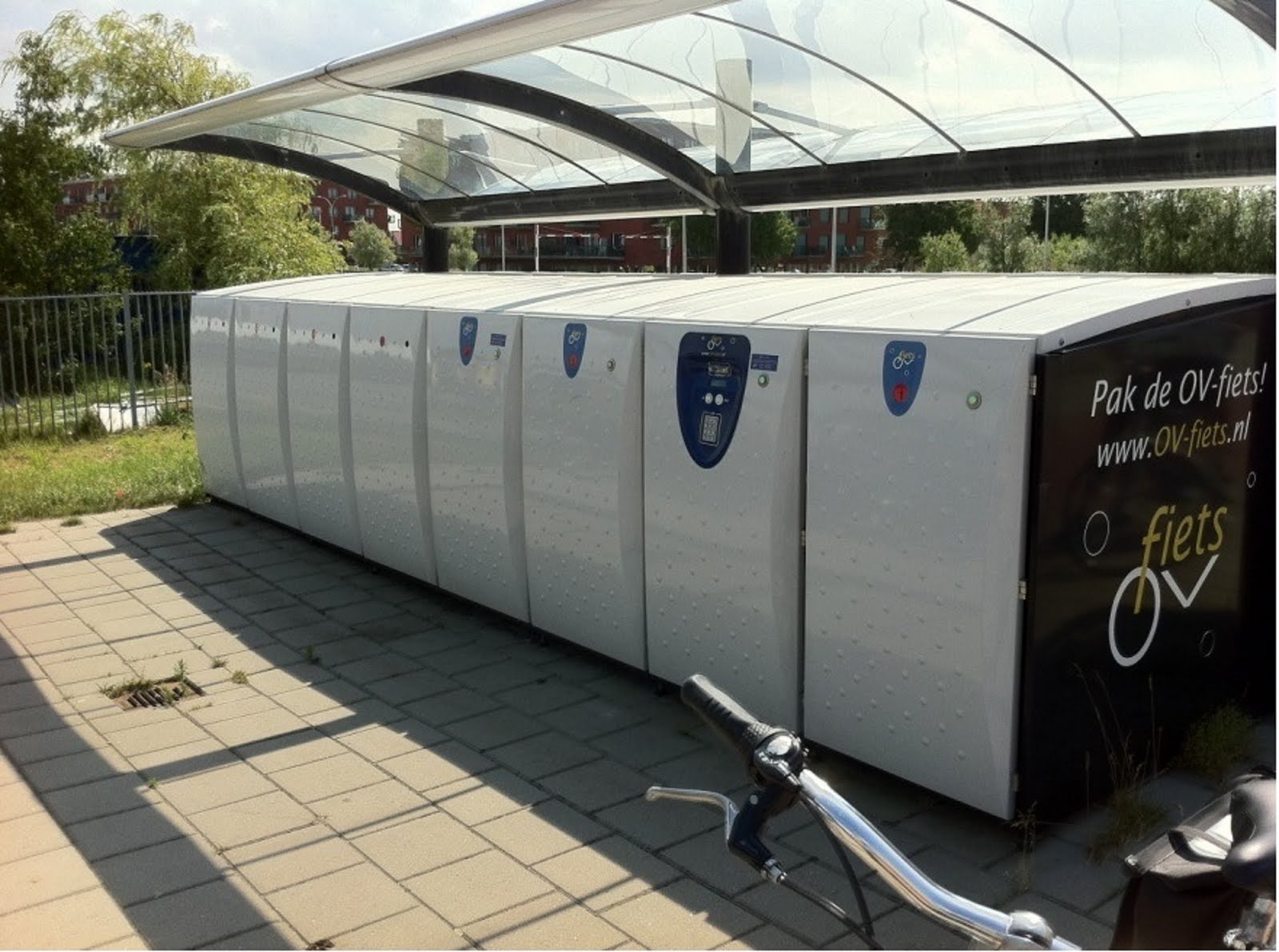
By the way, stashing bikes behind locked doors is actually what the "OV-fiets" plan in The Netherlands is doing (they are more like lockers, really: http://3.bp.blogspot.com/-PeUfIZbrzY4/Ti8hHZCsLyI/AAAAAAAAAE...), and it works quite well. As a bonus, you can also rent those lockers for your own bike.
Then you get one of the best folding bikes, perfectly good for general use too.
They have plans for long-term hires too so you can use a bike daily and guarantee it is there for your commute. In the UK these Brompton Docks are mostly located at rail stations so that you have a bike waiting for you at the end.
Montreal has the same system (Bixi), with exactly the same sturdy features as the London system. Some local management issues aside, the system is running quite smoothly.
It's a stretch to say "This will never work!" when something already is working, and avoiding the specific issues complained about.
"In total, the Montreal operation will bring in $7.4 million. Bixi will spend $7.3 million on operations, marketing, administration and research and development."
That's for 2012. Projections aren't results, but things don't sound too far off. What are you basing your statement on?
One can expect a little bit of taxpayer subsidy in the future, since it is freeing up incredibly valuable road space that in most city centers is a limited resource that can't be expanded.
It's a free system, because the 20 kroner coin that is used to unlock the bike is released when the bike is returned. These bikes have 20-inch wheel, which are non-pneumatic. Single-gear with a coaster brake. And weigh about 50 pounds. Also built like tanks. As a tourist, it increased my enjoyment of the city by a factor of 10.
I commute to work on bike every day, but I still am a happy member of my city's bike share program. Even though I have a bike locked in the garage under the building, I use bikeshare to go to meetings at other buildings in the city during the day. I would rather that my personal bike remain safe in my office building's guarded garage, rather than parked on the street. Also, heading into a meeting, it takes me 3 seconds to park a bikeshare bike at the station, as opposed to several minutes locking up my personal bike using a U-lock and cable. I know of other regular commuters who switched to using bikeshare for their commutes--the bikes may be slower, but you don't have to worry about maintenance or theft.
Essentially, I pay my membership fee so that someone else bears the risk of owning a bike in a city filled with vandals and thieves. It's a good deal.
You would typically do point-to-point trips between stations. Bixi Toronto has something like $500-$1000 liability if stolen, as I recall (less if recovered later presumably... the bikes stand out so it'd be rather difficult to pawn).
There are various ways to deal with this, and it can vary between programs. In general, the rider is responsible for ensuring the bicycle is kept in good order.
viaCycle's system allows riders to secure their bicycle between stations, so you're not forced to ride from to specific points until you're ready to check it back into the system. Enforcing a penalty for bikes that get stolen helps reinforce proper locking of the bicycle.
Not sure how those are counterpoints, in that they are all deeply unprofitable services provided by large governments that are subsidized to the tune of tens of millions of dollars per year. Maybe you should read my comment again.
I'm not sure how it matters that they're subsidized.
Cars are subsidized via road building/maintenance, after all, and it's likely to cost less to maintain a few bikes than it does to maintain roads/parking for the cars that would displace them.
Imagine if there were no transportation subsidies and road maintenance were privatized. A nightmare. It seems entirely reasonable that forms of transportation that can help bring tax revenues to a city are subsidized, and therefore entirely reasonable to create a start-up based in part on those subsidies.
HN isn't letting me comment on the reply to this, but in response - our systems can be subsidized if necessary. We're a B2B business right now, and sell to organizations that own/operate the programs. We're working on piloting our own consumer programs in places that are ripe to support them. Ultimately, bike sharing needs to make financial sense in one way or another, and we're confident our system does that.
I think there's a qualitative difference between a business model that can sustain itself and one that relies on rich backers to dump money into it every year, forever.
Isn't HN usually full of people saying you have to figure out what customers will pay for (meaning, what customers will pay more for than it costs you to provide)? Bike-sharing is not one of those things. End-user customers will not pay you more than it costs to provide.
I agree that cities subsidizing a bike-sharing system can make sense. But that doesn't help ViaCycle, which is going to have trouble if they can't run the system at a profit, since unlike the city of Paris, they can't pay for it out of tax revenues.
For example, DC's capital bikeshare comes from Federal grants that covered the setup costs, while Velib in Paris is entirely operated by JCD, an advertising agency that operates the system in exchange for advertising rights.
Take Velib. Last time I checked, JCD had revenue of $54 million, with an operating expense of roughly $35 million on Velib. The theft and vandalism complaints were regrettably exaggerated when the City and JCD were re-negotiating their contract last year. That they need subsidies to exist is patently false.
Financial aspects of US systems are also healthy as pointed out by other commenters.
On a related note, the subsidies to other modes, mainly rail and roads, are several orders of magnitude higher.
While I wish I could comment in depth on the subject, I will add Rio de Janeiro to the list. Here, we have orange Itaú (a bank that sponsors the program) bicycles throughout the city and they're quite popular. You sign up online and they have some sort of integration with your smartphone. I was recently informed they are R$10 (US$5) per month on a monthly plan. The downside is, also from what I've heard, you have to dock them every hour and take another bike.
Also, they add benefits to a city that are not easily quantified. They make the city look like a nice place to live, which increases property values, and attracts labor to the workforce. (They still might not be worth it from a taxpayer's viewpoint.)
Dublin bikes is a huge success, but is heavily subsidised by a private firm in return for advertising space around the city, along with some local government investment.
> For $100 anyone can purchase a bicycle that will last indefinitely and be available 24/7/365.
Having a bike locked up at my apartment doesn't do me much good after walking downtown with friends. For $65, I can get an annual membership to the Minneapolis bike share program (Nice Ride MN, a Bixi system) and have bikes just waiting for me all over the city. It's awesome.
I know of so many bike theft stories from my friends in SF, that this program is attractive because of those stories. It won't be your typical $100 bike-shaped-object and for $80/yr you can avoid all the bike theft, ownership and maintenance costs and stress.
These things are self locking, so you release it as soon as you leave it unattended and are not liable anymore. If you had to look for a docking station, it would be not practical.
Sounds like a No True Scotsman fallacy to me. I've commuted daily for years, plus occasional longer trips, on a used bike that cost $150 (plus another $100 to add lock, rear rack, fenders and lights). Maintenance may be a little bit more with a used bike, but it rides great.
Somehow car rentals do work - people don't blow up/sell/break rental cars. I can't imagine why bike rentals won't work. It will work only in the area with a lot of tourists/other visitors, because locals will buy bikes if they want to ride them.
Despite owning my own bike, I have considered signing up for DC's bikeshare program (havent pulled the trigger yet; just moved here). A couple advantages for me:
  - I don't have to worry about my own (rather nice) bike getting stolen
  - I don't have to lug around a lock+chain for short trips.
  - I'm not stuck with my bike if I use another means for the return trip
    (e.g., going to a bar, then cabbing home or hitching a ride)
The main negative, aside from the subscription fee, is that the bikes supposedly weigh a ton and are far from smooth rides.
When I first moved here I was amazed by the number of people that use the program. I'm quite curious about the actual municipal cost, though-- especially as a before/after comparison. Also would be interested in other effects. For instance, did it decrease parking woes? Increase public transportation usage? Cause more traffic accidents?
I was thinking the same... although with a little less doom & gloom. One of the reasons ZipCar, et al. have been successful is they exist in places where owning a car is impractical (infrequent use vs. price tag, upkeep & parking fees) so short term, ad hoc rental is optimal. If you remove the costs (since bikes can be pretty cheap, low maintenance and easy to store in your domicile) infrequent use does not make bike ownership nearly as impractical as car ownership. I could see moderate success in a tourist market. I could see jumping on BART into SF and renting a bike to ride around for the day. Those services exist but not in a "self serve" capacity like ViaCycle.
Number 1 is that people who ride bikes don't rent them, they own them.
I own several bicycles, but if I don't ride one to work, I can't ride one home. Due to my schedule, I often don't ride to work in the morning, but I would gladly ride home. A bike sharing program solves that problem. $20 a month? Well worth it.
I own a bike. Actually two. But even with two bikes I do not have one available 24/7 because sometimes I have to use different transportation. Then I am somewhere and my bikes are somewhere else. If it wasn't for a monthly fee I'd sign up for the service in my city and use it about once a week.
Very interesting information regarding monetization strategies and several problems regarding theft and vandalism of a network of the same kind in Paris: http://en.wikipedia.org/wiki/V%C3%A9lib
They are already succeeding in other markets, such as Atlanta. Met these guys at StartupRiot last year and they (a) had great growth and fundamentals, (b) were wicked smart, and (c) had a great product that users love. Wouldn't bet against this team.
I see what you did there, citing 3-year old articles on the start-up problems of then-brand new bike services. Of course, as you can see from other comments, those bike services no longer have those problems, and appear to even be quite successful. It's sort of like the difference between Groupon 3 years ago and Groupon today, but in reverse.
I hate the idea of promoting cycling (roads are for cars, not bikes), but there's nothing about what ViaCycle is doing that suggests it is doomed to failure.
In Germany we have a system like this called call-a-bike (it's run by the german railway!). It works surprisingly well. You're allowed to leave the bikes wherever you want and if they are left unused for a while a truck will come and move them back to a central location.
I really like what via cycle has done with the SMS unlocking. Back when I was in Germany, almost three years ago now (!), you had to call a service line to find/unlock a bike. Late at night there were usually wait times and it was especially difficult to manage the entire process if you were a little tipsy.
There's similar systems in many other European countries. I hear great things about a system in France called velib (I think).
Edit: I forgot to mention, the German bikes also have a second seat on the back. I'm not sure from the picture if this is also true for viaCycle but it's definitely one of the best features. Here's a picture http://www.pedelecforum.de/forum/imgcache/5382.png*
Call a bike in Germany is definitely a great system! viaCycle strives to improve on this by geo-fencing the bicycles when they need to be checked back into the system (and so you are no longer charged for usage). This helps maintain distribution and gives users reliable, structured locations to get bicycles, so they're not just strewn across cities.
Yea, and logistical problems like that are what gets me excited about this.
In grad school I did research on a on increasing the average vehicle occupancy in cities and we took a lot of inspiration from the bike sharing programs.
Have you considered offering dynamic pricing based on the likelihood that the bike will be used in the near future? I.e. riding into the city should be cheaper than riding out of the city in most cases.
Absolutely! Dynamic pricing is something we're really excited about. It's still a young idea, but even large systems like Velib have implemented simple incentives for people who ride against traffic flow. Since our bikes always know where they are, we can be much more proactive about balancing each system.
Edit: a few of us did graduate transportation research as well, your work sounds cool. Is it published anywhere?
Nope, never got published. Our first project in grad school was writing a report on "The service centric car of 2020" [1] (don't read, it's bad). I spun off a project called "Sustainable urban mobility in the megacities of the future" with a friend and we both landed scholarships to do research in the US and publish a paper on it. Then I got involved with startups and was never heard or seen again in academia (I think I'm technically "on leave" from school)
The french one is extremely convenient and I recommend it to any traveller passing through france. You need a smart card in order to use the system though.
How are they going to deal with the fact that demand is not geographically distributed/balanced?
E.g. everyone wants to ride towards downtown in the morning, so there are no bikes left elsewhere, and there isn't enough space downtown to hold all the bikes. And only 2/3 of the morning people want to ride back in the evening, because they're doing other things in the evening.
IIRC, some European cities have whole trucks that carry bikes between neighborhoods throughout the day to solve this problem. But that only works if you have big concentrated bike-parking stations. You can't do this if bikes are parked all over the place on the street.
It would be really interesting if this service would pay you to ride bikes in the opposite direction of demand. But I can't imagine that would be economical. There just aren't enough people to bike from downtown to the suburbs in the morning, plus you're going to have to pay for them all to get back downtown afterwards!
Current bike share programs do require redistribution of bicycles, often as often as twice a day. In large city operations viaCycle would likely be subject to this as well, but that leaves operation costs nominal.
On university campuses we have seen the traffic to be much more free flowing, as students do not follow standard commute patterns. During standard maintenance bicycles can be moved around as needed.
We have discussed the possibility of incentivizing riders to help redistribute bicycles, although the effectiveness of this has yet to be proven.
>We have discussed the possibility of incentivizing riders to help redistribute bicycles, although the effectiveness of this has yet to be proven.
This is almost certainly because no-one has the data or analytics yet. Seems like a very interesting problem algorithmically.
Even small incentives can have dramatic effects – look at the number of under-employed who recycle aluminum cans for 5-10¢/pop. It's by far the most cost-effective way to increase the rate of recycling. There are certainly quite a number of people willing to move bicycles a couple miles for $1-2. I know I'm beating the HN dead horse here, but markets do tend to be efficient at allocating resources when the basic costs are set correctly.
With your mobile app, you have the advantage that you know not only where a bike was picked up, but how far the customer had to travel to reach it. With so much data at your disposal, you should be able to get a pretty good predictive handle on the ebb and flow of demand in the system.
It'll be cool when I can subscribe to a higher tier to have my demand weighted more heavily. ;)
We couldn't agree more! One of the things we're very excited about is the amount of data viaCycle's system can collect and organize. And because we're not tied to permanent infrastructure we can be flexible; adjusting to usage on demand, etc. Some of it may work, some of it may not, but we're looking forward to pushing the traditionally slow-moving transit world into the future.
Interesting. I'm in Montreal, the birthplace of Bixi, which runs the London bike share program, and the upcoming NYC program as well as many others. Works fairly well, but apart from the cost the docking stations cost the city parking revenue.
One major administrative cost is moving bikes around. People tend to take them downtown during the day, and out of the town at night. Even if you don't need docks, you still have to move bikes.
Definitely true. Redistribution is always a hurdle, though with viaCycle's realtime data, we can do some very cool things with incentives and pricing to help the system balance itself.
Bixi takes a lot of parking spots partly because finding space for large stations is difficult. By using existing bike racks, we can often put in bikes without modifying anything. Plus, although parking is lucrative, replacing room for one car with 10 bikes that 100 people can use is a good trade in our book.
We do take payment info on signup. Right now programs are localized so we set up different websites for each, but we hope to link everything together in the future. You can see an example at http://gt.viacycle.com
Does that actually work to balance out demand enough? I know Paris tried to do the same thing but found that incentives weren't enough. Then again, that was the city government, so they may have been more constrained in terms of how large the incentives can be than you.
Incentives wouldn't have to solve the problem totally. As long as they made some users happy and redistributed some bikes, incentives would help reduce costs.
Yes, the cost of installing a Bixi-like system is fairly expensive.
However, when you're talking about transportation systems, Bikesharing is an absolute steal. Repaving a city street costs $338,000 per mile. A city bus costs anywhere from $500-750,000. Subway cars and commuter railcars run in the range of $2 million each.
Washington, DC built its entire bikesharing system for somewhere between $6 and $10 million. That's way less than the cost of a single 8-car Metro train.
If we're talking about a system for a large city, the infrastructure costs are low enough as to be irrelevant. If the system can cover its operating costs (which DC's does, even at a surprisingly-high $1,860/bike/year cost), it's basically a slam-dunk.
The bigger challenge will come from figuring out how to scale the system out into the suburbs.
The problems associated with a decentralized system such as ViaCycle (difficult to attract causal users/tourists, significantly more prone to theft, much more difficult to redistribute, similar maintenance costs, more expensive bikes) don't seem to compensate for the reduced capital costs.
This locking system would sell some units just so you can have a key fob for your bicycle as you do for a car. Bonus points if it makes the same unlocking sound.
I love bikes. I love the idea. I've loved living in Paris where a similar system was in place (Vélib').
However I think this is a textbook example of the shortcomings of capitalism: while it is great for everyone to live in a city where you can use such a bike, there is no way in hell this will pay for itself.
JCDecaux operates the Vélib' system and was estimated to get the equivalent of 2000 euros per bike per year in advertising concessions from Paris' municipality [1] and still not to make a profit.
As pointed out by others there are very high running costs and I believe the only viable way to pay for this is through taxes. I also believe taxes are the only just way to pay for it, because everyone benefits from living in a city with more bikes and less cars not only the users.
Again, I'd love to be proven wrong and see SF become a greener city through this, but I'm a bit skeptical.
This is pretty common in Europe, and as mentioned elsewhere here, somewhat doomed. I couldn't find anything in the linked article explaining how the founders hope to improve on those programs.
In particular, I'm curious to see how they plan to avoid the "Velib Extreme" phenomenon:
Concerning the design of the bikes, I think there is still room for improvement. The designers can look at the design of the Public Transportation Bike ("OV-Fiets") in the Netherlands[1] which was a major success in a country where there already were more bikes than people before it's introduction.
For a bike that is available 24 you would want a bicycle lamp on the front with a dynamo instead of just reflectors. This is a safety concern because reflectors have proven to be unreliable to signal other road users.
The bike doesn't have any mudguards but I suspect the weather in SF allows that :).
The carrier on the back wheel doesn't look that sturdy and there is a large gap in the middle. A front rack to place heavier cargo on could be a benefit.
There is definitely a lot of things we can do with the bicycles. viaCycle is actually bike agnostic. It's a modular device we can retrofit to secure onto numerous types of bicycles. It's easy to add features to bicycles as well, such as baskets, bells, etc. Customization is part of the offering. We're just showing off the bare-bones test bikes for the most part.
Batteries don't last and you need access to them in order to replace them, making theft easier. There are systems that integrate a dynamo in the chassis of the bike. It's also more environmentally friendly because you provide the power for the lamp. The article mentions there already is a battery in place powered by either solar or dynamo.
Bike-for-hire systems are like public transport: hard to run at a profit, but useful for a city to have. Most systems I know (Velib in Paris, Callabike in Munich) are very popular, but effectively run and subsidized by the government.
ViaCycle does not plant to operate the bikeshare, but providing the bike infrastructure for the operator. Which is a smart move - because a) being the operator is unprofitable and b) operators probably dont want to deal with the bike tech.
I would love to see a standardized, mass-produced bike intended for rent-a-bike services. It's really a different kind of bike - you need excellent protection against vandalism and theft more than sportiness or low weight. Also, each system currently has its own GPS/Phone tracking and hire system. If a company liek ViaCycle provides a cheaper, standardized system, it would probably lower the cost of runing a bike-for-hire system quite a bit.
Thanks for the feedback. It can seem complicated because we provide the billing platform but allow our customers to set pricing. Cities typically charge a monthly or annual membership, while companies usually provide bikes to their employees for free. Depending on who's operating your local program, you usually only have to choose between a few options.
Helmet use is an issue we take very seriously. Fortunately, safety has been excellent for US programs, but we try to make sure everyone has access to the right equipment and education.
We do require users to sign a waiver saying they understand the risks. Ultimately, it comes down to culture - grabbing a helmet needs to become as natural as putting on your seatbelt or grabbing your coat.
I checked up on the Australian experience, a country known for strict enforcement of helmet regulations, and found this. Perhaps you'll find it relevant.
I'm not sure how each service deals with indemnification against such claims, but the legal requirement, if it exists, to wear helmets, certainly makes a difference to uptake.
For health reasons, helmets are not considered as hireable with bikes in the Australian schemes. This makes it extremely difficult for either tourists or casual interests to just get up and go.
Definitely seems the problem is more accessibility than legality. If a helmet was included, it'd be beneficial to all parties - Reducing risk for the company and the customer. That's really the point I'm trying to make.
Well you have to be a registered user to begin using the bikes so I'm sure there are precautionary clauses in their TOS which prevent people from suing for things like that.
Seattle is located in King County, which has a mandatory helmet law for all riders, regardless of age. Melbourne, Australia has a program with helmet laws and it has struggled to maintain ridership. This is definitely a concern. Vancouver, BC is also launching a program in a similar situation, so people are watching it closely.
There is undoubtedly a solution out there, but it may take some time to see how users adopt helmet requirements. We're definitely excited about the Puget Sound planning that is going on. I would love to see bikeshare in my hometown!
The concern to me is less the helmet laws and more the fact that it's not actually safe to ride bicycles in most American cities without a helmet. It's not like we have physically separated bicycle routes like Copenhagen or anything--it's a basic safety precaution.
I agree and was really surprised to see the rider in the video not wearing a helmet, even though it is legal to do so in California if you are over 18 (it is not, however, smart). The answer is to just carry one with you-- they aren't heavy, and you can usually strap it onto a backpack when not in use.
I've had the pleasure of talking to the guys from ViaCycle. Koji himself is a UW grad. Apparently it's difficult to do bike sharing in Seattle because of King County's helmet law.
In the past I've used the government funded hire schemes in London and Dublin extensively and have had good experiences with them. I know how much they cost, so I'm happy to see an alternative.
The only issue I see with this is that it looks particularly easy to remove their locking system. It uses a chain lock, so what is to stop me from "locking" it without putting the chain through the wheel? From there is looks easy to remove their hardware with a spanner as it seems to just be attached to the pannier rack mounting points.
Yo, ViaCycle team: stop what you're doing right now and get an email signup form deployed to your homepage ASAP.
I saw the headline, read the article, got excited, landed on the homepage, looked for San Francisco on the list of programs... then left the site, disappointed. You won't get a lot of opportunities to capture customers like the one you just got (and lost) with me.
Use mailchimp or something similar and you can fill this deficiency in a few minutes.
"In addition, there is also an upfront cost of about $1,000 to $1,500 for every bike."
A recent article from the Economist says London's bikes cost
average price is £14,460/bike each, subsidised by government and advertising. Companies like ViaCycle will hopefully drop the price of these schemes.
http://www.economist.com/node/21557527
How are they so expensive? That doesn't sound right, unless it's looking at the entire cost of the program per bike, rather than just the marginal cost of a new bike.
Seems very similar to SoBi's offering. SoBi has the advantage of built-in vandalism detection, welded on GPS tracker (it looks like ViaCycle's is bolted on), a sealed shaft-driven drivetrain, and a more durable frame geometry.
We do weld the locks to some of our bikes depending on the intended environment. No matter what the method, the attachment is at least semi-permanent and can't be removed by normal means. Since our system can be fitted to multiple bikes, we can easily incorporate shaft drive or a different frame if people want them. Our Biria frames are very sturdy and people love them!
About time. In the US, we seriously need more emphasis on bikes and encouraging people to use them for shorter commutes. We either have to drive or walk (mostly). I once met a european lady (from Amsterdam I think) who would not stop talking about how behind the US in terms of bike culture, hardly any bike lanes on roads etc.
Hear hear! Things are changing for the better. Over the last 5 years, bike use has more than tripled in a lot of major cities. Bike sharing has the power to completely transform culture - Boston went from being rated the worst city for biking in the US to one of the top 5 after Hubway's launch.
Spinlister is awesome. Eventually we hope to use our technology to automate personal bike rentals, just as Getaround does for cars. We'd love to talk to either of them about a partnership!
This was a major factor we considered in our design. Every bicycle is GPS tracked, so you know their locations. The bicycles are designed to be rugged so they hold up to abuse, and regular maintenance is part of operations. There will always be issues, but nothing that can't be solved.




I live in a city with a bike-sharing system. It's deeply unprofitable and exists only at the sufferance of the city government. There are a number of flaws. Number 1 is that people who ride bikes don't rent them, they own them. For $100 anyone can purchase a bicycle that will last indefinitely and be available 24/7/365. Number 2 is that people vandalize the shit out of bicycles. Seats will be stolen, tires slashed, bicycles thrown in the river, cables cut. You're free to go after this sort of bicycle since it has no owner - no one is going to come storming out of a nearby store and kick your ass. Crackheads will steal a bicycle seat and try to sell it for $5 to get a hit of crack - I have watched them do it. We live in a world where people are routinely electrocuted trying to steal copper from live power wires and blown up stealing gasoline from pipelines. Those bikes might as well have a sign on them saying "steal me". If even ONE of the components can be removed and sold for a few dollars...
http://www.theglobeandmail.com/news/world/pariss-pedal-power...
http://www.cbc.ca/news/canada/montreal/story/2009/06/26/mont...
Combining high cost of bicycles, ongoing cost to repair/replace/corral wayward bicycles, and low cost of the alternative (owning a bicycle), there is just no chance that this can be a successful business. You will recall people talking about the future of electricity, as being "too cheap to meter". Well, electricity never made it that far, but time on a bicycle did. Bicycle-time is too cheap to meter.
(There may be some future for the company selling to cities or other large entities which intend to subsidize all the costs associated, but it can never be successful as a stand-alone business.)