Looks like this may be a bit more relevant than many of the snarky comments would suggest - the relevant German authority on this said that they have seen a unexpected increase in a specific type of blood clotting issue that usually is very rare: https://www.pei.de/DE/newsroom/hp-meldungen/2021/210315-voru...
It's not a medically reasonable response that solicits snarky remarks, it's the complete retardation of the official covid response so far, and even reasonable decisions just are landing on a pile of steaming crap now.
- billions per week of half assed lockdown vs a few billion more for high quality timeley vaccine delivieries of the good stuff --- of course they chose the lockdown
- open schools as if nothing happens vs using UV-based air filtering machines and so on as a minimum level of precaution --- of course they choose to open schools with classrooms some of which even don't have windows that can be opened properly
- governing party members of parliament scamming the public out of money by selling overly expensive, low quality masks
- minister of health busy sueing newspapers for disclosing prices on his million dollar real estate purchases vs minister of health actually being busy 24/7 with fighting the crisis
the list goes "on and on and on", these are just the most popular ones right now. It's just a dumpster fire at this point and the positives will not be recognized divorced from said pile of crap.
Let's not forget that the German government resorts to "alternative facts" since the pandemic began just as they see fit. When we had nor masks available last march, they said "masks are useless" two months later they were mandatory "because they are the best thing we have". Recently, a post by the government on Facebook said "AstraZeneca gave us one of the best vaccines ever" just as people started to cancel their appointments when they saw that their vaccine was going to be from AstraZeneca. Now they pause vaccination with it. Yeah.
I'm not aware what exactly the German government has said in the past w.r.t mask usage. However, governments claiming mask usage was not required near the start of the pandemic followed by them later requiring people to use masks was actually an understandable decision on their part from what I've understood of the situation as it unveiled.
At the beginning of the pandemic, it was believed that the virus was using droplet transmission alone. In such a scenario, surgical masks, for the general public, would only be required in people who were sick to prevent transmission and N95 masks would primarily be required by health care workers. Considering the mask shortages faced in many countries at the time due to panic buying, the communications made by governments to the public w.r.t the benefits of masks make sense from a cost benefit perspective since it would guarantee that the people who needed the masks the most (medical workers and sick people) would receive them and reduce the spread of the virus.
Fast forward 2 months later, airborne transmission as well as asymptomatic transmission of the virus were both confirmed independently in several labs. This would mean that the prior strategy of only using surgical masks on sick people wouldn't really work well anymore. In the meanwhile, the availability of masks was much higher due to increased production. Hence, to reduce the risks of airborne and asymptomatic transmissions, governments released advisories asking all people to wear masks.
Governments didn't say that a mask wasn't required. They said masks didn't help (presumably to prevent a run on them). It's definitely an understandable decision, but there's a big problem with it.
When officials start doing this, you have to play a sort of game where you try to figure out why they said something and what it signifies. You have to try to divine the state of reality and figure out what to do based on what you think they were trying to get people to do (there's a lot of uncertainty in this).
By that point, by definition, trust in the person (and probably the institution) is gone, and we don't have a lot of trust in institutions to spare.
Indeed. I'm quite furious that my government (Finland) ordered such a "mask assessment" from a retired professor, in order to reduce the political pressure caused by PPE shortages.
Now anti-maskers and other covid deniers are citing that report: "don't do anything, even the government research says it is useless".
I was well aware even by March that masks were the way to go. It was a simple lie, by e.g. the Surgeon General, in order to try to save masks (while they didn't even start ramping production of them!)
But of course if a government official lies to you about your own health risks then that has very high costs, much higher than whatever masks were saved. They could have just said "masks are useful, but you need to be trained to use them correctly, they are difficult to manipulate, etc. and they are very scarce so sadly let's stay home and let doctors and nurses use them".
I might sound as if I'm upset at that, because I REALLY am. I hate when governments lie, even if they are "white lies", and I hate when they treat their constituents as kids.
The lesson from 1918 for public health is that if you lie to or mislead the public once, even if by accident, you have reduced credibility in the future and are less likely to have the public listen to you. The authorities didn't learn this lesson and instead misled the public for 2 months, then did a 180 and expected people to blindly listen to them again.
As a citizen, would you trust the government if they did yet another 180, after demonstrating to you 2x that they didn't actually know what they were talking about?
> As a citizen, would you trust the government if they did yet another 180, after demonstrating to you 2x that they didn't actually know what they were talking about?
One of the many things that I've learned from this pandemic is that for better or worse, the answer to this question is emphatically yes for a significant percentage of the population. Many folks will indeed blindly trust whatever they are currently being told by people they believe are authorities or experts. At times this may be a good thing, but I personally lean toward thinking it's not good overall. And as you correctly point out, another big chunk of people will understandably lose faith in institutions and authorities that either were wrong or simply lied, which I'd argue likely causes significant long term damage to the healthy functioning of a society.
Even if it was believed that sick people wearing mask would be enough, there will be asymptomatic infections as well as the social stigma of wearing a mask if only sick people do it. The only way that enough people wear masks is to have everyone do it.
> Considering the mask shortages faced in many countries at the time due to panic buying, the communications made by governments to the public w.r.t the benefits of masks make sense from a cost benefit perspective since it would guarantee that the people who needed the masks the most (medical workers and sick people) would receive them and reduce the spread of the virus.
The government lying to its people is never acceptable. Also, there was plenty of time to ramp up mask production when the virus was spreading in China and later Italy. Taiwan did this successfully, why did supposedly more developed countries fail so badly at ensuring adequate mask supply?
Truth does not work that way. If you have to prioritize masks for something, regulate that market down - by simply making it a crime to deal with them without offering them to the government first.
And still nobody bothered to check what kind of trend-changes are visible in the epidemiological curves around the time of masking.
People never look at "date of death" or "infection date" all they care about is "reporting date" - and every newspaper out there will show you the effects of government measures on "reporting".
> When we had nor masks available last march, they said "masks are useless" two months later they were mandatory "because they are the best thing we have"
Wow, this is exactly how the masks thing played out in Poland.
I wasn't aware that this "makes are useless" followed by "masks are mandatory" (with Poland together with a ban on selling them on the biggest platform, big like Amazon is in the US - Allegro).
And now here in Poland we are at the "AstraZeneca vaccine is safe" and we are vaccinating with it, I wonder how many EU countries still use it besides Poland.
Pretty much the same thing happened here in New Zealand too, FWIW. I understand it was WHO providing this advice (i.e. no evidence regarding the effectiveness of masks etc) at the time so perhaps the German government is not entirely at fault. I know that once the WHO changed their tune (following research comparing countries who had policies on masks and those who didn't) the New Zealand government eventually got round to making masks mandatory but even then only in certain places.
Wow, same in Switzerland. They told people to keep using fully packed trains and buses and that masks weren't necessary. Couple weeks later, when masks were well available they suddenly made it mandatory to wear them on public transport.
To be fair, country borders in the EU are not that useful for containing anything. Earlier and better travel restrictions - both cross countries and between different areas in one country - would have been useful though.
Every country in the world except South Korea, HK, China and Taiwan failed to recognise the importance of masks at the beginning only to later change their minds.
No. They willfully misrepresented their importance so that civilians didn’t buy them before the hospitals could. They were unprepared to respond to the increase in demand due to their complete incompetence. Anyone using a shred of logic saw through the “masks don’t work” insanity.
> - billions per week of half assed lockdown vs a few billion more for high quality timeley vaccine delivieries of the good stuff --- of course they chose the lockdown
This is not the issue. A few billion would not have magically solved the problems with vaccine deliveries. The EU has contracts with pharmaceutical companies which these companies are not honoring sometimes intentionally so.
AstraZeneca for example doesn't have the production capacity to supply what they promised to the EU even if the Belgian site was working properly. That's the result of the EU audit. These companies are betting that the consequence of them not fullfiling their contractual obligation will be insignificant compared to their benefits. As these companies remain hugely profitable, their production issue is not linked to difficulty accessing capital. It is naive to assume things would have gone differently if the EU was paying more. It would just have meant more profits for them.
The heart of the issue is that contraty to the USA or China the EU is weak so companies don't hesitate trampling it. If a Chinese company did to China what AstraZeneca is doing to the EU, the CCP would take control of it and its CEO would never be seen again. Meanwhile, the USA has little qualm using its legal system to punish companies defying the state to much. Congressional inquiries are not fun.
Your claims are off-topic and irrelevant with respect to the safety of this vaccine.
Any potential safety issues with vaccines must be investigated, otherwise there will be a huge problem with trust in vaccines and in the regulator. There's already a huge problem with vaccine skepticism, and vaccine fanatics are making things worse.
Suspending vaccinations for side effects that happen in 1 in 300000 cases is not medically reasonable. Even if all these cases are due to the vaccine, not vaccinating gives a worse result than vaccinating so it’s the dumb thing to do.
Which is what WHO and EMA are saying. But now that there’s panic, they’re not relevant anymore.
When was the WHO ever relevant wrt Covid 19 though? Their advice has been contradictory. They gave guidance before knowing whether masks would help, and later had to change it. They gave guidance about the transmissibility of the virus, and then changed it. Not knowing whether something is true does not stop them from speaking with authority. To put icing on the cake, they perform a puppet show for the CCP and then declare their confidence in understanding the origin of the virus. They say a lot of definitive things without knowing anything definitive.
I'm very disappoint finding out that the minister of health is just a lobbyist with no medical background. He seems to care a lot about suing people who talk about his villa than doing actual work.
This is the best time for politicians to steal money, as people are unable to go to the street to do demonstrations.
Polititians are stuck between trying to make the free-for-all phase as long as possible, but still look as though they did everything to help, so that they can win the next election.
Compared to the status of 11.03.2021, additional cases (as of Monday, 15.03.2021) have now been reported in Germany. In the analysis of the new data status, the experts of the Paul Ehrlich Institute now see a striking accumulation of a special form of very rare cerebral vein thrombosis (sinus vein thrombosis) in conjunction with a deficiency of blood platelets (thrombocytopenia) and bleeding in temporal proximity to vaccinations with the COVID-19 vaccine AstraZeneca.
Translated with www.DeepL.com/Translator (free version)
Yes, cerebral venous sinus thrombosis, exceedingly rare condition in the general population. It can cause permanent neurological disability and death if not diagnosed and treated.
Cerebral venous sinus thrombosis presents with nonspecific symptoms (eg headaches). It can only be diagnosed with cerebral imaging of specific modalities (CT or MR brain venogram, expensive and specialised tests). From speaking to colleagues in the UK, their hospital system is quite overwhelmed and doctors are repurposed outside their field (eg surgeons looking after internal medicine patients). It is quite possible in the throes of a pandemic to be underestimating the incidence of this condition in the UK.
> The EMA has said that as of March 10, a total of 30 cases of blood clotting had been reported among close to 5 million people vaccinated with the AstraZeneca shot in the European Economic Area, which links 30 European countries.
"The decision today is purely precautionary..." given this level of signal. We don't have details on the age groups involved and the normal rates expected but I can hazard a Fermi Estimate that the risk is minuscule compared to COVID-19 itself. I look forward to seeing the actual data in coming days/weeks. Precaution without downside is acceptable; this is not one of those cases, IMO. YMMV.
> the risk is minuscule compared to COVID-19 itself
You don't know this at all - we don't know what age groups are affected here, and COVID is pretty much negligible in many younger age groups. It's best to wait for more data to come in before drawing any conclusions.
The risk *of death* from COVID is pretty negligible for some age groups. The biggest confusion of this whole situation is we've fixated on CFR numbers as a measure of risk.
Risks of long-term consequences don't seem to be all that low.
I haven't seen anything that indicates that the risk of long-term consequences is significantly elevated above other viral diseases. There is a condition (which we know too little about, and which - as one of the few good outcomes of the COVID situation - is now actually getting some attention) that can lead to fatigue and other symptoms after fighting off a viral infection, but it's not unique to COVID.
A year ago there was a lot of noise about things like heart issues induced by COVID, which turned out to be mostly statistical errors in the papers that made the claims.
A lot of people (often people who never actually had a positive test) also claim to suffer from various mental impairments after their COVID infections, and some newspaper ran an article saying that some of these symptoms were alleviated after the people were given anxiety medication. Go figure ...
There is no evidence of the link between sleeping sickness, EL, and Spanish flu.
> Since encephalitis lethargica’s (EL) prevalence in the 1920s, epidemiological and clinical debate has persisted over whether EL was caused by, potentiated by, or merely coincident with the Spanish influenza pandemic. Epidemiologic analyses generally suggest that the disorders were coincidental.
There is nothing to play down. More than a year into the pandemic are there is still no evidence of long-term damage except in rare cases. Evidence of inflammation in monkeys does not qualify, before you ask.
Someone very close to me is a “long hauler” and the quality of life effects have been horrible. A young and healthy person, now dealing with fatigue, blood clotting, and a host of other uncomfortable and troubling issues. Throughout, medical professionals have been struggling to give people like this answers as to what exactly is happening to them — and the common refrain is “we don’t knew enough about it yet, but we’re seeing a lot of this.”
I’ll let the eventual studies give the percentages. But my (personal, non professional) take on this is that long-hauler experiences are a LOT more common then people realize, have been fairly ignored while people have fixated on the death count, and have big possible implications for quality of life for younger, otherwise healthy people.
Agree fully, although even the mortality numbers far outweigh the thrombosis incidence!
Long covid:
> Estimates of the number of people with long COVID vary widely. In July, the US Centers for Disease Control and Prevention reported that one in five patients 18–34 years of age without chronic medical conditions and with a positive outpatient test had not fully recovered by 2–3 weeks after testing, and a research center in Rome found that 87% of 143 patients reported persistence of at least one symptom 60 days after onset of the disease. According to a preprint published in October that has not yet undergone peer review, 24% of 233 patients still had symptoms at 90 days after infection. Data from a smartphone app, as reported by the COVID Symptom Study, showed that one in ten patients with COVID-19 have symptoms after 3 weeks. Given the scale of the pandemic, if even only a small percentage of the tens of millions of infected people worldwide develop long COVID, a staggeringly large number of people would need long-term follow-up and treatment.
> COVID is pretty much negligible in many younger age groups
"Paediatricians in Israel, which has surged ahead in vaccinating its adult population, reported a sharp rise in covid-19 infections among young people, with more than 50 000 children and teens testing positive in January—more than Israel saw in any month during the first and second waves."
Susceptible to infection, absolutely, but are they suffering severe symptoms or dying in large numbers? No.
A single metric (e.g. positive tests) is not enough to assess any severity here, and even those metrics come with caveats because all of our methods of determining them are imprecise.
> Moreover, the database is not a representative sample of the sars-cov-2-positive population. Because it only contains records from people who have interacted with a medical service provider, it excludes those who weather the disease at home without medical assistance.
This will exclude the vast majority of people in younger age groups who were affected. Serology studies have shown us that in many densely populated places infection rates have been far into the double-digit percentages - if this statistic was true in the way you interpreted it, we would know that by now.
i.e. if a very large number of young people get sick, there will be sufficient severe cases among their population to fill up intensive care beds and there will also be many people with sequelae.
But in Germany and Europe children can't get vaccinated and by the time young adults can it will be September anyway.
Then why not temporarily suspend vaccinations only for those under 40? Or let people have a choice in determining whether the risk is worth it for them.
I would love to have a choice in determining whether the various risks are worth it for me, but my government has insisted on shutting all "non-essential" businesses, and only lifted a 3-month "stay at home" order last week.
That’s not really the same thing since an individual who, for example, goes to large gatherings also endangers others by making essential activities like going to the grocery store more dangerous for everyone. Besides that, wider spread of the virus increases the odds of dangerous mutations that make the vaccine less effective or the illness more severe. More spread also risks hospital overloads, which will hurt the medical outcomes of everyone. Going out beyond essential needs hurts everyone.
On the other hand, getting a potentially faulty vaccine would seem to mostly only be a risk to the individual, although I suppose there is some risk of overwhelming hospitals still.
Please just stay home for a few more months so this shit can finally fucking end. It’s already been a year.
Edit: an important factor, too, is that understanding the potential risks of the AZ vaccine is hard, and the average person may not expected to fully understand them. Right now, it seems like even the authorities don’t understand them.
How exactly will staying at home "for a few more months" stop a virus mutating forever? It's not that bad, we have to live with it. Viruses mutate all the time.
I'm not sure what your point is with the apparent difficulty of understanding the risks of a new vaccine. Are you saying "it's hard, so just trust what the authorities tell you"?
In a few more months everyone will be vaccinated, significantly limiting the spread, slowing mutation.
To be clear, we’re talking about the risk of the AZ vaccine specifically. It seems like there might be something specifically wrong with it. Ceding approval authority to bodies like the FDA is how medicine is regulated all over the world. That’s how literal snake oil is blocked from sale. Among other things, it prevents desperate patients from making uninformed, dangerous, and expensive treatment decisions. The average person really isn’t equipped to read a medical study and adequately interpret the results. This information isn’t even at the maturity level of a study, and the risk is that people hurt themselves and undermine the confidence in this vaccine and others.
That's nice, and I suppose everyone entering and leaving the country will need vaccine passports. It's as if everything that we were told would never happen, is going to happen. "A few weeks to flatten the curve", and now we are swallowing the idea of 100% vaccination and associated papers.
As for your comments on regulation - yes, that is correct, which is why I was surprised when I got so much flak for pointing out that, at least in the UK, regulatory shortcuts were taken to rush the approval of Covid vaccines.
I guess I don’t remember things the same. In my state, the most extreme restrictions (basically, everything is closed that isn’t remote or essential work) were lifted after a bit. I don’t recall ever being under the impression that restrictions would ever be completely lifted until the vaccine was rolled out. I recall at the time there being a lot of worry about how long that would take. I also don’t recall anything about vaccine passports, other than China doing it. Maybe I wasn’t paying attention to the rhetoric surrounding that.
There were shortcuts taken in all countries to get the vaccines out. In the US, there is no FDA approved COVID vaccine. Every “approved” vaccine is actually under an emergency use authorization.
COVID isn't the only health threat around, and the response is absolutely not proportional anymore.
FWIW, the LCD of most relevant studies show that maybe banning large gatherings is useful, whereas all other measures we've invented in the meantime have dubious efficacy at best - and extremely high costs.
There are plenty of places in the world that didn't implement the "fight COVID at any cost" policies and they're doing just fine. Trust me on that, I live in one of them.
No matter who you are, vaccination is safer than catching covid. The vaccines are designed and tested for safety; covid gains evolutionary fitness from making you sick. As a result, the risks from vaccination are orders of magnitude lower, no matter what the covid risk is.
(Edit: Deleted second paragraph that wasn’t clearly worded.)
Your claim is false, because for some (many?) people this disease doesn't seem to cause even mild symptoms. It's always possible that some terrible consequence will only be visible years later, like for Measles, but we don't know that.
Without a crystal ball, there’s no way to know ahead of time who’s going to have an asymptomatic case. If there were a way to predict it with high accuracy, it’d be a different story, but for now that’s science fiction.
It is somewhat true, but the virus doesn't know that, and there isn't a strong evolutionary pressure to make covid less lethal.
Covid is transmitted mostly during its mild phase, it only becomes severe a week later, if you are unlucky. If you are lucky, you clear off the infection and gain relatively strong immunity. For the virus, both scenarios are similar.
The only thing is that if it was just a cold, we wouldn't bother with preventive measures and the virus would spread more easily. However, when both the lethal and nonlethal variants are present, the nonlethal variant doesn't have an advantage since we treat everyone the same way, so it is unlikely for the nonlethal variant to take over on its own. At least not on a short timescale.
The solution is to create our own nonlethal variant, also known as a vaccine. Well, vaccines don't spread, I guess we could make a vaccine that spreads but "what could possibly go wrong..."
1. If holding off AstraZeneca vaccine does not affect vaccination rate during the investigation period, it is a prudent thing to do.
2. If vaccine rate is expected to drop, number of expected increase in death per day due to covid vs blood clog should be compared, if we were to minimize short term death.
3. More concerning is unknown effect that could take a long time to materialize. This is a tough call to make since any effect is only theoretical at this point.
Vaccination rate in Germany will drop considerably while the hold is in place, at least 20%, if not more. I don't know the exact numbers, but vaccination is quite blocked on vaccine supply at the moment.
This isn't really true for the AstraZeneca vaccine, though. There's supply, but people don't seem to trust it and it's just sitting on the shelves because even when people book an appointment they don't show up. I'm sure the number of vaccinations _will_ drop, because it's one of the only few vaccines being distributed, but I doubt it will be as high as you mention here.
There have been some delays due to the fact that initially it was only used for people under 65 and only medical personal was qualified to be vaccinated with it - all other vaccinations were limited to 80 and above. But by now the AZ vaccine is used for all age groups and the vaccination has been offered to wider groups. Now, vaccination is mostly limited by availability.
> This isn't really true for the AstraZeneca vaccine, though.
It is (or was), AZ was to supply EU with 500M vaccines this year but changed that to 200M.
EU got really served on the vaccine front, UK got more from AZ, US got more from Pfizer/Moderna (both have 3x more vaccinated than EU). And each transport that we ought to get is smaller or dalayed.
I wouldn't be surprised if governments there blocked some of the vaccine export.
I really hope that there will be a backslash for those companies for not fulfilling their obligations. If not now then later when there is a race for subsidies for "free" prescription medications.
don't discount trust in the vaccination process, it might be better to visible respond to anomalies to signal that the system that makes sure vaccinations are safe actually works.
British Columbia's Dr. Bonnie Henry discusses [1] (5min YouTube clip up until 28m37s) the decision process surrounding Adverse Events Following Immunization (AEFIs) [2] within the context of the EMA decision involving the AstraZeneca vaccine. Her explanations tend to mirror her refrain "Be Kind, Be Calm, Be Safe".
For those jurisdictions like the UK, India, and Canada that continue recommending AstraZeneca, I'd suggest that COVID-19 vaccines are like beer; the best one is the one in front of you.
It's 0.0015% compared to 4%, so at least a 2.6·1e3 difference. Given less than 0.004% chance to catch the disease in my city, the odds are 10 fold in favour of not getting vaccinated. I'll still get vaccinated regardless, because I am sick and tired of this pandemic and want to go on vacation instead of into an another lockdown this year.
The 4% deaths are from covid-19, not from the vaccines. 3.4% is the WHO global estimate if you want to be more precise and 2.5% in my country as of today.
The 0.0015% is the known rate of blood clots from all the AZ doses on the continent according to what the GP has reported and RFI has confirmed the same numbers today (30 cases in 5M doses but it's not clear how many have died and why).
So 0.4 death rate times 0.004 chance to get covid in my area equals 0.0016 chanches to get covid and die which is one point higher than the chances of getting blood clots from the vaccine. Yeah, I botched the last product, so it's actually about the same risk figure, but the benefits of getting vaccinated outweigh the risks and the allegedly faulty vaccine batch has already been halted anyway. I have acquaintances that were vaccinated with the allgedly faulty batch AVB2856 before it was halted and they're doing just fine.
Got you, thanks. (Side-note, I wish it were easier to transmit simple models like this as part of discourse).
The 0.0015 risk of death seems high. Where are you getting that from?
https://www.reuters.com/article/us-health-coronavirus-german... gives "The EMA has said that as of March 10, a total of 30 cases of blood clotting had been reported among close to 5 million people vaccinated with the AstraZeneca shot in the European Economic Area, which links 30 European countries."
But if you want to take the German numbers, 3 deaths out of 1.6m vaccines:
3/1,600,000 = 0.000001875 (In percent, 0.0001875%) which is 0.125 of your figure.
And the OP gives a base rate of "two to five cases per 1 million individuals per year" for context; we need to subtract out the base rate from the observed deaths too (because obviously the base rate of this condition occurs regardless of whether you take the vaccine).
There's a mistake on my part, the risk of getting blood clots, not death, is actually even lower, 30/5/1e-6 = 6·1e-6, not 0.0015.
The base rate is per year, the AZ vaccine was used for about 3 mo in the EU. That leaves us with a base rate of 0.5 to 1.25 cases per million per 3 mo, so using your numbers:
1.875 - (0.5…1.25) = 1±0.375
deaths per million if we were to keep the inputs unchanged?
The first cell is the model I was building, I finally got it into reasonable shape. It comes from the published national statistics for death rates. (Comments welcome, I just sketched this to help me think about the numbers here. No claim on this actually being right.)
The second cell is my attempt at rendering your initial calc, though I've not folded in the base rate changes. We can go into the weeds there but looking at the results I don't think we need to; my calcs naively attribute all the blood clot cases to the vaccine and still give COVID as being worse than the vaccinations by a factor of 400-800.
The way you're thinking about base rates sounds right to me though, and it does sound like the best guess is we're at something like 4x above base rate.
Given that I implemented my model with a completely different approach and we're both within a factor of 2 (if I've rendered yours correctly) I think we're in the right ballpark here, at least for "Fermi calculation" level of completeness.
Surely more people will die from COVID than from blood clotting, due to this delay?
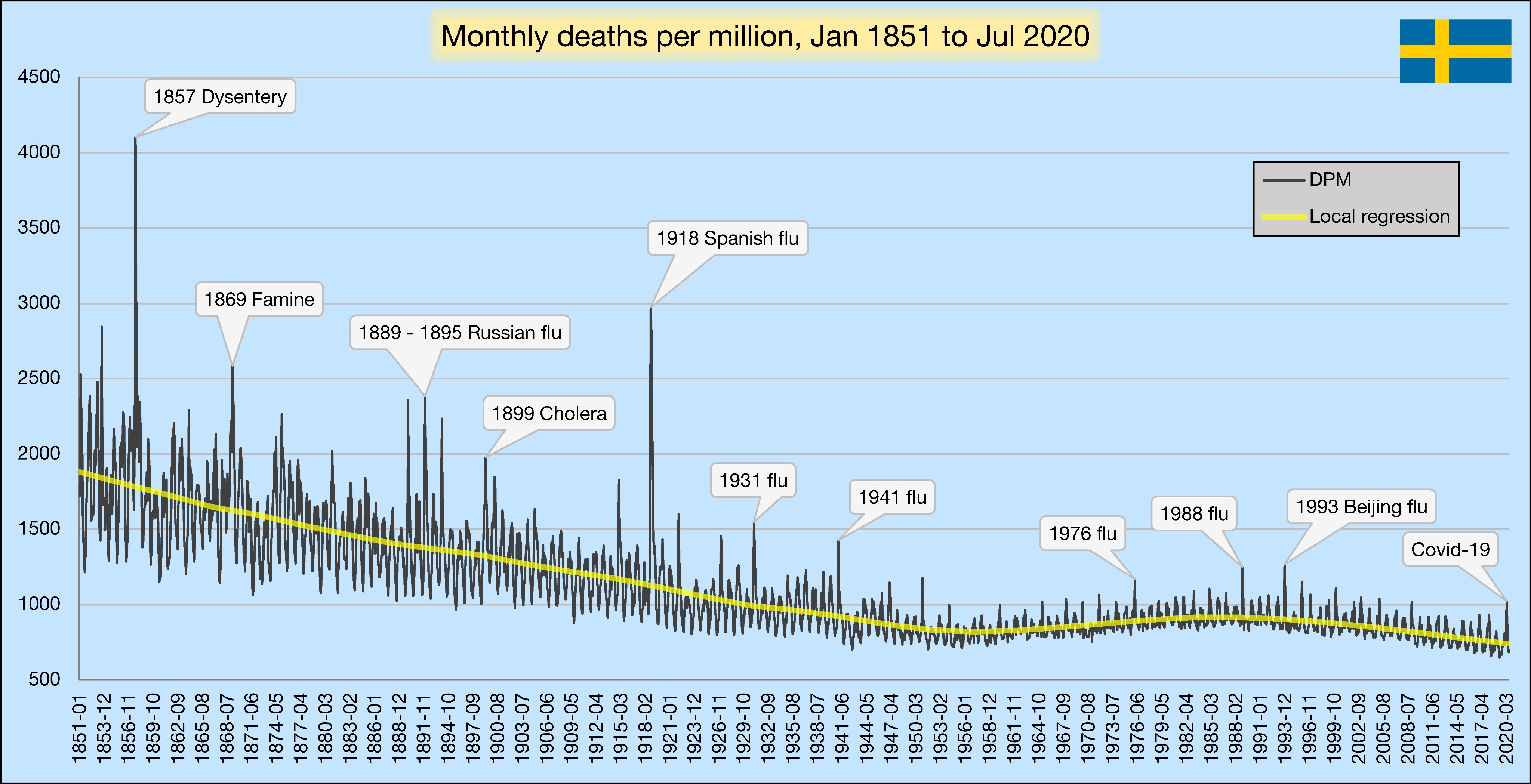
Or perhaps not, given that 2020 deaths in Germany were 985,145, only 4.85% higher than 2019, and only 3.2% higher than 2018 (and so basically in line with what we would expect from an aging society).
> Or perhaps not, given that 2020 deaths in Germany were 985,145, only 4.85% higher than 2019, and only 3.2% higher than 2018 (and so basically in line with what we would expect from an aging society).
Are we still having this debate.... Of course the overall mortality didn't change much, people stayed at home for literally 75% of the year.
Do you have the split stats for accidental deaths, road deaths, disease related deaths, &c. ? Because otherwise it's meaningless. We can put everyone in an artificial coma and get as little death per year as possible, it isn't a really interesting metric without the context.
You can check overall deaths for Europe on Euromomo.
It shows that despite everything we've done we've had significant more deaths in certain age groups.
You seem to be genuinely curious. For those who want to scoff it off: look at those numbers and consider the fact that these numbers are what we see after a war-sized effort to prevent more damage: in most populations only a few percent have been hit.
At the moment this epidemic runs unchecked a death rates also increase even more as it easily overwhelms even European health care if it isn't kept down.
And no, it is not just the elderly: my age group (40+) and above are all at risk.
> and consider the fact that these numbers are what we see after a war-sized effort to prevent more damage
Which doesn't seem to have worked - infection rates are dropping off all around the world, regardless of the vaccination levels. It looks more like we hit natural herd immunity at about the same time in different places whether or not masks and lockdowns were used.
The war-sized effort includes a lot of other things besides vaccines: lockdowns, masks, drastic reduction of international travel, tankerfuls of hand desinfectant, etc.
Yes, then it starts to have an impact; without those, there would have been mayhem.
If all that - which was in place in late spring and summer last year - was the reason, then why did cases start increasing anyway in the fall?
For the two additional things you've mentioned: Limiting travel works to prevent the virus from entering an area, but if it's already there and uncontrolled it wouldn't have an effect. Likewise excessive hand disinfectant doesn't seem to have had an effect, because the virus doesn't really spread through surfaces like that [0] - it was an early precaution that wasn't reexamined.
Your reasoning does not make sense at all. I hope you're just missing GP's point. Maintaining a 1 meter distance has been shown to reduce the likelihood of contagion by 80%. Using a face mask has been shown to reduce the likelihood of contagion by 40%.
With that in mind, and knowing that these were only two of the many measures made to reduce the infection rate, your parahprased statement "the measures were meaningless because they didn't stop the epidemic" is completely incorrect.
An epidemic isn't on or off. It develops at different rates, exponential->logistic if R>1 and exponentially dampening if R<1 for each area. A very steep exponential phase will obviously cause the problems we have been trying to avoid, and it's similarly obvious that the defensive measures have prevented that outcome most places.
> and it's similarly obvious that the defensive measures have prevented that outcome most places.
I'm saying that looking at aggregate outcomes and comparing locations that took these precautions to ones that didn't, this isn't obvious at all. It looks to me more like these defensive measures didn't work, and I kinda want to know why, if they're as effective as the percentages you gave.
There's plenty of null hypothesis societies to compare with. You'll find a very clear correlation between the outcomes in similar societies that used differing degrees of preventive measures.
It's hard to find a society that took no measures, as the measures so obviously work and no one wants an uncontrolled epidemic, but there's plenty of societies that had differing degrees of catastrophe up to the point where they realized this or started being serious about it. Czech Republic, Peru, Brazil, Bergamo (the latter just being unaware) +++.
Covid initially had a reproductive number between 3 and 6 in the absence of measures - higher for the latest mutations. A cumulative reduction of R of 80% + 40% would make this an R of ~0.25-0.50, but that's assuming 100% compliance everywhere and always.
Indeed, this is what you see in societies that were serious enough but didn't eradicate the virus altogether -- largely no significant epidemic, but wildfire-like eruptions of disease in local communities that don't strictly follow the measures. E.g. classrooms, public transport, homes, pubs/concerts and so on. Norway, as a case in point, currently has an R of 1.33, with measures that kept R cleanly below zero until the British mutation became dominant (through initial seeding through import and then a few almost-inevitable cases). Cities where measures can almost always be followed have almost no disease, the illness only spreads in areas where many people live close together and have children/teenagers in school. This alone is enough to threaten the capacity of intensive care.
Personally I don't really think this merits much debate anymore, if the objective is to seek the truth rather than some ulterior motive (e.g. politicians who wouldn't mind if the pension liabilities fell). It's not subtle if you actually dig into the details.
"Virus in the area" is not binary, on or off. It's always about rates and doses. Everyone is not infected instantly.
Germany provides a useful testbed for the impact of mask usage, because the mask mandates have been decided on local regional levels (federal state or city) at different times. From these different times of mask mandates and different progression of epidemic in the areas that are otherwise comparable, we can see that mask usage has a clear impact.
As said, it doesn't stop the epidemic alone, but it helps to contain it. To beat it, we need immunity through vaccines.
It did work, hospitals can only absorbs so many patients in ICU per weeks/months. Once an hospital is at 100% capacity people start dying because they can't be treated (not only for covid)
It really isn't rocket science, of course natural herd immunity is helping, spreading it over a year vs a month is a game changer though.
So COVID is dangerous enough to lock down entire societies, but not dangerous enough to justify continued vaccination when 1 in 166,666 have blood clotting? This is probably the background rate.
It seems like Europe and its bureaucrats just can't let go of lockdown. Or alternatively, they wish to push the vaccines and end of lockdown into Spring/Summer, where natural seasonality will take care of COVID and give the appearance that lockdown and vaccines were a success.
53% is nothing. Peru peaked at 260% excess mortality in February (2nd wave) and 230% in July (1st wave). My Facebook was (and is) a depressive mess of sad announcements.
> Or alternatively, they wish to push the vaccines and end of lockdown into Spring/Summer, where natural seasonality will take care of COVID and give the appearance that lockdown and vaccines were a success.
Did you somehow forget that this is the second year of Covid? We've already gone through the whole "natural seasonality" cycle and the disease is very much still here.
From an average of about 50k cases reported daily in April through October to about 200k cases reported daily in November, December, and January, then back down to 60k by March.
And there's a similar winter increase in the worldwide cases (some of which is from the US cases, but not all):
Further, South American countries were some of the worst hit during the Nov - Feb timeline. South Africa was badly hit around this time. And all these are Southern Hemisphere countries that were experiencing summer around then.
Now, there’s clear evidence that warmer weather makes things easier, since the virus has lower survivability outside a host in the heat, so all things equal, the spread would be lower in warmer weather, but it’s not so much lower that it can be considered seasonal, like the flu.
This is what seasonality means. It doesn't mean "it'll be eliminated next season".
They're referring more to, success can be claimed for lockdowns/etc whether or not they had an effect, simply by waiting until the natural seasonality causes a drop in cases.
yes, a certain seasonality is very probable. But with the variants we have right now (e.g. B1.1.7 from Kent), summer won't be enough to stem the tide. I'm saying this from a central european perspective (with not enough vaccinations either to help).
"Only" 6 5 higher mortality is huge excess mortality.
(In reality, in Sweden mortality is about 4.5 % higher than the average of 2015-2019, but that is still very significant; and of course, covid is not just that one either dies or is fine; there is the substantial but currently not very well known number of people with long-term health impact from the infection)
We already place a human value on life in healthcare, via QALY (Quality Adjusted Life Years)
This is typically about $50,000/year in places like the UK.
If you run this same calculation against what we have done for COVID, the figure comes to tens of millions of dollars per life year.
The same sums spent on lockdown and lockdown compensation could have been invested in general healthcare, or tackling air pollution (which kills 800,000 Europeans a year).
COVID lockdowns should not be immune from the cost-benefit calculations that all other Government programmes are subject to. Its also totally reasonable to ask why we tolerate influenza, which is a leading cause of deaths and fills hospitals each season, but not COVID.
> We already place a human value on life in healthcare, via QALY (Quality Adjusted Life Years)
That calculation is profoundly flawed and is based on linearity: some of the most expensive treatments are extortionate, relative to the true and actual cost to produce, against the QALY/DALY calculation. Instead, if a pharmaceutical company or a medical device company charges an extortionate amount of money for a product, the patents should be seized and governments should be allowed to produce them themselves. In a lot of cases, government funding does 80-90%+ of the research and work that allows the medical product to be marketed.
In the case of coronavirus, some governments, such as the United States, had the capability, at least theoretically to at least try and pursue the elimination strategy. That is, if the United States did not have a neoliberal government in place at the time and the citizens of the United States actually trusted its public officials. A lot of smaller countries have fared well during the pandemic. It is clear that the elimination strategy has been quite successful from an economic standpoint, for the countries that have pursued it.
> The same sums spent on lockdown and lockdown compensation could have been invested in general healthcare, or tackling air pollution (which kills 800,000 Europeans a year).
As for this matter, health insurance (private/public/national) should absolutely cover PAPRs (powered air purifying respirators) for people who are immunocompromised, have lung issues, have severe heart issues, or are at high risk from dying from illnesses like influenza. There are now half-mask (non-helmet and/or not full facemask) PAPRs that are more discreet and wearable, that are much more pragmatic than typical masks: https://industrial.optrel.com/en/product-selector-1/swiss-ai...
It is crucial that we first and foremost protect our most vulnerable, out of the principle of solidarity.
Obviously some of those deaths are directly from global warming. We have not done enough with respect to global warming, and people will die. But, this is unacceptable and we knew that it was coming. We have to do more, and putting a dollar amount on the lives of the most vulnerable is a distraction that keeps us from doing better as a society. We all pay a price by doing this.
Actually the actions work out at about $50k per qaly in US. We spent $5tn to save 1m lives Who each had about 20 years left to live. That would be $250k per qaly but hopefully not all of the $5tn was wasted/spend on additional health care costs, lot of it was to build roads and bail out mafia run multi employer pension systems in US which would have happened anyway
It's not about the "oh it's worth the risk compared to COVID 19". If it's a side effect it wasn't spotted in the trials, why was that?
It's not a side effect? It was a problem in production? What problem? Was is tampered with or was an accident? What failed in QA to let that batch come to the public? Was is a storage problem that compromised the batch quality? Was it while in transport or in the local hospital?
You talk about this like background noise. It's not. It should be investigated.
It's good that this is happening, because it shows regulators are doing their job. This is what builds trust in vaccines, not disregarding odd occurrences because they seem to have no "statistical relevance". That's just ignorance talking.
And those last couple of sentences are really, really important: If forging ahead despite the blood clotting causes folks to lose trust in vaccines, it could be worse than Covid has. And realistically, we don't need more folks to be anti-vaccine.
Exactly. This subject can easily backfire and blow the trust of a population on vaccines, or worst, on the regulators.
Imagine this is the outcome of a production problem, yet regulators refused to acknowledge this until it was out of proportions because the problem wasn't fixed. Not only people would lose trust on vaccines, they would lose trust on the regulator - this extends far beyond this vaccine, but all vaccines and medicines.
People need to feel safe, and to know that regulators are not sleeping on their job. It's not a bureaucratic job, but that they are actively looking at data and reports from doctors.
I think a lot of people (myself included) are more than willing to take a vaccine with these risks. As long as there is informed consent, what’s the problem?
Banning everyone from getting this vaccine is typical bureaucratic ass-covering. Their incentives are not aligned with ours. They get in trouble if they’re directly responsible for a few deaths, but not if they’re indirectly responsible for hundreds of thousands of deaths.
To give a point of comparison: 250 miles of driving gives you a one in a million chance of death. This vaccine is safer than that.
The problem is that it's starting to look more and more like a production problem and a bad batch, and you shouldn't be vaccinated with a product that probably should have failed QA.
It's not bureaucratic ass-covering, it's literally the protocol that's in place and has worked to keep populations safe.
>250 miles of driving gives you a one in a million chance of death. This vaccine is safer than that.
Again you're missing the point. The correct analogy would be: driving on a car that randomly combusts, or has faulty breaks, due to bad QA. And this actually happens/happened, that's why some cars are pulled from the market to be fixed when such things happen. Doesn't matter if it has happened on 1 or 2 cars, it shouldn't happen. Want another analogy?
Want another example? The Boing 737 Max.
You should only be allowed to use products that are working as expected, not faulty products. Specially not medicines and vaccines, that could blow up the trust on regulators and the vaccines.
The alternative to a car with bad brakes or a plane with design flaws is another car or another plane. The alternative to a covid vaccine is that you get covid. Even for young and healthy people, that can mean debilitating long-term illness.
There is no safe option here. We have to think like we are in war time, not peace time. Allowing people with informed consent to take this vaccine will save far more lives than banning everyone from taking it.
>The alternative to a covid vaccine is that you get covid. Even for young and healthy people, that can mean debilitating long-term illness.
Well that's arguable, I haven't had covid yet, and I don't plan on getting it. You had plenty of countries that handled covid without vaccines - we are where we are because western governments refused to take specific measures to control de pandemic (but this is another subject). So the alternative would be get a different vaccine.
Neither me EMA, or any regulator are advocating for not being vaccinated, I don't get where you're getting that from. The alternative to this vaccine is other vaccines, in EU alone 4 vaccines are approved and more are to come. Even AZ vaccine isn't excluded what so ever - they are investigating the potential cause.
>Allowing people with informed consent to take this vaccine will save far more lives than banning everyone from taking it.
Thankfully we have regulators that prevent such behavior. If there's a QA issue no one should be vaccinated with the batches affected by that, because proper QA seem to be without any of this reactions.
No one is saying side effects should not be investigated. The question is whether the vaccine administration should be halted in the meantime, and that would be determined by the risk/reward of preventing covid deaths.
Just like I trust the regulators for vaccine approval, I trust them in the decision of stopping the administration of a vaccine to further investigate the problem. This goes together.
It's not a political decision no matter how many people try to spin this. This is the outcome of doctors reporting an anomaly to a regulator. The system is working, and this should give you reassurance, not doubt about the consequences of stopping a vaccine.
I'm pretty sure they know the consequences of this setback, so for them to stop it it's because something is not right.
From the perspective of the regulators, there are asymmetric personal consequences.
If they make a decision that leads to 50 clotting deaths but saves 5000 people from COVID as a counterfactual, their head is on a chopping block because those 5000 foregone deaths are invisible but the 50 deaths are visible.
If they make a decision to halt the vaccine distribution and this kills an extra 5000 people - well that's no problem because they were just being careful.
Society has set up a political situation where there is literally only one choice that absolves the bureaucrats from a negative personal outcome. Of course they're going to go that route.
Personal incentives are incredibly powerful drivers of behavior, whatever the publicly stated reasons for an action may happen to be.
It may be the case that they've made the right decision, but we can't assume that it was for the right reasons.
You could use the same arguments and mindset when you're an antivaxx.
Vaccines can't be a holy cow that gets defended no matter what. It's always interesting that people who claim to not trust big business big pharma somehow defend everything vaccine related to death. Regulators halted it snd wait for new information to come in, that is how it's supposed to be.
Perhaps individuals should have a say as to which risk is preferable to them. As it is, the antivaxxer gets to choose not get vaccinated, but the provaxxer must wait for someone elses approval.
I'm not necessarily disagreeing with the decision, I don't know enough about the clotting data to do so, and I can certainly see the necessity in preserving the public's faith in vaccines.
I'm more saying that the incentives of regulators/politicians aren't always aligned with public health, since the decision that protects public health and the decision that protects careers aren't always the same thing.
Then it's not political reasons, it's simply self interest.
I like to believe that these institutions - regulators - know better then to cover their asses, because if that was protocol until now for sure there would be a lot of problems with medicines and vaccines.
At leas the European ones (the cases I know) seem to have been pretty competent on their jobs, so I doubt that is a motivation.
> we can't assume that it was for the right reasons
But what are “the right reasons”? This one is a moral dilemma that has no solution. “OK, let’s kill these 50 people so that that those 5000 could live.” No one in their right mind can propose that.
Overall the number of blood clots observed is actually less than expected, with an incidence lower than in the general population (i.e. without vaccine at all). My source is BBC News this evening.
On the contrary, I'm just repeating the published data and opinions of experts and indeed health agencies from the WHO to the EMA (European Medical Agency).
I think it is therefore those who are calling for who have suspended this vaccine to explain the reasons because they seem to baffle everyone.
Bearing in mind the previous 'doubts' some in the EU had about the vaccine's effectiveness for people above 65 I am not convinced that this 'cautionary approach' is all in good faith... And the head of Italy's medicine authority has just said that this was politically motivated...
What published data are you referring to? Because the event that's causing this is in no way within the statistical references most of the British media is pumping out - which is what you're talking about when you say "blood cloths".
It's not "just blood cloths", it's the type of cloths, where they are located, with low pallet count, with more incidence on a younger age group, localized in an hospital staff.
The European Union medicines regulator has reiterated there is "no indication" that the Oxford-AstraZeneca Covid jab causes blood clots, after several countries paused their rollouts.
European Medicines Agency (EMA) head Emer Cooke said she remained "firmly convinced" that the benefits of the vaccine outweighed any risks.
But even if the blood clots observed are in fact due to the vaccine the numbers are so small that it seems to me irresponsible to suspend vaccination and to publicise this so much.
> Birth control pills can also cause thrombosis. So why is there all
the fuss about the COVID-19 Vaccine AstraZeneca?
It is true that for birth control pills thromboses, even with fatal outcome, are known as a very rare side effect. They are listed in the Summary of Product Characteristics (SmPC). The birth control pill is available only on
prescription. Every woman must be informed of this risk by the prescribing
physician. For the COVID-19 Vaccine AstraZeneca, there is currently a
suspected very rare side effect of sinus vein thrombosis with accompanying
platelet deficiency, sometimes fatal. It is not listed in the SmPC.
The consideration of whether the vaccine can continue to be used even
though it may cause this very rare side effect (if necessary, after this risk has been added to the SmPC) will be made at the European level by the
European Medicines Agency (EMA) and at the national level by politicians.
The procedure has been initiated.
Which sounds pretty clearly like bureaucratic CYA instead of an actual cost/benefit analysis that takes into account the excess deaths that are now being caused due to pausing the vaccine rollout.
I'm set to take the oxford d vaccine, but I could also take the pfizer vaccine.
I've had elevated blood markers for clotting during covid-19, and now I hear of this.
I'm thinking of taking 75 mg aspirin, before and after the vaccine. On the other hand, the issue is the patients have low platelet count and I understand that this is the way aspirin reduces blod clotting.
So, do these patients have low platelet count because they had blod clots, or the other way around?
Afik, in the case of COVID-19, clotting is an autoimune issue, so perhaps the clotting is not something related to the astra Zeneca vaccine, but something about the immune response itself.
Talk to your doctor before making decisions. Taking aspirin right before a vaccine might not be a good idea as it can blunt your immune system response, but the whole point of a vaccine is to elicit a strong immune response that builds memory. I know acetaminophen is specifically mentioned as something not to take right before the COVID-19 vaccines (and afterwards, if you can deal with the immune response naturally).
I'm not a doctor but I can tell you what they will say and save op $200 for a useless visit. Doctor will mention there's no data and does not recommend it.
Is there a citation for that (acetaminophen mentioned as something not to take right before and afterwards COVID-19 vaccine)?
From personal experience today (spouse getting second dose of Moderna), the nurse explicitly suggested using Tylenol to handle fever in case it occurs.
For all currently authorized COVID-19 vaccines, antipyretic or analgesic medications (e.g., acetaminophen, non-steroidal anti-inflammatory drugs) can be taken for the treatment of post-vaccination local or systemic symptoms, if medically appropriate. <ellipsis>
AFIK, the dosage for blood thinning properties is 75mg, anti-inflammatory dosage is much higher.
I'm not worried about blunted immune response because I've taken heaps of asprin when I had COVID-19 (it might be why I got tinnitus for close to 6 months afterwards -- that or the antibiotics) and I mean grams per day and I had very high antibodies levels afterwards.
(Not a doctor) From listening to the "Faucis" of various countries (incuding the original): I believe that the vaccine is not a watered down virus, so technically you are not making yourself vulnerable/more sensitive to the virus. It is suppsed to 'teach' your body how to build the defence.
Only the Chinese virus is a 'watered down' version of the virus. All the others (including the Russian) is an RNA-type-thingie.
What in the world are you going on about? Drugs can make your immune system's response less severe--this is straight medical fact, look up diphenhydramine (benadryl) or anti-histamines in general.
No where did I say any of these vaccines are 'live' or even attenuated coronavirus. It is 100% impossible to get infected with covid-19 from any of the vaccines. However it is possible to take a drug which lowers your immune system response and you fail to build a strong response to the vaccine and the spike protein RNA or other bits in the vaccine. Hence why I said _talk to your doctor before doing anything like taking aspirin right before the vaccine_.
This site is full of pure lunacy when it comes to any COVID-19 or medical issues. The comments in this thread and many others over the past weeks are just unbelievable low quality. Folks, stay in your lanes with software and startups...
"If the rash is itchy, you can take an antihistamine. If it is painful, you can take a pain medication like acetaminophen or a non-steroidal anti-inflammatory drug (NSAID)."
I'm going to take a very low dosage of aspirin -- 75mg per day, this dosage has anti-cloting properties, the anti-inflammatory properties start at higher dosages.
> Only the Chinese virus is a 'watered down' version of the virus. All the others (including the Russian) is an RNA-type-thingie.
This is not true. There are 11 current vaccines in use around the world, of 4 different types. Even the vaccine mentioned in this article is an adenovirus-vector vaccine.
The Pfizer-BioNTech and Moderna vaccines are the only mRNA vaccines.
According to a high-ranking doctor on the German TV today, the observed effect isn't normal thrombosis but a brain related thromboses, where prophylactic treatment is not possible.
I am a bit out of my depth here, but from what I understood, it is not a normal kind of thrombosis, but more an interaction of the immune system with the thrombocytes in the brain which actually causes bleedings, so aspirine or any other blood thinner would not be helpful.
Okay, so they looked for correlations with a million conditions and when they found a vaguely significant one they automatically suspended the vaccination campaign prolonging by days or weeks the national lockdown.
Is that the real reason? In times of crisis one must be wary of propaganda. AstraZeneca has recently announced they'd deliver even less to the EU because of Italy's interception of the delivery headed to Australia [0]... Europe having to halt the vaccinations with AstraZeneca due to none being in stock makes europe lose far more face than halting them because of quality concerns...
> The Paul Ehrlich Institute (German: Paul-Ehrlich-Institut – Bundesinstitut für Impfstoffe und biomedizinische Arzneimittel, PEI) is a German research institution and medical regulatory body, and is the German federal institute for vaccines and biomedicines. It is a federal agency and subordinate to the Federal Ministry of Health.
They are hopefully scientific, but they are definitely not independent, not even by name.
It is, according to the law (Gesetz über das Bundesinstitut für Impfstoffe und biomedizinische Arzneimittel) a "selbstständige Bundesbehörde" and true, it is not independent as a judge and not independent as public broadcasters, but its not a mere department of the ministry directly tied to the political will of the minister, but bound to its task by law.
> AstraZeneca on Friday said unspecified export restrictions now rendered plans to bring in large amounts of doses made outside Europe unlikely. It said it now expects to provide 100 million doses to the EU in the first half of this year, down from earlier commitments of around 270 million.
Australia also likely won't be looking to export theirs now, until their whole country is immunized. They are targetting to produce 100 million doses by the end of the year.
All of this over the 3.8 million doses they bought, and were intercepted and taken by Italy (whose export control already reduced the shipment size to 780k doses).
You do have to wonder if some of this is politically driven. Germany are losing hundreds of life's a day, while in the meantime the UK has administrated 23 million doses (not sure the ratio of those that were AstraZeneca) and not recorded a single fatality or adverse reaction and are seeing infection rates / deaths drop. I can understand caution under normal circumstances, but nothing is normal right now.
A problem with bureaucracies is that they often care deeply if people die from an action they are responsible for, but are fine if there are massive deaths due to inaction.
It's interesting because I feel the opposite as an acute care doctor in the US. If I give a medication, or get a scan, or whatever, and the patient has an adverse reaction, it's the medication/scan's fault. If I don't give the medication, don't get the scan, and something bad happens, it's my fault. At least that's how people see it for now. Leads to a lot of over-treatment and extra unnecessary testing in my opinion, especially around COVID (for example, I frequently see high-dose dexamethasone given for longer than 10 days or given to normoxic patients, despite the recommendation being for 6 mg daily for 10 days, and only for patients requiring oxygen).
Exactly. You care if people die on your lawn. So you give out medication, do scans, etc. so that if people die they do it on someone else's lawn. It's ass-covering all the way down.
I don't know how you know that. Given the significant time and effort required to become a doctor, isn't it at least as likely that they are motivated about people not dying on any lawn?
Or 42 000 people dead in traffic accidents (in the US year 2020), most of this preventable, eg by middle of the road separation barriers or separate bike lanes.
Most of the public doesn't care or understand, neither do the politicians. Not interesting to fix because no one intentionally did anything bad? And, spending time on this won't win any elections?
I mean, it doesn't actually say that, it says "I will do no harm" and "I will abstain from all intentional wrongdoing". That doesn't mean that doing nothing is fine, because you didn't do harm.
Feels similar to government IT risk aversion that I've seen. Folks are afraid to approve a new piece of software, or a new version, or a hotfix or whatever, because what if it goes awry and causes problems? But little weight seems to be put on "what if we keep running the same version we've been running for years and now that there's a known vulnerability, someone exploits it?".
Because you can very easily destroy public trust medicines if you approve something unsafe, even if in grand scheme of things, it was better for humans. Just look at antivaccination movement, and imagine how many more people would be there if their claims were actually supported by data.
Practically the last half year of Germany's corona policy is influenced by the anti vaccination movement. It's really annoying, on the other hand I think the anti vaxxers seemed to have stopped all major public appearances. So at least one positive thing.
The solution is simple though: politicians simply ask experts how many people die if they do X versus Y, and make sure it is recorded (e.g. by journalists) so they can refer to it later.
Why would any politician/regulator/expert willingly opt-in to accountability?
The best strategy (however cynical) is to not be quantitatively explicit about expectations so that you can frame it as though you succeeded no matter what happens.
Even assuming this utilitarian viewpoint is the correct one, you're putting a lot of faith in the general population to trust the experts / journalists and to be un-emotional when examining the facts.
I don’t think that beurocrats are supposed to be leaders. The elected officials should be pushing for the change, not the people who run the operations.
The cliché of the EU is that it's bureaucrats all the way up, though.
Of course this is an exaggeration, but there is a somewhat disturbing neglect of EU elections, functions and political appointments in the public view (it's seen as less prestigious than national/federal elections in many EU member states).
As a result, it's a climate that doesn't always attract and get the leadership it really needs (given that the EU formally and practically overrules legislation and jurisdiction of member states).
I’m not sure if it’s bureaucracy or human nature, as government procedures had been responsive to the pandemic, and pressure to urge inactions have been overriding the pre-pandemic determined actions.
Pretty much all the responses of the government that were done quickly were to prevent action (i.e. no going to restaurants, no flights to certain areas, etc) so I'd argue that that also represents "inaction", just in a roundabout way.
Right. They were playing it safe, as opposed to having to defend themselves some day in the future for not playing it safe.
This would explain why the Swedish state were so heavily criticised for not locking down. Also would explain the UK government arresting people for being outdoors (there's not really any data supporting outdoor transmission, that I know of).
Well, yeah. First, do no harm. It's not ethically acceptable to kill or seriously hurt a bunch of otherwise healthy people in order to plow on through with vaccination that'll save a bunch of other people. Especially since there are many other vaccine types, the issue with AZ could be a tainted batch instead of a fundamental problem with AZ per se, etc.
In Norway at least, where we have high compliance and relatively few corona deaths, one important point is to keep public trust in the authorities. The worst case scenario would be loss of trust in the vaccine and loss of trust in the health authorities. Then people would not get vaccinated even if the authorities were recommending it.
Also the symptoms are bizarre, the deaths and hospitalizations from blod clot have all been young health care workers in good health with onset of symptoms a few days after getting their first shot. They have all had low platelet count which is very unusual with blood clots and complicates treatment immensely because the standard thrombolytic treatment is then not safe to use.
Do I see this correctly that Norway has about 2 COVID-19 deaths per day on average recently? If so the governments is doing the absolutely right thing. Not halting vaccination with AZ would be highly irresponsible.
Norway is one of the few countries where it makes sense to be extra cautious, as they have excellent medical records and strong control over virus transmission.
It's absolutely mad for Italy, Austria etc.
But this is not a surprise: countries that handle the pandemic well (evidence based rather than populism or dogma) continue to manage the vaccine rollout well, and vice versa.
Yes, the US and the UK have done a good job ordering vaccine. The UK learnt a lesson about outsourcing and used the NHS for vaccine delivery. Delivery in the US is still shambolic, they just have an enormous supply.
I'm not sure at this point. When it was one suspicious death, countries suspending the vaccine definitely seemed like an overreaction, and unfortunately this particular vaccine has been something of a political football and subject of a lot of noise.
But as more blood-clot deaths emerge... you gotta think caution is wise.
OTOH yes, we in the UK have administered a lot of this stuff, and you'd think someone would have noticed a serious side effect like this. So far reports from the UK seem to show no greater incidence of blood clot problems than would be expected without the vaccine.
Difficult to call, but I hope it's all being investigated thoroughly.
> Difficult to call, but I hope it's all being investigated thoroughly.
Important point! I start to get anxiety that there might be some Chernobyl level incompetence building up in our bureaucratic countries.
I feel like we are getting to levels of a huge quantities of regulations, where then to unblock the process, relevant regulations are relaxed to be able to move forward, leaving us with a lot of regulations that make us feel safe, while the elephant in the room is building up through other valves.
I fell like the 737 max thing also more or less fits this framework.
So for the future: Let them incentives be aligned and them regulations work in the right direction!
> Difficult to call, but I hope it's all being investigated thoroughly.
We don't have time for that, we can't wait for some government panel to announce in 2025 "actually the blood clots were no more common than in the general population"
It actually will, considering a giant 3rd wave is starting in many of these countries. I saw some rough french analysis that stated that for every 100k doses that are delayed for a day, it will cost 15 lives.
Germany for example has nearly 2 million doses they are delaying, so that's ~300 deaths per day that are caused by these delays. If you delay by a fortnight that's more deaths than on 9/11.
I'm not so sure about that - vaccination efforts are just finally starting to ramp up, so 2 weeks of vaccinations lost can be hundreds if not millions of people who could have been protected from covid, not to mention the side effects of these people getting infected on the already overloaded hospitals.
> But as more blood-clot deaths emerge... you gotta think caution is wise.
Last I saw it's 30 blood-clot deaths. Given the number of people that have received the vaccine that's a tiny, tiny amount. Even if those 30 were directly linkable to the vaccine (and so far no such link has been proven) you could still make the argument that the benefits of mass vaccinations outweigh the concern.
I don't envy anyone in charge of making those choices, though.
Some anti baby pills cause 8-12 trombose cases in 10,000 women. And they are properly tested, approved and on the market.
Usually I don't read notes coming with meds, but I am almost sure that even everyday stuff has potentially deadly side effects in the ball park number of the blood cloths AZ is causing.
They're called contraceptives or birth control pills :-)
Yes, some drugs have pretty nasty side effects, but vaccines are rather special, because their acceptance affects the entire society and vaccine safety is a sensitive topic, especially in a climate of skepticism. Undermining the idea of vaccine safety will be much worse than Covid (at least at this time).
If it only happened on the continent and there really is an issue, it might lie with one or more batches from the Belgian factory. My country has only halted the allegedly problematic batch. The UK has been using the domestically manufactured vaccine without issue.
> we in the UK have administered a lot of this stuff, and you'd think someone would have noticed a serious side effect like this
Apparently EU vaccines are produced in Europe, maybe there's something wrong in the local production facilities that's causing this. UK has only used AZ vaccines produced in the UK, afaik.
Millions of doses administered to mostly senior citizens, whose deaths may not arouse suspicion or further scrutiny, who are at greater risk from COVID than any vaccine side effect.
The equation changes when otherwise young and healthy individuals are at risk of serious complications, even if exceedingly rare.
> The [International Society on Thrombosis and Haemostasis] recommends all eligible adults continue to receive the #COVID19 vaccine, despite recent decisions by some countries to at least temporarily suspend the use of the AstraZeneca vaccine due to reports of thrombosis. Read the full statement here: https://isth.org/news/556057
> I would challenge the term "caution", as it implies giving the vaccine is more risky than not.
I suppose it depends on the alternative - if it's "not having the vaccine" clearly that's worse. If it's "controlling the death rate by prolonging lockdowns" then that's clearly not desirable either, but not quite as bad.
If it's just "give a different vaccine", then that would be no problem. Of course then there are the supply issues it's unlikely that simple.
While I'm not necessarily disagreeing with your idea, couldn't you make the opposite case as well? Namely that since the AstraZeneca vaccine is mostly British, the government of that country has an interest in hiding/downplaying potentially harmful side-effects?
As far as I know by now a bunch of European countries have already suspended vaccination with the AstraZeneca vaccine. These include France, Germany, Italy and the Netherlands - not really a politically homogeneous bunch.
Sure, but the EU is not a federation. There are still many divergent interests between these nations. Take the Netherlands and Italy for example - not a lot of agreement between those two, usually that is. They do seem to agree on AstraZeneca though.
This. I've lived in both Germany and UK and from my humble experience with both the government and the health standards, I think it's more likely the UK/AZ are downplaying this. It could be that they are right and the impact is minimal given that millions of people have been vaccinated. But I do believe the german version here more. The tory government can't be trusted.
I find so many of my British friends who are attacking the NHS-of-Germany (for being overly political in this scenario) while totally missing the point that British NHS could be doing exactly the same thing at the same time.
That being said a lot of Europeans who would come to the UK would be appalled by the quality of NHS compared to other European countries.
So I would argue that I would trust what German NHS says more than the British one.
Where did I mention the NHS?
I'm referring to the government downplaying the impact of the vaccine. Which could be true, because millions of people got the vaccine and only a few had the clot issue. But I would rather believe the german version on this.
Why do you believe there's a link to blood-clotting, and not to, say, broken dishwashers?
People (especially on HN) like to say "correlation doesn't equal causation", but there isn't even a correlation here. There are not higher rates of blood clots.
Part of our monitoring role includes reviewing reports of suspected side effects. Any member of the public or health professional can submit suspected side effects through the Yellow Card scheme. The nature of Yellow Card reporting means that reported events are not always proven side effects. Some events may have happened anyway, regardless of vaccination. This is particularly the case when millions of people are vaccinated, and especially when most vaccines are being given to the most elderly people and people who have underlying illness.
https://www.gov.uk/government/publications/coronavirus-covid...
I suspect it's probably "possible side effects and deaths within 28 days of administering a vaccine", in the same way that the UK records "deaths within 28 days of a positive COVID test". One does not imply the other was the cause. (edit) other commenter points to the official UK docs.
Even with that information, you need to know the non-vaccine incidence of the illnesses in that report to make any meaningful comparison and assessment of the efficacy of the vaccine. Which is what I rely on scientists to do.
From the horse's mouth:
Ann Taylor, Chief Medical Officer, said: “Around 17 million people in the EU and UK have now received our vaccine, and the number of cases of blood clots reported in this group is lower than the hundreds of cases that would be expected among the general population. The nature of the pandemic has led to increased attention in individual cases and we are going beyond the standard practices for safety monitoring of licensed medicines in reporting vaccine events, to ensure public safety.”
Yup. In the UK when you get vaccinated they (should) give you paperwork that explains how to report any side effects. Obviously if your side effects are severe like you're struggling to breath or something your first action should be to seek medical assistance for the difficulty, not fill out a web form - somebody can do the paperwork later, but there's no reason any person who, for example, experiences otherwise unexplained dizziness for an hour the next day shouldn't write it up themselves if they don't feel they need to trouble a doctor.
The Yellow Card scheme and similar schemes are not useful for direct analysis, they're basically an aggregator for anecdotes. I had a mysterious craving for a kebab after the flu-like side effects from the Oxford vaccine subsided. Probably nothing. I'm not going to waste a doctor's time with a video appointment to report "I suddenly really wanted a kebab". But while musing about it I might as well fill out this web form (with the other boring side effects too), then it goes in the big pile and hey, maybe over the millions of shots given in this country they find 8000 people reported a craving for a kebab which is enough to be interesting even though it's unclear how that could happen or what you should do about it.
Medics are going to write a lot more of these. Patient comes in with unexplained back pain, can't recall any triggering incident, but they did get the Pfizer vaccine 10 days ago? It goes in a Yellow Card report. Again, probably nothing, patients turn up with unexplained back pain all the time, vaccine or not. But collecting these anecdotes gives us a better chance to spot real problems early, so long as we don't mistake them for serious data.
Not quite sure why I'm getting downvoted for publishing those two links, but hey :)
Anyway, here's the UK's disclaimer from the Yellow Card summary link you posted.
Part of our monitoring role includes reviewing reports of suspected side effects. Any member of the public or health professional can submit suspected side effects through the Yellow Card scheme. The nature of Yellow Card reporting means that reported events are not always proven side effects. Some events may have happened anyway, regardless of vaccination. This is particularly the case when millions of people are vaccinated, and especially when most vaccines are being given to the most elderly people and people who have underlying illness.
It can definitely be interpreted as CYA. They are following the recommendation of the Paul-Ehrlich-Institute, a federal regulatory body.
Imagine they went against this recommendation and it turns out there is indeed an issue with the vaccine. That would cause a shit storm of epic proportions. This way the "worst" that can happen is that there was a delay.
Now people could die during that delay because they weren't vaccinated, but it's much easier to sweep that under the rug as a politician, in my opinion.
The ethical issue is that the people dying from COVID and the people who might have an adverse reaction from the vaccination are not the same people.
If mostly old people die from COVID but the adverse reaction of the vaccine is independent of age, then for very young people the risk of an adverse reaction of the vaccination might outweigh the risk of permanent damage from COVID.
But if these reactions are a result of the vaccine, it has to be at an extremely low rate of people vaccinated. Even the small rate of death from COVID for young people is going to be higher than that risk.
> Even the small rate of death from COVID for young people is going to be higher than that risk.
But it doesn't mean that you will surely get COVID if you refuse to get a shot. Also, some people claim the vaccines are not very effective against some variants such as the South African one. So it means you can get vaccinated, suffer some serious side effects, and once you are recovered, get COVID.
Yeah. As someone not in any risk group I will prefer the Pfizer or Moderna one. I'll be happy to get the Janssen one or even the Sputnik, but if the vaccine they offer me is AZ then I will refuse.
And not just because of the obviously higher risk associated, but also because it appears not to be effective against the new strains. (Especially the new South Africa strain). Unlike for example the Janssen vaccine (goes by their parent company of Johnson and Johnson in the US) which was actually validated in South Africa or the rna ones which are just a technical masterpiece.
Keep in mind that the real shortage of vaccines is production locations right now. And the type of production of the Janssen, AZ and the Sputnik vaccine is all similar. So why even produce more of the worst vaccine in any of these locations.
> Yeah. As someone not in any risk group I will prefer the Pfizer or Moderna one. I'll be happy to get the Janssen one or even the Sputnik, but if the vaccine they offer me is AZ then I will refuse.
Maybe they won't let you know, to avoid people refusing to get the AZ "vaccine".
How long until you can buy it? This way it's not a (possibly corrupt) politician deciding which corporation will make the stuff that gets into your body.
Its unfortunate they felt the need to stop the administration of this vaccine, as this will only further slow down vaccine distribution in Germany/Europe. I think you've got it spot on there - it stinks of politically motivated attack, but I'm not clear how this could benefit Germany's politicians slowing down the administration of the vaccine? Maybe they can use this as an excuse for the poor administration rates???
BTW I literally just had the Astra Zenica vaccine here in UK - I have a sore arm, lets hope I don't get any of the reported side effects!
Get them to look at https://yellowcard.mhra.gov.uk/ and report their side effects. That's the UK system for reporting side effects in medications of any form.
Just because we are at a medical topic and you are mentioning pomelos: they contain a substance (naringin) that can interfere with certain drugs. Just fyi
Germany has high rates of vaccine hesitancy. One way to tackle that is to be extra cautious. So, as soon as there's information about problems the vaccination programme is halted, an investigation is carried out, accurate and clear information is then presented showing rates of harm in unvaccinated and vaccinated people, and the programme is restarted.
Historically interesting: In the Soviet GDR there was a 95%+ vaccination rate and people trust Russian/Soviet vaccine science (I am from the region). Introducing Sputnik V to Germany may boost vaccine acceptance in the East.
The majority of the vocal deniers is localized around Munich btw, same with homeopathy advocates. Not sure why that is but I suspect 1888's medicine book by Eduard Bilz, which was extremely popular in Germany, could play a role (https://de.wikipedia.org/wiki/Bilz-Buch).
Europe is paying the technical debt from years of unquestionably devouring mumbo jumbo cures like homeopathy, organic everything ('bio') and diminishing respect for science.
It's going to be interesting to see if western europe doubles down on the anti-vax beliefs or they swing round to be more like the Ossis.
I never considered that angle. I wouldn't mind if Sputnik V would be certified in the EU as well. The more vaccines the better. And the faster we get out shit together here, the faster poorer countries can get their doses as well. Which was the EU plan anyway, at least initially.
We will at some point have vaccinated the true believers and be left convincing the rest of the population to get their shots. From that perspective, taking action to demonstrate that we are being absolutely rigorous on the safety of the vaccines might be the global optimal in terms of minimizing time to herd immunity. Especially if we keep manufacturing the shots while studying the data.
It seems like a dumb move to me. Like you said hundreds (thousands!) are dying daily and they get a few blood clots out of 17 millions doses and they stop completely and panic, even though this stuff has been out for months now.
When you plot the infection and death rates of the vaccinated vs the unvaccinated population, the rates in the vaccinated group drop like a stone. The effect is highly significant.
The vaccination strategy is highly effective and is absolutely a major contributor (if not the primary contributor) to the decline.
If someone would say this about COVID, they would be downvoted into oblivion for spreading unfounded conspiracy theories. It's already 6 countries in the EU that reported issues until now.
Yeah, and I rightly so if you ask me. AZ seems so to get all the heat in the press. I really wonder why, but as soon as you start looking at the numbers, there never seems to be something to it.
First it was efficiany with elderly in the study, were the numbers were totally misunderstood. Then it was overall effectiveness, then prevention of severe cases. The list goes on. In the meanwhile, the press is reporting every single rash people get with AZ.
EDIT: Just checked, they found 7 cases of thrombosis in the brain, out of 1.6 million vaccinated people. Well, we'll see how that develops.
So we've been in a 5 month lockdown already in Germany, all of it to stop the spread of the virus with huge costs to the country, and now the comment that I replied to is saying that "I think this is part of political cover for the failing". Meaning that Germany and the EU, which have been doing everything that they can to stop this, are now somehow involved in a political cover to get some sort of revenge on the UK/AstraZeneca at the cost of the people that would be affected by COVID?
But they did not do everything they can. They did not expedite AZ vaccine approval, they are messing up the rollout, they tried to negotiate prices instead of securing vaccines at all costs. They made a whole theatre about AZ deliveries and almost created an international crisis around Ireland..but no, no political aspect to it, none at all..
I don't think they are trying to get revenge. They are trying to cover for their own failings. By any reasonable means, the vaccine rollout in continental Europe in relation to the wealth and logistics available compared to US/UK is a complete failure.
so how does further slowing vaccine progress, making it even less likely they'll meet the adjusted goals and anouncements, "cover for their failings", especially if there is a good chance it'll turn out it was unnecessary? At least right now people's reaction for sure isn't "oh too bad then, not your fault".
Well, as of early January the EU ordered almost twice as many doses as needed. They, and by that I mean the member states more than the EU, screwed up the distribution and vaccination campaigns.
As I said, no idea whether or not something is wrong with the AZ vaccine.
And yes, governments are doing everything they can. And the screw up with vaccinations. No idea why, because I don't have all the details, but maybe AZ is just coming in time to have been 1) a good scape goat early on when one was needed during the frustration with vaccine deliveries 2) bad at PR 3) earned a bad rep and now everybody is over cautious. And public / media pressure isn't really helping.
The difference being that there is no evidence yet to point towards vaccinations causing these, while there is plenty evidence for covid. Further, there is plenty of evidence for the lost lives by NOT vaccinating faster.
> Nearly 60 years ago thalidomide was prescribed to treat morning sickness in pregnant women. What followed was the biggest man-made medical disaster ever, where over 10,000 children were born with a range of severe and debilitating malformations.
> The thalidomide scandal may have led to 10,000 miscarriages, stillbirths and infant deaths in Britain, according to the former director of the trust that oversees payments to hundreds of people disabled by the drug taken by their pregnant mothers.
> The thalidomide scandal may have led to 10,000 miscarriages
So, over an entire century, the worse drug approval mistake caused fewer birth defects than the number of Covid per day. Deaths that at this point could be easily prevented by faster vaccine approval.
What rational person could possibly look at that state of affairs and not conclude that our drug approval process is trading off far too many type II errors relative to type I errors.
How do you know that before the cautious testing and approval procedure?
The EU recently approvied and has bought 200M J&J vaccines, I don't remember numbers of the other vaccines. If that vaccine were about as harmful as thalidomide, about 3000 babies would die during birth, and a considerably larger number would be born without an arm or similar.
Without hindsight we can still see that countries differed in approval timelines by a month even though they should have the same information available at the same time. Which means either one is taking more risks than necessary or another one is wasting time (and thus lives).
And that's just approval, then there's the whole issue with the EU taking too long to negotiate lower prices instead of pre-paying for faster production ramp-up.
Vaccines are not that different just because they are for different sickness. And there are no vaccines with any of these side effects, so there is no reason to believe the COVID vaccines will cause anything even close to that. Besides the normal stuff every drug has.
Contagan, which is part of the reason why we have the drug approval process we have. And ever since, we didn't have anything comparable. At least not that I remember.
I don't think that answers the question. The question was "for which kind of…". Naming one specific past product doesn't answer that, because surely you don't mean that no future candidate warrants can pose similar risk.
Contergan (thus spelt) is thalidomide, BTW. Thalidomide is the name of the active agent, which is used in products named contergan (as well as several other names).
this is awful first order thinking. If public authorities are perceived as untrustworthy on the safety of vaccines, there's a very high chance there will be widespread rejection of vaccination altogether in the population.
People aren't utilitarian machines, trust in drugs is very easily broken, vaccines in particular. Showing neglect and lack of precaution may harm vaccination efforts for decades.
There are large swathes of the world, where significant fractions of the population refuse vaccines out of fear of witchcraft and voodoo.[1]
Do you think we should add an FDA phase five stage, where exorcists and witch doctors carefully study Covid vaccines for evidence of black magic and evil spirit? Because it's perfectly sensible to let rational people die to satisfy the whims of whoever holds the most irrational beliefs? Because you're making the exact same argument, except just substituting out Western anti-vaxxers for folk superstitions.
There's no evidence to indicate that anti-vaxxers are sensitive to clinical evidence whatsoever. A third of American adults are considering foregoing the vaccine[2], despite it being the most extensive and sophisticated safety trial in vaccine history.
Why would you believe that the minutiae of the FDA approval process would have any effect on anti-vaxxers, when the vast majority of their beliefs come from wholesale fake news.[3]
sorry, but this is an abysmal straw-man. In this case the vaccine distribution has been paused because of reports of blood-clotting. Even if that turns out to be spurious, it has to be investigated and precaution has to be used.
This stop in Germany comes from Germany's federal vaccine authority, which as far as I know, does not employ witch doctors.
If it turns out that a vaccine actually has harmful side effects (which is possible, this is not some conspiracy but a risk of all drugs), and the administration would have ignored it, you have eroded trust far beyond anti-vaxers.
I've mentioned it in a comment in the previous thread but it's not completely unexpected and with no causal link. Adenovirus induced blood coagulation problems are known:
Adenovirus-induced thrombocytopenia: the role of von Willebrand factor and P-selectin in mediating accelerated platelet clearance
You can see the number of reported cases across Europe in the EUDRA Vigilance database (if you manage to get through the Oracle BI interface and if it doesn't error out)
I don't understand why AstraZeneca doesn't just say: yeah blood clots are a risk, incidence 1/100,000 and everyone can move on. Why does everything needs to be so politicized with this vaccine.
>Why does everything needs to be so politicized with this vaccine
It is politicized because it effects more or less everyone on the planet and people are setup to take popular things and turn them into polarizing issues for political power in politicians and social capital for ordinary people. This is how a whole lot of people seek out happiness, by being "right" in their social circles, especially in a way that shows them as superior to large groups of others who are "wrong".
Social media preys intentionally or unintentionally on this human psychological vulnerability (can we get a CVE on the human psyche?) and every bit of media wants to sell you a compelling story so they stoke the flames of A/B conflicts.
The mass psychology/mythology/philosophy of the day is based around this crap and will turn anything into a "political" issue and people just generally aren't well educated enough to think independently or evaluate situations rationally on their own so they allow their reason to be driven by systems which are evolutionarily dependent on preying on addictive human behavior.
Agreed. I add that the 24-hour news cycle is in it for the clicks, and they get lots of clicks selling fear. Risk assessment isn't one of our stong suits, either (human nature being what it is).
> This is how a whole lot of people seek out happiness, by being "right" in their social circles, especially in a way that shows them as superior to large groups
And apparently they do this instinctively, without reflecting about it or understanding what they're doing (they do it also when it gives a silly impression, at least on me). It's hardwired in the brain I'd think
mikem170:
> Risk assessment isn't one of our stong suits, either
Long ago, in a hunter gatherer tribe, almost everything bad that you ever got to hear about, could happen to you too? So there was no need for the brain to get good at risk assessment -- just assuming that everything was "deadly dangerous" made sense, evolutionary?
Doesn't scale up well, with news from the whole planet
The pandemic has made me believe we need to be greater consiquentalists in our polices. It's pretty obvious that on the whole the AstraZeneca vax will save more people than are killed from the side effects. We don't not live in a 0 risk existence.
In the US, ~160,000 people over the age of 85 have died while 216 people under the age of 18 have died. Covid represents a proportion of deaths from all causes of 13.5% for 85+ and 0.58% under 18. The trend in between the age group extremes continues in an expected way.
You can't make the same decisions about risks when you have one side so skewed by age. There is absolutely no guarantee that side effects from vaccination would be a preferable risk for younger populations or that vaccination side effects would have comparable age-related effects.
Covid response isn't a religion, it's not "we have to do everything" or "we shouldn't do anything", responses need reason not gut reactions.
0.58% is an order of magnitude higher then 30 out of 17 million. Going by these numbers, AZ is still better than COVID. And I doubt any worse than other vaccines.
It is 0.58% of all deaths being caused by covid. As in 994 out of 1000 people under 18 died in the same period from other things.
Compared to people who are alive covid killed 0.000288% (or 1 in 350,000) under 18s.
30 in 17M is too few to have a reliable statistic, but that comes out to 1 in 567,000.
If that holds, is age invariant, etc. etc. and ignoring the time-based nature of the covid deaths, taking that vaccine would represent a *50%* increase in death risk for under 18s, which is just absurdly high. (it doesn't matter that that 50% isn't exactly right, anything remotely close is an unacceptable risk)
One metric is the ratio of COVID deaths / total deaths the other is COVID deaths / total population.
Since everyone is expected to get the vaccine, it's not fair to compare COVID deaths / total deaths to vaccine deaths / total population, you need to compare COVID deaths / total population to vaccine deaths / total population.
In this case, assuming the numbers posted are remotely accurate, then this specific vaccine could end up being far more dangerous to people under 18 years of age compared to getting COVID and waiting it out for two weeks.
We don't know and I'm not asserting one way or another. I'm just saying that making comparisons is much more difficult and nuanced than the straightforward naiive approach.
They are relatively close, enough so that unknowns may change the equation. Are there more unknowns for covid in young people, or more unknowns from the vaccines?
(I'm not commenting on how to solve this equation, just pointing out other factors)
Wouldn't taking the 1 in 567,000 risk eliminate the 1 in 350,000 risk. Vaccine risk and disease risks don't stack. But I could be mistaken, statistics is hard you know.
~200 people in this age bracket in the US already died. If you gave everyone in that age bracket this particular vaccine an additional ~100 might die. They stack, they don't negate, those 200 people already died.
If the covid risk was flat over time, if you offered this vaccine yearly (quite possibly necessary) then you'd be saving ~90 lives in this age bracket per year. 10 would still die of covid, 100 would die from the vaccine, 90 whom would have died of covid would would instead survive.
It would be "better" depending on how you think about better. Telling people to throw away huge chunks of their lives to protect against a risk that you turn around and tell them they need to take a risky vaccine that's only half as bad... it isn't necessarily a good line. Especially because pandemic diseases tend to lower in their negative outcomes at time goes on, the vaccine will probably stay the same while the risk it prevents will get less and less threatening.
All of this based on statistics and assumptions that have a lot of uncertainty in them.
The bottom line is that in order to be a good idea, a vaccine needs to be much safer than the disease it prevents. Half as risky doesn't meet this mark; AZ would be fine for the oldest age bracket because the risk profile wouldn't change much, but the youngest age bracket there is a significant comparison between the two (and perhaps further unknown risks which haven't surfaced)
But you cannot stack people that died, past tense, with people that might die from something else. The best comparison would be comparing people that might die from blood clots against additional people that might die from COVID.
Neither of us was doing that so far. Case mortality seems to be the best basis, adjusted maybe for overall risk of infection when everything is opened up and nobody is using masks anymore. At which point any comparison most likely degenerated into guess work.
The main difference so is that vaccinations reduce the overall risk for the population. And we didn't even talk about severe long term effects of COVID.
That being said, we live with a lot of medications that have severe side effects in the 1/100,000 plus bracket without breaking a sweat.
By the way, I don't see how you come to the conclusion that the AZ vaccine is in any way riskier than COVID.
fwiw about current state of play: in the US and most EU countries no vaccine is even approved for those under 18.
The challenge with COVID as always is that the risk of death is correlated across the population. So a 25 yo having COVID increases the odds that he dies and that everyone around him dies. But that’s a whole other discussion.
Yes, but those are different people that might be killed, which makes it an ethical dilemma.
Depending on the type of adverse reaction, it might be safer for young people to not get vaccinated at all or with a different vaccine. (For example if the adverse reaction affects mostly young people, while COVID affects mostly older people.)
Thats why everyone should be free to chose to get vaccinated. It is not fair to transfer the disease risk from old/risk groups to (longterm) side-effect risks for young/healthy people
It's a little cold, but the rollout targeting old people first helps a lot with de-risking. It reminds me of the group of people over 60 who worked on containing the Fukushima reactor. That was more altruistic and would only happen in some cultures, but it's a similar net outcome.
> Thats why everyone should be free to chose to get vaccinated.
Isn't that the case? At least in my country, there is no obligation to take the vaccine, and even incentives (e.g. being able to attend public events sooner) are seen very critically.
There are definitely people with the view that they should be mandatory and I've personally started to encounter social pressure to get vaccinated, which I don't want to do, because I lead a low-contact hermit's life and the odds of dying from COVID which I probably won't catch if I maintain my lifestyle a few more months appears to be lower than the chance I'll die from a vaccine that I definitely get
For my age cohort the chance of death from either is infinitesimal but because of Bayes it might make sense to continue to avoid both, but if I try to explain that to my peers they might think I'm a Trump supporter, and as everyone knows, Trump supporters should be shunned from polite society (especially since the "insurrection"), so I see this as a choice between social excommunication and a questionable injection I don't want
I’m curious as to why you find the injection questionable? From my understanding, all of the vaccines approved in the US followed the same path every other vaccine follows. The difference was that Covid is everywhere, so stage 3 went really quickly, where it could normally take many months or years for the requisite amount of people to catch the disease in question.
To me, these vaccines have been as rigorously tested as they could be, and none of this was really ever about people in your health category anyways, so that seems irrelevant in the “utility of vaccination” argument.
I could be incorrect though, so I’m interested in your unease and rejection of what I find to be sound science.
For what it’s worth, the vaccines have been released under Emergency Use Authorization, not the normal approval process. The EUA still requires safety data etc.. but isn’t as rigorous as the full process. Here’s a decent write up:
https://theconversation.com/what-are-emergency-use-authoriza...
>To me, these vaccines have been as rigorously tested as they could be
Not for me. The fact is, the vaccines have been pushed through faster than any vaccine before. Anything foreign entering the body should be tested and based on solid evidence. Doesn't matter if it's an artificial heart, stent, prosthetic, or a biological agent like a vaccine. If decades of medical research shows determining a vaccine's safety takes years because of ethical protocols, then it takes years. The present vaccination campaigns are performing more comprehensive stage 3 trials on the general population because the risks are deemed acceptable. As other people have said in this thread, a person under the age of 18 is 50% more likely to die of SARS-CoV-2 vaccine complications than from SARS-CoV-2. The risk isn't worth it at this time.
Additionally, the technologies being used for the vaccines is still deemed experimental, specifically the mRNA ones. No mRNA vaccines have been deployed before, but now it's being deployed on the general population without public knowledge of any potential risks of this unproven technology ("unproven" meaning lacking a prior real-world deployment effort; a rocket engine is only proven when it flies, not in simulation). One risk with the mRNA vaccines is that they need to be kept extremely cold to preserve the mRNA sequences [1]. If the dose warms, good mRNA sequences break down into junk mRNA, which for all intents and purposes are random nucleotide chains. That ties into an above point: no rational person wants random mRNA pieces put into their body. Again, while all risk is relative, for my age group, the risk is not enough.
If you're well-versed in the science, I recommend reading this complaint [2] filed with the EU regarding Pfizer trial safety.
This pandemic was never about the risk to this cohort that continues to be brought up. The point is that taking the vaccines reduces deaths. In places where these vaccines have been deployed widely, you cannot refute that statement. Just because the people who are dying don’t look like you does not diminish the utility of the vaccine.
I’m so tired of hearing that young people shouldn’t take the risk of vaccines because the risk to them of the virus is less. That is not why anyone at all is urging you to get the vaccine, or why we did any of this at all for a year.
A society is built on mutual trust and actions and speech like this shatter it; the selfish arguments seem to know no bounds in this pandemic. I did not sit in my damned house for a year because I was afraid for my own safety!
Furthermore, The article linked claims PCR testing isn’t good enough for efficacy and from what I understood had nothing to do with safety at all. In fact, the title of that submission includes “... REGARDING CONFIRMATION OF EFFICACY” and no mention of safety, but maybe I’m not “well-versed in science” enough to understand it. Thank you for talking down to me though, we would not want me to leave this conversation with a sense of self worth.
It seems to me like you’re unintentionally spreading disinformation. I assume you don’t want to be doing that, so you should probably check your priors here, as they seem to be outdated.
It is impossible to study the long-term effects of any vaccine within a year. Impossible. Unless you are elderly or immunocompromised you are almost certainly exposing yourself to more personal risk by being vaccinated.
Assuming your odds of catching COVID is 1 in 1,000 that’s still a higher risk for any adult age group than the vaccines. I doubt your risk of catching covid is actually that low.
More importantly it’s not just about avoiding death, a bad case of COVID is terrible even if you survive. On top of this you reduce the risk of spreading it to someone else.
I don't agree. Vaccines are about group immunity. The disease is pretty harmless to young people. We are vaccinated them to stop the pandemic in general.
People in the UK are pushing for a vaccine passport that people will need to be allowed into venues or travel. Here's a story from today about BA introducing a passport to travel - BBC News - Covid-19: British Airways plans app-based travel pass
https://www.bbc.co.uk/news/business-56392570
No one is forcing you to get the vax. I would have personally taken the Moderna vax months before the FDA approved it because I was following the research closely.
I'm curious, were you able to find specific numbers for any of the studies done for regulatory approval? The raw data showing how many people got the drug, how many had side effects, and how this compares to normal rates?
I haven't had any luck with that. I assume these numbers are what the FDA is looking at. Possible side effects are documented in the packaging for a drug, but that doesn't qualify the risk without numbers. I'd prefer to know this for any drug I'd consider using. I find it strange that this data is so hard to find.
I ask because it sounds like you went pretty deep in the vaccine you mentioned, maybe you bumped into this.
Agreed, and the same argument can be applied _against_ lockdowns (meaning measures such as mandatory stay-at-home orders that go beyond usual NPIs). I think it is slowly emerging that hard lockdowns have done more harm than good. There is no zero risk in life.
There's a big difference here though - when it comes to a vaccine, we have hard stats to define the risk/reward ratio.
I believe it's likely that lockdowns may cause some deaths, or possibly even lots of deaths. However, they certainly help prevent the spread of deadly disease too and hence prevent many deaths. We can probably get fairly definite numbers on how many deaths lockdown prevents in a large population. I don't think we can get similar numbers on how many they cause. My gut says they probably prevent a lot more than they cause, but I'd like to see any studies on this, if anyone has a link to share.
> What are you basing your claim about lockdown causing death on?
It's pretty obvious there's a profound psychological, developmental (children), and economic toll of lockdowns.
For anyone that's below 60 or so, it's very clear they've got net negative effects on their life from draconian across the board measures that go on this long.
edit: wow immediately flagged? Is it verboten to mention the simple fact of economic trade-offs in any decision we make?
I'm not even saying that lockdowns are bad, I'm saying that they have profound consequences that can't be brushed away or ignored.
The fact that so many are reticent to even admit that is why I think it's so important to mention it.
I agree with you. There is a lot of fear around this topic, so I assume rather than engage with on the merits people may be downvoting you in defence of their emotions.
It probably depends where you are located. There are some less developed countries countries that jumped the gun on hard lockdowns without any sort of care infrastructure I which people have died due to inability to get food or care for births.
I don’t attempt to extend that to more developed countries however. And I can’t say they things wouldn’t be worse if they hadn’t locked down, but according to a family I know in Uganda, they were locked down before they had even one case. I haven’t done the research on whether that is true or not so take it or leave it.
Fair question. In a sense, the evidence for vaccines is upfront, while the evidence for lockdowns required the careful accumulation of data. I would cite for instance the paper by Ioannidis and co-authors [0].
"In summary, we fail to find strong evidence supporting a role for more restrictive NPIs in the control of COVID in early 2020. We do not question the role of all public health interventions, or of coordinated communications about the epidemic, but we fail to find an additional benefit of stay-at-home orders and business closures.
The data cannot fully exclude the possibility of some benefits. However, even if they exist, these benefits may not match the numerous harms of these aggressive measures. More targeted public health interventions that more effectively reduce transmissions may be important for future epidemic control without the harms of highly restrictive measures."
As we have learned over the last year, doing a cost benefit analysis on anything related to covid is the equivalent of drowning your grandmother in a bathtub.
And not just financial costs, but quality of life costs. One to two years of restrictions, quarantine, and/or lockdown is a sizeable fraction of everyone's lives.
I feel bad for people in countries where people are even restricted from being outdoors, despite hearing again and again that outdoors is the safest place to be.
In EU at least plenty of Pfizer and Moderna vaccines are still incoming, so there are actually alternatives to AZ.
Do not forget that these vaccines are still very new, plus there's the possibility of a production issue with the AZ vaccine that affects only part of the production; I wouldn't say it's "politically-motivated" or a dumb idea to pause AZ vaccinations until one does a deeper investigation; I personally chose to avoid AZ due to a history of strokes in my family, I preferred to reserve a spot on the Moderna list. Better safe than sorry.
Pull the lever, and the lever might do things you didn't expect - like derail the last few cars. Don't pull the lever, and people die for sure.
If you derail the last car and don't try to put it back before the next train, you now suddenly have more folks that don't trust the lever and avoid all trains, not just the one you operate.
But the real risk here is that the lever will get stuck. Even if 1 person dies from vaccine - it can create huge, long-lasting case against vaccination, causing more people to choose not to vaccinate and eventually killing a lot more people.
There must be no doubts with vaccines, 100% trust in them is essential.
> There must be no doubts with vaccines, 100% trust in them is essential.
Completely unrealistic. Everything in life has associated risks, and vaccines do carry a (small) risk.
It would be better to educate people about understanding and balancing relative risks rather than sensationalising a few outliers. The main fault here lies with the lack of proper rational discussion in the media.
Really? We have over 200 years of vaccine use in public health programmes to control contagious disease. The most effective medical treatment humanity has ever devised. That has completely eliminated some of the most transmissible and debilitating diseases on the planet. Go and read a book on the subject, it's not like it's secret arcane knowledge. Reducing transmissibility is a basic (and bloody obvious) consequence of acquired immunity. If a vaccinated individual is reinfected, then compared to an unvaccinated individual the time to eliminate the virus is greatly reduced and the window of transmissibility is greatly reduced.
Ummmm....we can wait and get another vaccine? The vaccine is done on HEALTHY people, we're not talking about meds on terminal stage cancer patients with nothing to lose.
That doesn't work so great if you don't die and have lifelong complications, though. It doesn't work so great if you get it and kill your child/grandmother either.
It doesn't work so well if you have to catch the virus multiple times to have immunity either (folks aren't always immune after catching it). Not to mention the unknowns with mutations of the virus.
It is seriously much better to try to avoid catching the virus at all. The virus means you might be ok... or you might die, or you might have a lifetime of suffering that you wouldn't get with a vaccine.
You also need to bear in mind that it's much more subtle than the "risk of death". If you're vaccinated, the symptoms and complications are greatly reduced even in younger age groups. So a small risk is reduced to a tiny risk.
But it's not just about the risk to the individual. It's about the risk to the population as a whole. Both of these risks need to be balanced.
While the vaccine might not /appear/ to be worth it at a young age, by getting vaccinated and blocking the transmission of the virus you are protecting the population at large. From that perspective, not getting vaccinated is actually very selfish (using the exact meaning of the word).
People need to look at both the personal and societal aspects of the vaccination strategy. There will be social pressure to be vaccinated because it's not just about you, it's about everyone, and if we are to reopen society and get back to normal, then the expectation is that nearly all of us will need to get vaccinated.
- Death is not the only bad outcome. Many otherwise healthy younger people have experienced months of debilitating sickness, in addition to weeks of the worst flu you've ever had.
- You can pass it on to people less fortunate than yourself, who can't take weeks off work, and (in some countries) may not have health insurance, and might be at higher risk of death or morbidity.
- You're burdening a stretched health system, literally preventing other people (or even yourself) from getting life saving treatment.
- You're stopping me and everyone else from going to the pub.
As others have said, there is more risk than just death. I don't really want more of a chance to have a poor quality of life for the rest of my life.
The vaccine greatly reduces the chances that I have any of these things. Or heck, it even greatly reduces the chance that I'll have a week or two of misery.
I bet the risks for flu are even lower than that and I still get the vaccine every year like clockwork. Because having the disease sucks and can leave you with long-term sequelae.
The fact that we have insufficiently tested vaccines does make the decision harder.
Ummmm... I already have been vaccinated and it feels amazing not having a fear of death over me. Guess what. I'm going on vacation to a beach in a few weeks because you know, science.
Nothing is going to ever be 100% safe. Live your life how you want, but I'm personally fine with a little risk and live a more fulfilling life with more life experiences. I ride a motorcycle. It's defiantly not safe, but I've had so many great memories on it that I am fine with the risk.
I rode my motorcycle to the burger shack, unvaccinated, without a helmet, where I doublfisted cheeseburgers and had a large chocolate shake. Life is for living indeed.
What you said about different strains has never been more than click-bait and conjecture. Please stopping spreading this, people are scared enough already. This is not how t-cell immunity and coronaviruses work [0].
From an article titled "Lab studies suggest Pfizer, Moderna vaccines can protect against coronavirus variant" I quote:
"While the blood serum samples produced less neutralizing antibody activity, it was still enough to neutralize the virus, they wrote in a letter to the journal. This is in line with other studies. And it's well within what is seen with other viruses, one of the researchers said." [1]
If you have a well functioning immune system the vaccine should likely impart an advantage over no immunity and you have a good chance of fighting off the SARS quicker than without vaccination or immunity.
The problem however is those with weak immune systems. In these cases, the vaccine is unlikely to help these people much, and they become breeding grounds for escape variants.
It's like taking a quarter dose of an antibiotic, against an infection of an organism that tends to mutate at a high rate. This places a large pressure on the organism for an escape variant.
I'm not sure why you brought up immunocompromised people. Does that have anything to do with the video you linked? Seems like a wash, they are immunocompromised and anything they catch will have time to live and mutate in them, not just covid19. Maybe this is something separate we should set aside? Or I don't understand the relevance.
I watched enough of the video you sent to see what Dr. Bosche was saying - that vaccination immunity is more specific than natural immunity, and that may present problems down the road with variants. I also found this note/presentation/slides by him [0]. I read some of this to get more detail, video is kind of lame for relating so much information. I'm not a virologist. But I have read a bunch of this stuff. I thought what Dr. Bosche said was interesting. I had a few initial questions. I'd love to see more virologist's opinions on this.
He says "Covid-19, a highly mutable virus, only needs to add another few mutations in its receptor-binding domain". I didn't know that covid19 was considered highly mutable, like the flu. Is he hedging here, saying this might happen? I guess the specific proteins that the vaccines target would need to mutate. I wonder how likely this is. I assume there are lots of things that are "several mutations" away from killing us all. Papers I've seen early on said that left to its own covid19 had a 50/50 chance of mutating to become no more deaadly than the common cold (because it would spread better that way), or settle into something that flares up every few years, like a bad flu season. I took that to mean that there are also pressures to mutate to something less deadly. They think this is what may have happened in 1873 (if memory serves), a new coronavirus came on the scene, it looked like a very bad flu season at the time.
He mentioned several cases of young people dying from covid19 variants, and several cases of people shedding variants. "Several" is not a large number, especially considering how much we don't understand about the immune system. Typhoid Mary was shedding for years, and that had nothing to do with a vaccine. I don't know that I'd consider his several examples to be anything out of the ordinary out of a sample size of how many tens of millions.
He seems to be saying we'd be better off if we didn't proceed with vaccinations and allowed the population to reach natural herd immunity at this point, since covid19 has already spread to so many people. That people who caught it and got better on their own would be better protected. This reminds me of the virologist early on who recommended finding the least deadly variant and spreading that around on purpose.
It's an interesting topic, and I appreciate you bringing it up! I don't mean to argue over it, so much as relay my thoughts and left some of the details of what he's saying.
Do you think most of the people fearful of variants are on the same page with this guy? The news stories I see mentioning problems with vaccines and variants don't ever seem to have solid sources/studies backing them up, I've never heard this guy mentioned before, and he seems to be a relatively lone voice at this point. I'd like to think that the experts have had a chance to hash all this out amongst themselves, but I know things don't always work out that nicely.
Is that obvious? If you have the choice between self quarantining and trying to avoid contracting a virus that, if contracted, has a low percentage of killing you, vs choosing to get a vaccine that also has a low percentage of killing you, why would you choose the vaccine?
Right, but that's assuming you get the virus; to properly compare it you have to factor the chance you contract the virus in the first place. I'm not saying the math works out better, I haven't done it myself, but I'd bet most people would choose to try to avoid contracting
Yeah, I'm willing to avoid contracting the virus... by getting the vaccine, which certainly isn't as deadly as the virus has been. It isn't just the kill rate, though: I truly want to avoid the long-term complications that some folks are getting. I'll avoid the suffering that comes with the virus too, even without the complications.
most people in my experience are fed up of trying to avoid contracting and would rather the much lower risk of vaccine (bare in mind 10+m people have received this vaccine in the UK with no known issues)
Maybe because one probability is significantly lower than the other. Maybe because you just can't self quarantine because you cannot work from home. Maybe because you need to take care of other family members and don't want to put them at risk.
There's a lot of good reasons for choosing a vaccine even if the risk isn't strictly zero. And you also need to remember that receiving vaccination isn't mandatory. If you personally aren't comfortable with the risks you don't have to get vaccinated.
This makes me skeptical of the suspension, but I'm not an export on these matters and haven't done enough research to claim to have done my due diligence, so I'll refrain from either advocating for or against this step.
Three weeks ago I was debating someone here on HN, defending the FDAs choice to deny approval of the AZ vaccine. I pointed out that while the FDA can be conservative compared to the EU, they have a strong track record of being right.
Thalidomide is the most well known example, but there are many others:
Given that some amount of alternate vaccines are available, governments are doing the right thing by "deferring" deployment of this vaccine for a short while, because this move has the highest chance avoiding direct harm to people from medicine (which is often perceived worse than harm that would have befallen people without medicine) and highest chance of avoiding an increase of brand-agnostic vaccine mistrust from the public.
As news about some countries pausing its deployment spread, the pressure rises on other countries to follow suit, as they weigh the risk of public mistrust.
If in the near future, public mistrust about this brand of vaccine climbs higher but confidence in other vaccines does not drop as much, then governments will benefit from having deferred deployment of this vaccine, and they may benefit further by suspending deployment of this vaccine entirely, even if the vaccine is entirely vindicated to be safe.
This outcome would be unfair for the manufacturer, but it would sacrifice this brand to preserve public trust. Public trust is a key factor in healthcare policy in societies where some healthcare participation is voluntary and elections can significantly influence policy priorities.
Thank you temp-dude for this viewpoint.
I did not think about it in this way before. Weighing the possible deaths of barring one of the vaccines against the possible deaths of a rise in mistrust towards vaccines seems like an impossible task.
However, the findings of blood clotting alone would not have sufficed for this argument as they really should be no cause for concern at this point in time. The knee-jerk response of other countries on the other hand makes this reasoning much more valid. Something something self-fulfilling prophecy
>Given that some amount of alternate vaccines are available, governments are doing the right thing by "deferring" deployment of this vaccine for a short while, because this move has the highest chance avoiding direct harm to people from medicine
I think so too, especially since AZ is one of the least effective ones available.
Sounds like a real world case of the trolly problem. Either take no action (by giving out no vaccine) and let hundreds die each day, or give out the vaccine and kill a few people each day (assuming the vaccine is causing the deaths, which likely isn't the case anyways).
That trolly problem is a one off. Having a major vaccine lead to serious issues puts all of vaccines into question, creating a far larger problem spanning time. It's already the case that various sub-communities are hesitant to get the vaccine based upon previous experimentation on their populations long ago, such as the Tuskegee Study.
> Having a major vaccine lead to serious issues puts all of vaccines into question, creating a far larger problem spanning time.
Is pulling the vaccine (with minimal evidence that it's causing issues) worse? How many people are going to turn down the AZ vaccine now, even if there's not actually an issue?
Some people are set to not take a vaccine, they will take whatever version of this story as an argument for their view point. It is not about them.
But take someone like my father (76) as example. Not anti—vaccine at all, but a bit cautious and not in a hurry to get it. If there are stories from reputable news papers, that vaccine A causes X issue but government keeps giving them out, he would not take it. If on the other hand it got stopped, investigated and found to be harmless he would be open again.
If based on the data it should be continued to be given out while investigation is ongoing, I don’t know. I think as with a lot of things about this pandemic and it’s handling in different countries it will maybe take years to have conclusive insights in hindsight what were the right decisions.
People turning it down would happen anyway once the reports started coming out. By withdrawing it pending more data, when (if) it comes back to market there will be increased confidence that it's been properly vetted. At least, more confidence than if it was left on the market as clotting reports continued to roll in.
I don't think there's really a good answer here though. It's balancing human lives in the basis of imperfect data and predictions of human behavior.
> Having a major vaccine lead to serious issues puts all of vaccines into question
This is false. Problems with AstraZeneca has little to do with any other vaccine. They're engineered entirely differently and mechanisms of action are wildly different.
Tuskegee experiment has nothing to do with covid. Yet that doesn’t stop people from mistrusting vaccines. There are a non-trivial amount of people that think all the covid vaccines are a way for Bill Gates to track you.
When we’re talking about population-level inoculation, you need to maximize trust by minimizing any perceivable harm.
Using the Tuskegee Study is a bad example. The African American community has among the lowest rates of vaccine hesitancy, it’s about half of what Republican males report.
It wasn't brought up for comparison it was brought up as an example of why POC have their doubt about a 90% white government telling them it's not a problem. You and I know there is a 99.99999999% chance that this is not Tuskegee 2.0, but when you've had to live with bias and doubt about government/police/etc.
Maybe AZ should have charged €3 per shot instead of €2 and spent the extra € on a PR agency. They just seem to be constantly taking a hammering in the press, unfairly I’d say.
I believe AZ have said they will not profit off the vaccine until the pandemic ends. The interesting thing is that they may get to decide when that happens.[1]
It was totally deserved, the EU helped fund the vaccine with a €336 million grant and what they did was stopping the exports from the UK plants to the EU while still exporting from the EU to the UK.No wonder that they didn't delivered the promised doses since their best efforts were being allocated to the UK.
This is false. The €336m was a down payment to AZ for 400m doses, not funding for development. It was agreed in August after protracted negotiations as the EU demanded a lower price.
Please provide some evidence for that claim. I've get to see even one bit of confirmation that this happened, just unfounded speculation by politicians playing political games (at the expense of their citizens' own health). The EU even went to raid the Belgian production facility to look for evidence this happened, and I've yet to see any further action after than. Want to bet it was completely made up?
The UK and EU supply chains are completely separate to the best of my knowledge. The UK manufactures and packages its supply, and the EU manufactures and packages its supply.
Not that unfairly. They keep reducing vaccine deliveries on short notice in the EU and have been opaque in general. I think they have delivered about 10% of what they agreed to for Q1.
Indeed they promised 120M doses in Q1 and so far delivered 12.3M, out of which about 70% has been administered. While delivering basically exactly as promised to the UK and having a stockpile of 30M doses waiting in a warehouse in the US because they paid a higher per dose price.
I wouldn't use the word "promised" here. The contract , which is public, mentions "Best effort" deliveries only. The promised word is used to by EU officials who made a mess out of it and in articles for views.
True that. There is also a clause the frees AZ from any delivery delays caused by the request of additional doses above the agreed deliveries if these orders had a negative impact on availability. Or something a long these lines. And the EU happened to order more, which is the reason why AZ did rework on the factory, if memory serves well.
There is definetly a couple of case studies for a lot of discipline in that. Besides virology, epidemiology or medcine.
The feeling I am getting is that AZ is being less cautious with their promises. What I fear is that they did the same with their fase 3 trials.
I read an unsourced claim on HN a few weeks ago that they did 9 phase-3 trials, and applied for approval on the basis of only 2. Which would be rather bad if true. Moreover, it is clear that their 1.5 dose regimen was a mistake in trial execution.
Meanwhile, the FDA still hasn't approved AZ.
It seems possible that AZ was overeager to present good results, and thus was less cautious than they should have been.
It's only a possibility, but its one that worries me.
Anyone here have an source to confirm / debunk the rumor that AZ did 9 trials, and only applied on the basis of 2 trials?
edit:
I just looked at the stats in the UK, and it certainly seems like since they started vaccinating cases have dropped off, and deaths have dropped of even faster. Since vaccines are probably targeted at the more vulnerable, it certainly seems to show that the vaccine has very positive net effects.
I really don't understand the "unfairness" about how AZ is being treated. This isn't an NGO that's doing their best with limited resources, it's a private company that is getting funded to expand their operations - this isn't charity, and I doubt anyone asked for charity.
EU is buying vaccines with profit margins, and those are delivering.
If that cost structure is proving to not be enough for AZ, then they shouldn't have accepted it, because clearly what they are doing now is borderline criminal, all while hiding behind a "best effort" clause in a contract, that's being stretched far beyond what is acceptable.
They messed up the trials, they set up production infrastructure that would have never worked to begin with (because of the UK contract not allowing exports of vaccines), giving notice of failed deliveries on short notice, and still make new promises of deliveries that are showing yet again not to be true. They are yet to file approval for other production facilities in EU that should have been working for MONTHS.
Now they dare to question independent regulators from different countries by saying their vaccines are fine - when they didn't seem to even have bothered to investigate any of the cases - it's like they looked at a spreadsheet and said "this anomaly is within these intervals", completely disregarding the type of cases, their local incidence, time window and age group. Ignoring the fact that these occurrences are 4x greater then the ones in the UK.
I understand that the EU doesn't want to file a lawsuit because it's counter productive, but at this point I think it's the only path - pull the funding, place it on other candidates, sue AZ. It's too much incompetence for such an endeavor, which makes you question if they are not simply cutting corners. Again, they seem to be pushing "best effort" to what is acceptable.
Vaccine skepticism is already very high in many European countries, including Germany. Vaccination doesn't work if 1/3 to 1/2 the population doesn't want to get the vaccine because they are afraid of the side effects. There may be some value in governments showing citizens how cautious they are being, even if it is not necessarily warranted based on the number of adverse reactions.
Yes, but herd immunity makes it possible to protect the total population from a disease including the ones that cannot get vaccinated, such as children or those with contraindications.
In Norway, two health care workers are receiving intensive care for isolated low platelets and blood clotting. A third was also admitted but died from a cerebral catastrophe. These are all young (<50 years) and previously healthy. Of course this is serious and needs proper investigation.
Maybe the risk for some specific groups justify giving them another vaccine?
There is an availability bias, where stories about people dying after vaccinations are amplified in fringe media, and conversely, the numbers of people who died in nursing homes of actual covid were suppressed by mainstream authorities. There's uncertainty on every part of the issue. Interpreting the general uncertainty we live with as evidence for a hidden agenda on the part of authorities is it's own self fulfilling bias, but when I read about these vaccine risks, I'm looking for a plausible model of the options.
I would (and did) jump out of planes with a parachute recreationally, but if untrustworthy people started advocating it, proposing it should be mandatory, and unstable people dressed up in double flight suits in the streets started shaming others into doing it, I would definitely not jump out of planes anymore.
If it were true that the probability of complications/death from covid are heavily skewed to people over 75 and some obvious co-morbidities, we could vaccinate everyone in that risk group in a matter of weeks. What is the case for anyone who isn't a medical worker outside the real at-risk cohort to take on the endogenous risk of a vaccine? I could make one, but I'm more interested in what more knowledgeable people have to say about it, and judging by rising popular skepticism, we're going to need one.
When covid started last year, as someone young'ish and healthy I signed up to volunteer for human challenge trials and started to organize a convalescent plasma drive, because that's what I thought being civic minded meant. I have living family members who were affected by polio before widespread vaccinations were available, and recognize the importance of vaccines on herd immunity. After a year of hall of mirrors bullshit about masks and politics, I'm struggling with the case for why a low-risk healthy person would take a vaccine with non-trivial side effect risks for a virus that is less dangerous than their normal activities, when the vulnerable people who get vaccinated (for whom the risk/reward is clearer) are no longer vulnerable.
Is there a conversation to be had on the model for this, or does it come down to "conspiracy theorists who put us at risk," vs. "normal people" and there's no point in engaging it? Is the best argument just a matter of, "we live in a society and part of that is accepting the jab?"
This was always going to happen. Make it political/religious that the vaccine is 1000% safe and anyone who says otherwise is antiscience and probably a white nationalist. Then discover there may be some issues with the vaccine after all. Now the train has no fucking brakes, so you've got to derail it instead.
Meanwhile we "anti-science" folks who have been blowing the whistle all along that the vaccines were not and could not even theoretically have been adequately tested (9 women can't make a baby in one month!) will just get shat on some more for some reason.
At the moment, the decision-making looks like a trolley-problem. You've set the trolley to move on the "let's vaccinate" track. You have a risk that there might be a person who suffers down those tracks. If you pull the lever to stop vaccinating, on its path on the other track, the covid trolley will smash into 20 people.
Because you will be held accountable for vaccination but not for progression of covid, you pull the lever to change tracks.
Since these vaccines got emergency use authorization, that means they did not follow the standard procedure for clinical trials.
Therefore, precautionary measures which respond dynamically to trends detected in newly available data, is the logical, ethical, and scientifically correct thing to do, imo.
As I understand it, one of the reasons vaccinations were so delayed in the EU compared to the UK is that they went through the normal approval process rather than emergency use authorization.
The foundational weakness in what you're saying is that politicians tend to make decisions based on sentiment, rather than basing their actions on data.
I'm not saying the conclusion is incorrect, but it's driven by fear, uncertainty, and doubt -- not quite the same as a clear evidentiary basis.
That could be acceptable if the logic goes that AZN bears the burden of proving that every potential adverse side effect is extremely rare. However, by that logic the vaccinations will be paused several times and more people will suffer due to COVID.
I have seen 2 similar cases of immune thrombocytopenia in the news in US, one related to the Moderna vaccine, and one related to the Pfizer-BioNTech vaccine:
Let’s see if any new data comes out, but from what’s public right now I can only see this pause costing many lives across Europe.
We’ve had millions of doses in the UK without serious side effects, so unless there were faulty batches I think any risk must be minuscule, and certainly lower than the known risks of covid deaths for unvaccinated people.
This is a case where a cautious ‘first do no harm’ approach will likely cost many lives.
These cases are 4x greater then the ones in the UK, so either UK isn't reporting some cases, or something isn't right with AZ production.
Also, I'm pretty sure each regulator knows the pros and cons of this decision, and they know well the consequences of stopping the vaccination - it's not like they are all incompetent. I mean, imagine the odds of the amount of ignorance to have reached this level of decision making in several independent countries.
Not likely, at all.
It's not a "a case where a cautious ‘first do no harm’ approach will likely cost many lives.", it's them doing their job and follow the procedure that has worked pretty well, based in science. It's what builds trust in vaccines and medicines, knowing that regulators are there, aware, and if they think something is wrong they won't take a stupid risk out of pride or pressure.
The European regulator and the WHO have said that countries should continue to vaccinate with the AZ vaccine, but the national governments are ignoring this.
With this many countries pausing vaccinations, we know that there will potentially be thousands of extra deaths.
EMA retracted what was said and is evaluating the problem. The WHO doesn't want this event to spread to other countries, because the vaccine seems safe, this might be a production problem.
Should be investigated, and if it's a bad batch shouldn't be given to people.
This number is highly dependent on the case numbers of a country, so I wouldn't be too sure about it.
My very rough calculation: There are ~ 200,000 vaccines administered daily in Germany, of which maybe 50% are AstraZeneca, so lets say we are delaying 100,000 vaccines / day - corresponding to 0.1% of the population vaccinated with Astra-Zeneca per day. Currently there are ~ 200 daily COVID-19 deaths in Germany, so in proportion one would expect ~ 0.2 additional deaths per day (~2 per week) due to the delay.
Assuming people prioritised to get AstraZeneca are 10x as likely to die from COVID than the general population, this still leaves us with 20 deaths / week due to the delay.
The big question is now how many people will die because they are infected by someone who could have gotten vaccinated sooner, but with a R of ~1, and less than 20 weeks until the whole population is vaccined, I doubt this will give two more orders of magnitude.
the usual figure now is 5 Million vaccinations and 30 reported deaths from blood clotting. Which appears to be not much different from the number without vaccinations.
So you are saying that no one would die in Germany if the vaccine would not be temporarily suspended? That's a bit simplistic. Not to mention that we go so far as to consider that every life is precious and we need to fight for every single COVID patient, but the people that could be affected by this are just statistically insignificant.
>"we go so far as to consider that every life is precious"
We who? If you're talking about healthcare the chances of survival are constantly moderated by various policies ( both government and private ) against the money spent.
From the numbers I saw, the problems with AZ seem to affect only a very small portion of people.
It kind of feels like people are only now reading the note that comes with a drug. And we are using these drugs on millions of people, so yeah even the one in a million complications will start to show.
It sure seems that AZ is singled out on that so. And I really wonder why. Because it sure is getting into dangerous territory by now that we are artificialy limiting our vaccine availability.
Maybe many immediately. However, getting bad press for vaccines and the government not doing enough to prevent "unnecessary" death could decrease the voluntary vaccination rate significantly. That would bring much more problems in the long term. Of course, you can only guess what would happen, they want to play the safe game, medicine in general is not a friend with risk.
They have been very visible a year ago (jeez, it's been a year already, what a time to live in), but people got mightily desensitized to this. 300 more deaths? Meh. In the other news, the sun continues to rise every morning.
Until of course it's yourself, a family member, or a friend that joins the rank of those 300.
To be fair, people in Germany were quite worried when covid deaths were around 1000 per day. 300 deaths per day is on par with a bad flu season. The important question, of course, is: are deaths on the way up or down?
They haven’t submitted to the FDA for emergency use authorization yet because their trials aren’t done yet. Their trials started well after Pfizer/Moderna and are longer than J&J. They’re expected to apply in the next 3-4wks.
My understanding is, FDA requires data from trials run on US population. Trials from other countries are not sufficient alone. AstraZeneca is currently running a trial in the US.
> the benefits of the AstraZeneca vaccine in preventing COVID-19, with its associated risk of hospitalisation and death, outweigh the risks of side effects.
Yeah, this seems to make no sense from the outside and the data I've seen, which all puts this in fairly normal ranges. And not enough transparency into the why then IMHO. But well, transparency into why this is supposed to make sense is something sorely missing from German covid policies for a long time now...
EDIT: as pointed out elsewhere, the official press release gives us that there has been new data in the past few days with a specific concern, that's at least some info.
The rates at population levels are not enough. These are rare cases and, at least partially, in groups of people who shouldn't get that ill and suddenly die
Last week, Lothar Wieler, head of Germany’s Robert Koch Institute for Infectious Diseases, said there was no evidence that patients who received the vaccine were more likely than patients of a similar age group to suffer blood conditions.
Is that guy wrong or basing the statement on outdated information?
Might be outdated, since he talks about clotting generally but the agency in charge of halting the vaccinations mentions a specific rare complication today [1]:
> accumulation of a special form of very rare cerebral vein thrombosis (sinus vein thrombosis) in connection with a deficiency of blood platelets (thrombocytopenia) and bleeding in temporal proximity to vaccinations with the COVID-19 vaccine AstraZeneca.
Perhaps really just a bad batch somehow if this particular complication wasn't observed in the UK.
There is new data, and the statement from the Paul Ehrlich Institute refers specifically to a specific type of thrombosis. The PEI is the institute responsible for vaccines, the RKI is for infectious diseases in general.
It's hard to say if this is a good decision, my impression is that this is too risk-averse given the real danger and very significant chance of COVID 19 infections. But it does seem to be based on different data than just a few days ago.
Most likely liability. Since all the AZ vaccines were rushed to market they did not go through the regular channels of approval, in some countries legislation had to be changed in order to limit the liability of doctors/technicians and the companies themselves.
I've personally seen the waiver forms send to doctors, and none of the usual testing was done, including the effect on youngsters, pregnant women, etc.
There is a very good reason we had these regulations in place to begin with.
tl'dr: Governments have let AZ off the hook legally if side-effects or worse occur.
Blood clots have a known set of causes and risk factors. If the people getting these clots aren’t people who normally would get clots , it’s cause for concern. The overall rate doesn’t matter much
They should at least donate the vaccines to Ukraine and Moldova and other poorer countries through the Covax mechanism instead of letting them go to waste.
I'm due to get vaccinated with AZ in less that two weeks and I will deninitely do it regardless, if doesn't get
halted of course. Most EU countries decided to use it on recipients older than 55 and now they're halting it due to a baseless claim. It has worked fine and the UK has already vaccinated millions of people with it.
Most interesting would be data from the UK. My understanding is they've had by far the biggest AZ rollout, so any anomalies should be more obvious - assuming it's a design problem, and not caused by a manufacturing defect from one specific supply.
Today in the news (in UK) the figures mentioned are that out of 17 million doses given in EU and UK they have recorded about 40 cases of blood clots. So far there is no indication of any link with the vaccine and the 'anomaly' is that these numbers represent less blood clots than they were expecting as, according to a Prof interviewed on BBC, blood clots occur at a rate of 1-2 per thousand people per year.
The summary of the experts' opinion in the UK is that those countries' decision to suspend the vaccine is "baffling".
The EU commission has framed AZ as not trustworthy from the moment the first delivery targets could not be met.
This has influenced public opinion in NL quite a bit ( in DE too I suspect ). I can read in the local comment sections that people want to decline the AZ vaccine as they don't trust it, and it is only 60% effective. They would rather have Pfizer, even Sputnik or rather no vacination at all than AZ. These commenters seem quite hostile to AZ and the UK for that matter.
And these comments are from before the clotting allegations.
This is and has been quite a contra-productive negotiation strategy from the EU commission, directly endangering public health in my humbe opinion.
It's funny because on the other way around it seems like the British Government did precisely the opposite by selling this vaccine as a prime example of British superiority and why "Brexit makes sense".
You're criticizing EU commission for transparently expose the shortcomings of this private company, but you seem to forget what this wave of what apparently are thousands of "internet specialists" that know better then independent regulator bodies for medicines.
Yes, this isn't EMA (that British propaganda painted as a slow and incompetent agency) - it's each country own regulator that have been responsible for the safety of millions of citizens, and they have been doing a pretty good job for many, many years.
This isn't a joint operation. It's scientists expressing their concern about these cases which are anything but normal.
Or now, every single EU country regulator (including Norway) are all incompetent, including the doctors who reported these cases and are following closely their development? They're all in this conspiracy to put down AZ?
I mean people rightfully criticize anti-vaxxers, but trust me, this bullshit attitude is just the same as the anti-vaxxers. It's blind fanaticism towards a vaccine, that even science should be disregarded, exactly the extreme opposite of anti-vaxxes.
> The EU commission has framed AZ as not trustworthy from the moment the first delivery targets could not be met.
AZ was considered less trustworthy than Pfizer or Moderna vaccines several months before that due to irregularities in phase 3 clinical trials (original dosage leads to ~62% efficacy, while inadvertently given half-dose to a part of test subject leads to higher efficacy): https://www.thelancet.com/journals/lancet/article/PIIS0140-6...
Conflicts between AZ and EU commission seems silly compared to that and IMHO lead more to discreditation of Ursula von der Leyen.
> The EU commission has framed AZ as not trustworthy from the moment the first delivery targets could not be met.
source? Yes, there is some negative opinion about this, but at least in Germany it's much more based on media citing "government sources" and general FUD tactics than anything the commission has said.
This seems like a case where the precautionary principle is misleading. Maybe there's a small chance that the vaccine can be harmful for a few people. Meanwhile there's a large chance that not having the vaccine can increase your chance of getting COVID. Doesn't even a week's delay in vaccinating predictably increase the number of deaths in a country, perhaps by a large amount given the nonlinear dynamics of epidemics?
I'm assuming that these decisions aren't political and are genuinely being taken for medical reasons. I mean, I sure hope so.
> even a week's delay in vaccinating [may] predictably increase the number of deaths in a country
The big impact is not a few days of delay. The big impact is the loss of trust in this vaccine in the general populace.
> I'm assuming that these decisions aren't political and are genuinely being taken for medical reasons. I mean, I sure hope so.
Obvious disclaimer: I'm not a medical expert.
However, I wouldn't be so sure it's a wise decision. I primarily trust Karl Lauterbach's [1] opinion on these matters, and he is actively criticizing the move on Twitter as an overreaction [2].
[1] Karl Lauterbach is the director of an institute for epidemiology at a German university and also a member of the German Federal parliament for the Social Democrats (who are part of the current coalition).
> I'm assuming that these decisions aren't political and are genuinely being taken for medical reasons. I mean, I sure hope so.
Not that I agree with the decision, but it's more complicated. People have to trust the vaccines to actually take them.
There is already the fear that the process has been rushed, and particularly with AstraZeneca, there are some trust issues.
Again, I don't want to argue that the concerns themselves are founded, just that they exists.
If that is the right measure to address those concerns is not purely medical or easily quantifiable. If you don't suspend it, would people still take the vaccine? Would they take the others?
Personally, since that is the case, I think one should stick with the facts. Be transparent about it, and try not to preempt whatever people may think. I would take it without a moment of hesitation, if I would be offered the opportunity.
> Doesn't even a week's delay in vaccinating predictably increase the number of deaths in a country
One of the many unknowns about these vaccines is the length of time they give immunity, this can only be determined with confidence by looking at the data after a sufficient amount of time has passed. If the immunity only lasts for say 10-20 weeks, then getting it one week early, would mean the immunity goes away one week early as well. So in this case, I'm not sure there would be a major measurable impact. If the immunity lasts for say 50 weeks, that would be a different story.
Poor reporting to not include that Italy, France, Ireland, Bulgaria, Denmark and The Netherlands have all paused the vaccine along with Norway which is mentioned. Expect better of Reuters.
The very first sentence of the article makes it clear that Germany is neither the first nor only European country to suspend AZ vaccinations:
> making it the latest of several European countries to hit pause
The article also cites the EMA, an EU institution, and notes:
> Several EU countries have called a halt to the AstraZeneca vaccine
Would you have them list each and every country individually? It seems, to me, that you're just complaining for the sake of complaining. Expect better of HN comments.
Yes, or at the very least the number of countries that have paused the vaccine, this is a rapidly changing story and where this reporting lands in the narrative is important. I had to go check anothe news site to see which/how many EU countries had now paused the Astra Zennica vaccine.
Romania did not stop the vaccination. It is ongoing. Only the faulty ones (as believed from the intel/reports we got from Italy and Netherlands) were eliminated from the pool.
From the BBC's health correspondent: "The data supplied by AstraZeneca shows there have been 37 reports of blood clots among the 17m people across Europe who have been given the vaccine" ... "The 37 reports are below the level you would expect. What is more, there is no strong biological explanation why the vaccine would cause a blood clot."
My better half was olanned to get vaccinated with it tomorrow. Because of people dying from blood clots after getting vaccinated, we decided it might be a good idea to take Aspirine as blood thinner. But today I read that oeople had issues with bleeding and cloting.
The PR damage alone from this move is undeniably going to cause an unimaginable amount of loss. People who were on the fence of taking the vaccine have just solidified on their decision.
The PR damage happens when authorities engage in noble lying and all of this weird non-transparent messaging.
Public health really hasn't been upfront with a lot, and their back and forth on a number of issues, while maintaining this air of authority is ultimately counter-productive to building trust.
Thirty cases of blood clotting out of five million. More people will die because they're not vaccinated.
And that's ignoring the fact that this may just be a statistical blip. There's a lot of diseases humans could catch, and sometimes there's going to be clusters.
German politicians said they're suspending vaccinations "out of an abundance of caution".
Given these numbers, we should continue to vaccinate out of an abundance of caution.
These people would refuse to board a rescue vessel because "it seems kind of unstable" and prefer to keep treading water.
An hypothesis: I'm not sure about Germany but in France, Spain and several other European countries 40% of the population do not want to get vaccinated. I believe the countries that have suspended AZ have done so so that those who generally doubt the safety of vaccination don't have a reason to further doubt this one. Even if a small percentage of those 40% is convinced by this act it's a large number of people.
The headline is misleading, half of Europe put AZ on hold. Because the complications hit young health workers. We prefer to keep our health workers alive, maybe other countries have other strategies, just go ahead, maybe we will follow.
On Monday Germany, Spain, Italy, and France were among those to suspend deployment of the vaccine, following similar moves made last week by Denmark, Norway, Ireland, and others.
Judging by what the German press is writing nowadays about their politicans, especially the populists (and the unionists also) that are increasingly frustrated on the incapability of Germany (and the EU altogether) to handle the COVID situation and deliver a homemade vaccine, without the help of the USA and UK, it doesn't surprise me. It could be politically.
Germany has a "homemade" vaccine (BioNTech), in fact it was the first reliable vaccine on the market, and pioneering an entirely new medical paradigm at it, but the EC botched the process of acquiring it.
Yes, I know that the brains behind the vaccine are the people from BioNTech, but without the engineering, manufacturing and delivery guaranteed by Pfizer, we would have been in a bad spot here in the EU. Research is great, but implementation is what kills us... and bureaucracy.
Mainly, by signing the orders to late and to to few doses. Which held back extension of the production capacities. In the meantime, a new production site in Germany went operational (Marburg) and increased the output of BioNTech. In Q3 there is probably enough production to supply Germany, but that means at least one more quarter where people and businesses die.
The deaths don't seem very high, I wonder if this is meant to be exactly the opposite of what they say: purely a political move to justify their slow vaccine rollout compared to the quick UK one (which used AZ).
They would eat it up if this was swept under the rug and it later comes out there was a problem.
You can't cover up and refuse to investigate merely because the investigation might have bad optics.
The worst case scenario is that there is problem, its gets covered up, and then a few weeks later the problem kills people and now the public has zero faith in vaccines.
The anti-vax groups have been eating this up since before it was even related to the AZ vaccination. There were posts about medical professionals in the US who received the Pfizer vaccine having similar issues shortly after having that injection.
Sure those cases happened. Of course in a country of 300 million people strange stuff happens every day.
What is more likely, that two independently developed and tested vaccines using a different technique both have the same rare side effect or that these things happen at a low level in the population and are completely uncorrelated with the vaccine?
So far they only vaccinated older people with it. These complications all happened in younger people where we don't have a coverage if millions. More like a few thousands.
Thanksfully Germany acted now rationally, like the other countries. One idea would be to administer only half the dosis on younger people, as this was already tested, with much better results than with the full dosis. AZ is pretty strong, compared to the others.
As far as I understand it, the EU member states are not generally short on doses, more on distribution and other regulatory issues. If they pause AZ, they can use something else which is already being manufactured right now, and likely within the EU, quelle surprise.
I would not be surprised if this is simply a political and economic snub from the EU, one of very many the UK can expect over the coming decades.
The UK has spent the last half decade ENDLESSLY trying to score points against the EU on any and every topic. This sort of wrangling is part and parcel for the relationship the UK has chosen. Basically, if the current UK Government has gone anywhere NEAR this topic, don't expect the truth to linger. This certainly includes the chest-beating around the AZ vaccine, which the government were actually going to require be shipped with a fscking Union Flag on every vial.
Edit: My understanding was based around stories like this suggesting some delays, that AZ were "striving" to deliver, and more dosed being ordered after AZ testing not covering over 65s (at the time), some hesitancy, and general mud slinging. When I say "generally short" I guess I should say that I doubt even the chest-beating Brits will be fully two-dose vaccinated to 80-90% before Autumn. It's been a year and a month or two is second order optimization in my view.
If you are concerned about shortages, there are some other continents to consider first.
>As far as I understand it, the EU member states are not generally short on doses
Let me correct that understanding. The EU is absolutely short on doses. AZ has only delivered 10% of what they promised. There is no doubt if the EU had a greater supply the vaccine rollout would be going much better.
You understand it incorrectly. EU vaccination is largely constrained by doses. The exception is AZ, which in some countries has already seen people declining it, but AZ is currently a tiny portion of the EU's available vaccines due to AZ's failure to deliver. This will indeed delay things more if it isn't sorted out quickly (but possibly not THAT much more, because AZ is so behind on deliveries).
The last German news before this was "available vaccine slots need to be reduced due to missing deliveries". While the distribution certainly had and has its issues, using the limited available stock is less of a difficulty than handling the fact that the available stock is limited.
It's also worth noting that it seems like Germans perceive the AstraZenica vaccine as second-rate, and were even skipping appointments in the hope of getting the Pfizer/BioNTech shot later.
> Many people — including health workers — are skipping appointments or refusing to sign up for the AstraZeneca shot, which they fear is less effective than the Pfizer-BioNTech vaccine, the officials say. As a result, two weeks after the first delivery of 1.45 million doses of the AstraZeneca vaccine arrived in Germany, only 270,986 have been administered, according to data collected by the public health authority, the Robert Koch Institute.
I think the concerns are very valid about AZ and German's have a right to choose. Big point is that HN is largely an American forum so there will be a bias against AZ doubters.
Interesting that Twitter and Facebook also not labeling the concerns about AZ as "Fake News" so likely there is some merit to the claims against AZ.
I am also against taking AZ as well. If HN folks are confident it is fine go ahead. I will choose what I'm comfortable with and Germans or anybody else for that matter should have a say.
Why would there be an American bias against AZ doubters? It's not approved in the US and I expect a lot of otherwise pro-vax people would not want an AZ vaccine--which, in at least some states, is not actually a choice you have once a vaccine is approved.