Is this a case of Arrington actually trying to make something happen instead of watching things happen?
I for one, am surprised. I am very happily eating crow. Not that anyone should care, but I have always disliked Arrington and the other bunch of observers because they think they're important when all they do is watch things happen and then write about it.
I hope this succeeds, and I hope they carry it through to completion. I will buy one of these for sure when it comes out.
Watching things happen and writing about it IS important. There's no shame in admiring startups but not spinning one up.
Of course, he HAS spun one up. He's got a big blog network in lots of countries, built up Crunchbase with a team of great devs and a reportedly cool API, etc. TechCrunch has tons of custom software. And it's profitable.
Admiring's fine, it's criticizing that I have a problem with. It takes all of half a second to say "Twitter stability sucks," but it takes a LOT more work to actually make a Twitter that is stable. Anyone can say what's wrong with the world.
This sounds to me like you are implying that journalism is a less important profession, since they are only criticizing things and writing about them, and not actually change them directly? Or, I don't get your point... (ok, Arrington is something between journalist and a blogger, but my objection still applies).
In my opinion, Journalism is a less important profession. Why? Because it depends on the movers. Arrington's job would not exist if there weren't people out starting companies. Journalism cannot exist in a vacuum.
Also, I would argue that journalism (as we know it) does not create value. Rather, it is an arbitrageur of information.
Journalism fuels newspapers. And newspapers/blog in themselves are essential. Without Techcrunch or ArsTechnica, you might have not been aware of "startups" at all. You wouldn't know about startup failures or successes, and might have less motivation to build a startup. Also, there comes a time where you were looking for employees and those are the only destinations where you could get the word out.
I have a friend that says that small towns have a symbiotic relationships with their local newspapers. With those, people cannot know what's going on in the community, they wouldn't be able to post small ads, economy would slow down by lack of information.
So yes, journalism might appear as "easy" but they are the blood of society.
That wasn't the point. The original question was whether the journalism industry is less valuable than other industries. And I said yes because they aren't first movers; they are reactionary.
Sending a PR release to Ars is valuable but it's not like you wouldn't have a business if it didn't exist. They may enhance value, but they certainly don't create any on their own.
I have a friend that says that small towns have a symbiotic relationships with their local newspapers.
Absolutely. Newspapers are helpful in society. But the example you use just has the paper as a medium of information exchange. The front of a church door served the same purpose a couple centuries ago. As information becomes more fluid through other technologies, the newspaper will fall into irrelevance.
Arrington reminds me a lot of the character of Anton Ego in Ratatouille. A vicious critic. This speech (by Ego) in particular comes to mind:
[POTENTIAL SPOILER WARNING]
"In many ways, the work of a critic is easy. We risk very little, yet enjoy a position over those who offer up their work and their selves to our judgment. We thrive on negative criticism, which is fun to write and to read. But the bitter truth we critics must face, is that in the grand scheme of things, the average piece of junk is probably more meaningful than our criticism designating it so. But there are times when a critic truly risks something, and that is in the discovery and defense of the new. The world is often unkind to new talents, new creations. The new needs friends."
Who cares? Do you think people writing about Twitter sucking actually makes them improve things? If this were so, then automated phone response systems would be history. So would off-shore call centers, and so on.
Bad Twitter stability will get fixed if and when it translates into lost revenue and/or market share. From what I have been reading, it already is (apparently to FriendFeed if I remember correctly. I am not at all into the Twitter thing, so please correct me if I'm wrong).
These are businesses. Profits, market share, revenues, that kind of thing matters. Everything else matters only when it translates into something that matters.
It sounds like the techcrunchies haven't actually used the Nokia N810. Just like their dream web tablet, the N810 already uses a Linux kernel, runs Firefox, Skype and plays Flash and other media. It also just hit their $299 price point.
They dismissed it, however, and said they want a bigger screen, even though it has has a fantastic 800x480 resolution and 225 pixels per inch (compared to the iPhone's 480x320 resolution and 160 pixels per inch).
nothing to do with profit - they will retail at cost. it will be cheaper than the Nokia because of what the device doesn't have in it (eg. bluetooth, GPS, being browser only etc.)
you can finish my sentences with whatever you want for however long you want. the conclusion is that no matter what anybody does there will always be people like you who find it easier to troll
I don't think that my comments above are trolling much compared so don't get so sensitive. Why be on the offensive, just think about it, doesn't that sound possible?
And welcome to HN, although you've been here for 9 hours or so.
Didn't the XO project give us some indication on how difficult it is to create this type of thing?
And unless Arrington is ready commit to this project full-time, it is going nowhere fast. I suspect that he is using his clout to simply trying to get into the inbox of vendors.
Don't get me wrong, I'd love one.
I suspect Apple is working on something like this. We have the technology of Air and the technology of iPhone. Their love child could fill this gap.
I don't know going OS-less either. I think "Grandma" mode would be fine, otherwise, I'd rather have more control over the box.
This is asking for speculative work on an awe-inspiring scale, and I find it brazenness to be a bit hard to swallow. Arrington wants other people to build something he wants, and will not pay them for it. Instead, he is offering a promise to eventually open source the design specs.
Regardless of whether or not this project ever amounts to anything, and I don't believe it will without an individual at the epicenter with the talent and taste to make final decisions on all details, this is a scam for those who are contributing to it. I hate spec work posing itself as generosity, and the humanitarian effort this most closely resembles is King Leopold in the Congo.
I thought everyone here at HN was ....well, to put it simply, less negative. I mean, YC is all about doing new things, revolutionary or even just evolutionary changes to existing products or markets. Thinking outside the box. Changing! (etc etc ad nauseum).
Why did this thread devolve into "it can't be done" or "it can't be done that cheaply" or "it's just product x" or, finally, "its just revision n+y of product x"
I mean, ok, you think it's a crap idea: fine. You don't like it: fine. You have another product that fits this niche for you: fine. But I don't get why everyone is dumping on this.
Let's keep the conversation constructive at least. Saying "it can't be done for x$" and laying out the prices of the components you assume is furthering the conversation. Saying "it can't be done"- and leaving it at that- is useless.
My negative bias comes from having attempted a hardware development project in the past, with similarly ambitious and optimistic time frames, only to have reality kick in and demoralize the team by having the project drag on and on far beyond our projections (but well within industry norms).
I think it's an awesome, exciting project that the world wants to happen. But if it turns out that the original timeline is skewed heavily toward irrational optimism, it may be demoralizing to those involved to have their expectations repeatedly quashed. However I may be wrong here, because if the supply chain company that's involved is being realistic and has experience, I may be the one who is off-base about the timeline.
(I posted more details of my experience on the main thread).
I agree with you that a lot of comments on here are negative without adding any value, ie. no new data / insights, just content-less, emotional pessimism.
Back at the 2001 Comdex, Bill Gates announced that by 2007, such devices would be the most popular form of PC in the U.S. Although his timing was off, I think Gates was definitely on to something.
Yet as brm notes, it's probably going to take more than just the open source community. Open source seems great for advancing the bleeding-edge; but honestly, unless money is on the line, how many devs are going to cut out their cool feature that they spent hours developing, just because it's hard to use or might make the device more complicated?
Perhaps, a team (but not necessarily a large team) of hackers devoted full-time to making a successful interface / kiosk for this might make it big. Perhaps, such a business might make a good fit for Y Combinator. ;-)
I do think Bill Gates was on to something. From a UI perspective, a pen/touch screen is superior in that it removes one level of indirection in a UI paradigm that is attempting to be "direct manipulation".
However, for this to be the most popular form of PC, I think there will need to be a breakthrough in text input. I've looked at a lot of alternative text input techniques and I don't think any of the current ones will cut it. This includes soft keyboards, crazy dasher-like things, predictive stuff, handwriting recognition, gestures, voice, etc. The huge advantage of keyboard entry is not only the tactile feedback, but that it has a fairly low cognitive cost. In other words, you can think about other things while you type - it's automatic. Pretty much anything aural or visual will take away from thinking about your real tasks.
In Gates' 1996 'The Road Ahead' he was talking about the convergence of devices to what seemed like a mobile, touch screen web browser (within 5 years, a bit optimistic).
He talks about the wallet pc, a sketch of which looks like an iphone in landscape mode.
I owned a TabletPC. I argue they did try it, and did a decent job of it. However, the big roadblock was the fact that they are at the mercy of their hardware vendors.
Consider multi-touch. When Apple decided that multi-touch is the future, they simply started building it into their laptops. If Microsoft decides multi-touch is the future, they build an API and some of the vendors offer a few models with multi-touch and the market decides whether it wants to pay a premium for multi-touch or not.
Meanwhile app vendors sit on the sidelines while everyone plays chicken and egg. This is why tablets went nowhere... the market refused to pay a premium for tablets, so the vendors only made a few, which kept prices high, which kept sales low, and so forth...
After I saw this video, I really appreciated the time and money the Apple engineers must have spent in designing the iPhone keyboard.
I've got a new policy: I refuse to get excited about open-source vaporware. Talk is cheap. Design is expensive, and having one thousand people work for one hour each is no substitute for having one person work a thousand hours.
Any information on who actually worked on OpenMoko? Just because it is OpenSource doesn't mean that there are zillions of volunteers working on it. It might still just have been one company that screwed up it's product.
He will get his for free of course, as will a bunch of celebs and media tech "stars" etc. etc., but the rest of us will be the ones who have to pay for it.
Sites I want YC to fund include a new product review site. One that focuses on the details of a device's software rather than pure hardware spec. The iPhone/iPod touch is far from just a tablet with firefox (safari) on it.
It's understandable, affordant, responsive, coherent, slick, sleek, predictable, wonderful. It has QWAN by the bucket load. It DWIM.
And you don't get a feel for that in a review that talks about its 128Mb RAM and 400Mhz processor and IMAP email support. That makes it sound identical to my Windows Mobile HTC, yet between the two is a vast yawning cavern of difference.
What he describes is, frankly, a crap idea. It's got a big touch screen, processor, memory, storage, OS, power supply, video card, mainboard, USB controller, WLAN, but No keyboard, and with extremely limited software.
Yes, a general computer with extremely limited software. Exactly what drives the development of OpenMoko, pwnagetool, Linux, ipodlinux, DD-WRT and openWRT, linux for the PS2 and on and on.
Has he seen the Asus EEE inspired Dell E? The other dozens of small, cheap, wireless-enabled, flash driven linux subnotebooks?
I did a research about this subject and it could be done... even with price around 200$.
They will face two big problems:
1) touch screen
- what type they would use? how it "lights"? weight?
2) battery
- capacity? POSITION of battery!
and few other problems such power supply (integrated?).
CPU, RAM, SSD are not problems, they are cheap and really easili intergrated, OS is not problem too (already seen such devices with Linux).
And the last thing is design... lets face it. It's important how it will look and feel when carrying. And I'm not talking about catching the right size of it (in my research A4 is too big and A5 is too small).
So lets see what will happen... I offered I will try to help them, what about you?
Doesn't mean that hardware has to remain hard forever. Maybe something could be done to make it simpler. Some things already have been done. For example, it is very simple to build your own PC out of readymade components.
By hard, we don't mean "difficult to understand and master"; one can learn electronics on his own in the same way he can learn programming. The tools and skills required are on par with software (well, the tools are usually better); it's just that hardware requires much more capital and time to build, and you have to deal with a lot of logistics and business issues.
A small team with no capital can build a ready-to-ship software product. A small team with no capital can build a working hardware prototype, but the step from prototype to actual, ready-to-sell product requires lots of resources.
I'd consider the Monome a successful open source hardware project. There are three production versions, a kit, and a lot of community created software. It is popular enough that they auction for over the original price and there is a waiting list to purchase them.
I will be amazed (and applaud them) if they can pull this off as fast as he anticipates. I am no expert on hardware design, but I did manage the development of a touch-enabled control panel and electrical system for a home appliance, and it required a hell-load of work from a few dedicated staff over 3-4 months (and that was just to get a decent prototype -- refinements took additional months).
Mind you, we had a couple of things going against us -- (1) a brand new cross-cultural team, which meant learning curves and inefficient communication; (2) we did it in China, where something as simple as renting an apartment can turn into a full-time job for two weeks due to their culture of distrust and inefficiency... (doing it in the U.S. must make things a lot smoother), (3) we didn't have the benefit of being able to take advantage of a lot of existing software, so as to avoid doing a lot of custom coding, and (4) we had trouble finding proper parts which could both do the job right & pass electrical inspections for european/US markets, whereas I'd imagine that their supply chain company should be able to find good parts quickly and easily.
Maybe all of their advantages will result in a stellar timeline. Or maybe not. (When we began, we also thought we could get it done in a month or two.)
1. It won't cost $200. The Nokia N810 has similar specs and had a price drop to $300, so I don't see how this will happen. It might be possible to source the parts for 200, but not build it, ship it and make a profit.
2. Why not use Ubuntu MID? I have not used it, but it was made for these kind of devices. Certainly much easier and cheaper than writing custom linux/ff code. Just add Firefox with a preset homepage to the startup and you're done :)
Open source just means Arrington won't need to pay coders to write the software, and will get to enjoy discounts from people who have contacts to help build the hardware.
I do a lot of reading online (one of my fav. sites being: http://www.aldaily.com/). I've been searching around for something like this for a while. Something that is easy to read on like the kindle, but can surf the web. Basically what I've been looking for is a sort of digital reader. I still print out a number of longer articles just because I find them easier to read on paper (and much more portable).
This seems like a possible solution to that problem and could be the future of the news industry.
I'm usually pretty excited about plans like this, but the way Arrington talks about this project makes me wonder whether he actually has any clue about what he is getting into.
Specially, the part where he said that they will put together a nice software stack and then see on what hardware that will run. It is a very wrong approach in my opinion. Software is not the limiting factor here. It is the hardware. There should be a fine balance between the hardware and software choices for this thing.
I would find it much cooler, if the front was symmetrical and without any buttons. It would probably be eays to put a little on/off switch on the back. I would like a switch, that shows in a physical way if the thing is on or off. Buttons are much more confusing.
Tell me if I'm wrong, but wouldn't the parts alone cost around $200. I am not saying that this is impossible, but reliable batteries alone have got to be pretty expensive.
+1 to where are you getting the screen. I recently (4 months ago) was involved with a touch screen project and the available screens were garbage compared to the iphone. if techcrunch has a source for awesome touch panels that is amazing but I'm skeptical. the rest of the hardware is tricky but at least doable. the software stack will take at least four times longer than estimated, perhaps moreso now that every armchair programmer on the internet has been invited to participate.
our supply chain guys sourced it - we haven't set yet if we are going LCD or exact specific specs (we need to run power tests). the dual touch pad sitting behind it is coming out of a company that hasn't seen their tech integrated into a major product yet.
im sorry we cant mention company names just yet - we are doing this through proxy (ie. using a supply chain company, design firm and manufacturer). I am hoping I can publish the full tech details at some point in the next 24h and we can go from there
Cost to build a single one, ignoring volume discounts and cost to assemble: $498. Being able to make one without a proxy (ie. using a supply chain company, design firm and manufacturer). : Priceless.
I really hope the screen company is Pixel Qi. Here is their prediction for a touchscreen price:
"INTEGRATED TOUCHSCREENS
Touch should just be an incremental cost increase to the screen and embedded directly into it. Pixel Qi is working on low-cost approachs to integrated touch with a target of a $5 -$10 pricetag." (http://pixelqi.com/products)
"Nik Cubrilovic (koo-bree-low-vick) is an Australian-born entrepreneur, technologist, software developer and blogger. Nik is the founder and CEO of Omnidrive, a web content and storage platform. Nik was also the founder of Solutionstap, a technology solutions and software development company. Prior to Solutionstap, Nik was a freelance developer, project manager and security specialist in Australia, the UK, South Africa and throughout Europe. Nik has contributed to a large number of open source projects and published a number of security vulnerabilities for various platforms and applications since 1996. In 2007, Nik was named in The Bulletin magazine as one of Australia’s “Smart 100.”
Nik has been a contributor and advisor to Techcrunch since 2005. In 1998 Nik was a founding member of the 2600 chapter in Australia, and in 2005 was a founding member of 2web, a loose-knit group of Australian technology entrepreneurs. Nik has advised, or is a current advisor to a range of companies and startups based in both Australia and the USA."


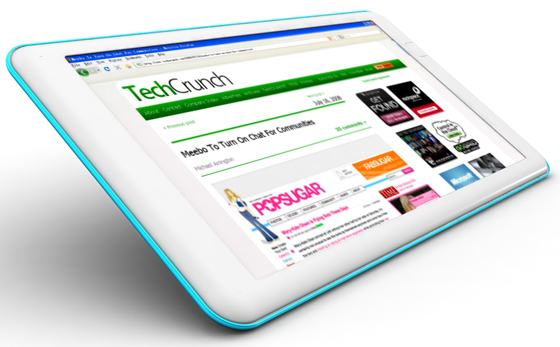
Is this a case of Arrington actually trying to make something happen instead of watching things happen?
I for one, am surprised. I am very happily eating crow. Not that anyone should care, but I have always disliked Arrington and the other bunch of observers because they think they're important when all they do is watch things happen and then write about it.
I hope this succeeds, and I hope they carry it through to completion. I will buy one of these for sure when it comes out.