I get your point but I liked it a lot despite this. They had some big names but the focus on the little people (players), the Nintendo call centre, and stuff like Gay Blade was a part of history I hadn't really seen especially as a non-US person.
Finishing at Doom seemed an odd place to stop, though I guess an argument can be made that's the start of the modern era even though it was nearly 30 years ago now. There's definitely setup there for a sequel covering things like MMOs.
As an American, the Nintendo callcenter and Gay Blade parts were new to me as well, and I lived through most of the time period of the series.
I think Doom made sense to end on. It was really the first modern 3D FPS. Plus, in the mid-90's (when it was released) there was an explosion of gaming. It would be hard to summarize the period after the mid-90's to today (look how much they had to cut out during the comparatively quiet 70s and 80s.
It makes sense in retrospect, I just wasn't expecting it to suddenly stop when it did (I was paying no attention to number of episodes).
Though every year in the mid-90s was indeed a huge step forward so it'd be tough to cover everything that happened.
It's a bit funny to me they didn't drop the term 'Doom clone' in there before going straight for FPS. That term hung around for years as a testament to its influence.
It never claimed to be an exhaustive history of the video game industry so I'm not sure why so many people levy this criticism against it. It reminds me of the G4 show called Icons, with each episode covering a specific game, developer or piece of gaming hardware.
I thought it did a great job of covering the topics that were chosen. It wasn't quite as good as The Toys That Made Us but it was still very enjoyable if you're into video games and I really hope they're making another season.
Exhaustive or not, it is very wrong on quite a number of topics it claims to cover. For example Chun-Li being a first fully playable female video game character? No matter how you try to frame it is either wrong or extremely wrong.
“ One thing to say though, is that perhaps you should be careful to have an accurate historical record? Queer theory did not exist until ~mid 1990s, so perhaps none of these games are LGBTQIA+ — they’re Gay and Lesbian works.”
How to frame history with understanding that didn't exist for the people in it is probably a whole field of study. Most of the letters in the acronym existed (if not by the same name) before then, though meanings have evolved.
Eh, I think it's comparable to how some musicians sound really punk but were ten years too early to be labelled as such (and hence are often considered rock & roll of the "proto-punk" variety, for example)
I think a lot of the gay culture is not well known , even though it's such an important and disproportionally influential little part of western culture. Part of it is because parts of it are considered too racy for todays generally conservative world.
Given the intentional double entendre and commercial success - it's now a cultural icon - I'm going to optimistically interpret its existence in a positive light. I mean, I can't imagine this product existing in many (most?) countries at the time.
When I was a child, Smear the Queer was a game all the boys played. Fag was a commonly used slur. When I was in high school the state of California told gay couples to go fuck themselves. Societal progress is a wonderful thing to see.
Not sure how old you are, but even in 2010 when I was in high school our boy scout troop played smear the queer and the first time I learned the word gay was as an insult. Didn't really help with the whole growing up gay thing.
If it makes you feel any better, I'm a senior enrolled in a Maine high school right now and there's very little homophobia. In fact, a not-insignificant amount of the school is queer. Growing up I only ever heard "gay" used as an insult on-line. Times seem to have changed, and for the better!
Yes, I'm amazed at how quickly things have changed. My sister who is only five years younger than me has a friend who is gay and went to the same high school that I did. In only half a decade the culture shifted from just clear and open homophobia (including some teachers) to him being able to be out and open in HS without too much of an issue.
The problem isn't really out in the open harassment anymore though. I haven't been in HS for a bit now, but I'm a grad student in a fairly progressive university. Nobody would really think we have homophobes here anymore. But, in reality they exist and just learned how to hide it better.
To give an anecdote, I'm quite straight passing and it came up that I had a boyfriend at a bar with some other students while at a conference. For the rest of the week, this one guy in my cohort would make comments to me once everybody else got out of earshot. Stuff like how "sneaky" I am or how he wondered why they let people like me into the conference. I just ignored him and it eventually stopped.
Are you gay? Because, if you're not, then you might just not be experiencing the homophobia head on any longer since it isn't so much out in the open.
My sexuality isn't public but I can say that none of my friends have ever mentioned encounters with implicit homophobia, and that my local school administration (while not being the best) would put an end to that very quickly. However, in Maine it's ground-up: I learned about queer struggles as a kid and I learned about how to protect oneself from any sexually transmissible diseases from a teacher that didn't use gendered pronouns for either party engaging in intercourse. It's very normalized here. If I recall, the University of Maine too runs television advertisements about how accepting it is of queer students.
Implicit transphobia is still a thing (it wouldn't be unheard of for someone who's trans here to have an experience similar to yours) but fortunately that's changing too.
Note: I should add that this social progress only really applies to the city I'm in and maybe the two other big ones here. There are some rural areas that are sanctuaries (to the point of sounding like legends though they're 100% real) but most of the state geographically speaking is still as far in the past as the deep south in America.
It was explicit for me as late as 2004! I am still rather shocked at the progress. I’ve also noticed a huge distinction between lgbt people of different generations, gen y is practically prudish comparatively. “Sex positive” is far less of a thing it seems.
I find it interesting that you mention this offhand because I've been very seriously noticing this type of prudishness in a lot of gen z and younger gen y people and its begining to manifest as old style homophobia
Gen Z is weird. Most young people are very accepting of LGBT peoples but stuff is starting to turn around back to homophobia now that transphobia is Hip And Cool again (thanks J.K. Rowling[0]), because many feminists are invalidating transgender women in the name of equal rights. Transphobia breeds homophobia. I worry sometimes what will happen if young people too become trans-exclusionary feminists but thankfully it's unlikely such a thing could occur. Young people are more open-minded now and discovering they're transgender themselves.
I should add that I'm not quite sure exactly how the trend of homophobia that you speak of is hitting younger people. I haven't noticed a shift backwards in real life or on-line. If you're referring to social media homophobia you should realize that "zoomer humor" is radically different from typical humor and many kids will sound like a deranged homophobes/racists/sexists until you realize that they themselves are gay/black/female and are making jokes at their own expense. That being said, ask before assuming they are or aren't joking.
[0] - I'm not sure about the legitimacy of Slate as a publication but a brief skim of this article makes me think it hits on everything relevant in the controversy (if you don't already know about it; it's semi-common knowledge nowadays): https://slate.com/human-interest/2020/06/jk-rowling-trans-me...
The experience seems to be the same for us in northern Italy. When I was in high school, about 12 years ago, there was some homophobia and, even if I knew my friends would have supported me, I hesitated to come out for a long time, simply because I didn't know how to move, and it seemed a big thing. There were maybe one or two openly gay students and they were supported by some, insulted by others. A younger friend of mine, just 10 years later, was completely out and had a good high school experience as an out student.
I'd say probably half of the people I associate with are in some way queer, and probably more than 10% of the student population. I'd just say the amount is significant outright but there's no way to really know for sure if my numbers are correct because nobody's polling for that.
I played smear the queer as a kid and had no idea queer meant gay. That was a few decades before you played it though. I think I was in my twenties before I knew queer meant anything other than “unusual”. I even had a couple of gay friends who never let me in on it.
I'm not sure where that came from since I don't think anyone knew what it meant and it definitely wasn't used as an insult by us kids. I don't think I learned what it meant until well into my teens. Pre-internet days, of course.
We had a a game in Germany which was called "wer hat Angst vorm schwarzen Mann", which means "who is afraid of the black man". I remember that in my mind it was always a chimney sweep, I only realised at some point as an adult that it's actually an incredibly racist name for a game.
The "Schwarzer Mann" of the children's game doesn't have anything to do with race. Historically it was a mythical figure used to scare children (Kinderschreck) comparable to the bogey man, visualised as a man with black clothes or a shadow creature not a man with black skin color.
There is a theory which connects him to the black death also, which would fit to the game mechanics.
I read somewhere that The Black Man was a historical figure who actually used to ride through Germany clad in black for "recruiting" children to be raised and trained for war. (Lots of wars going on during the Middle Ages)
For those who aren't familiar, Smear the Queer is a playground game in which one person has to keep a ball away from the rest of the group, who tries to tackle them. It's sort of like a cross between "reverse tag" and gridiron/rugby football.
(The gay-bashing element is just a metaphor, you see.)
This game has many, many regional names. I heard it called "smear the queer" but we usually called it other names.
It's semi-interesting, though, that the "queer" was the one with the ball.
It took serious guts to be the "queer" for any length of time - after all, it was you vs. everybody else trying to tackle you. The kids who spent the most time with the ball were the fastest, toughest kids. So "queer" was a slur but also, the "queer" was the fast/strong/brave one.
Of course, there are many regional variations. It sounds like in some places, there was no ball involved, and "smear the queer" was just a name for an ass-beating.
I detest this slur now, and I hate that I used to use words like that as jokes/insults. Today I would be fighting alongside my gay friends against folks using those words.
Queer, in particular, is a tough one. Obviously, smear the queer is an awful name for a game. And while queer has a century of being use pejoratively, it's also been adopted as a label by some lgbtq+ folks like myself (often as a way to be more politically forward than using the safer "LGBT" label).
You'll find that there really isn't consensus around the use of queer as an identity -- some in the community hate it, others love it. There's a lot to unpack in its history, and it's continuing to evolve every year.
Yeah. That term that should... probably not be used by folks outside the community, for the reasons you say. LGBT* is probably a safer and more inclusive alternative, so I don't see any real reason for folks outside the community to throw "queer" around. (Aside from perhaps discussions about the term itself, like this one)
That aside, the near-total reclamation of that slur by the LGBT community is such an interesting topic. I can't think of any other slurs that have been quite so fully reclaimed.
I would probably say that positive/neutral use of the term outweighs negative use like 10 to 1 at this point. Maybe 50 to 1.
In middlesex county massachusetts in the late 70s, early 80s we called it "kill the carrier". Rough game, I dislocated my elbow playing it. It was a wonder anyone picked up that ball.
Ah! I think we knew it by that name as well. Also: "kill the guy with the ball"... I think... "every man for himself football", the aforementioned regrettable "smear the queer" and "roughie-up" was apparently a very local name for it. Everybody had so many different names for it, I think everybody knew at least a handful of them!
It was sort of unique that way. I didn't know any other game that had dozens of totally unconnected names.
The "queer" in the game's name probably means odd, not homosexual. As in the person holding the ball is the odd one, and everyone should try to hit them. That doesn't stop people from misinterpreting it, since queer mostly means homosexual or some other sexual minority. It's slightly more pessimistic to think that the game is teaching our kids to kill homosexuals vs. some undefined oddness.
> It's slightly more pessimistic to think that the game is teaching our kids to kill homosexuals vs. some undefined oddness.
not by much, because even taken literally creating a game around the fact of beating up the odd member of a group isn't exactly what I'd consider a great pedagogical concept
Lol so when I was getting my ass beat in middle school for sounding a bit effeminate during a game of "smear the queer" it was just because I was "odd". That must be why the called me a faggot too.
Same. In my experience, this "game" was only "played" targeting femme boys (or in my case, "boys"), and never with their consent. But if we'd hide behind a teacher the mob would be all "oh it's just a game" and more often than not the teacher would try to goad the victim into playing. Fuck that
In my experience the game was played by someone punting the ball in the air and the person chose to become the target by grabbing the ball. We used to rush to grab the ball, it was a way to prove your toughness, by how long you could last as the target.
I do not discount your experiences at all, homophobia was still prevalent in my elementary and middle school and I also graduated in a liberal state in 2008.
Oh for sure, but at the same time queer in the context of the game didn't mean a generic 'odd', divorced from homophobia. At least by middle school, the kids knew that it meant gay and that gay was bad. Hell, we snickered at the world gay singing Christmas carols in 3rd grade. Using it as an excuse to beat my queer ass was a consequence of that, but I'm sure they would have invented another if the game didn't exist.
If you were getting beat up for the way you sound, that was regular homophobia, not the game. In smear the queer, you only get chased and tackled if you have the ball; if you get tackled you throw the ball away and someone else gets it and everyone chases the new person. What you described does not sound like a game of smear the queer.
Kids games have a lot of regional differences. I don't deny the existence of the game you describe, but I and others were beaten up by crowds of bullies yelling "smear the queer" with no ball to be seen.
So when the other kids got chased and everyone called them faggots and queers it wasn't the game either? Or it was the game and 'faggot' isn't homophobic?
No, the game itself it homophobic, and everyone who played it knew or was learning exactly what everyone meant by queer, and it certainly wasn't 'odd'.
Anecdotal, but even as kids in the early 80s we understood "queer" was "gay" and therefore "bad."
(I absolutely hate that this was ever the case! Wish I had a clue back then)
There was no literal gay element to the game (in our town) but it was still a very hateful name for the game. The message was clear: when you had the ball, you were "queer" and therefore the bad guy and so therefore everybody chased you.
That said, we typically called the game by other names. It had a different name in every town and neighborhood, it seemed. I think we only called it "smear the queer" when we were trying to explain it to kids from elsewhere... it was called "roughie-up" where we lived, but that was apparently hyperlocal, so if the kid was from out of town he might have known it as "smear the queer."
That is, obviously, a homophobic “game”; I suspect it is newer than the ball game of the same name, and probably the result of homophobes applying the name of the ballgame.
Queer was used to denote (pejoratively) a gay person starting in the late 19th century, and increasingly was used that way into the fifties and sixties. The term was later reclaimed by the queer community in the 80s, 90s, and aughts.
The term, particularly in the mood century, was absolutely used to describe gay people.
I didn't say that I doubted that the use of the term to refer to gay people was current when the ball game was created. I said that I doubted that that’s the sense that was referenced in the name of the ball game.
The pejorative use to refer to gay people wasn't the dominant use of the term until, well, quite late in the 20th Century, and the structure of the game makes it a whole lot less likely that the reference was a pejorative reference to a sexual minority rather than simply the odd man out.
It's kind of like if you someone argued that the “ball” in the name of association football was a reference to testicles and not the main piece of equipment in the game. Sure, the word also was used that way at the time, but it doesn't make as much sense in context as the alternative, and without some evidence beyond the mere existence of the sense of the word it's not a particularly compelling explanation.
I don't think it much matters how the term originated based on my memories as a child—it was certainly internalized as homophobia and caused me a lot of pain growing up.
What does "probably" mean here? Does it mean "Here is the evidence-based argument why this is more plausible than that," or does it mean "I would be happier believing this than that"?
It's part of HN's tradition of gaslighting victims of demographically-targeted violence by ignoring any kind of context and pedantically claiming "it couldn't possibly have been $bad_thing". Of course, because being contrarian is more important than learning about the history of LGBT abuse.
Very much this. Do you have an ubsubstantiated conspiracy theory about the evil machinations of bigcorp? Congratulations - upvotes for your wisdom. An actual report of your lived experience of homophobia/racism/sexism/whatever? Hmm, are you sure it's not just in your imagination?
Thank you for this. I expect you'll get down voted or flagged, but my experience as a queer person on hn had absolutely been full of exactly what you describe.
I play games with people in their mid-20s and a few have let out "that's gay" as a synonym for something being bad.
I don't think any of them would qualify as homophobic, it's just more a case of hearing something so much that it creeps into your lexicon and comes out by mistake sometimes in a moment of distraction or emotion. It took me a while to unlearn it myself because it was extremely common in the 90s at my school (even among guys who later came out as gay, I guess you have to fit in).
They probably aren't explicitly homophobic, but it's disrespectful and a tiny bit homophobic to not adjust your language a tiny bit, because it's obviously negatively impactful to gay people (not everyone, but I know it is to me).
I agree but everyone has moments of emotional weakness where things come out without thinking. It becomes more about breaking a habit so it doesn't happen unconsciously. Or apologising if it does happen.
It can take a moment to realise, my original post said "bad/lame" because the use of "lame" was another popular one that took over as supposedly less offensive than "gay", but it too has the capacity to offend those that it would apply to so I thought it best to edit that out.
You know what I only realised now from your comment what "lame" in "that's lame" actually means. It tells you how easy it is to create certain associations without someone realising.
Mind you I don't use that's lame, not a native speaker and probably also too old for that phrase.
Keep trying and making progress. There are so many testimonials out there about what a positive difference can be made by avoiding the use of "gay", "lame", etc. as insults.
I understand. "That's gay" was popular enough recently enough that I have some tolerance. I still bring it up though and don't appreciate if it's an ongoing problem they aren't trying to address (or are pretending to try to address).
Fag on the other hand I have very little tolerance for. It's a nasty enough word you don't really drop it accidentally unless you use it regularly in some communities (lots of gamers for instance).
Perhaps i am just a stupid Neanderthal, but the recent urge to "adjust the language" is something i really don't like... i realize it is based on good intentions, but it feels to much like some orwellian newspeak in the making.
I'd disagree if only because it's not going to be enforced by some authority. Personally, I've stopped using some words because I know that they could be offensive to certain groups of people, not because I was pressured to do it or told it's the only way forward. It's just easier to call someone "weird" or "loopy" instead of "crazy", call something "bad" instead of "gay", call them "cigarettes" and not "fags". If someone was pestering me about it all the time, I reckon my base instincts would kick in and I'd go "Well I was going to do it but not anymore." As is, I came to it on my own and haven't felt any discomfort after adjusting my way of speaking.
No one is forcing you. However, it's language that has historically been used to hurt people, so it helps to avoid it if you want to avoid bringing back those memories for people.
When I get called a fag, it reminds me of all the times I got my ass kicked for how I present myself. I won't force people to stop saying it, but I'll mention it and won't associate with them if they don't stop.
It is a great thing to see, California is described as some sort of lefty-socialist-liberal bastion today but like you said it was only 12 years ago they (unconstitutionally) voted in a ban on gay marriage
I know HN generally dislikes discussion about comment voting, but this comment should not have been downvoted. There’s a big difference between a statement saying they “unconstitutionally voted” and one saying they “voted in an unconstitutional measure”
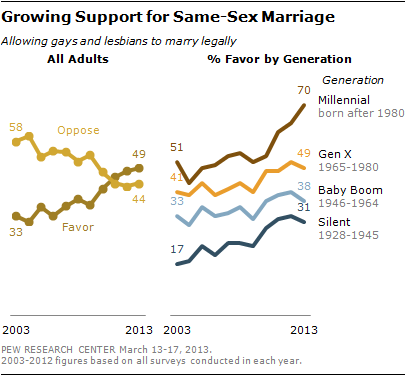
Public opinion on same-sex marriage changed very quickly from 2008 to 2016. Obama opposed same sex marriage in 2008 and didn’t really support it until after the 2012 election.
And I'm not sure it's totally accurate to say that what happened was people coming around to "lefty liberalism." The nature of the debate changed quite significantly after 2005. First, it became clear to the public that sexual orientation was an immutable characteristic. When I was growing up in the 1990s, it was still common to hear it called a "lifestyle" implying it was a choice. Second, there was an increased focus on equal legal rights for committed same-sex couples. Appealing to neutral application of universal legal principles is usually a compelling message for even non-lefty Americans. Around the same time as Prop 8 was passed, a state Supreme Court decision legalized same-sex marriage in Iowa. Iowans aren't particularly lefty, but a slim plurality supported the decision within a year or two. Third, in the same timeframe a number of mainline Protestant churches began ordaining gay clergy. While the political influence of these denominations is less than in the past, they’re still a powerful force in the center of the political spectrum among middle age and older Americans.
The end result of all that was Obergefell which wasn't particularly lefty or liberal. Justice Kennedy's opinion was a paean to marriage as an ancient and essential social institution. Because marriage was fundamental, participation in it could not be denied to same-sex couples just because of the programming they were born with.
Of course, none of this would've happened without decades of tireless "lefty liberal" advocacy. But public opinion changed dramatically within a single decade, and wasn't accompanied a similarly large leftward shift in peoples' politics generally. So it's interesting to think about what drove those changes.
I believe the outcome in 2008 was driven more by differential voter turnout than by California residents changing their opinions between 2008 and 2016.
It's interesting indeed. In Spain there was a similar fast-paced change: when I was a kid at school in the first half of the 90s, I remember the equivalent of "faggot" being practically the go-to insult for anyone people wanted to bully (and of course any kid deemed to be even mildly effeminate was bullied), and gay people almost always kept it in secret.
In the early 2000s, some famous people (TV anchors, etc.) came out of the closet. In 2005, gay marriage was approved, with some controversy but according to polls 65% of the population supported it at the time. 3 or 4 years later, only a minority of extremists remained opposing it, so even the main (and in that time, practically the only) national right-wing party stops actively opposing it.
It's curious because I don't think the change was driven by any obvious big movement or campaign with media attention (analogous to, say, BLM, or in the Spanish context, the 15-M movement). Maybe I wasn't paying a lot of attention to the issue, but it seems like most people just kind of spontaneously decided that hating on gay people was stupid.
I guess secularization probably helped (2000 was also the year where a fast downward trend started in statistics like religious marriages vs. civil marriages) but it's at most a partial explanation. Most religious people now don't object to gay people getting civil marriages either.
PS: This is not to discredit the Spanish gay movements and the people who tirelessly fought for their rights, it's just that my impression is that they weren't on the news that much so most people weren't convinced directly by any specific movement. Plus, gay rights movements in Spain existed at least since the end of the Franco dictatorship but it seems that it wasn't until the early 2000s that there was the sudden change I'm mentioning, it wasn't a slow and constant change.
I think there were two elements. One was that gay marriage suddenly started happening in many places around the world and instead of dire warnings coming true, all the public heard were media reports of some happy couples getting married. The other was generational shift: a generation who had grown up when homosexual relations were unthinkable where even many left-leaning people felt the natural order was being disturbed and Something Must Be Done was supplanted in numbers and political influence by a younger generation where even most conservatives didn't exactly see the gay people they knew as a threat. (And in some parts of the world, the Right even flipped the whole thing on its head and used "their homophobia makes them not like us" as an argument in their campaigns against immigrants or religious minorities). In the middle, lots of people's views on marriage turned out to be a lot less strong than the conservative culture warriors had hoped...
I think it goes to show that conservatives can generally rely on younger generations becoming more receptive to their arguments about tax and security and Chesterton's Fence (and less interested in provisions for people on low incomes) as they age to compensate for older conservatives dying off, the switching sides in culture wars tends to trend in the opposite direction.
Interesting [and different from the UK data in many ways] but they're still more opposed than any of the other generations were, and it's pretty clear that increasingly supportive millenials taking over is the driving force. Especially when you consider that as well as becoming more heavily weighted in surveys of overall public opinion, millenials also went from being a political non-factor to compiling much of the media coverage of gay issues their generation and others consume over that time frame.
The article is definitely capitalising on the show, but I think it's more of an ad for the Internet Archive and the value it brings. A lot of people will be searching for that game after the show, and it makes sense for them to post about it.
An advertisement that entices you to buy a submarine.
Actually, it's a reference to Paul Graham's observation that when news articles start to appear about anything almost simultaneously, it might be the result of a deliberate effort on someone's part to sell something along with all the generated talk: http://paulgraham.com/submarine.html
A native advertisement is an ad, dressed up to look like news.
A submarine ad is news. It's true, it's newsworthy (though that seems to be a low bar), it's a perfectly reasonable thing to be published as news. It just... happened not to be discovered by a journalist. Instead it was discovered by a company who hunted for possible news stories that would make them look good or would mention their product, found one, and presented it to a journalist. All nicely researched and ready to go; an easy story. (If this doesn't make sense, Paul Graham explains it better.)
That's my understanding, at least. I'm sure there are tons of shades of grey and no clear boundaries between these things.
Thank you for the clarification. I can see this being a pretty blurry boundary between the two but I think the distinction does make sense. In one sense I wouldn't really call native advertising lazy, but it seems like that is a defining feature of submarine ads (if we use "lazy" in this specific way).
> "One of the most surprising things I discovered during my brief business career was the existence of the PR industry, lurking like a huge, quiet submarine beneath the news. Of the stories you read in traditional media that aren't about politics, crimes, or disasters, more than half probably come from PR firms."
I see nothing that would indicate this is an ad, covert or otherwise. It was posted by Jason Scott -- whose reputation should be familiar to readers of HN -- on the Internet Archive, and has a legitimate reason for being posted there. This is as good as it gets for "not for profit" and "not an adverticle".
Neither of those cases excludes the possibility that the article was influenced by a PR campaign in some way (author's intentions are in fact irrelevant to this question), in this case for a recently-released, and apparently not particularly great documentary by Netflix.
The causal chain is obvious: the documentary surfaced interest in the game; this led to a call to try to locate the lost game; it was located and uploaded on archive.org (a library) for preservation's sake. You can consume the game with or without watching the documentary or subscribing to Netflix and no one was compensated.
Of course the documentary and the release of the game are connected, but in precisely the opposite way from what you propose.
Actually, no. We had GayBlade up and emulated earlier this year, completely unaware of the documentary. Causal chain is actually: People working with Ryan Best to tell his story at something called RAINBOW ARCADE, the world’s first exhibition on LGBTQIA* video game history at Schwules Museum Berlin. This includes multiple groups of people and museums. That's early 2019.
During that point, the story of GayBlade and Ryan Best become known to the HIGH SCORE production team, and Best is interviewed for it and his story told.
Late 2019, Best discovers some original materials and they are used to recover the game.
Early 2020, Internet Archive hosts a copy of the game emulated, and LGTBQ Game Archive does an extensive writeup on the game.
Mid 2020, HIGH SCORE is presented to Netflix, and a card is inserted into the documentary to indicate it was found. (I'm finding not many people have seen the card.)
Well, as you saw, someone brought up "Death of The Author" (i.e. I may not even know I'm posting an ad) so there's that.
But.
The blog post is 100% posted because of the Netflix documentary. It's causing literally hundreds of people to go 'Now I hope they found GayBlade! How do we find it!' and also a screenshot of my twitter account (which I had nothing to do with and became aware of after people starting pinging me) is in it.
The GayBlade stuff went up in January and was announced at that time, by the LGTBQ Game Archive (this was mostly their gig, the whole project to find and recover it).
Internally, our social media and outreach folk went "Hey, did you see we're getting mentioned a lot as people find GayBlade on the archive? We should do a blog entry about it." I was hesitant for the reasons people here seem to bringing up, i.e. cynicism that we must be doing it for money or something. But the fact is: we did it, we worked with Ryan Best and Strong Museum and LGBTQ Game Archive to make Gayblade playable (and also downloadable, when I realized nobody had taken that step). So why NOT talk about it, in case people missed it?
(It was also easier to point to the blog entry than endlessly tweet at people asking.)
Thanks for responding with that clarification. I'd like to clarify, in turn, that my original post was intended more as observation than accusation. No malicious intent imputed!
One thing I would like to add, that I think we would both agree on, is that regardless of everyone's exact motivations and the actual causal chain of events, the post is still, de facto, part of the miasma of publicity for the series. Anyway, I appreciate your work, and that of archive.org.
I think there's been a discussed theory that if something gets public attention, and people respond to it, even if they're not intending to, that they're contributing to the promotion of that item. That goes back many decades.
I don't mind that discussion but I definitely don't want people thinking in any way we got money to write the entry; we simply put into a formal entry that we've had this for a while. A popular awareness of something we do helps a non-profit, so we'll clarify the context of it. I think we're both in agreement the more people know of our work, the better.
Out of curiosity why are you searching for that? Like if that's your only comment it makes it seem like the possibility of it being an ad dilutes the message they are writing about?
Many articles are sponsored. Many are ghostwritten.
Protip: Often times the second company/solution in the article about the solutions is the one that paid for it.
Who cares?
You want the FTC to step in with an "AHA! #AD!" banner forced on everything?
Well, it's an important concept to know when something is an ad or not and to, even in general, know or be able to reason about the motivations of the writer of an article. I think that's why it's important. This is especially relevant when it's a submarine ad, as the person to whom you're replying mentioned.