Americans are fascinated with race. It's used as an explanation for practically every kind of social injustice. To me, economic situation is much more important here. After all, outside of a serious mental illness, a wealthy person will not go and try to break into someone else's house.
There are cultural aspects that have developed to support certain behaviors within an economic setting, there is plain ignorance, but all these can be addressed with proper economic support for the impoverished populations.
In California, LA stands as the biggest source of the 3-strikers[1], order of magnitude larger than other urban centers. Part of this is the sheer size of the population, part of it is the size of the economic strata occupied by the majority of 3-strikers. Of the 6.5% (is this even accurate?) "black people" you reference, what % live in utter poverty? Of the 55% of non-black 3-strikers occupy the same strata?
I don't have a source of these statistics, but to me it seems very intuitive that you will find that the vast majority come from the same economic situation, and race plays less of a difference than you might think.
As for the suburbs, I fail to see the reasoning - are you proposing that we limit the free choice of people of where they want to live? Most people I know who chose to live in suburbs and endure horrific LA traffic did so not because they do not want to be next to other races, they did it because they want their children to have a yard to play in and breath fresh air. Schools with a smaller classroom size are an issue too, but that goes back to the economic situation - large lots/more expensive houses result in greater tax income and therefore better schools.
Race is simply the most identifiable trait. Everything else, you have to actually work at finding root causes, this is why people gravitate to issues like that - it's easy, it's horrific and everyone immediately knows the solution. Unfortunately, that is also why we have made very little progress on the issues, despite making the subject socially-radioactive. Instead of feel-good/feel-bad rhetoric, it would be nice to see a tangible plan for improving the economic conditions in the blighted parts of LA for a change... If that happens, I'm willing to wager that crime will drop with poverty, and such horrific stories will become non-existent.
Moreover, it's hardly unique to Americans. Racial and ethnic conflicts are common across the whole world. The U.S. is still dealing with a legacy of slavery and desegregation that ended only recently. When the Governor of Alabama promised "segregation now, segregation tomorrow, segregation forever" Bill Gates would've been about eight years old. He would've seen on TV when Governor George Wallace physically blocked two black students from enrolling in the University of Alabama, and had to be moved aside by a National Guard general under the orders of the President. This isn't ancient history, it's a sociological blink of an eye.
Other western countries have to deal with the legacy of their repression of particular ethnic groups, but the U.S. is unusual in that its repression of blacks was particularly brutal and long-lived, ended very recently, and left a very large number of disaffected people among the population of the country (12-13%). The treatment of the Irish by the British might come close, but is mitigated by physical separation. What would the politics of England look like if London was 40% Irish, confined largely to ghettos in the city?
> To me, economic situation is much more important here.
In the U.S., race and economic situation is inseparable. That's the legacy of segregation. When Bill Gates was a child and going to school in the 1960's, most of America's black children lived in the South where they went to segregated schools, ate at segregated restaurants, etc. Economic segregation is a natural consequence of this very recently ended racial segregation.
> As for the suburbs, I fail to see the reasoning - are you proposing that we limit the free choice of people of where they want to live?
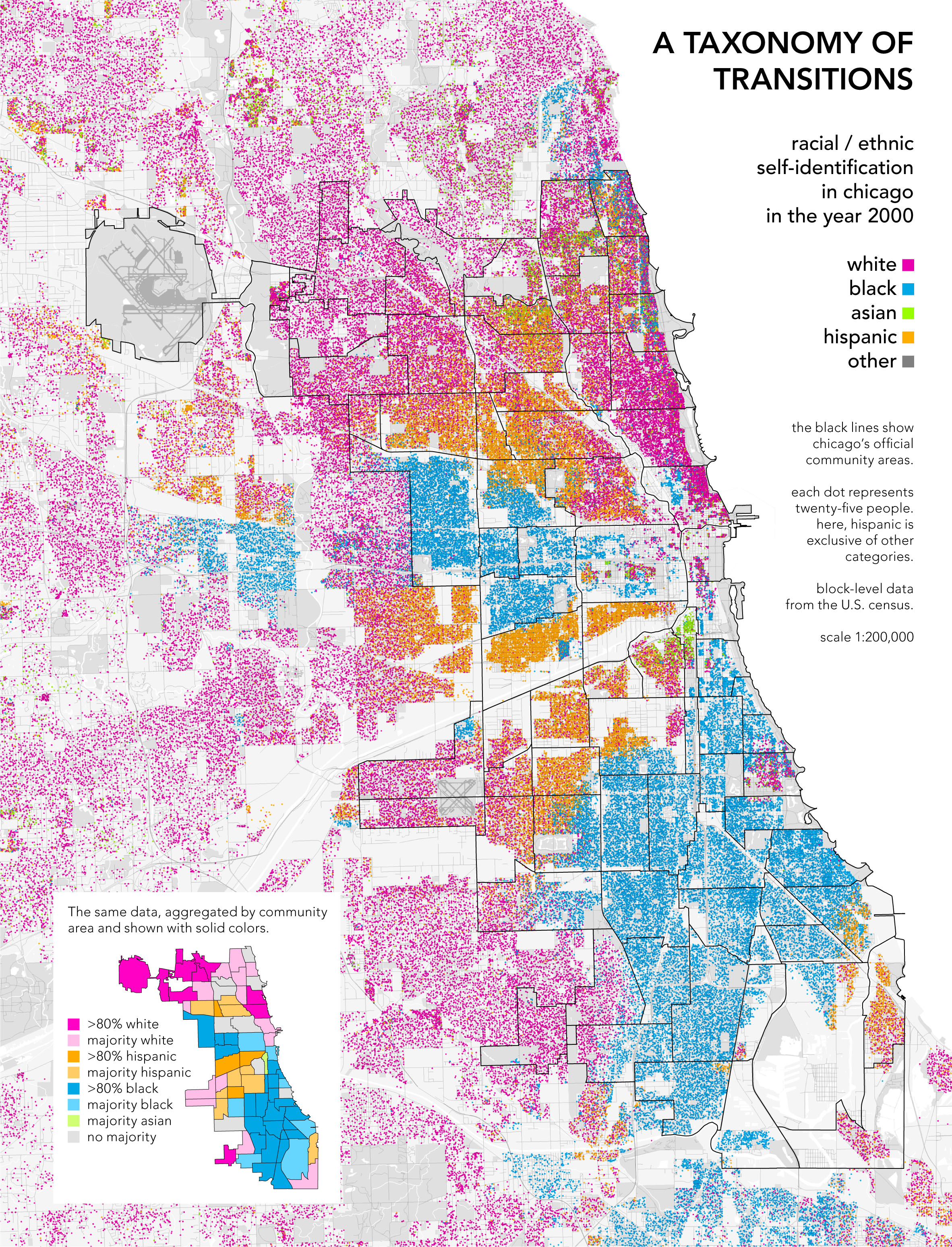
No, my comment is descriptive rather than prescriptive. Suburbs are segregated, by race and socioeconomic status. Voters living in the suburbs never see the impact their support of particular criminal law policies have on poor people and minorities, who disproportionately live in cities.
This is a race map of Detroit and its inner suburbs: http://cdn.all-that-is-interesting.com/wordpress/wp-content/.... The Detroit metro area is 70% white, but the city itself is 80% black. How much exposure and insight do you think those red dots have into the lives of those blue dots? When those red dots vote to support criminal policies that disproportionately affect the blue dots, do you think they even get any feedback about the ramifications of their decisions? This is the impact of segregation and suburbanization. People naturally have trouble empathizing with people who are different from themselves. Suburbanization exacerbates that natural phenomenon. People have particular trouble empathizing with people who live somewhere else that they never see or meet or interact with on a daily basis.
I'm afraid you are missing my point. History is history, what happened happened and there isn't anything we can do about it. My point is simply that non-discrimination policies without tangible focus on economic wellbeing is meaningless and will have zero impact.
Yes, on average black population is at an economic disadvantage when compared to white. Yes, there are historic reasons for that. But the problem is not that they were disadvantaged, but that they stay disadvantaged, much of it through somewhat self-sustaining social processes.
What I mean by self-sustaining, in this case, is the cycles of criminal activities/violence many of these communities are gripped by. The three strikes law hurts these communities the most not because they are black, but because the economic situation is such that people are compelled to steal or commit other crimes. Not only that, but it is socially acceptable to be involved in criminal activity. Both make repeat offenses more likely.
On the flip side, the suburban voters are acting very rationally. It's all in how you ask the question. "Should a repeat rapist be prevented from hurting anyone else?" Most people will answer yes. "Should a person convicted repeatedly of serious violent crimes be prevented from hurting anyone else?" Again, most people will answer yes.
Now, break these statements into what lawmakers and law-enforcement can actually implement, and you get something a long the lines of "people that commit multiple felonies should be sentenced to life without parole". Then the same lawmakers start expanding what a "felony" is to include non-violent crimes, and so on... Everyone appears to be acting somewhat rationally, but the end result is a lot less clear cut.
What we really need to focus is changing the economic situation, then the cultural aspects will follow, and only then we will have fewer stories like this and fewer victims in general.
> History is history, what happened happened and there isn't anything we can do about it.
We can't change history, but that doesn't mean we can't look to history to understand how the present got to be the way it is. Moreover, just because history has happened and we can't change it doesn't mean it doesn't have ongoing repercussions.
> But the problem is not that they were disadvantaged, but that they stay disadvantaged, much of it through somewhat self-sustaining social processes.
The problem is that they were enslaved, and then actively repressed. Those are facts that have repercussions in the present. Anecdote: my grandfather was trained as both a doctor and a lawyer, and was a wealthy man. My family didn't inherit any money, but my mom inherited an education from a private tutor and I grew up hearing about him and being shaped by those stories. Well the grandfathers of black people alive today were systematically repressed, denied education and denied economic advancement. What kind of stories do black kids grow up hearing, and how do those stories shape them in the present? The problem goes far beyond economic disadvantage. It's one thing to prevent a group of people from accumulating capital. It's another to destroy their social structures, actively prevent them from bettering themselves, and use the authority of the state to segregate them from the majority population. That results in cultural devastation that goes far deeper than simple economic loss.
> The three strikes law hurts these communities the most not because they are black, but because the economic situation is such that people are compelled to steal or commit other crimes.
Crime isn't a simple function of economic status. There is a wide variety of crime rates within communities of identical economic status. Crime is a function of social cohesion, the vitality of social structures, community respect for authority, trust, etc. Those things are deeply tied up in race as a result of the legacy of segregation. You don't think there is a difference between a poor black community and a poor white community when it comes to respect for authority? When that authority was, until just a few decades ago, fighting tooth and nail to maintain segregation and repression?
All valid points, but the reason I disagree with race as the main factor, is that I have had the privilege of working with and befriending many people who are either black or mixed. All of them had made the choice to work hard and gain education. In the end, in today's world there are choices. This is why I focus on the economics - to enable more people to make better choice, black or white.



There are cultural aspects that have developed to support certain behaviors within an economic setting, there is plain ignorance, but all these can be addressed with proper economic support for the impoverished populations.
In California, LA stands as the biggest source of the 3-strikers[1], order of magnitude larger than other urban centers. Part of this is the sheer size of the population, part of it is the size of the economic strata occupied by the majority of 3-strikers. Of the 6.5% (is this even accurate?) "black people" you reference, what % live in utter poverty? Of the 55% of non-black 3-strikers occupy the same strata?
I don't have a source of these statistics, but to me it seems very intuitive that you will find that the vast majority come from the same economic situation, and race plays less of a difference than you might think.
As for the suburbs, I fail to see the reasoning - are you proposing that we limit the free choice of people of where they want to live? Most people I know who chose to live in suburbs and endure horrific LA traffic did so not because they do not want to be next to other races, they did it because they want their children to have a yard to play in and breath fresh air. Schools with a smaller classroom size are an issue too, but that goes back to the economic situation - large lots/more expensive houses result in greater tax income and therefore better schools.
Race is simply the most identifiable trait. Everything else, you have to actually work at finding root causes, this is why people gravitate to issues like that - it's easy, it's horrific and everyone immediately knows the solution. Unfortunately, that is also why we have made very little progress on the issues, despite making the subject socially-radioactive. Instead of feel-good/feel-bad rhetoric, it would be nice to see a tangible plan for improving the economic conditions in the blighted parts of LA for a change... If that happens, I'm willing to wager that crime will drop with poverty, and such horrific stories will become non-existent.
[1] http://www.lao.ca.gov/2005/3_strikes/3_strikes_102005.htm (2005 analysis, so a bit out-dated)