This bike has a weird design. I understand that they are trying to make it as inexpensive as possible, but why do they put (expensive) disc brakes and front suspension on but then use fake fenders? Why not use regular brakes and a $30 pair of fenders that actually work? Also, do people really want to be confined to one handlebar position for 20 miles? (I am also confused as to why you need front suspension when riding on pavement, especially if you are trying to cut costs. Why not a sprung saddle?) Finally, no chain guard? Do people think rubber bands around their pant legs are stylish, or something?
Anyway, I will save my detailed rant for another day... but I think the reason Americans hate cycling is that the bikes that are marked towards them suck. A simple, traditional (steel!) road bike with a chain guard and eyelets for a rack and fenders would be cheaper, more reliable, and more flexible than most of the crap people are trying to sell today. I don't get it.
If you are really going to fly down the road at 20 mph, you cannot use caliper brakes. They won't have the stopping power or "bite" you need to stop quickly. If they get wet or dusty, then for get abou tit. Ditto for suspension if you are going to be making a turn at 20 mph or even 10. At speeds above 10 you really have a motorbike.
I work in san jose and saw some guy on a, as you put it, simple traditional steel roadbike with some kind of gas motor on it, going about 20. He tried to take a gentle turn along Tasman in front of Cisco building D or something and almost lost it. It was busy traffic and he could have died if he had gone down.
These things aren't bicycles with electric motors. They are motorbikes. These are not the same things. The handling is all different ( you lean into and push into turns ). A serious bicylist might know what I'm talking about. I think the difference is the motor. :) The torque it makes has different characteristics than a bicycle with a fast rider on it.
Executive summary: be careful out there. It's harder than it looks.
As far as hating bicycling...I don't...but I'm not going to get killed for the sake of commuting since bicycles on roads meant for cars are more or less incompatible in traffic.
All I can really say is "citation needed" on all of your points.
You don't need suspension to turn a heavy bicycle. Look at all the tandems and cargo bikes without suspension. (I routinely load 35 pounds of groceries onto my bike without even thinking twice. Handling is barely affected, if at all.)
Caliper brakes develop plenty of stopping power, even in the rain. I have gone down hills fairly quickly (say, 35mph) only to encounter a red light -- and caliper brakes work just fine for stopping the bike quickly. (I have also ridden bikes with disc brakes. They also work very well, but are unnecessary if you are not riding through mud.) I am sure they are not adequate for stopping a motorcycle driving on the freeway, but that is a completely different case. The forces involved are an order of magnitude apart. This is an electric bicycle with a top speed of 20 miles an hour.
I am especially confounded with your statement, "At speeds above 10 you really have a motorbike." 10 what? At 10 miles an hour, you are struggling to balance a bicycle. Stopping and turning is not going to be a problem, even if you have a battery.
As far as hating bicycling...I don't...but I'm not going to get killed for the sake of commuting since bicycles on roads meant for cars are more or less incompatible in traffic.
(Yes, drunk drivers or psychopaths might hit you. But plenty of people die in car accidents, too, and nobody has any qualms about taking their car on a public street.)
(As an aside, I am not even going to comment on your anecdote of someone "almost losing it" while turning. That could be due to anything, most likely a flat tire.
Continuing along the path of making hasty generalizations from personal experiences -- I have crashed my bike. I did not die. Therefore nobody dies in cycling accidents...)
Caliper brakes are old tech. V-brakes work great on tandem bikes; I'm sure that thing isn't going any faster than a tandem on a downhill, and it weighs about half as much. That said, good caliper brakes will slow a solo rider down just fine. If you can brake enough to endo, you can brake enough.
I also disagree with your statement that this is not an electric bike. It is, and it is marketed as such. It has bicycle geometry and bicycle weight, and notably lacks a pair of heavy-ass gyroscopes. This is going to handle like a cargo bike.
For me, the biggest problem with biking anywhere worth going is sharing the road with cars, and thus the possibility of getting hit by a car (something I saw almost happen a few days ago.)
But that's only a problem if your officespace is dreadful. For all the time I was at Songkick, the office had a full bathroom (and kitchen), and most fancy law offices I've seen have this as well.
IMHO, this is the future of transportation. 20 miles one way should be sufficient for a HUGE proportion of workers (you'll recharge the battery at work).
Have any of you converted a regular bicycle to electric DIY-style? I see articles about that on the net. I'm wondering if it's worth it to do that. Would appreciate pointers.
Meh, I walk 1 block to work. I think the real solution to commuting problems is the reolization that it's ok to live near office buildings.
Then again I am single, and don't own a place, but it's a great tradeoff when possible IMO. The issue with all city's being dirty, smelly, dangerus places to live is mostly a solved problem. I also have a lower enviermental impact than most american's living in "eco frendly" housing.
PS: Granted, I also make far more money than most people so I can afford to living in a nice highrise, but I think it's a great option which can quickly scale.
I did the DIY thing with my Marin San Rafael bike. I purchased the bionx 250 from nycewheels (don't recommend them for their patchy customer service - missed most of last year's riding season thanks to them). My commute is about 12 miles each way with some big hills. Getting the kit allows me to easily do the commute both ways in a day. It left me pretty dead before.
Was it worth it? To me, yes. Riding the bike is FUN. If you miss the strenuous workouts do what I did Saturday, and turn the motor off for all or part of your ride.
The bionx 250 maxes out at about 17 mph for me. It really makes a huge difference on the hills. With my battery enclosed in one of those nylon 'trunks' you can't even really tell it is an electric bike without looking closely. But this thing is a couple years old now and I'm sure isn't state of the art anymore. If I was buying today I'd definitely look at the non-kit, pre-built options. I spent hours getting everything the way I wanted it--enjoyable hours for me, at least.
Sigh...I wish this were the case, I really do. But I sincerely doubt it, at least not in the US. Lots of reasons, but main ones would be weather, comfort, initial cost, time, and the sheer difficulty of getting people to change.
Within the US, something like this would only work in city centers...people aren't going to ride their electric bike 15 miles to work each way, especially when you throw in the fact that a) they're wearing business attire, b) the weather is lousy for this in a lot of the country a lot of the time, c) they already have a car and our entire infrastructure is built around letting them use it.
Even within cities, there are only a handful where it's not too hot or too cold too much of the year for this to be worth it.
I think small hybrids & electrics are the future of transportation. Plus more people cramming into cities and using public transportation, not to mention things like telepresence may mean that fewer people need to commute to work in the first place.
But millions of people in the mid-west US riding their electric bicycles to work each day? Not gonna happen :)
The Practical Pedal (lo-fi utility biking 'zine) had an article about the past, present and future of electric bikes, and also rolled their own with available technology.
Wouldn't an electric scooter or motorcycle be more attractive?
I suppose the bike riding crowd is already keen to the cons of bike travel (lack of comfort, exposure to weather, etc), but I'd be game to exchanging my car to a powerful electric motorcycle, at least in the summer. Although my wife wouldn't be too keen on the idea.
Indeedy,and I believe some are available. However the bike in question is only $900, which is really quite competitive. If you don't mind looking French, they also make a scooter-format velo (like a small scooter but with pedals, which is even cheaper). http://www.pacificebike.com/bk1.html
Back in the 1970s little motorized scooters with pedals (or little pedal scooters with motors, depending on your point of view) were popular in France. They may well have been popular elsewhere in Europe too, but stuck in my memory ever since because I never saw one until I went on a trip to France. They weren't popular in the British Isles.
My wife and I have electric scooters instead of a car - 20 mile range between charges, 20 mph, $1500, and no license or insurance because they are technically bikes (but they look and feel like scooters). Works great for us most of the time, though of course on occasion a little more range, power, and carrying capacity would be welcome...
E-bikes are everywhere in (urban) China and are a certain kind of status symbol--you graduate from a bike to an e-bike to a scooter to finally a car as you move up the economic ladder.
If my office actually had proper secure bike parking, I might get one of these to replace my monthly metrocard.
I agree with the premise that an electric bike is a great way of commuting 5-20km.
However, the problem is the same for electric bikes as it is for good quality push bikes: theft. Bicycles get stolen like nothing else in a lot of places. In cities where bicycle transport is common (The places I have experienced this have been Amsterdam & Beijing), they seem to have arrived at an inelegant solution to this: Cheap bikes you can afford to lose. That way you can rely on a combination of crappy wheel lok (no need to tie to a pole), low resale value & indifference to losing a bike or two a year.
For me, this is what keeps me from replacing my driving with cycling more often.
At what point does a motorised bicycle become a motorbike?
Here (Australia), anyone of age age can ride a bike pretty much anywhere for just the purchase cost of the bike, but to ride a motorbike I need to be of a certain age and have a license. I also need to page yearly rego and insurance, and pay stamp duty on top of the purchase price.
At the moment, I think there's still a reasonably clear division, but with improvements in battery life and capacity, and better motors soon there won't be a lot separating an electric bike from a scooter or basic motorbike. At which point I'm sure some bureaucrat will notice and well... we all know what will happen then :(
I usually find Treehugger to be a bit soft on scientific rigor, but this is an intriguing idea. Make this a folding bike, where the wheels have the same axis when folded so it can easily be rolled around when folded. Also give it an internal hub shifter. Such a bike would be perfect!


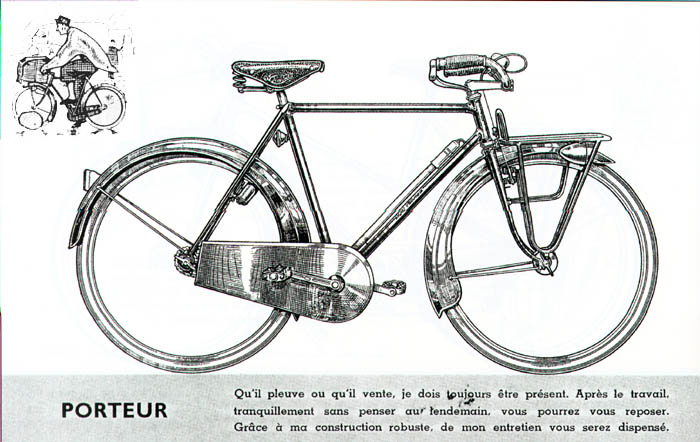
Anyway, I will save my detailed rant for another day... but I think the reason Americans hate cycling is that the bikes that are marked towards them suck. A simple, traditional (steel!) road bike with a chain guard and eyelets for a rack and fenders would be cheaper, more reliable, and more flexible than most of the crap people are trying to sell today. I don't get it.