> [The class action lawsuit against AT&T] was dismissed on December 29, 2011 based on a retroactive grant of immunity by Congress for telecommunications companies that cooperated with the government.
What an overreach of power on the part of Congress. Something goes to court to discuss its legality, and then Congress retroactively declares it to be legal? Yikes.
I already mentioned this and sorry for repeating but our beloved liberal / transparent / change-and-hope-loving president Obama voted for the retroactive immunity back when he was still a senator.
Well no: Congress is well capable of granting retroactive immunity. The constitution restrains it from retroactively criminalizing things, so that you can be prosecuted for something that wasn't illegal when you did it; but retroactive decriminalization happens fairly frequently and is an essentially liberal action. Why should a private actor be burdened for the perceived misdoings of government? It's not up to corporations or individuals to regulate the government, from a legal standpoint.
> Why should a private actor be burdened for the perceived misdoings of government?
But why does this have to be ensured through the action of the Congress? If the misdoing was the Government's, it is up to the courts of law to absolve the private actor of guilt.
Granting immunity of private actors for government illegalities is a very dangerous precedent. Imagine if the same was to be done if a private security company fires on civilians on behalf of state orders, and is then absolved of responsibility through an act like this one.
When a private authority does something on behalf of state authority, the state effectively gives away some of its responsibility; when it decriminalizes it later, the part of responsibility that it has given away is now vanished. In some cases, of course, the state can still be sued over the initiative, but such a measure ensures that companies are sheltered in case the whole thing goes awry, so there's little incentive in not collaborating.
What does suck about this in terms of ethics is that it's hard to draw a line between when retroactive decriminalization is beneficial and when it isn't. After abolishing slavery, it obviously makes sense to decriminalize slaves' attempted escapes. But does it also make sense to decriminalize racist behaviour?
Edit: just to be sure, I'm arguing over principles here, and all I have to bring is historical arguments, not judiciary ones, since I neither am a lawyer, nor do I reside in the US. If I missed something due to unfamiliarity with the US law, I apologize in advance :-).
Granting immunity of private actors for government illegalities is a very dangerous precedent.
That ship sailed a long time ago, and the Constitution grants a broad power of pardons to the President.
My favorite example of this being used block something being Bush Sr's pardon of everyone involved in the Iran-Contra affair. A matter which seems likely to, if further pursued, lead to wrongdoing by Bush himself. Or possibly worse, if you subscribe to the http://en.wikipedia.org/wiki/October_surprise_conspiracy_the....
"But why does this have to be ensured through the action of the Congress? If the misdoing was the Government's, it is up to the courts of law to absolve the private actor of guilt."
Courts don't absolve anyone of guilt. They merely determine if a law has been broken. It is congress that makes law, so it is up to congress to construe the law such that the private actor has not broken anything.
But does this not open the way for arbitrariness? At this rate, given enough support in the congress, the executive power can pretty much do anything -- the congress will just decriminalize it afterwards.
Edit: What I meant in previous post was that a court of law has the possibility of absolving private actors or responsibility, the same way they do with someone who has committed an illegal action under blackmail: they are still guilty of having broken a law, but there are obvious reasons why they should not suffer the full penalty of it (or any penalty at all), and legal action moves against the blackmailer.
Well, the things you mention do happen; that's been a long-standing problem with hiring mercenaries throughout history. I should have made it clearer that I'm looking at this from a strictly legal perspective, insofar as I don't think Congress is actually overreaching under the US Constitution.
On general principle, I agree with you that it's far too easy for government to employ private entities as a cat's paw, but those kinds of compromises are unfortunately a common side-effect of war.
Sure, but it would be a bit of an uphill struggle. You'd need to show standing for starters, which is quite difficult in the wake of Twombly and Iqbal (two recent and important cases address this key aspect of civil procedure, which I don't feel up to explaining).
Bear in mind that the judiciary does not want to be in the business of micro-managing the executive branch, both because it jeopardizes its independence and because its rulings would almost certainly be circumvented on a technicality, thus weakening its actual reach. Among other factors, this is why the courts often decline to hear matters that are political questions (that is to say, questions of policy) and invites plaintiffs to work through Congress instead.
EDIT: well, political derives from polity rather than policy, but given the context, I hope my meaning is clear.
this is not to say it might not be worth filing a lawsuit to draw attention to the issue or to put the Executive branch on record as to what its position is; often change does result from some gestural litigation. But you want to be careful to separate the issue you care about (mass surveillance in the age of technology) from the long and bumpy road of legal procedure; it would be a mistake to express one's understandable frustration with the latter as a malign consequence of the former.
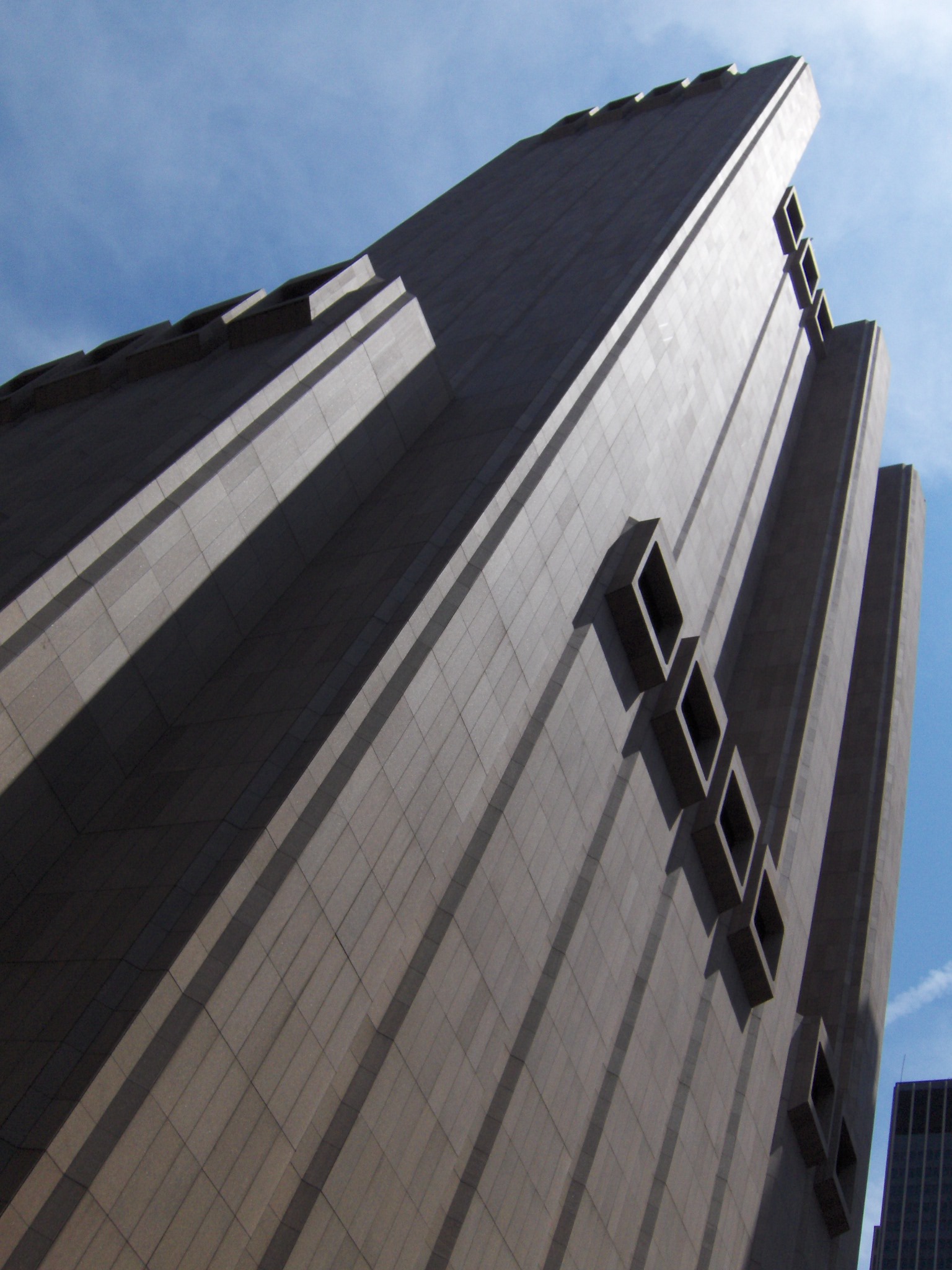
I had never been to SF before last summer. This building was right across from the bus I took home every day. And every day I wondered: what was in that windowless building? Never was it not an imposing sight.
Even after I found out about this, it freaked me out; especially that it's right in the heart of downtown.
It's a bit a lot of things. I can't find when the building was built, but I'm guessing the 60s/70s, so pretty much the height of brutalist architecture. Basically, very hard geometric forms, heavy on repetition, lots of concrete. There's a lot of that type of stuff sitting around, especially on university campuses.
It appears to be have been actually designed for use as a telephone switching center, for which windows actually are mostly useless. Should take a look at http://en.wikipedia.org/wiki/33_Thomas_Street, another telephone exchange in NYC. It is literally a window-less skyscraper.
Same here! I moved to Lansing St. 2 years ago and so I always walked past the building. The fact it had no windows was pretty weird and concerning and so I often joked that it was probably a spy agency/wire tapping operation. I was pretty surprised when I read that it pretty much was built for that purpose.
You honestly couldn't have designed a building that could have stuck out and raised more suspicion than this one.
"I often joked that it was probably a spy agency/wire tapping operation. I was pretty surprised when I read that it pretty much was built for that purpose."
The building wasn't built to be a spy agency or a wire-tapping operation. It's an AT&T switching center. Among other things, it's the terminus of a number of important trans-Pacific fiber cables, and it's been around for longer than the NSA has been rumored to have a room inside of it.
No, sorry, but there's absolutely nothing "weird" about a windowless telephone exchange building. At one time, every single neighborhood in this country had one.
This building was not created for this, it's just an old Bell building that had some empty space which could be repurposed.
The talk page for the PRISM article[1] is also very interesting.
> Why is it all caps? Some other reason? It should be noted in the article somewhere...
And:
> Everyone is losing their minds over this thing, but as far as I can tell, data is only provided with a "legally binding order or subpoena". This isn't the NSA reading through every inbox in the world. Or am I wrong?
Once more:
> The denials by the participating companies are not surprising and may, in fact, be a requirement under the National Security Letters, which the NSA and FBI use to give quasi-legal cover to their signals collection.
> A related program, a big data or data mining system based on cloud computing and Free and Open Source Software (FOSS) technology known as "Boundless Informant", was disclosed in top secret documents leaked to the Guardian and reported on June 8, 2013.
(my emphasis)
So, after we've had licenses claim (in one way or another) "do not use this software to wage war", will we see a rise in "do not use this software for secret intelligence gathering or processing" licenses?
Still, both are rather pointless when the entity you're trying to subject to the terms of your license has a standing army and heaps of nukes. Seriously. This is why we can't have nice things.
"There’s a line I’ve seen trotted a few times now that goes, “Ah, we knew all this was happening, you idiots!” We didn’t know. If you knew about PRISM you should have scooped The Guardian and made a name for yourself. The fact is, this story is mammoth and is bringing an incredible amount of attention to a program that’s been operating in total secrecy for a decade. But, yes, you’re smart and get a pat on the head for not being a “sheeple.” "
Care to enlighten us as to how? And by "us" I mean President Obama (who was pretty much forced to comment on it and certainly didn't say anything like you did), those in the administration going after the leaker(s) (for if this is uninteresting, the leakers aren't in the wrong at all), and those people who marked the slides as TOP SECRET. Oh and the German data protection and freedom of information commissioner [1]
What of the others programs in the slides? Two even had to be redacted out because of the potential of the fallout against NY-based Guardian US
The discovery of Room 641A is more profound than PRISM. Every web request, text message, phone call... it goes through these hubs where the data is copied and saved. PRISM is just about getting access to data sent over secured HTTPS connections, from what I can tell. It's not (currently) economical for them to use computing power to break (all of) those codes, and it's easier to apply pressure to tech companies to just hand them the keys.
Yes, that must be exactly what they're doing. Siphon all the unencrypted data at the ISP level, and gain access to the rest of the data that is encrypted from the biggest companies - and then expand the "program" to more companies in the future.
And to think that they rejected the idea of UN doing the same thing (the ITU debacle last year). It was only so they are the only ones doing it, all along.
"...The room measures about 24 by 48 feet (7.3 by 15 m) and contains several racks of equipment, including a Narus STA 6400, a device designed to intercept and analyze Internet communications at very high speeds.
Author James Bamford raises the suspicion question of an Israeli backdoor to the Israeli Narus in The Shadow Factory 2008.
From that link, the guy who leaked it was a "computer technician" for twenty years. Is that real, or was there a effort to discredit him or something. Twenty years is a long time in the same role.
Yes it's real. It's amazing to me how quickly this room, ECHELON, Carnivore and all the rest have been forgotten. There seemed to be a small but vocal technical uproar over this rooms existence when it was discovered but the public at large ignored it. Then Congress retroactively made it legal so there was nothing we could even do about it at that point.
I think it is basically a form of semantic satiation. Mention something controversial enough times and eventually the public stops understanding that it was real. I wager that if you took a poll of Americans, most would believe that ECHELON is a fictional plot device in spy movies that "conspiracy theorists" think is real because they are dumb.
Different building. Twitter was at 795 Folsom (at 4th) which was also an AT&T building. This building is at 2nd and has very few windows and does not appear to be occupied by any office tenants (I walk by it every day).
It's surreal to watch all of this old stuff get drudged up here and elsewhere.
I almost wish I watched mainstream news to see how much of this depth is covered or if it's just PRISM and not anything about how bullshit FISA warrants are or how crazy insane National Security Letters are (and how many hundreds of thousands of them are issued)... OR that they regularly wiretap the internet.
Between:
- this (which we've known about)
- the new leaked slide that indicates they do massively, widely wiretap fiber
- PRISM (which I suspect were simply the dates that the companies brought up infrastructure to be able to quickly and easily comply with FISA warrants. Which means "direct access" is true, but it also means that "we were forced to make it easy to give the government what they want as soon as they need it")
They basically have real time access to HTTP data (and HTTPS if a CA is compromised or controlled by them [is it really even that crazy of a theory at this stage]). They also can get organized, categorized access to my data with a FISA warrant (please, read up, they are as rubber-stamp as they're referenced in these articles).



What an overreach of power on the part of Congress. Something goes to court to discuss its legality, and then Congress retroactively declares it to be legal? Yikes.