If that's the case, it was interesting to me that the waves appeared to manifest a bit like a standing wave, with regularly repeating, equally distanced, higher and lower probability/amplitude propagating away from the atomic groups.
If that's correct, and electron probability wave functions mimic a standing wave, do different atoms have different standing wave frequencies? Does the resonance between different elements create any physical properties or predict anything...like what elements are likely to form a compound or the physical property of a compound?
Yes, great insight! One of the reasons quantum mechanics is "quantized" (which means limited to certain discrete values instead of being continuous) is that standing waves are reinforced as particles move around. For example, the rotational frequency/energy of an electron is limited to integer multiples of the circumference of the orbit. The "particle-in-a-box" model is the name of this quantum model. https://en.wikipedia.org/wiki/Particle_in_a_box
"The device works by passing an electrically charged, phenomenally sharp metal needle across the surface of a sample. As the tip nears features on the surface, the charge can "jump the gap" in a quantum physics effect called tunnelling." So the image is a map of the probability that an electron will jump from the scanner to the surface! Check out the "quantum corral" at the bottom of this page http://education.mrsec.wisc.edu/Edetc/background/STM/


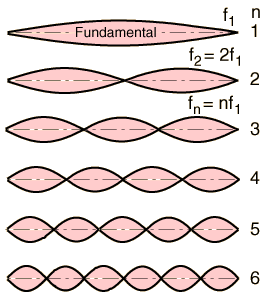
If that's the case, it was interesting to me that the waves appeared to manifest a bit like a standing wave, with regularly repeating, equally distanced, higher and lower probability/amplitude propagating away from the atomic groups.
If that's correct, and electron probability wave functions mimic a standing wave, do different atoms have different standing wave frequencies? Does the resonance between different elements create any physical properties or predict anything...like what elements are likely to form a compound or the physical property of a compound?