> It's just not feasible or economical to have 4+ broadband networks being built in an area
Actually, it is. When telephone systems were invented, lots of telephone companies sprang up and ran wires everywhere. The barrier to this happening with broadband is regulation. Regulators work hard to ensure there is no broadband competition.
> it seems like a ton of people see the problems created by capitalism and decide the solution is even more capitalism.
I find that rather funny, as most people see the solution to failed government programs is expanding those programs. Anyone who wants to cut back such failures cannot get elected.
There is not enough space to dedicate to electrical and internet wiring with a competition model like this. The physical space is a natural monopoly. What should be done is to treat the wiring as a utility but allow for unlimited competition on the actual service, which is how the UK operates their internet service iirc
Which proves my point. It was not cost that prevents multiple sets of wires being laid. It's regulation, and frankly rather poor management by the government.
For example, a road nearby was widened for bike lanes. While they were at it, a trench was dug before the repaving to enlarge the water/sewer pipes. I emailed the people in charge that they should consider burying the power lines, too. The power lines ran on telephone poles along the road, and the poles were festooned with wires. The power lines regularly get dismantled by trees and wind storms. Laying wire in an existing trench is cheap as dirt. Digging a trench and laying wire and repaving costs about a million dollars a mile (I was told this a few years ago by a power employee).
The reply I received was they'd already made the plans and couldn't be bothered.
>Which proves my point. It was not cost that prevents multiple sets of wires being laid. It's regulation, and frankly rather poor management by the government.
Do you look at the picture I linked, and think this is a preferable end state over some extra regulatory cost? That you would rather have those sets of cables all over the place and think the government is preventing this better state?
If you do, that's an opinion you can have, but I also think we have fundamentally different views of the world.
> Do you look at the picture I linked, and think this is a preferable end state over some extra regulatory cost?
Alternatively, we can dispense with the false dichotomy (along with the presumption that the technical constraints of 19th-century telegraph lines are applicable to modern telecom) and identify ways to incentivize competitive markets without dealing with externaliies by imposing regulatory barriers that ultimately generate oligopolies.
OTOH, the modern version of your picture would probably consist of dozens of fiber lines all running through the same network of underground conduit, so the most direct answer to your question is "yes, absolutely".
> Do you look at the picture I linked, and think this is a preferable end state over some extra regulatory cost? That you would rather have those sets of cables all over the place and think the government is preventing this better state?
Yes, I saw the picture. It means it is not prohibitively expensive to run multiple wires.
Yes, it is unsightly. But there are many, many ways to run multiple signals today. Technology has advanced a great deal. For example, one trench or pipe can provide space for a large number of wires. The community can provide a pipe for such purposes, like they provide pipes for other purposes. Or the providers can agree to share a wire. Or use microwaves. Or the cell towers. Or Starlink. And on and on.
> For example, one trench or pipe can provide space for a large number of wires. The community can provide a pipe for such purposes, like they provide pipes for other purposes.
Congrats on describing municipal broadband while arguing against government involvement.
Nothing in the preceding comment remotely resembles any proposal for municipal broadband. Even if a municipal government were doing the work he assigns to "the community", that work consists of maintaining a system of conduit within which other parties can run their own fiber lines connected to their own networks, and wouldn't at all imply that the municipality would own or operate any of the physical network infrastructure, nor operate ISP services.
And there's no necessity that role of "the community" be handed off to a municipal government, either. People can and do solve complex coordination problems without relying on political authority all the time -- "the community" could easily be a non-profit organization, a mutual owned by local residents, or just a series of reciprocal agreements to maintain the baseline infrastructure needed for other parties to run cables, without any municipal government being involved.
The idea that any non-trivial coordination problem can only be solved by centralized political authority is one of the principal drivers of corruption and stagnation in modern society, and is itself one of the main causes of competitive markets degenerating into monopolies or oligopolies.
There are enormous economic forces that push for standardization. For example, your keyboard is likely connected via USB. USB isn't a government standard. Neither is Standard C. And endless other things that the market standardized. Even 2*4 lumber is standardized. Gasoline is standardized. And so on.
Ever since the iPhone, USB stopped being an actual standard to connect accessories to computers, until it became a (EU) government standard.
It is actually a great example to the opposite. The history of USB as a connector is of a direct consequence of the IBM PC, itself a standard. The only reason USB became a widespread standard is that there was a widespread standard computer and, as we see today with many other forms of computers, that is largely an accident : smartphones do not have a widespread standard, neither do gaming consoles, etc...
I never claimed as much. The IBM PC was a short-lived accidental scandal that IBM didn't fully intend, but couldn't stop when they failed to sue clean-room BIOSes out of existence. Only because of this was USB possible, and even then only for 10 years before it stopped being really universal, until the EU stepped in.
And yet somehow those incompatible telephone systems, rail systems, power systems, and everything else all came into existence.
USB is widely highlighted as an unusual success. But Apple has notably created their own incompatible connectors, and made money that way, which is why Europe is busy forcing a charging standard.
Gasoline is very obviously government regulated. 2 by 4s are only sort of standardized.
> Gasoline is very obviously government regulated.
The chemical makeup of it? The government banned tetra ethyl lead in it, and mandated some ethanol in it, but the rest is various mixes made by the gas companies.
> 2 by 4s are only sort of standardized.
I've bought 2 by 4s for most of my life. They're a standard size.
> The chemical makeup of it? The government banned tetra ethyl lead in it, and mandated some ethanol in it, but the rest is various mixes made by the gas companies.
There's a mil-spec gasoline that has to contain exact proportions of specific alkanes and ethanol to very tight tolerances, that could be taken as the golden standard gasoline.
Let's say it costs $1000 to bring fiber to each household in a given network build. The take up rate might be 35%. That is 35% of connected households become customers. Well that customer has to recoupe $3000 to pay for that build.
Now imagine there are 2 last mile networks. The take up rate hasn't changed. If they cost the same then each customer has to recoup $6000.
Network overbuilds make absolutely no sense.
Government programs don't fail per se. They're designed to fail by underfunding them or adding layers of administration (eg state block grants to replace direct Federal funding) and then that failure is used to justify more cuts. It's called starving the beast [1].
> Regulators work hard to ensure there is no broadband competition.
Regulators can be the tool to stifle competition. The driver though is inherent in business needs. Competition is the biggest cost to any business, so there will always be a drive to reduce the competition to as close to zero as possible. It's inherent in how businesses operate.


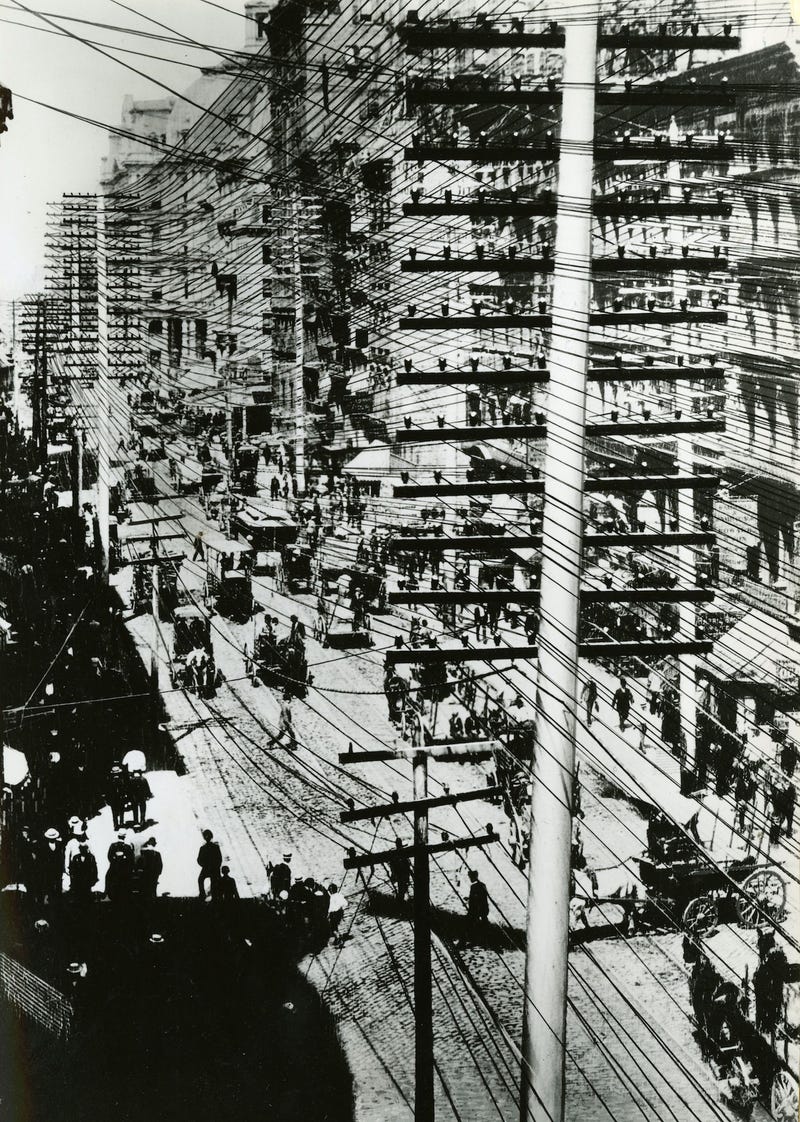
Actually, it is. When telephone systems were invented, lots of telephone companies sprang up and ran wires everywhere. The barrier to this happening with broadband is regulation. Regulators work hard to ensure there is no broadband competition.
> it seems like a ton of people see the problems created by capitalism and decide the solution is even more capitalism.
I find that rather funny, as most people see the solution to failed government programs is expanding those programs. Anyone who wants to cut back such failures cannot get elected.