The third point explains the first two. Something has to be done with the billions of dollars fleeing real estate and the general stock market. You get billion dollar valuations when people are saying "I have a billion dollars and I really need a place to invest it"
The startup community needs to get over the idea that "valuations" are based in reality. Rich people need ways to get richer. They could choose tech startups, they could choose real estate, they could choose tulips... it doesn't matter as long as they can make up money and push it back and forth between one another.
But alas, it feels much better to say "My company was valued at a billion dollars!" than it does to say "Rich people used my company as tool to transfer money to each other!" If we would just stop taking the numbers seriously then we could stop the debate about whether or not we're in a bubble.
Yes, but the rich only get rich on a bubble if they know it is a bubble and get out soon enough. So we are to assume that the rich are getting the tech train moving, letting the Hoi polloi add some rule coal to the fire, then hopping off before the thing crashes off a cliff?
That is possible, but every part of my forced analogy is necessary for the idea to hold water.
Grammar trivia: "children" contains redundancy, a doubled plural. The germanic plural of "child" is "childer", and that didn't sound plural enough, so they added the -en that pluralized such fine words as ox -> oxen, and child-er-en then sounded correct.
I think the term you're looking for is Ponzi scheme. Much like Bernie Made-off... err Madoff operated. Or perhaps more recently: Groupon. A classic pump and dump, take a look at the charts.
Your 'train analogy' is merely painting a glib picture of what is clearly insider trading by the likes of Goldman Sachs in a different, albeit obvious, guise.
Perhaps in detail, but they both constitute classic Ponzi schemes. Convoluted valuation(s)/promise of returns only to find yourself trapped with a worthless 'investment' when the core of the operating capital has been pilfered by its biggest players.
Goldman Sachs is the underwriter (and reason enough to scoff its initial valuation and then spike in price) of the IPO in question, hence the pump and dump; JP Morgan was taking a billion in fees for services rendered while Madoff laundered his money there.
I love how people jump on the anti-GS train because it's the hip, popular thing to do. No doubt, GS has done things wrong. But:
  1) They were not the SOLE underwriter of GroupOn, nor were they the largest (that was Morgan Stanley).
  2) They were co-leads with Morgan and Credit Suisse.
  3) They made $8mm in fees on the deal.
To put it into perspective, GS's Q1 2012 revenue was $9.95bn. Let's compare for perspective:
  9,950,000,000
  8,000,000
Obviously GS also profited from the fact that they could buy GroupOn on the cheap, at pre-IPO prices, but even then I hardly think it would have made a dent in their bottom line.
So if you're going to criticize, add Morgan and Credit Suisse to your list. And JPMC wasn't even a lead underwriter on GroupOn. And even then, if you're going to implicate people, you might as well add the other 11 underwriters.
And in fact, you might as well add GroupOn's early investors who standed to make a KILLING on the inflated IPO price.
It's dollars all the way down, sir - and it doesn't start or stop just at Goldman Sachs.
This bubble will hurt the smaller startups by no-name people, people that invested everything in an idea that in a non-bubble environment would be laughed out of the room, but with companies like YC around (not that this is their fault) that are harping on about the value of ideas and people it's growing.
There are people here on HN daily that post links to their blog posts that have put all their savings into their startup that has no potential to ever be anything other than a furnace for their money, but people encourage them, they are the people who will be hurt.
How many incubated startups (through programs like yc) will ever go on to be anything other than shut down? With all this cultish behaviour around YC a lot of people are believing that making money doesn't matter any more. Just look at the startups people posted in the yc rejection day threads, some of them just make absolutely no sense.
There is so much money in the internet now that when everything goes wrong nobody outside of the startup scene will really notice because the businesses that matter, the businesses people rely on will be doing fine. There will always be room for businesses that make money, bubble or not, those businesses are the ones the "public" care about. How many "normal people" would care if Instagram disappeared tomorrow and would have their lives impacted a week later? How many would care if ebay went? I suspect the latter would be the worse for the general public, and the latter will never happen because ebay actually makes money.
I'm not sure I buy that. Obviously it's true that "outsider" startups will see their funding dry up faster than YC companies and other "insider" groups will. But I don't think that's the right metric. In fact access to "big money" funding is if anything anti-correlated with success among these companies. Almost all the big YC exits so far were from the early rounds, and those happened during an era of very limited VC cash.
>> There will always be room for businesses that make money, bubble or not
Absolutely. Cycles happen, and for now those of raising money can enjoy the peak. The problem is that with all the fanfare, people forget that companies need to make money.
I am not interested in any of the "we are in a bubble" posts as much as I am interested in "What the fuck will happen when this bubble bursts!"
I have been in tech in SV since 1997. I was here for the build, frenzy and pop of the last bubble.
In 2001 I had a BBQ at my place - 50 people came and we ate and drank by the pool. Of those 50 - all tech workers - 4 had jobs.
I was out of work for 18 months (6 of which I traveled the world) - and luckily I have more than just tech skills which I was able to fall back on.
On HN we are really focused on technical ability - but there are millions of employees in all our tech companies that are not technical: think of any department outside of IT and Development == Sales, Facilities, HR, Marketing, Finance (although this is the class of people most responsible for this problem), etc...
ALL of these people are at the greatest risk - what will happen if this bubble bursts. We will be FUCKED.
People didn't die in the last collapse, my goodness. Many of them went back to banking (B2B) or back to Cleveland (B2C).
Nobody was F*'d, although there was a lot of self-centered melodrama.
The same thing will happen again and again. Areas of the economy will get overheated, and subsequently get overcooled. Fortunes will be made, fortunes will be lost.
It depends on how much leverage gets into the system before the burst. Witness the difference between the tech and housing bubble bursts: People were buying tech stocks with the 1:1 margin requirements (because dude! tech stocks only go up!) vs housing which were leveraged by the home buyers at 5:1 - 10:1 (because dude! home prices only go up!) and by the hedge funds at 30:1 (because dude! national home prices never go down!)
I haven't heard a lot of people buying GRPN/ZNGA/LNKD on margin yet. FB might well change the tone though.
I don't expect the same level of carnage. THE bubble, the late 1990s, was so enormous that I have trouble explaining it to my younger peers who did not live through it as an adult. They just can't grasp what was going on because it was so damn crazy.
Of more concern to me is the bursting of valuation bubble for the United States. Currently, people are undervaluing the risk of lending money to it. What happens when they realize its future revenues won't cover all of its commitments?
US Gross debt is currently around 16.4 trillion, its GDP in a given year is around 14.6 trillion, and its operating budget is around 2.5 trillion with a 1 trillion deficit. It seems within its capabilities to repay its debts, though it has opened up the throttle a good amount in the past couple years, and there seems to be no political will to raise taxes right now.
For reference, the US spent $2.73 trillion in 2007 and $2.9 trillion in 2008. It plans on spending $3.8 trillion in 2012 and about the same in 2013. When you say "opened up the throttle a good amount" that amount is in the vicinity of ~35%.
(These numbers are not adjusted for inflation. Sorry.)
"The political expression of altruism is collectivism or statism, which holds that man’s life and work belong to the state—to society, to the group, the gang, the race, the nation—and that the state may dispose of him in any way it pleases for the sake of whatever it deems to be its own tribal, collective good."
I don't see how that applies here? That communism doesn't work well or is inherently unfair doesn't generalize into the idea that the less communistic a society is, the better. In general, I think Rand is overly reductionistic and shouldn't constitute a significant portion of anyone's worldview.
If the US had European tax rates, it could support its current commitments and more. The risk is political: that the US will default on debts which it has the ability to pay.
In fact it doesn't even have to go to European tax rates to pay off its debt. All levels of government in the U.S. currently take in a combined 27% of GDP in taxes. In Germany, it's 41% (not to mention Denmark at 49%), which leaves quite a lot of fiscal headroom for the U.S. to raise additional revenue while still remaining a relatively low-tax country.
And by commitments, I don't just mean its budget and its 16 trillion in debt.
I include all the debt we took over from the banks and the bottomless pit of AIG.
I include all the private pension funds that are insured by the government.
The President of the Dallas Federal Reserve, Richard W. Fisher, painted a rather bleak picture of what our liabilities actually are when he spoke to the Commonwealth Club.
Fisher said back in 2008, before the collapse of AIG, that our liabilities exceed $99 trillion. His speech is here:
I don't think it'll be as bad. There is much more adoption of technology in every business today than back then. I know plenty of profitable small businesses looking for developers and having no luck. I can't imagine all these jobs in unrelated industries not being there just because the SoLoMo bubble pops.
> ALL of these people are at the greatest risk - what will happen if this bubble bursts. We will be FUCKED
I have the same thoughts exactly. I was a junior at university when the last bubble burst so i have no idea what it was like. Currently i have been running my startup after quitting my job for almost a year and we are doing OK but this talk of bubble worries me because i dont know what to expect.
Will it only effect startups that are social types that dont exactly generate revenue but through capital injection( which i assume is what will evaporate the fastest during a pop) have the potential to become massive such as instagram etc or will it also effect the startups that actually do turn up a profit every month so that the founders can eat and re-invest their money back in the business.
When i try to draw parallels from 2000 from a technology stand point, i assume the bubble pop killed the tech industry because getting a startup of the ground required tons of cash, it didnt matter whether you could charge from day one or it was a great idea but needed to get to scale before you could make money, you still needed to buy servers, hosting and your development team was larger because there were no frameworks etc .. basically there was alot to spend before you could turn a profit, so when capital dried up so did the ability to start a new company or even continue to run an existing one. As a founder, unless you were already wealthy you could not bootstrap
Now with amazon, great frameworks that cut down development time many times over and other things of the like, founders can take savings of 10-15k and start a business that can return that investment maybe after 4-5 months and start making profit soon after.
The question is, do these kinds of startups still survive, could this be the differentiating factor this time if the bubble pops.
Maybe after the bubble pops we wont get those massive social startups that require millions of dollars worth of injection for a while but instead get many smaller bootstrapped business types that take a small investment and return a profit monthly that eventually grow into large business. Its slower but similar to more traditional businesses. If this is the case then i feel its OK, at least if we find an area there people still have a need and technology solves that need we can still make a living doing our own startup and work on things we love.
Im also interested because we are bootstrapped and we have managed to get our small startup to give us back about 60% of our salary that we used to get at our 9-5. its enough to live of and not make us wonder where we are going to get our next dinner, however we are thinking of starting something new because we feel there is a ceiling to what we can achieve with our current startup and its important for us to decide what startup to do next if we actually are heading into a bubble that may pop midway through our next project, 1,2 maybe 3 years down the line
What do you guys think the tech scene will look like in the valley and possibly around the world if such an event would occur again ?
Sorry for the long post but i thought it important to get ideas from the HN community on this topic.
I've lived through the previous tech bubble, but was only an employee. It didn't really require a lot of cash back then to start up, depending on what you are doing. A shared server at an ISP or university and some perl scripts could get you going. Racks of modems in your garage to start a small ISP. What really drove the bubble was that larger companies would buy these small operations, often including shares in the bigger company, and package them together into a group which then in turns gets sold to even bigger companies like Cisco etc. Things also got crazy because a company's turnover could mostly be based on paying Cisco, Microsoft and Compaq money for equipment and software. I know some people who didn't sell, they remained small in comparison but are still in business today and doing very well.
My advice is that if you sell, make sure you get some cash for it to park somewhere to use during the bad times when raising cash will become impossible and skills will be cheap when you actually do have cash. Parking might mean an asset you can borrow against when it's hard to get funding based on a promise. Don't sell with any deal like shares in the parent, making an assumption that tries to time the market. Most experts can't even time the market right. Apart from that, keep making stuff people outside of the technology industry use and give them value that is worth paying money for, and try not to make it depend on things you get during a bubble: easy funding and clients with easy funding. Trust me those things are hard to determine, you only realise how much of your client base also depended on the bubble after it's over. Most importantly the effects of bursting bubbles take several years to unravel, so don't think that if you're still fine a year after it's obviously burst that you are in the clear.
That said, I think you are already at an advantage. During a bubble salaries are very good and it takes some guts not to get lured in by an easy salary and doing a startup instead. When the music stops and you are still turning some profit you will be glad.
I am doing a Startup for around 5 years - doing reasonably well, not very well (drawing less than market salary).
Thankfully, was unfazed by the last slow down in 2008. In 2000/2001 I was doing a job. But that burst was very loud, and the first one for the Internet. Can only hope there are not many like those.
Based on your story, I think, you also should not be too much affected by any bubble bursts. As you work in a mode of drawing 60% of your salary, and it looks like its from revenue and not VC funding. So that kind of modes, clearly suggest you are not inside the bubble.
So when a bubble burst, it will happen to directly affect the ones who are VC funded. If you run based on revenues, then it will hurt you only indirectly.
PG wrote in one essay, that be like a cockroach(which survives), and not like a beautiful flower(which gets crushed). So in this context of a bubble burst, can say that revenue based is being like a cockroach. :-)
And then ask yourself if what happened then is anyway similiar to what is happening now.
For starters, I think you will realise that most startups circa 2000/1 were nothing more than litteral "thin air" -- compare that to the likes of Facebook who actually have revenues, hell, they even have a product.
I know that some of the valuation numbers being thrown about can be unreal, but I'd rather have a converation about whether FB is worth $1b or $10bn or $100b, instead of whether is has any value at all.
But did Instagram have revenue? The question wasn't if investors back then had money, but if the company they invested in were making any money. Facebook had money, Instagram wasn't making any. So to me that's very similar.
Also he's right that now that Instagram was valued at $1 billion, we're already starting to see others like Square immediately looking to raise capital at huge valuations, just because Instagram was valued so high.
Besides, doesn't it even that even Facebook and others are valued based on how much more others will invest in it later on? That's pretty much how Facebook's valuation grew, and how they got the $100 billion IPO, too.
But isn't that a flawed philosophy? Shouldn't companies be valued based on how much potential for making money they have in the future, and not how much potential they have to attract more capital at a higher valuation?
This is a tired argument. Everything is a tradeoff. In this case it's a tradeoff between adoption and revenue. Hipstamatic chose the revenue-first approach (they apparently made plenty of money) and Instagram chose the adoption-first approach. Which one is more valuable (and you must include strategic value in this evaluation!) right now? Clearly Instagram.
> Also he's right that now that Instagram was valued at $1 billion, we're already starting to see others like Square immediately looking to raise capital at huge valuations, just because Instagram was valued so high.
I'm very, very skeptical that this is the case. Has anyone involved in the situation made any statement hinting at that?
> Shouldn't companies be valued based on how much potential for making money they have in the future
> Hipstamatic chose the revenue-first approach (they apparently made plenty of money) and Instagram chose the adoption-first approach. Which one is more valuable (and you must include strategic value in this evaluation!) right now? Clearly Instagram.
Not necessarily. You're assuming that had Hipstamatic chosen the adoption-first approach they would have been a more valuable business. That assumes that both products are basically identical and the successes and failures turn only on whether the app is paid. Conversely, you're assuming that the only reason Instagram got such widespread adoption is because it was a free app.
> Yep! That's what people are doing.
Um, no they aren't. Most companies in the social space are valued based on how much hype they can generate, not how much money. A lot of people assume that an app like Path must be worth at least a billion. Is that based on money-making potential? I'm not buying it.
Instagram is an outlier. If you have ever looked at raw Internet traffic you will know that Facebook is largely a photo site. So it was a choice for Facebook between a potential competitor and making a jump ahead.
When these deals become commonplace, we'll be back to the bubble in full force. The rumor about Cloudflare worries me more.
The tech companies in question (e.g. social media) are not worthless, but they're almost certainly overvalued. Eventually, the market is going to realize this and then they'll be undervalued for a while as a reaction.
It's probably going to go back and forth in cycles between overvalued and undervalued for a long time because no one really knows what the market value of an intangible digital asset is. Can anyone explain how much money the data in the Facebook databases are worth?
> For starters, I think you will realise that most startups circa 2000/1 were nothing more than litteral "thin air" -- compare that to the likes of Facebook who actually have revenues, hell, they even have a product.
In 2000/2001 Yahoo! was one of the biggest websites on the planet. Its revenue doubled in 1999. Between 2000 and 2001 Yahoo stocks went from a high of $118.75 to $4.05 (though they obviously recovered to an extent and are still a cash cow today). Perhaps that could be a good comparison for FB?
They also spent big on acquisitions in the late 90s just before the bubble burst.
Just because it isn't the same size or type of tech bubble, doesn't mean it's not any sort of bubble. I'm not saying it is a bubble (I haven't done enough research to form an opinion) but you can't look at previous bubbles and declare we currently aren't in one because the circumstances aren't identical.
For a further personal exercise I would recommend reading the first half of "Extraordinary Popular Delusions and the Madness of Crowds" which gives some insight into early economic bubbles. I think the fact that things have changed so much since it was written allows you to easily see the things that don't change, namely the snowball effect of hype (madness of crowds).
Edit: The Tulip Bubble that meric mentioned is in the book. Really insightful stuff.
Sure, but Facebook is like AOL or Yahoo in the 2001 analogy it seems to me. Real companies at the top which are overpriced which leads to hyped prices for lots of other companies like Pinterest ($7.7 Billion price tag as per Forbes), Instagram etc. Is it 2001? No, because there's that lesson to look at and learn from, but it's a bubble 'we're' in.
Each incremental company, to some extent, dilutes the values of others.
Ask yourself: Are you part of a herd? Is your company doing what the next one is doing, just slicker and faster and with a twist? If the answer is yes, and you're trying to do a startup, then you are part of the bubble that will pop. (In a bad way. Worse still, you may be part of a "reputation bubble" as in the music or fashion industry.)
Also ask yourself: Is there an information asymmetry on your side? Do you know something that most everybody else doesn't? Is there something that scares everyone else away, or that everyone else hasn't seen yet? If not, then you might be in the part that pops.
For those standing off to the side: Are there an awful lot of startups doing similar looking things?
For those standing off to the side: Are there an awful lot of startups doing similar looking things?
Yes.
EDIT: It is getting increasingly difficult to see actual technology companies through the haze of consumer internet startups, many of which are indistinguishable "the <some startup that got bought> of <some market>" roadkill.
EDIT 2: Not that technology companies are the only ones that can be profitable; but many of the small startups are positioning themselves as technology companies, because they don't have any other conceivable identity.
Social is a bubble. Sharing information is going to continue to get easier, and i agree that distinguishing the various services is increasingly difficult. But i do not buy the x of some market argument. The ebay of space has built a new type of marketplace.
"Startup" is a way to say an organization that does not follow the rules of the industrial revolution. Social technologies are a bubble, but there is a distinction between social technologies and technology in general, and startups aren't exclusively business models of the former.
We are seeing growth in online advertising which is driving the perception of a bubble regardless of whether one exists or not.
The "We are in a bubble" argument should be - Ad revenue is capped at a total # of dollars. We have seen various internet businesses take share from magazines, cable broadcasters, billboards which has led to unsustainable growth which will end soon. When it ends people will realize projecting 30%+ growth for website ad revenue is dumb and will lead to massive losses.
The "we are not in a bubble" argument should be: Internet advertising is taking share from other sources and will continue to do so for a long time. Because online advertising allows you to buy products right away or customize ads to individuals, its more efficient. That efficiency makes advertising spending more likely to increase as a percentage of costs for businesses. A combination of those will help fuel continued growth in startups.
Regardless of which you believe or a hybrid version, at some point internet advertising will reach its max and there will be a bubble followed by a crash. I have no idea whether that is happening now or will happen sometime soon or in 20 years.
[edit] it is also possible that it will never happen
I'm taking a non committal stance while explaining a framework to view bubble/no bubble. I would love to hear why people think this is such a terrible framework to down-vote it. I'm sure I could learn something.
I'm getting tired of hearing people claim we're in a bubble, especially when people cite the Instagram deal. Instagram didn't have any revenues? So what. The value of a company is whatever someone is willing to pay for it.
Facebook's killer feature is their photo sharing. Given Instagram's surging popularity and mobile dominance, Zuckerburg saw Instagram as a threat, especially if Instagram fell into the hands of a competitor, like Twitter. So Zuck pulled out FB's wallet and scooped up Instagram.
I've been hearing people say we're in a bubble for at least 2-3 years now, yet venture firms are raising new funds every week. Acquisitions are happening every day, IPO's are ramping up again. Unlike the companies of the DotCom bubble, companies going public today have real business models, with real revenues, and most of them are already profitable. In 2000 there were companies going public that were still trying to figure out what their business model actually was. I guarantee you'd never see that today.
Sure, it may seem like it's easier to raise seed funding nowadays, but that's thanks to all the incubators that have popped up and the funding model pioneered by YC. That doesn't mean we're in a bubble. Angel Investors simply found a way to make seed funding scale in a way that reduces risk.
We're not in a bubble, and no, I have nothing to gain from saying that.
Right, some of the business going public at that time seemed like they where written on a napkin two nights before. They where not even at the pivot stage. It was absolutely insane at the time and everyone knew it. I remember working at some companies on contract and thinking there is no way this is going to last. It seemed like the only people that where making money last go around where the ones providing infrastructure and services, everyone else was just drinking it up at the party. Make no mistake I think we are bubbling but I thing today looks a lot more like 1996 than 2000. It can and will get a lot crazier especially with the crowd-funding bill.
I the 1996 analogy makes sense, but that does not mean there's 5 years left until the big crash; the nature of investment and trading horizons is such that it gets shorter all the time -- so what took 5 years 10 years ago, might take less than 2 years now. (At the extreme - stock price reaction to news that took hours in 2000 takes seconds now. Most things haven't speeded as much, but everything speeds up; the tulip bubble took much longer to inflate and pop than the internet/telecomm bubble of the late 90's).
And, just as in 2000/2001, when the bubble pops, it would look like the specific reason was independent (some other economic disaster, like a big bank going bankrupt, or fraud bigger than the MF case, that would disrupt the easy flow of money and would require some liquidation). But the specific event that causes a bubble to pop is actually immaterial.
Instagram isn't a great example: it was already useful and successful and might well have been worth more if it had held on. GroupOn is a much better indication that a bunch of non-technical people are eager to buy overvalued tech stocks.
Of course we are in a bubble. Not in the real estate bubble sense, mind you, but in the 1999 tech bubble sense. Tech and health care are the two industries actually growing.
Right now no one knows which companies are really creating value and which are just hype. The last bubble created more value than money was invested, but the investors don't discriminate well between valuable companies and those that are just taking them for a ride. That doesn't mean that all the companies are overvalued, just that some of them are.
Plenty of companies emerged successfully from the last bubble. Plenty of companies will come out of this one by creating actual value. Just don't be an idiot and invest your money, don't believe companies that tell you they'll get you rich, don't take jobs that seem to be too good to be true, and who cares what investors are doing?
(Zoom out to "all".) It closed today at 11.76. The official IPO price was 20, it peaked at just over 26. That's not exactly a stirring argument in favor of a generalized tech bubble.
Since 2008, most traditional investment vehicles like real estate and the stock and bond market have had poor returns. Capital has been shifting from these traditional vehicles to Asia and Venture Capital in search of extraordinary returns.
So, what you have to remember is that there are actually several different kinds of economic catastrophes, and that a bubble is only one of them. You also have hyperinflation, for one, and it's much more plausible that this is what is actually happening. And while this is largely irrelevant for America as a whole, it matters a lot at a local level: if you're in California, for instance, you're alright as you're upstream from a lot of folk. If you're in the Rust Belt, though, you might find it's suddenly even harder to compete with Asia. So while there is something rotten in the state of Denmark, the tech sector is not the one in trouble.
When Peter Thiel started his class at Stanford, he spent the first couple of lectures reviewing the 90's. One of his argument to explain the dot com bubble was the influx of capital from around the world to the U.S., and ultimately to the valley. Could be the same here. not sure.
The rise in the inequality of wealth has led to an excess of capital and a lack of demand for it to fill. It's not just the US: around the world there is more people who want to invest than there are people with money to spend on the things they might make.
So we get "job creation start-ups", aka bubble businesses. The only winning move is to break the rules of the game by simply redistributing wealth/income to people who don't have it to spend.
Well, that or to build a luxury rich people will pay for.
It's time to move on from HackerNews and focus on building companies/businesses rather than talking about things that are not productive in any way or shape.
Naysayers. Pessimists. Negative thinkers. "No man". Doomsayer. So long...
I've seen a lot of this back-and-forth on HN of late, but I can't help but wonder what difference it all makes.
Even if we are in a bubble, I doubt we have any real chance of turning things around gracefully. Everyone participating and benefiting from this bubble are inclined to support it, while those outside the bubble have no power to change the current trajectory.
The true losers in this scenario are the entry level players, and other support folk who become collateral damage when things finally come tumbling.
General rule of thumb. If your company has solid revenue or is close to profitability...you will be fine when the bubble bursts. If your company is not even close to profitable...you will need to polish that resume some more. The better option is not to let other people's opinions, abilities and spending habits control your life.
The term "Internet bubble" was very commonly used during the bubble. And the term "irrational exuberance" ganied fame in 1996, prior to the greatest craziness.
It was a lot more obvious than the real estate bubble. The real estate bubble was only visible to most people as a chart in the NY times that showed the gains in prices were historically unprecedented and clearly unsustainable. Most people didn't know that the ratings agencies were earnestly relying on models that pretended that real estate could never go down, and assumed that baskets of mortgages are uncorrelated risks. Both of those are obviously silly assumptions, but the population in general didn't know about it.
On the other hand, it was obvious to most people I knew that Internet valuations were unreasonable during the first bubble, but a majority of them werent willing to call a top at any particular point.
Purely from investor perspective, here's how I would do FB valuation:
Assume that FB doubles its profits in next 2 years. Then also let's say it gets in to 3 new businesses as big as its current business and dominates them just as well. That would put their profits to ~$8B.
Now again assume that FB maintains its dominance successfully on all of the above 1+3 businesses for next 10 years. So in this "dominating life span" of FB, there would be total $80B made. If you put probability of everything from inventing new businesses to fending off all competitors successfully for next 10 years at 0.5 then FB's risk adjusted worth would be $40B. It should be obvious that this valuation is way too on generous side (normally I would more aggressive parameters). It should be easy to see that valuations like $100B is extremely unrealistic.
As OP has pointed out bubble is an effect when people take one unrealistic valuation as a reference point and make their own valuations just as unrealistic causing system-wide chain reaction. With Instagram, Evernote and such that chain reaction is unfolding right in front of us.
From a business perspective (and believe it, it hurts me saying that), this discussion makes no sense. It's like saying: 'are we in a PMIs bubble'? Or, 'are we in a multinationals bubble?'. The point is that we tend to group things together in categories. But does it make sense to put, say, Facebook and, say, MakeLeaps (start up that manages invoices for small businesses) in the same category? It think it does not, as much as it does not make sense to put Apple and Mc Donald in the same pot. Would you say Apple and Mc Donald are in a multinationals bubble?
However, those discussions do show something, that there is an underlying need to understand the market and the businesses out there. More start ups focused on BtoB I think are needed. Corporate and business software sucks and costs a lot in terms of actual cost and lost efficiency, when are people going to realize that and work on that too?
>comparing yourself to another company’s valuation based on some metric like registered users
I really doubt anyone does valuation like this. What is more interesting is engagement and time using product. # of people is more a 'vanity metric' - it looks nice, but it doesn't mean much.
You should discontinue doubting that. Valuations are done using every available metric (users, revenue, etc) and some metrics that have to be "triangulated".
Valuation experts select the one they think is most relevant or mix several metrics to arrive at a value. Some acquirers view different metrics as important depending on what they need. Some companies need top line growth to keep their multiple so they buy less profitable companies with a better chance to grow revenue for example.
You can argue all day whether you think that is right/wrong, dumb/smart, but that is the way it is currently done and the smartest people in finance constantly work on new ways to value companies but most of those ways involve coming up with new metrics.
Most valuations are done like that. It is called the comparable method.
Essentially all valuations have 3 components:
.
1) Comparable Method
This is the method you are talking about and it is ALWAYS used. In some cases, with companies with revenue and net income analysts will value things like Dividend/Price, or Price/Earnings.
In cases where small changes in the business model can yield huge changes in Earnings for example, analysts may use other metrics to get a more 'accurate' measure of profitability. In cases of internet companies it may be users, or may be 'content share' or some other metric, and they compare it to public companies like google or facebook.
The downside of course is that no one knows for sure what the value of each 'user' is for the new company. But the upside is it gives the analyst another way to think about a tough problem.
2) Discount Method - First the analyst estimates future cash flow over a specified period using assumptions about how the company will perform. He then 'discounts it', divides the future cash flow by a discount rate, and arrives at a value.
The downside of this method is that the assumptions are very hard to come up with.
3) Net asset value method - taking the companies hard assets and valuing them. (I'm not sure if anyone is doing this, but I would guess that the cost of hiring awesome, top rate engineers is probably modeled and incorporated in the a NAV when making talent acquisitions.
Now, with instagram you might be saying, wait, they don't have a metric that gives them a $1B value. That is the entire reason they didn't IPO rather than sell. Because facebook thought that their were synergies in the deal, whether they be future earned cash flows, or a reduction in negative future cash flows.
Zuck may not have done a model, but he very well may have said to himself...
The buyside (stock buyers at mutual funds and hedge funds) all are asking me about competition, and how I'm going to grow this business over the next 3 quarters (what matters), and he says, for 1% of my valuation, I can probably get a 10% higher stock price at exit.
This is also why Yahoo sued Facebook a month ago as well. They figured the lawsuit would cause investors to balk at the IPO which would cause Zuck to settle it quickly for more than Yahoo could get otherwise.
In the long run, valuations are complex, and so is business. Most programmers/hackers etc. look at the Wall Street Journal and think that everyone is crazy and that there is a bubble. There may be a bubble, but everyone isn't crazy.
"Each incremental company, to some extent, dilutes the values of others."
I take issue with this point in the article as it assumes competition. While there is competition obviously, many start ups are actually complements for other companies. It is entirely possible that many of the start ups "competing" with each other actually thrive on the success of others and even increase the success of other companies through their existence.
As an example, think about a company like Heroku, and Amazon. Heroku makes using AWS easier, so Amazon rents more time and servers to Heroku while Heroku also makes money that otherwise wouldn't have been made. These relationships exist all throughout the business world and are good, not "bubble" influences.
I think the OP is missing the point here, because there is much more than just profits when we talk about valuation. There is sales obviously, but assets too like more materials things (chair, buildings, etc) but also immaterial assets (employee, IP, so on).
On top of that, the whole situation (the when/how/where thing) is also important, like someone said, a glass of water worth much more if Zuckerberg is in the desert, than instagram at that moment...
Valuating a company just with profits (or users) is in my opinion, too simplistic and so undermine a little bit the argument here.
There's a lot wrong with this, but I'll just say that there are many more than two ways to value a company, and if you used the first type he cites (taking the net present value of future profits) you are effectively ignoring any assets the company currently owns, including IP, cash, property, plant, and equipment, short-term investments, long-term investments, just to name a few.
All this "look at that. now look at this. We're in a bubble"... is this an Old Spice ad?
Edit: oops.. I forgot to add value to the conversation. Yes, we are in a bubble. Is it as big as before? probably not. Is it going to deflate (or even burst) eventually? yes. Is it going to be tragic? yes... a fool and his money are quickly separated.
You have a bunch of people either in the startup scene or very passionate about getting into it. These people don't want to hear about how their livelihood/passion may spontaneously combust one day. Then you have people who aren't involved and are (probably) jealous at least on some subconscious level, and people who legitimately believe the bubble exists. This makes for some heated (and usually nonconstructive) debates.
if a developer sells a game for .99 cents and it sells 1.3 million copies, is the company worth a million dollars? No one knows how this "bubble" will go down, there should be more focus on the evolution of Javascript


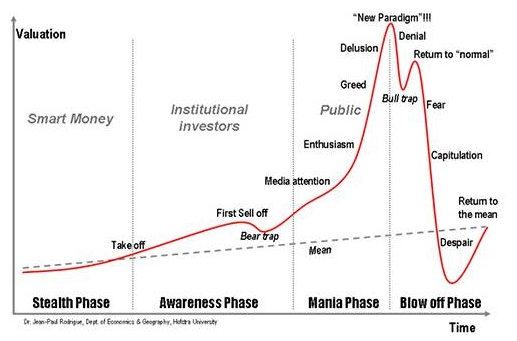
The startup community needs to get over the idea that "valuations" are based in reality. Rich people need ways to get richer. They could choose tech startups, they could choose real estate, they could choose tulips... it doesn't matter as long as they can make up money and push it back and forth between one another.
But alas, it feels much better to say "My company was valued at a billion dollars!" than it does to say "Rich people used my company as tool to transfer money to each other!" If we would just stop taking the numbers seriously then we could stop the debate about whether or not we're in a bubble.