To be frankly honest, the society humans have built over the years is pretty funny and hard to believe.
I've been on this planet for just over 30 years, and since I was a little boy I was told (manipulated?) that having things, better cars, better equipment, luxury, wealth, was the right thing to do.
This system produced and still produces many unhappy people, many poor and miserable people. On the other hand, it also left a lot of rich people in the middle of the road. but today, the press, big companies and the rich (multi-billionaires) accuse that, in fact, we are all to blame for our unbridled consumption (which they helped to build, by the way).
Even though I'm not stupid and I'm a big believer in science and the changes are real (after all, we're seeing this in our everyday lives) it's hard not to believe that there are SOME manipulation going on again.
We created an autonomous system of entities running on meat CPUs with a singular non human aligned goal of profit maximization at all costs and the system has exceeded the capability of human governance which is stalled at a country / block level.
It by now controls almost every single human’s everyday schedule - the entire race has been put in service of it and it extracts all resources and externalizes all the costs and by now benefits a tiny fraction of the planet primarily - but even that fraction appears to be powerless to stop it (Lol Big tech billionaires tearingly having to take responsibility and make hard cuts at times of record profits. It’s the system, even the majority Shareholder Zuck cannot escape it. )
Despite clear evidence that its continued trajectory amounts to suicide for the human race, we appear unable to stop it.
Everyone always wonders when the Ultron scenario will come to pass but I maintain that _the AI has already taken over_. This AI doesn't run on a computer- it runs on a machine made of laws, business interactions and human brains. This AI does not have personality, and it isn't that smart, but this algorithm is very much in charge over every human being on earth, every minute of our lives from birth to death. It seems to have no higher aspirations than grinding the bounty of our Planet into bitcoin. We made this machine that turns everything into capital and it won't stop until... what exactly? When some captain of industry has _finally_ achieved their goal of _owning it all_? Because if you follow the trend, that is where the line is headed- A ever-shrinking class of Skeksis ruling over a ruined planet, with just as many slaves, or as few, as they want.
It's time we all had discussions about evolving past this phase. I think it can be done.
I don't love everything Noval Harrari has to say, but I love his idea that money is a story we believe in, if we didn't, it would have no value, and it's a story we need rewrite if we want to survive.
Greed is not good, being a billionaire is unwise. Money is the root of much evil..or something like this.
This is it. If we just all gather around some pet HN public intellectual, chant something about a real thing in fact just being a narrative, then that real thing will disperse as the mind-goblins that were giving it life let go.
I too think it can be done, but good luck finding a platform that allows uncensored discussion of the full spectrum of the situation and countermeasures.
What is amusing and sad to me is that we have now created so many insanely big problems through greed, and unbridled technological progress in the name of profits that we actually now need AI (which will for sure have introduce it's own problems) to get us out of the shit situation we've created.
I hear this parroted all the time, "AI will save the world", well maybe, but what about thinking about what has fucked this world and tackling that instead?
I know AI progress is being made but I really think it's also a fantasy to think a talking computer is going to come to our rescue.
I 100% agree with you and have recently come to the conclusion that we already are the paperclip maximizers. We have turned the entire fucking ecosystem into money.
If "AI saves the world", we should consider handing over the keys. We've been weighed, measured, and found wanting. Let someone competent drive for a bit.
It's fair to, in some combination, underestimate the learning curve of AI and overestimate the competency of humans. Lots of systems in place today that behaviorally nudge humans through economic and other signal, for example. And they are just dumb lines of code. How smart is a traffic light? Exciting times ahead to understand what the concept of reasoning is.
Don't fully disagree, but feel a counterpoint needs to be said.
> created so many insanely big problems through greed, and unbridled technological progress in the name of profits
Capitalism is an allocation algorithm that scales.
We haven't just created insanely big problems, we've delivered insane boosts to productivity.
Capitalism's outputs in that name of progress (the things that greed and unbridled technological progress have enabled) are now necessary to deliver the current living standard we have for the number of people we're supporting on this planet.
- Fertilizer-boosted and genetically-modified factory agriculture
- Mass manufacturing with global supply chains
- Global energy markets with worldwide distribution
- International capital flows
If we're talking about toppling the current system, then we have to admit that means losing its positives as well as its negatives.
Reengineering isn't complete when only looking at the negatives we'd avoid and the positives we'd gain.
It needs to also include the positives we'd lose and the negatives we'd incur by shifting to an alternate system.
The alternatives to capitalism aren't just 'avoiding capitalism's problems' -- they've historically also been 'rampant inefficiency to the extent that it decreases standard of living.'
One reason I'm bullish on carbon taxes et. al. Adjust the incentives, and then let the best allocation model we've found run to optimization under the altered constraints.
>If we're talking about toppling the current system, then we have to admit that means losing its positives as well as its negatives.
Except you could have a free (as in freedom) market instead of a free (as in free of costs) market. The former doesn't even look that different to "capitalism" except die hard capitalists would accuse you of artificial redistribution or some other nonsense.
>The alternatives to capitalism aren't just 'avoiding capitalism's problems' -- they've historically also been 'rampant inefficiency to the extent that it decreases standard of living.'
Historically, the best alternative to capitalism has worked pretty well. In fact it worked so well, the capitalists shut it down because they were concerned that unlike the communists, someone actually came up with a competitive and superior system. In fact, the capitalist system at the time generated such a rampant inefficiency and unemployment that a man named Adolf Hitler has risen to power who had to channel that unused output in a war to maintain full employment, because capitalism is a demand starved system and therefore warmongering is a popular remedy.
Meanwhile some dinky little town in Austria "printed" 10000 shilling (about 3 shilling per resident) worth of "labor confirmation vouchers" and solved their problems without war.
The trick? The money forces participants to maintain an equilibrium economy that follows Says Law. Suddenly all the research neoclassical economists made about equilibrium economies becomes applicable. Meanwhile in Capitalism? Capitalism is a disequilibrium economy so why would you expect any of the outcomes that neoclassical economists predict? It's like expecting a car to fly.
I under most of what you’re saying there but if capitalism can’t provide the solution for the climate crisis it needs to go as it’s reached it’s usefulness. There is no point in maintaining a system which will destroy itself like cancer.
In my opinion, it’s had its chance but it’s too slow to deal with this. This is urgent.
I’d say this much. It got us to a decent place, now maybe we need to have something else replace it. Personally I think it actually is time to move into a post scarcity type world, eliminate poverty and favour open source style collaboration, sharing and communication in every possible. At least until we get the climate under control.
This is giving Africa and India the renewables they need, for example.
I agree with much of what you say. But how are we supposed to get there from here? It seems hard, if not impossible, to convince entrenched interests to give up the game. It seems even harder to get “the people” united enough to overthrow entrenched interests, given what we’ve seen of the increasing dysfunctionality of public political discourse.
> it's hard not to believe that there are SOME manipulation going on again
Not at all, it's actually really rational. We all optimized for money for as long as we could. Because if you have more money, you can have more things and more power.
Then we slowly realized that by doing that, we are killing ourselves. And we don't have much time left to save what can be saved.
Now the situation is actually so bad that many people just can't face the truth and prefer to doubt it. Until they see the consequences, which will quickly go towards global instability (think billions of climate refugees), poverty and famine.
Of course it's not fun. But it is pretty clear and backed by science.
> Not at all, it's actually really rational. We all optimized for money for as long as we could. Because if you have more money, you can have more things and more power.
I think you missed the point. If everyone is on the same page and have the same motivation then there is no manipulation.
> If everyone is on the same page and have the same motivation then there is no manipulation.
Or the manipulation was very successful. The 401k system manipulates the working class into supporting capital class causes: through injecting liquidity, supporting policies that boost share prices, and being unsophisticated investors who never pull out of downmarkets (i.e. bag holders)
I wouldn't call it manipulation per se. I would frame it as "The Overton Window has moved and we have new socially acceptable talking points."
Talking points are never The Truth, The Whole Truth and Nothing But The Truth. More nuanced discussion is not readily well-accepted and embraced in large groups -- like, say, the internet.
The government is by far the largest enabler of consumption. Overall, it taxes savings and investment more aggressively than consumption. And in addition to massive government borrowing and spending, the government also directly underwrites much of the privately held debt (mortgages and student loans)
I think you are conflating different authorities and special interests into one monolith. Corporations want you to consume. Pro-business libertarians want you to consume. Environmentalists want you to draw down consumption. Authoritarians of every stripe want to tell you how to live your life and control your behavior to match their worldview.
The science says that our economic system is at total odds with our biosphere and that our exponential consumption growth will come to an end. At that point, we will be forced into a new economic system. It’s an inevitability. People’s opinions and ideology can only defy reality for so long.
Corporations want you to “consume“ because that's in their self-interest. Meanwhile nation states also want you to do that, and need you to do that because the economic system itself relies on it.
In other words you have all the actual authorities on the side of consumption and the non-authorities like environmentalists on the side of non- or anti-consumption.
And it looks like the "solution" from their point of view is that you consume less, but pay the same amount of money or even more, so that the economy keeps "growing".
We forgot why companies - or for that matter the entire economy - exist, not to make profits and enrich the shareholders but to provide people with goods and services they need and want in an efficient way. Profits are not the goal, they are just like markets, prices, competition and many other things implementation details that are used to control the economy, the allocation and distribution of resources. The question is of course whether there is a different implementation that is better than current system. And on the other hand the people must also care about the consequences of their consumption, the best economy will ruin the planet if people demand stupid things from it.
I feel it is pretty straight forward. We are just the greediest species on the planet. Greed begets power and power begets more greed.
But part of the problem is that by and our large our quality of life is ever increasing. No one wants to go back to subsistance farming and bartering. That will only happen when there is literally no other choice to live. Water is going to be the most valuable resource in the coming decades in a way we can't yet contemplate.
George Carlin — 'Never underestimate the power of stupid people in large groups.'
> I was told (manipulated?) that having things, better cars, better equipment, luxury, wealth, was the right thing to do.
When I grew up, I had one pen, one mechanical pencil, one bottle of ink, and etc , at any time. They were enough, and I never felt inconvenience. Having moved to the US, I was shocked to see how many one-time things. Parents buy dozens of pencils for every kid every few months. Hundreds of god-knows-what in stores like Party City. Kids get them via goodie bags in birthday parties and then throw them away quickly. It seems, well, just too much and unnecessarily wasteful.
And isn't "luxury" meant to send a message to beholders? I failed to see the need to pay for such message at all. If you're rich, you're rich. You don't need anyone else to know unless others knowing that gives you an advantage. On the other hand, I have to admit that premiere goods drastically improve the quality of life. A quiet car is much more pleasant to drive than a noisy one. An equipment that simply does not break down gives me peace of mind. A powerful air conditioner is a godsend in an extreme weather (most of the time a fan is good enough, though). The top-line MBP is certainly more enjoyable than the cheap model Boeing gave to its engineers. Frankly, I sometimes don't know where the line is.
I just watched a programme on TV that is pretty popular right now in some countries where they drop a couple of naked people into the middle of nowhere and they need to survive for 21 days.
It's pretty eye-opening to be honest, to see how detached we became from nature.
I was so disappointed when the first season of Survivor years ago was not this.
"You're giving them food? And they aren't allowed to hunt? Wtf!?"
Lately, I've really enjoyed Alone, specifically because it focuses on the mental struggle of pushing through failure and disappointment in (especially restricted calorie) survival scenarios. https://en.m.wikipedia.org/wiki/Alone_(TV_series)
When I was a kid, the seasons were that nice free thing, now I dread them all together. Summer is just too much, and I'm scared of the winter because I love snow, and if it stops, I won't cope well with that change, it will just be too sad.
I refuse to use the A/C and I'm just sitting here sweating profusely just typing.
I can't see humans surviving another 20 years unless we start making some very, very radical changes.
I don’t know what best means, but essential items are certainly not free. Once you include healthcare as an essential item, which has no upper limit, you can see the incentive to secure more resources. Can also throw in legal resources too in the event you get railroaded by the system.
The desire to compete for mates is also an element, and that one is built in by nature.
It's not manipulation. The economic system is as simple as the game of life when it comes to the coarse understanding of why it has screwed us:
* Prisoner's dilemma: New inventions give people a differential advantage over others, so everyone has to use them
* We think new inventions give us an advantage because of our maladaptive instinct to gain knowledge and avoid death
Hence, we have one mechanism (the prisoner's dilemma) operating on our instinct to gain wealth and power and that drives us via capitalism towards the brink of death.
What we need to do is have a society-wide mentality that endless growth is bad and that our throwaway society is bad but with the momentum humanity has today, we are screwed. Of course, we'll be okay (I'm talking about people over 30), but our children will be extremely miserable. That is the karma that has accumulated every time you buy something in single-use plastic, every time you use Google and support their tech monolith, every time you drive your car, and every time you live in extreme luxury with modern technology.
We cannot avoid this karma now from all this destruction we have done.
It is manipulation. Different countries have different values systems and people in there don't need huge cars and huge houses to feel like they are better persons.
If it happens through an educational system tailored and expanded to produce obidient factory and then office workers,
with trillions in advertising spending (around 600 billion just in the US) to get people buying,
plus all kinds of experts in customer manipulation, dark patterns, number chunching, and so on, working to get people to buy more stuff,
plus an orchestrated early 20th century campaign to create the modern consumer and be done with thriftiness, debt-aversion and self-sufficiency as common prior ideals,
plus planned obselence,
plus a political system designed to support two party monopoly, allow campaign contributions and lobbying from corporations with big pockets, and discourage active citizen participation aside from voting once every several years (hell, iirc in the US people don't even get a mandatory free day from work to vote)...
Right, but it's a self-perpetuating process. It's not happening just top-down, but cyclically. The people "at the top" are also caught in the same system. Jeff Bezos isn't just trying to sell you stuff; he really believes that having more stuff is better. That's what the parent meant by "self-manipulating."
this is why the world is ending...[1] because people like you have swallowed the propaganda line that it's about “mentality” and not the economic system itself.
I do think one of the major components is the economic system, I never said it wasn't. I believe a reform of the economic system will still be better than nothing, never said it wouldn't. I would like nothing more for the mechanisms to be eliminated that have made the powerful people, because they are certainly drivers in this disaster. I still believe in doing everything possible to mitigate it and changing everything we can...but let's not kid ourselves, our general mentality that makes us think short-term has also given us those powerful people...it's not like "little people" aren't to blame either.
The sooner everyone acknowledges their responsibility, the better. Of course, I still think we will suffer due to what we have done but I believe in doing everyhing we can to change it. Of course, you were snarky because I was snarky at your other comment first. Tit for tat.
Blaming “powerful people” is just a shorthand for the system itself.
One can do what anyone who is serious about things like politics does: research power. Who has it, how is it wielded. Who influences the discourses? Or who dictates it? Who plans societies? Who decides that America shall be dominated by four-line highways? That it shall have terrible mass transportation? That the megalopolis from Philadelphia to Boston shall have a terrible and slow railway? That its urban/suburban planning shall be such that people will have to commute to work by way of cars?
Why are consumer products produced and imported from across the Pacific Ocean (in the case of the US)?
One could research who planned the consumer capitalist economy. Who invented modern marketing. Why the economy needs “consumers”.
... one could research whether the “little people” actually have power. The Princeton study that concluded that 90% of the population have no influence on policy (no correlation between policy preference and actual policy) would say no.
Alternatively one could stuff all that. Say that it's about an all-encompassing "mentality". That we're all equally to blame. That it's about Game Theory.
I think your mentality is exactly what the system needs to perpetuate itself. You should feel good about that.
--
Really I should know better than to vent my frustration by simply saying that I think about the world ending every day... How selfish of me.
Other side of the problem is, we just haven’t been able to come up with a better economic system. Sure it might be sucky for us, but millions of people were lifted from extreme poverty over the last 10 years. Those people would probably support the system since the benefit they see is larger than what we see.
Maybe it’s younger millennial talk, but most of my peers have given up on everyone else except their direct contacts.
>Other side of the problem is, we just haven’t been able to come up with a better economic system
We just haven't applied one. And we've dismantled (or witness the dismantling) of dozens of better attributes the current one used to have (from unions to Glass–Steagall).
There's nothing special that needs some novel invention.
>we just haven’t been able to come up with a better economic system
If we did, the levers in every country that runs on capitalism would feel threatened and undermine it. See plenty of socialist/communist regimes as examples. This is not to say that those are better systems, but they are demonstration by precedent of what the reaction to their presence will be.
No. There is absolutely no evidence that switching economic systems will magically solve global warming. Out of all economic systems capable of industrialization, capitalist mix economies are the only ones that expressed any interest in caring about the environment at all. Communist China was willing to destroy forests to make charcoal to make little bits of low-quality steel and decimate its bird population because they were eating a little bit of grain. The Soviet Union nearly drained the entire Aral Sea to grow cotton. The fact that Communism didn't pollute more was only because they were very bad at industrializing.
And before you motte and bailey your way into saying you're not promoting communism, any proposed economic system is going to have the same problem. Even if you distribute Jeff Bezos wealth in a way that he has to give up his megayacht, then you're going to give 10,000 people a means to buy F-150 Raptors.
> No. There is absolutely no evidence that switching economic systems will magically solve global warming.
The thing about being the most successful at something is that you both get all the praise for the results and all the criticism for the “externalities“. Welcome to the real world.
I mean you could inject any other real-world-existing thing instead of the economic system, like industrialization. It doesn't change what I said by one iota.
What are you on about? Both of the Communist superpowers are/were state capitalists.
I don't know what the fuck LessWrong lingo “motte and bailey” really means but it's not like I have stated my pro-ideology. For all you know I could be an anarcho-primitivist.
> What are you on about? Both of the Communist superpowers are/were state capitalists.
"Capitalist" has a definition that does not mean "something I don't like." Capitalism specifically refers to where trade is controlled by private owners for profit. This does not match either the Soviet Union or Communist China at all, where profits were distributed to the state, which was nominally for the benefit of the people.
> I don't know what the fuck LessWrong lingo “motte and bailey” really means but it's not like I have stated my pro-ideology. For all you know I could be an anarcho-primitivist.
But you aren't, are you? I don't expect people to completely detatch themselves from society, but you at least need to commit yourself to that lifestyle of a certain extent if you want me to consider you a real anarcho-primitivist as opposed to simply a contrarian. At the very least, you should be able to survive with minimal support for a year before you make the conclusion that this is the way you want all of humanity to live forever.
> "Capitalist" has a definition that does not mean "something I don't like."
“Something I don't like”? Don't be a child. Capitalism is a mode of production. According to Marxism it could be state-lead, which the Soviet Union pursued because they wanted to move through capitalism into socialism (and then communism).
Of course one can disagree with Marxism.
Go grind your axe somewhere else. The topic is climate change.
> But you aren't, are you? I don't expect people to completely detatch themselves from society, but you at least need to commit yourself to that lifestyle of a certain extent if you want me to consider you a real anarcho-primitivist as opposed to simply a contrarian. At the very least, you should be able to survive with minimal support for a year before you make the conclusion that this is the way you want all of humanity to live forever.
Have you heard of the phrase “e.g.“?
And also, not really. I could be an anarcho-primitivist who claims that industrial society has made such opt-in lifestyles impossible. For one, someone who happened to be born into industrial society might not have the skills to live in the wilds since they weren't embedded in that kind of environment from birth. Second of all, maybe industrial society has already forced former hunter-gatherers into society as wage workers and whatnot. Then what chance does an “Internet Contrarian” stand?
Third of all: the goal for someone of that ideological bent might not be to convince some Internet Contrarian of some opposite persuasion. In fact, it is mind-boggling how arrogant it is to claim that such a person would first have to prove something to you, who—considering how most Internet Contrarians are like—is likely to be so ideologically possessed that any evidence contrary to your own beliefs is likely to make you dig in your heels further (backfire effect or something...?).
If you're using a nonstandard Marxist definition of capitalism, then you should point that out because that is not the definition that people typically use. You know full on well that you're calling them capitalist to make capitalism sound worse and communism better.
This reminds me of another Marxist motte and bailey where when you call out their use of "exploit" they retreat and claim that "exploit" is a neutral word, knowing full well they used that word to illicit negative emotions.
Also, no. The Soviet Union never considered themselves state capitalists. That was a label that certain leftist critics used.
> Go grind your axe somewhere else. The topic is climate change.
Says the person who brought up their personal economic grievances to this discussion in the first place. I'm not making an attack on communism. I used it as an example of how economic system has zero correlation to climate change.
> Have you heard of the phrase “e.g.“?
Yes. Have you heard of giving a counterexample to an example?
> And also, not really. I could be an anarcho-primitivist who claims that industrial society has made such opt-in lifestyles impossible. For one, someone who happened to be born into industrial society might not have the skills to live in the wilds since they weren't embedded in that kind of environment from birth. Second of all, maybe industrial society has already forced former hunter-gatherers into society as wage workers and whatnot. Then what chance does an “Internet Contrarian” stand?
That's why I said "minimal assistance." The important part is making a good faith attempt to imagine how you would fare in such a lifestyle. If you were to do so, I'd expect that you at least be as committed as the Youtube channel Primitive Technology in learning this primitive skills. If you don't make such an attempt, I'll think that you're an contrarian.
> Third of all: the goal for someone of that ideological bent might not be to convince some Internet Contrarian of some opposite persuasion. In fact, it is mind-boggling how arrogant it is to claim that such a person would first have to prove something to you
A contrarian also isn't just "thing you don't like." I believe in mixed market capitalism, and my actions are consistent with that of a mixed market capitalist. If you attack my brand of mixed market capitalism, I'll give you a defense of such beliefs. I won't make up a hypothetical of something that I may or may not believe in and defend that instead.
> Also, no. The Soviet Union never considered themselves state capitalists.
They did not describe themselves as ideological state capitalists, they did recognize the existence of state capitalism, and advocate it, in the hands of a “revolutionary-democratic” state as a step from the pre-revolutionary status-quo toward socialism.
Lenin wrote fairly extensively on the topic.
E.g., for one example, in The Impending Catastrophe and How to Combat It (1917)
> That was a label that certain leftist critics used.
Leftist—largely Marxist—critics of the USSR, and vanguardist-authoritarian systems more generally, point out that there is both a theoretical reason to see a vanguardist regime as not “revolutionary-democratic” and an empirical case to be made based in experience in the USSR and other countries employing similar approaches that vanguardist state capitalism gets stuck in elite-serving extractive capitalism and does not transition to socialism.
But the label “state capitalism” does not originate with that critique.
> If you're using a nonstandard Marxist definition of capitalism, then you should point that out because that is not the definition that people typically use.
You bring up two Marxist governments and then get upset when I talk about capitalism as defined by Marxists.
Like I said: you can disagree with Marxism (or its perspective on what capitalism) but to call it akin to "something I don't like" is childish.
> Says the person who brought up their personal economic grievances to this discussion in the first place. I'm not making an attack on communism. I used it as an example of how economic system has zero correlation to climate change.
Yeah, sure. The problem with making any comments on this contrarian stronghold is that some ideologue will take offense to the specific words unless they are surrounded by three paragraphs of expository context.
But in the service of offending your sensibilities slightly less in the future I will reflect on what I could have replaced this part with:
> > and not the economic system itself.
I really should have said:
> > and not the system itself.
There. Still no less true.
> That's why I said "minimal assistance." The important part is making a good faith attempt to imagine how you would fare in such a lifestyle. I
That's not how ideological critique works. We're all armchair opiners here.
You're gonna be disappointed if you think your naysayers are going to live out this perverse performative exhibition. And it's even less likely for an ideology that lives in the pre-agricultural revolution past.
> A contrarian also isn't just "thing you don't like." I believe in mixed market capitalism, and my actions are consistent with that of a mixed market capitalist. If you attack my brand of mixed market capitalism, I'll give you a defense of such beliefs. I won't make up a hypothetical of something that I may or may not believe in and defend that instead.
> What we need to do is have a society-wide mentality that endless growth is bad
With the realization that the first culprit is being 8 billions on earth. I'd love a society where, say, 50 million humans would all live in abundance and luxury.
But apparently the goal seems to be to pack tens of billions of people living in high-rises "because efficiency".
As if having ever more humans on earth was somehow something to aim for.
> I'd love a society where, say, 50 million humans would all live in abundance and luxury.
That would be a society where you tell people "you're not allowed to have kids", and you enforce it through law. Do you think it's reasonable to forbid people from having kids if they want to?
Think through your suggestion: You have 50 million very happy people living in abundance and luxury. They are not struggling to make ends meet, and can very easily afford to have kids. So they do. They have a bunch of kids because there's so much abundance and no reason not to. Give it several generations and you're back to billions of people.
> But apparently the goal seems to be to pack tens of billions of people living in high-rises "because efficiency".
The goal is to support the needs of the population. If people have kids and kids aren't dying because of modern medicine, the population explodes; there is no "because efficiency" conspiracy.
We do have a lot of work to do in terms of resource management, but stopping humans from having kids is a sure-fire way to end up with mass revolt.
Latvia. Every year we hear news about closed rural schools due to not having enough kids to teach. Lots of abandoned houses in the countryside. Public transportation routes cancelled due to not having enough population. Railway to my hometown was straight up dismantled a few years ago.
This is how degrowth looks like.
So any advice about having less kids should be directed elsewhere.
Now I'm no demographer, but I found some articles online saying fertility rate in Latvia is around EU average. It's the mortality rate that's quite high compared to the rest of the EU. That and a high migration rate are driving the population decline there. Does that match up with your experience?
> That would be a society where you tell people "you're not allowed to have kids", and you enforce it through law. Do you think it's reasonable to forbid people from having kids if they want to?
That sounds like a terrible thing to do.
Can you come up with a less terrible alternative?
Think of any animal populations, be it seals or starfish or lizards or anything. When the environment is optimal there is a big boom in their numbers. When the environment changes there is a huge die-off.
Humans have the benefit of advanced technology to smooth out these environmental bumps. But, nothing can grow to infinity so there will be those die-offs at some point.
Hypothetically, if we could plan out the next million years of humans on Earth, would it be better to hold a population level that could adapt to anything, or to go for the unlimited growth boom/bust cycles of nature?
> The goal is to support the needs of the population. If people have kids and kids aren't dying because of modern medicine, the population explodes
It actually doesn't, though; when modern medicine lowers childhood mortality, people voluntarily choose to have fewer children. This is part of the "demographic transition" which has been happening around the world over the last 200 years. There's no need to stop people from having kids; you just stop the kids from dying, then parental investment skyrockets, and next thing you know your population's fertility level is below replacement.
I generally agree with your view, but to play devil's advocate:
The birth rates have been below replacement rates in developed countries for quite some time now. If the 50 million humans were happy people living in abundance and luxury, it may not inherently follow that the population will increase.
That said, I'm not sure how one would choose the 50 million or restrict people from having children in a way that isn't dystopic.
No doubt you get to be one of the lucky 50 million, right? Keeping in mind that, if you are indeed a "coder" of some sort as your name implies, you likely are one of the relatively few people currently causing global warming, while greatly benefiting from past emissions (i.e., you live in an industrialized, developed nation, or otherwise to "first world" standards)?
What would be worse, being one of the Chosen and knowing all your friends and family are going to die, or being unChosen and knowing you and all your friends and family are going to die?
For climate change, the problem is not the number of people on Earth. The US produces 14% of emissions with 3.8% of people. Four times the CO2 the 1.2 billion people in Africa. The 1% globally (80 million people) produce as much CO2 as the poorer half of the population.
Also, we don't know if it is possible to run civilization with 50 million people. It is possible that static society that depends on leftovers is possible. If it is possible to run society with that few people, relying on robots and AI perhaps, then it is possible to have robust, prosperous civilization with 5 billion or 50 billion.
The manipulation is in what you are told to buy. Instead of actually curbing consumption you are told that you just need to buy Product X and that buying Product Y makes you a good person. All problems can be fixed if everyone just buys the right things.
There are a bunch active in my area, but the most organized seems to be Citizens Climate Lobby. (my metric for 'most organized' is that 'they actually reached out to me personally, as in a human emailed me when I registered') CCL's main platform is advocating for a carbon tax and their main activity is arranging meetings with Congresspeople (both Ds and Rs) to drum up support. It seems like a good organization, if a bit on the moderate side.
I haven't actually joined up with CCL or anybody else yet, so please don't view this as a stealth attempt at advertising haha. Just looking at what's out there and trying to overcome anxiety. I can find a million reasons to do nothing...
I don't know about those orgs but as someone who has attended some rallies and plan to attend more, I'll tell you this, the minute you do something to help improve the situation, the better you will feel.
Whether it's planting trees, raising awareness, install ting your own solar, it will all make you feel better.
Currently I'm rebuilding a roof on my property, hopefully out of recycled lumber and plan to put a decent sized solar array on top.
I find pretty much all politically active environmentalists to be economically and sociologically illiterate. Proposals range from, "let's turn off the economy", to "let's reduce the standard of living" or "let's just increase the cost of living 10x as much". That is not to say that the economists are any better, because they are often sociologically and environmentally illiterate.
It seems that to be politically active you have to turn off part of your brain and accept whatever ideological bullshit your chosen tribe pushes fervently as their doctrine.
I do not think you can actually achieve much politically at this point in time, without angering and alienating a lot of the electorate. The environmentalists say, "fuck them, we will force them with laws" and the economists will say, "fuck the poor, we will create a pay to play system so that the rich can continue with their lifestyle and the poor will be priced out of it".
I think democracy only works because it averages over all these very different groups to get a solution that satisfies nobody but is somehow pointing in the right direction.
> without angering and alienating a lot of the electorate
This just means that this part of the electorate hasn't yet grasped how bad climate change is. The question is not "how do we find more moderate solutions", but really "how do we get those people to see that we are going towards wars, poverty and famine globally".
All that in a context where fossil energies are going down and we don't have solutions to replace them. So the world will become much more complicated because of climate change, and on top of that a lot more complicated because we will have less and less energy to face it.
Whoever is not alarmist, at this point, hasn't really grasped how bad the situation is (or they believe that their country will be able to survive alone, with big walls and a big army, I don't know).
A lot of the outrage is cultivated by right wing paid-for by billionaires media outlets that post extremely neoliberal to downright neofeudal takes, alongside the ragebait anti-woke stuff. The Daily Wire is probably one of the best examples. In Germany, the backlash against climate protests has been driven by an outlet - NIUS - that is copying them word for word, down to their video editing style.
when people are struggling to pay rent and afford food, telling them that they need to decrease their living standards because they will be poorer in some indeterminate amount of time, is not very convincing.
> when people are struggling to pay rent and afford food
Those ones don't have to change that much, we can start with those who can afford taking the plane to go on holiday and eating meat.
I guess those who struggle and can use a bike instead of a car already do (because the bike is cheaper).
So that's not really an excuse, IMO.
> in some indeterminate amount of time, is not very convincing.
Well it's getting clearer everyday that it's not so indeterminate (it will be really bad in our lifetime), and we're not talking about being poorer. Depending on where you live, you may just have to migrate, and see what it means when nobody wants you in their country ("you should just go fix the problem where you come from and leave us alone").
> I do not think you can actually achieve much politically at this point in time, without angering and alienating a lot of the electorate.
Maybe if the self righteous pragmatists like yourself had spent as much energy reminding the electorate that, if we don’t solve this problem then our standard of living will be forced even lower whether we like it or not as you do attacking the only people trying to do something about the problem we’d actually be able to make some headway.
> I think democracy only works because it averages over all these very different groups to get a solution that satisfies nobody but is somehow pointing in the right direction.
Then you can only come to the conclusion that democracy has failed. Climate change has been a known problem for 40 years now and all that democracy has achieved is complete impotence. It’s not pointing in the right direction at all, it’s stuck to the status quo of the careening towards the edge of the cliff.
Any economist worth their salt will advocate for putting a price on carbon emissions (like cap and trade), and letting the market work it out.
If you’re concerned about regressive impacts (e.g. the price of gas increasing), you add a tax and pay it out as subsidies to the poor.
It’s not hard or complicated, there’s just no political will, so instead we end up with super inefficient subsidies for specific industries and technologies that might or might not allow us to hit the emissions goals we need to avoid cooking ourselves.
Citizens' Climate Lobby is a bipartisan group that includes former US congressional representatives. They advocate for a tariff on fossil fuels at point-of-entry into the US of $15 per ton of co2. The fees would be used to boost domestic clean energy production, making the US cleaner, more resilient, and more self-reliant while being revenue-neutral.
> and the economists will say, "fuck the poor, we will create a pay to play system so that the rich can continue with their lifestyle and the poor will be priced out of it".
This approach has practical limits though. At some point you can't realistically get people to work for you, or create a pseudo-insulated environment that's actually failing. On one hand side that's most still far away, on the other... see the SF and people complaining about the homelessness problem.
I don't know, if your working definition of democracy involves the rich making as many compromises as the median income person in a developed country or even someone in the global south, democracy is broken.
We had extreme outliers corresponding with the same time of the year, but this time the record is compared with the hottest point of the cycle, like breaking all summer heat records in a day of winter (and all winter were nearly as hot).
And the year and going up trend is not over yet. We are driving into uncharted territory.
I'd say you're reading it correctly. This is what I see:
There's an underlying yearly cycle that goes something like:
- gets hotter around March
- gets colder around May-June
- gets hotter around August
- gets colder around November
This is, let's say, a sort of cyclic baseline that repeats every year. But over it there are variations. Some years are generally colder, or generally hotter. Some the differences are bigger or smaller, etc. Then, obviously, it's not a perfect curve and there's "noise" on it. It's also interesting to note that the "March peak" is generally hotter than the "August peak", and that the "November valley" is generally colder than the "June valley". All this, broadly speaking.
Now, until last year, the highest temperature had happened in 2016, in the "March peak". This "makes sense". I mean, it makes sense that the hottest it got was on one of the hot peaks. What's more, it happened in the hotter one of both hot peaks.
But if we look at this year, what we see is two things. One is that, as the title points out, there's been a new highest, higher than March 2016. This is pointed out because it makes an easy and simple headline.
The second thing you can see is what you pointed out, that in 2023 we haven't had much of a valley in May-June and instead it has been hotter since March producing that the August peak be not only much higher than other years but even higher than the highest March peak. (And, I may add, it may still get hotter in this peak)
Yes, you're absolutely right. There's more sea surface in the southern hemisphere, so it makes sense that generally the peak would be determined by southern summer.
Clearly we can't know for sure unless we have more information about the data itself.
But my reasoning is this: If we assume a uniform number of "samples per area" then the north/south distinction does matter. Larger total sea area in the south would mean more samples taken in the south. And therefore more influence of "southern samples" on the total average.
Again, we don't know unless we have more info, but it seems like a reasonable assumption to make.
I've heard all my life that the climate system is fiendishly difficult to model (which seems true enough to me), and nearly always in the context that perhaps the undesirable predictions of these models may not come to pass (AKA climate change denialism). To me, the unpredictability of making measurable changes to the composition of the Earth's atmosphere is a reason not to do it; not an excuse that can do whatever we want with no repercussion. I'm pretty sure this all ends badly.
Not sure im reading you right but i assume ur just saying “it cant be done”? To which I would like to to point to decades of consensus on global warming and that, yes, the climate is absolutely over 1C warmer now than the mid 20th century. Models are wrong, but the ones climatologist use are clearly getting something right!
Oh, I suppose it can and has been done well enough that we can now see the shape of our doom. The denialist argument for a long time seemed to be that impeccably accurate models are impossible and thus no model should be used for any predictive purposes, and therefore we didn't need to take any action. The game may still be technically going on, but I'm fairly sure their side has already locked in their "win" and the outcome is now certain.
It's good to be skeptical of models, but a bit too much to presume any ill intention without evidence of the same.
Let's see if we can find any singular raw data source, so we can verify for ourselves (or "closer to the measurement" (which doesn't imply "closer to reality" - a good model combining several data sources would be closer to reality than a singular source), since satellite data probably needs a lot of pre-processing)
There is no such thing as "raw data" independent of past practice, because all measurements gain their meaning from a model (though this is more or less explicit in different engineering and scientific contexts).
For example, we might say that a "thermocouple is a temperature sensor". But a bunch of physical assumptions have to be made - a model needs to be adopted - in order for a person to justify a temperature reading using a thermocouple.
That’s called a tipping point. I think it’s now been broken through. The hardest part of all this is not nearly enough is being done to stop atmospheric greenhouse gases growth. If you looks at growth rates in CH4 and CO2. It’s pretty steady since recording began. It isn’t until it flat lines and we get back to 350 ppm CO2 that we can even begin to get back to the habitable planet we are suited for.
Why not? That would effectively bring emissions growth to 0. More carbon would start to be fixed then released into the atmosphere again due to growth in afforestation efforts. Within the next 5-10 years we would start to see negative greenhouse gas emissions growth. It's all about balancing the math so we fix more then is released. Stopping fossil fuel emissions shifts the curve towards fixation and greenhouse gas reductions.
As long as we continue to grow carbon fixation efforts without burning more fossil fuels we should head towards a negative growth trend and 350 ppm again.
All the other years are the same colour, giving the impression that it varies within a range. But other graphs colour them by recency and the most recent ones are clearly moving upwards, which makes the newest one seem more inevitable than surprising.
Why? What will be the consequences besides the two mentioned in the aricle (sharks may become more aggressive, and some fish and wales may move in search of cooler waters)?
Slow increase until there is little to no sea ice in winter . . . and then ... oh shit.
The context is that atmospheric gases are trapping more and more solar energy.
The same unit of energy that transforms a mass of zero degree ice to zero degree water can also transform that same mass of zero degree water to ~ 76 degree Celsius water (over two thirds of the way from almost ice to boiling).
Once there's significantly less ice to buffer the increasing solar energy the water gets much hotter much faster.
ADDED: It's unfair to savagely downvote my parent jansan for asking "Why?" Not everybody is across the potential consequences here.
True though there is a risk that before we get to the end of the 2nd step on your flow, that loads of methane is released from across the currently frozen plains of Asia/Russia - along with more CO2 released from more regular wild fires. The earth could go on releasing greenhouse gases even when (if) we stop releasing, if it gets too warm.
There is only so much methane trapped, and the warmer climate is said to increase the chances of wildfire, so it too will eventually reach a tipping point where the forest growth can't keep up.
The very existence of something affects its environment. Even the caveman burned sticks for warmth; would you say he is the "cause" of "the problem" of increased carbon emissions? Because unarguably he did release carbon into the atmosphere. So you'd have to be very specific about the "cause" and the "problem".
The electricity that feeds my computer allowing me to type this comment comes from the local power plant, which is fossil-fuel based (coal and natural gas). Shall I be put to death? Or am I far enough removed, and instead perhaps the CEO of the utility company? Or considering that they answer to the shareholders, maybe anybody who owns shares? Considering that it's a publicly-traded company that serves roughly 4% of the landmass of the continental US, that's quite a lot of people.
In the end, nobody burns polluting coal and gas for fun. They do it because it's the economical choice; if we could all have abundant clean energy from fusion power at the wave of a wand, we would do it. The fact remains that "problems" cannot be "solved" as much as they need to be weighed against the tradeoffs; there is no free lunch, and the scarce time and resources that can be spent "solving" something can be equally spent somewhere else. I'm afraid that the desire of some people to classify the problem of the changing climate as a categorical imperative that must be "solved" at any cost does not change the underlying reality, which is that "at any cost" is an impossible thing in real life.
So nuke most of the Western World? The couple still-standing cold war bunkers should be enough to house the couple of deserving offgriders and climate activists that can be judged innocent.
And yes, we would also have to kill part of China, especially the cities
Oh yeah, because using nukes always works out for the best for everyone involved, yeah? Let's just do that. Much faster and more efficient than waiting for the 1% to boil us slowly to death.
It's more efficient than trying to put a billion people (give or take a couple) to the guillotine or the electrical chair, and the side effect of nuclear winter didn't seem that bad to me given the context. Might cause some food shortages though
Of course the trouble is those same people have been capturing enough value out of the destructive process that they will surely go last. I suspect this is no small part of the reason we're in the fix we're in.
I don't get this figure: how can the average temperature be higher than that of all the years? If this is a model prediction, it's extremely misleading. And if each gray line represents a year, we can't tell if there is a steady increase year/year, all we see are clusters for different years. Also, it seems having wide fluctuations is not uncommon: I see a +2.6 degree increase in 2015. Climate changes can be serious, but it's hard to get straight facts anymore, it seems.
The line shown is a spatial average: its value is the average over all (measured) points of the ocean, at a given point in time. It's not a model prediction, these are actual recorded temperatures.
The graphic is illustrating how the current year compares to the cluster of previous years. It would be more informative if it were interactive and you could hover over or label other years, but that requires Javascript abilities that this news outlet doesn't have. I think I've seen other presentations of this data and there is a clear later-is-hotter trend, but it's subject to the normal El Nino / La Nina oscillation plus random fluctuations.
The bar graph is measuring a different quantity: it's ocean temperatures in the equatorial Pacific (vs. all over the world), and specifically illustrates the El Nino cycle. The reason this is important is because overall ocean temperatures tend to be cooler in La Nina years anyway. One point of this research is that the naturally cooler temperatures from La Nina may have masked ocean warming that would've happened over 2020-2023, and now that we're switching to El Nino conditions, the temperature increase will come back with a vengeance.
My personal experience and research coincides with the graph presented in the article.
Where I'm at, sea temps have risen greatly and this also has a weird side-effect: elevated humidity, through evaporation. Currently we have humidity levels similar to Bangkok, in a place which was otherwise a place with low to medium humidity place. I hope this will swing back to normal soon.
The X axis is the day of the year. The y axis is the average temperature across the entire surface area of the the sea (between -60 to 60 degrees) on that day. Each line is a different year.
It sounds like you're interpreting "average" as being an aggregate over time, but it is actually an aggregate over space at a given point in time.
The graph you're getting the 2015 number from is not comparable. It is only about the temperatures in the limited area in the Pacific where the El Nino effect happens.
Average of daily surface temperature across oceans, so every point in the plot is basically a day and its respective temperature. The problem is on average the graph lines are moving up on Y axis, potentially causing problems in a longer run.
The world doesn't end for a while. But the things that will end it are causing problems now.
If this climate change were natural, I'd be sad at how much it will cost to save what can be saved, and how much will be lost. But I myself won't live to see the worst of it.
What makes me angry today is that the same climate denialists are applying equally motivated reasoning to make a lot of people's lives worse right now. Climate denialism is a conspiracy theory, and they see conspiracies everywhere. American national discourse is non-existent because every issue is immediately shut down with "if you want it, it must be part of your attempt at world domination." The reasoning is appalling, but they've been trained on climate change (among others) to accept just outright stupidity.
And I'm at a complete loss for what to do. Everything I believe in stems from being able to make a solid case and have it be accepted by at least a majority. If that fails the alternatives are awful.
Many people agree with you. Here's a question though. If you observe what they do as against what they say, it's clear that governments in major economies do not share your and their concern and indeed it's difficult to see what can be done if they did. Example: just recently we've seen the British Prime Minister sign off a new raft of offshore oil and gas licenses. This is probably not unrelated to the dramatic decrease in average living standards in the UK thanks to energy policies. UK Climate protesters seem to have had a negative impact on the public especially since Britain's contribution to global warming is estimated to be around 1% - for a population of around 67 million.
Reduce industrial activity? Look at the Mauna Loa CO2 levels from 2020 to 2023 which do not appear to deviate from their regular increase of around 2.3 or so ppm. So even a 'devastating' industrial economic shutdown had no perceptible effect on the relentless increase.
Certainly one contributor to recent warming is the 10% increase in water vapour in the atmosphere brought about by the January 2023 under-sea earthquake off Japan. It's estimated to have projected trillions of gallons of water into the sky thus causing a substantial heating effect.
It may all collapse earlier than you think. We seem to observe year after year that it is changing faster than what our models conservatively predicted.
We're not talking about a hundred years, we're talking about decades. If we don't change society in a major way in the next 2 decades, we're pretty much done.
Most people alive today will live to see how bad it gets (and many of them won't survive it if we keep on doing nothing).
Things will have to get worse, so folks will see direct impact on their lives, not just some reports in news. That's crossing the line even dimmer part of population will react to, since it will be sort of survival instinct. Probably not valid for Alaska.
But yeah we 'lost' in past few years non-trivial part of population and the correction is nowhere in sight. Discussion doesn't seem to be possible, facts on one side and bad emotions on the other are missing each other pretty badly.
Things have already gone worse for many groups of people.
Economically: fishermen, businesses near low-altitude ski stations, mediterranean farmers (Spain, Italy, Greece, Maghreb).
Quality of life-wise: Iran, Northern African countries now have to live with 45-50C temperatures every summer.
Disasters-wise: increased intensity of floods in South-East Asia, China, Taiwan, South Korea during rainy season, ...
The list goes on. The thing is, QOL improvements based on economic growth often counter-balance these in the short term. But growth is slowing down and warming is speeding up.
> Northern African countries now have to live with 45-50C temperatures every summer
20 dead bodies were brought into the morgue in Phoenix AZ every day last week. They have a backlog of over 300 unexplained deaths from July alone. You don't have to go as far as Africa to find unlivable conditions.
To bring a counterbalancing perspective, in Europe at least, there are an order (or two, depending on the country) of magnitude more deaths from cold than from heat[0]. I'd imagine the US, being a primarily northern latitude country, has a similar story.
As for the Phoenix numbers, I assume you're referencing this situation[1]; as of a week ago, Maricopa County had 24 confirmed heat-associated death year-to-date, with another 249 deaths under investigation. Maricopa County has four and a half million people, over 60% of Arizona's population; even if all 249 deaths under investigation end up being heat-related, that's still way fewer than deaths from diabetes, suicide, or drug overdoses[2] (reasonably assuming that the causes of death in Maricopa County are proportional to that of the state of Arizona as a whole).
As of this week it's 39 confirmed and 312 under investigation. The "under investigation" ones always turn out heat-caused or -related, because that's how summer goes in Phoenix. The number of confirmed heat-caused deaths in Phoenix doubled in the three years to 2022 and quadrupled in the 10 years to 2022. A cause of death doesn't have to double very many times before it becomes a leading cause. The crude deaths among 4.5 million people would be expected to be about 37000 people per year, so over 400 heat-caused deaths is already substantial. If it increases by only 20% it will be a top-10 cause of death.
Many of those are the same people that keeps shooting themselves in the foot for decades while finding new ways to boycott nature and ignore any ecological advice, fishing quota or ecological measure that does not came with instant monetary reward.
Please. Rational people like researchers for the petroleum industry have known about this for many decades and yet (because of their employment) worked against the truth. Meanwhile rational people who believe it and are telling the truth have no radical solutions, only bike-to-work platitudes.
I don't care about conspiracy theory losers. They're not powerful enough to put the blame on. At least not the majority of it.
As a conspiracy theorist myself: one thing you could do is try to raise the quality of your own thinking to meet the level of your self-perception of it.
Maybe your argument isn't good enough? I can certainly tell something (this can be anything and I won't clarify) is wrong and that it is overwhelmingly likely related to the climate. I also have as low of a carbon footprint as I can (it is near zero and my main focuses have been reduce followed by reuse and finally recycle(but only stuff I know gets recycled).
With that said. I don't trust the article nor do I enjoy reading it. It makes odd claims, and comes from a place running articles that I have a real problem with. Things that reach into my childhood and that would probably (very high) mean my death had I been born a bit later. You can disagree, but I am oft correct to a point where my hope that you are correct is sincere.
One thing of note is the term conspiracy theory. There is nothing wrong with observing a situation and coming to the conclusion that something isn't right. It is natural and more important than I think people are willing to admit. The conspiracy portion of the term is quite simple to achieve given almost everything involves at least one other person. A news network doing an interview with a person being a great example. Or there is this article where a writer/editor/business are in a conspiracy. The other requirement being a theory. Theories got us where we are today, often with others involved.
If you truly want to use your words to fight climate change, go talk to those with an alternative theory and present your facts to win them over. All you are doing now (and this is fine, I am not critisizing you here) is complaining to already converted people.
Lastly, and this will be the first time I have made this public, I think we should shift the goal posts as a society. No more stopping climate change. Let's change it to controlling the climate. The climate will change without us here and targeting THAT also targets climate change. The key difference is what it means to the person. One goal makes you a bad person because you like to enjoy a long drive. The other goal makes you a good person because you are fighting the world for the sake of your fellow humans.
It goes without saying that we need to reach both goals anyway at some point. Best start early.
I mean that's pretty much all an individual can do. Drop in the warm ocean. Personally I'm convinced we've passed the point of no return a long time ago, and even if human emissions suddenly dropped to zero the balance would be disturbed for decades or thousands of years to come.
I think it's at least a 100 as the carbon rises through the atmosphere? So we've locked in warming until the 2100's at least.
My optimistic side says that technology will fix it (AI
& superconductors?) and we'll look back on this like we look back at kids doing nuclear war drills in elementary school during the cold war.
My money would be on China unilaterally putting a giant ultra thin foil in geosynchronous orbit over parts of their country. Everyone will act outraged, but as positive results for nature and agriculture roll in everyone will rush to copy them.
Yeah, if we could block something like 2% of solar radiation that would counteract global warming for now. The usual suggestions are to put the foil in low earth orbit or the L1 point, but geosynchronous might be easier politically
It takes 20 years for Co2 concentration at the required altitude to equalize with what's emitted at ground level, and the half life of Co2 is more than a thousand years.
Would it? More than half the carbon dioxide in the atmosphere was emitted in the last thirty years, and a small fraction of the global population accounts for most of the consumption those emissions made possible.
Many people whose consumption is very great complain of time stress, diseases of affluence, a sense of purposelessness, etc. Going back to the per capita material and energy throughputs of the 1960s by raising consumption for many and decreasing it for a few could easily make both groups significantly better off.
> Personally I'm convinced we've passed the point of no return a long time ago
Yep. I have a variation of Hofstadter's law.
Climate Change Law: "The amount of time it will take to see the dangerous effects of global warming will be shorter than estimated. Even when taking the Climate Change Law into consideration."
the world is about to end and my grandparents are in love BY KARA JACKSON
still, living like they orbit one another,
my grandfather, the planet, & grandma, his moon assigned
by some gravitational pull. they have loved long enough
for a working man to retire. grandma says she’s not tired,
she wears her husband like a coat that survives every season,
talks about him the way my parents talk about vinyl—
the subject salvaged by the tent of their tongues.
grandma returns to her love like a hymn, marks it with a color.
when the world ends will it suck the earth of all its love?
will i go taking somebody’s hand,
my skin becoming their skin?
the digital age is taking away our winters,
and i’m afraid the sun is my soulmate,
that waste waits for a wet kiss,
carbon calls me pretty, and i think
death is a good first date.
i hope when the world ends it leaves them be,
spares grandpa and his game,
grandma spinning corn into weight,
the two of them reeling into western
theme songs, the TV louder
than whatever’s coming.
Since I'm personally gonna die anyway whether this is a thing or isn't a thing, then honestly at this point I've just decided to not care and live my life as happily as possible with the time left (maybe humanity deserves it if it doesn't have the evolutionary makeup to make it out of this, I'm sure there's other species on other planets that will).
Do not go gentle into that good night,
Old age should burn and rave at close of day;
Rage, rage against the dying of the light.
Though wise men at their end know dark is right,
Because their words had forked no lightning they
Do not go gentle into that good night.
Good men, the last wave by, crying how bright
Their frail deeds might have danced in a green bay,
Rage, rage against the dying of the light.
Wild men who caught and sang the sun in flight,
And learn, too late, they grieved it on its way,
Do not go gentle into that good night.
Grave men, near death, who see with blinding sight
Blind eyes could blaze like meteors and be gay,
Rage, rage against the dying of the light.
And you, my father, there on the sad height,
Curse, bless, me now with your fierce tears, I pray.
Do not go gentle into that good night.
Rage, rage against the dying of the light.
So you propose to be unhappy and dwell on the things that one can't control? I have heard no realistic solutions, just soothsaying and hand wringing. Give me something real that I can do, that I'm not already doing, and I'll do it. I choose to not be miserable and panicked about it though-- it's a pointless exercise.
Go to your city council meetings. Argue to remove minimum parking requirements. Argue for mixed use zoning. Support public transit projects, affordable housing projects.
George Carlin is the type of person who would make the following joke: I hate racists, sexists, misogynists, and other people who hate people unevenly: I am the kind of person who hates everyon equally!
And then he would get a roaring applause for being the worst kind of cynic that exists: someone who has no ideas or thoughts other than pandering to people's sense of self-importance.[1]
Truly glad that that waste of space is dead and buried.
It feels weird that a reputed publication like BBC chose to focus on climate change when focusing on ocean temperatures but completely ignored the effect of S02 regulation[1] of 2020. This[2] is from three months ago when the ocean temperatures were warmer than normal. From what I gather, that trend has continued and accelerated.
[1]: SO2 content in fuels was mandated to be no more than 0.5% instead of existing 3.5% in 2020(#IMO2020) citing pollution. SO2 absorbs heat in the atmosphere. This combined with end of a rare triple dip La Nina[3] (responsible for colder temps in last three years) were responsible for a sudden spike in April.
I suspect it is imminent (5-10 years) that we will start manually spraying the atmosphere with some sort of reflective aerosol.
For all the ho-ha about green energy and an electrified society, nothing will stop the hemorrhaging faster than spraying the atmosphere. It's not even close.
It seems as though we currently have the technology to make a major dent in the release of carbon into the atmosphere. Due to the negative third party externality of something affecting the entire planet, this is a rare case where there should be unanimous agreement wrt allowing our governments some authority to take action.
1.) All coal, oil, and gas power plants are phased out with nuclear power taking their place. In rare exceptions where it makes sense, solar, wind, geothermal, and hydroelectric may be considered.
2.) Continued massive subsidies for purchasing electric vehicles. Large funding for public transit, and in the US, a serious reworking of the way that bidding on contracts, etc, occurs, such that construction of this nature can actually be accomplished
3.) All forests cut for agriculture must be replaced with at least 1:1 carbon sink
4.) All large shipping vessels are changed to nuclear
> It reached 20.96C. That's far above the average for this time of year.
Nothing to worry about. A new era has just started, and LK99 levitates still at 22C. Once there is nothing left to protect in the oceans, we can work on finding a way to magnetize them and get floating ships!
Is there going to be any leadership here from say, the USA? The UN? The EU? China? Anyone?
Like, we're obviously in the middle of some type of rapidly escalating climate emergency / crisis and honestly, there is just silence from any of the agencies and or institutions who may have any chance to avert a potential catastrophe of unimaginable proportions. The news we're starting to receive on a daily basis is the kind of thing you'd hope to see The POTUS making an address to the world over and actually discussing next steps.
That graph looks bad enough it's time to declare the war on the climate crisis and end fossil fuel usage immediately. If this means re-organizing society to build nuclear plants at scale in record time, so be it.
Let's be honest, we let free markets try sort it out, and they have been fairly successful through renewables but not successful enough, we need to try something more radical now. Not panic, but we need to move.
If you think the Q-adjacent populist right is scary now... wait until governments actually make serious attempts to deal with CO2 emissions. Like, beyond the soft incentives, mild carbon taxes that do little, and the subsidies for electric cars etc? Like, real "we're gonna shut down large parts of the oil & gas sector" or "we're going to ban coal mining"...
Riots, revolts, assassinations. Secession attempts from oil producing states and provinces. Wars. And not revolts in favour of carbon caps, but against it.
The metaphorical ground has been covered in ideological mines by powerful energy sector interests, and the living has been too "easy" and the needed transition too "hard" (unprofitable) for some people to bear the change. They'd rather things go up in flames while they still hold their piece of the pie.
There will be plenty of pro-climate action too. When people start dying in their millions from undeniable climate change then there are going to be a lot of angry people with nothing left to lose.
>> is there going to be any leadership here from say, the USA? The UN? The EU? China? Anyone?
China has been been aiming to reduce human impact on the planet for decades by reducing the number of humans. They are finally getting somewhere with it.
That sparked a thought: Considering how global all supply chains are nowadays, would the disruption sparked by the first big impacts of climate change be better for the climate, or worse?
Let's say most of the markets for luxury goods crash because of poverty due to mass migration and food and water shortages. That would be a net benefit to overall CO2 emissions, right?
Maybe they are paying lip service to such, but in practice, no, they haven't, and they aren't. At least internally.
Why?
Because their economy is slowing down and they have a massive population imbalance. They ended the one-child policy and want families to have 2 or 3 kids in hopes that they can help revive their economy. They can't continue to grow at the pace they have been since the turn of the century, but if The Party wants to maintain its power (which it does at all costs), it needs to continue to hit growth targets. Can't do that with a shrinking population.
Their Belt-And-Road doesn't really help either because it brings new money to developing countries which in turn brings new lifestyle demands from countries with now increased standards of living due to an influx of capital from increased trade with China.
It's really bizarre. From my perspective, comments on HN are usually at least slightly better reasoned than other social sites. But this thread is absolutely crawling with comments flat out denying the science
I think the banned Redditors from the alt-right subs have started to work their way in here.
It kinda used to be like old reddit in here. Empirical analysis, people who read the article first. These people jump into these hot-topic threads just to piss all over it with every possible dumb thing to say. Climate denial, "Just let it get worse" kinds of comments. Knee-jerk making up stuff, and coping to make it OK.
I wouldn't be surprised if it's astroturfed bots. It's not like HN does much to filter out fake and real accounts.
I don't find it bizarre at all. It was the same during COVID, and it's the same every time rent or gun control are discussed. HN leans pretty conservative.
A very small but incredibly vocal contingent of HN leans towards climate "skepticism", and I also think some of the denialist accounts are organized brigaders who swoop into these stories from other sites. The goal is to make it look like these weird denialist opinions are mainstream, so HN readers vulnerable to influence will feel social pressure to accept them.
You also see lots of organized flagging and downvoting of climate stories.
In what way is it bizarre? The science is settled, so the only thing left to talk about is denial of the science.
Consider the flat earth topic as a parallel. If there was no flat earth idea floating around, would we ever talk about the spherical nature of the earth? The answer is no. Why would we? What would there be to talk about? The topic of the shape of the earth comes up only because the flat earth challenges what has been settled, creating something to talk about.
I love ideas like this, actually seems easy to implement too. I don't know how well the science checks out but I suspect things like this would be better than spray aerosols into the air.
If I recall correctly higher temperature in the ocean means more powerful hurricanes. My guess is cities and coastal areas that have never seen hurricane level storms might start getting hit. This is just the start and it looks like the speed of warming is faster than most people expected. I blame that directly on US right wing politicians they and their bullshit has resulted in a large number of people not believing in global warming and because of how loud they are the world.
>I blame that directly on US right wing politicians
Gonna be honest there are other people/places to blame. I'm not saying your target is or isn't a contributor to the issue, but they really aren't the biggest factor.
That's ignoring all the issues American environmentalists identified and were proven right about since the dawn of the movement.
DDT thinning bird eggs and causing near extinction of many species? Banning DDT resulted in recovery.
Companies dumping sewage, PCBs and industrial waste into our water, killing entire ecosystems? While not perfect, the Great Lakes and many rivers are worlds apart from where they were 50 years ago thanks to the EPA and Clean Water Act.
Same situation for the Clean Air Act.
Same for the Endangered Species Act.
Same situation for banning lead from paint and automotive gasoline.
Same situation for the ozone layer and the Montreal Protocol.
These movements were not unopposed. In most of those fights, business and conservative (in the traditional sense of the word) groups fought against the regulation needed to address the problem. Hell, the current GOP platform for 2024 is to completely gut the EPA's authority within the first year.
Climate change is much more complex than any of the mentioned issues and will take much more global cooperation. Crazy to somehow blame this on environmentalists just because the effects are larger scale and slower-changing.
Everything in life is a tradeoff. There are no "solutions" to problems, because every solution must be accomplished using scarce resources that have alternative uses, and may carry unintended consequences.
> Banning DDT resulted in recovery.
It also caused more people to die of malaria[0,1].
> Same for the Endangered Species Act
And adds to worsening homelessness in the Bay Area[2], so much so that a recent infrastructure bill signed by the governor weakens many environmental protections[3].
Banning things is easy. We can just ban every modern convenience and go back to pre-Industrial Revolution living standards and drop our carbon emissions by 99%. But the hidden side of every success story that comes from a ban of whatever material or practice you can think of is the human toll at the other end.
I'd love to hear what the mainstream right-wing plan for addressing climate change is then.
Because right now it appears to be "deny it's happening, let's continue enriching fossil fuel shareholders" [0]. And there is increasingly large human cost to doing that too.
Also, a big issue is the west Antarctica glacier. If sea ice sheets stay this swallow until next summer, that might accelerate it's demise. Artica is done and we can't do anything about it, but most of the ice is sea ice and the Groenland glacier aren't that big (compared to Antarctica), and the sea level rises caused by Artica melting won't be really high (1 to 3 meter max). If the west Antarctica glacier melt (or slide), it will be 4 to 5 times that.
I'm all for decarbonisation.
For the BBC, which claims to be a world class journalistic organisation, to omit the fact that the data they cite only begins sometime in the 1980s is very poor.
The observation that "we only have N years of data so we don't know anything!" creeps up frequently in climate denial arguments.
But I am sincerely curious, do you earnestly believe that, ignoring the other methods of estimating these values we have, that if we had satellite measurements going back 100s of years they would reveal that this level of heating is in fact quite common?
Of course we do have data that suggests, at least as far back as 1880 [0] that we are in an era of record sea surface temperatures [0]. But even if we didn't, we have countless other observations that strongly suggest the planet is heating up in multiple ways. We also have a fairly good hypothesis as well that nicely explains all of these observations (CO2 released by human industrialization is capturing more solar heat, causing the planet to warm). Yes, when we try to get too granular with our predictions the models aren't as great, but overall we have a nice hypothesis that seems to explain a wide range of observed phenomena over a large range of time scales for different data sets.
When you take into account all of this information, while it is important to always remain open to skepticism, it seems remarkably unlikely that what we're observing is in fact common in recent human history and therefore not particularly worth of note.
> But I am sincerely curious, do you earnestly believe that, ignoring the other methods of estimating these values we have, that if we had satellite measurements going back 100s of years they would reveal that this level of heating is in fact quite common?
No. Where would you get that idea? I don’t doubt the sea is warming, there is data for that. I don’t doubt the sea has been warming rapidly since 1880 (or their abouts). We have data for that. I don't doubt that 2000 years ago the earth was a lot warmer than it is today. We have data for that, and not just all the “Viking village emerges from melting ice” stories.
What I lament is journalists inability to give the proper context.
> I don't doubt that 2000 years ago the earth was a lot warmer than it is today. We have data for that, and not just all the “Viking village emerges from melting ice” stories.
No, 2000 years ago, or during the “medieval warm period” much later than that that people making your style of argument usually point to (and better fits the Viking villages comment), global temperatures were signifantly cooler than today (warmer than the end of the Little Ice Age in the mid-1800s, sure, but cooler than today.) We have the data for that.
I wonder: CO2 emissions are often discussed, but what is the effect of the heat generated from our billions of machines?
> In 2007 the world consumed roughly 500 quadrillion BTUs of energy and is expected to increase at 1.4% per year. [1] About 90% of this energy was generated through fossil fuel combustion with a typical efficiency of 30-40%. The remaining 60-70% of the energy was lost to the environment via automotive exhaust, industrial processes, and more.
My quick calculation shows about 6e22 BTUs of energy hit the Earth every year, 5e17 BTUs consumed by us. So that's 0.01% of heat from our consumption. Total napkin math, but if it is in the ballpark, that's pretty negligible.
According to this: https://scholarsandrogues.com/2013/05/09/csfe-heat-capacity-... it would require 6e21 J (1 BTU ~= 1000J) to heat the entire atmosphere by 1°C, so just 6e18 BTU, so with our consumption that would be 1/10 of that, so on the order of 0.1°C extra per year (assuming no sinks)?
What is up with all these comments (this is the 3rd one I've seen on this thread) that start with something along the lines of "the BBC which is supposedly a world class journalistic organization"...
First of all, it makes your overall argument much weaker than you think it does. If you had just stated something along the lines of "Note this data only begins in the 1980s", which the graph also clearly states, I would have considered it a fair observation. I would still agree with the general conclusion, primarily because there are so many other data points this year, that we are "generally fucked". And my "generally fucked" I don't mean that Earth will become uninhabitable, but certainly many regions will be. Count me as one of the "climate change immigrants" - I'm started the process of moving out of my Southwestern US city because (in a reverse analogy), this is just the tip of the iceberg, and this summer has been brutal, and I'm generally used to brutal summers.
Really? You're looking at the graph, showing a clear and frankly ominous anomaly, especially in the context of the clear wording around "the oceans should be warmest in March, not August", and this is your response? Well done.
You'd hope that the kind of audience that this site has would be able to read and understand graphs and statistics. But seems like nope.
Imagine looking at e.g. some service RPC logs and seeing P95 latencies off the charts during certain peak hours of the day but then just taking the average of the whole day and being like "only 10ms higher than the day before so it's fine"
I mean, I failed high school math but have since had to learn enough stats in my career to understand the consequences of ignoring variance...
(the comment above mentioned the current temperature being only 0.01°C higher than the previous record in March)
> Since total ocean heat capacity is about 1000x greater than total atmosphere, it means that a barely measurable temperature increase in the ocean (1/1000th of a degree C) could drive a massive spike in global air temperature (1 degree C).
> Mid-winter temperatures above 35 degrees Celsius in South America leave climatologists in disbelief
> Data from Chile's national meteorological agency, Dirección Meteorológica de Chile, shows several weather stations in the country reached temperatures above 35C on August 1.
> This is between 10C and 20C above what is normal for this time of year in parts of Chile and Argentina, according to data from the European Centre for Medium Range Weather Forecasts (ECMWF).
> What's causing South America's heat? Dr Perkins-Kirkpatrick said the South American heat extremes were also likely to bear the fingerprints of climate change.
> "There are likely multiple causes to these temperatures — record warm sea surface temperatures in the Atlantic, the developing El Niño in the Pacific, a heat dome that was recently over the region combined with foehn winds, and anthropogenic climate change," she said.
> "Isn't it so that higher temperatures (up to a certain limit) help marine life to thrive?" (emphasis on your word choice)
> "Those temperature limits are being passed."
> "Can you point out regions of the oceans where water so hot that sea life can barely exist?" (emphasis on your words again)
I think this should demonstrate to everyone how disingenuous you're being. Also, downvoting doesn't make you right, nor does it stop the planet from boiling. ;)
    This graph shows how the average surface temperature of the world’s oceans has changed since 1880.

    The shaded band shows the range of uncertainty in the data, based on the number of measurements collected and the precision of the methods used.
* Sea surface temperature increased during the 20th century and continues to rise. From 1901 through 2020, temperature rose at an average rate of 0.14°F per decade (see Figure 1).
* Sea surface temperature has been consistently higher during the past three decades than at any other time since reliable observations began in 1880 (see Figure 1).
Data from:
NOAA (National Oceanic and Atmospheric Administration). 2021. Extended reconstructed sea surface temperature (ERSST.v5).
* since worldwide direct measurements began, in the '80s. But also, we have no indirect/proxy measurements from before then to suggest that the ocean was warmer before the '80s than it was when those measurements started, let alone now.
However, the focus should be on how the ocean will cope with this today. If the consequences are significant, is there anything we can do to avoid or mitigate them?
The same with the global warming (boiling?).
I'm not saying you're doing this (it's not clear), but I'm quite tired of these kind of responses to these kind of planetary stats which focus on 'when records began'.
Whatever you think of when this started or how it started or if humans caused it or not ... we still have to respond to it as best we can.
> Since total ocean heat capacity is about 1000x greater than total atmosphere, it means that a barely measurable temperature increase in the ocean (1/1000th of a degree C) could drive a massive spike in global air temperature (1 degree C).
> Mid-winter temperatures above 35 degrees Celsius in South America leave climatologists in disbelief
> Data from Chile's national meteorological agency, Dirección Meteorológica de Chile, shows several weather stations in the country reached temperatures above 35C on August 1.
> This is between 10C and 20C above what is normal for this time of year in parts of Chile and Argentina, according to data from the European Centre for Medium Range Weather Forecasts (ECMWF).
> What's causing South America's heat? Dr Perkins-Kirkpatrick said the South American heat extremes were also likely to bear the fingerprints of climate change.
> "There are likely multiple causes to these temperatures — record warm sea surface temperatures in the Atlantic, the developing El Niño in the Pacific, a heat dome that was recently over the region combined with foehn winds, and anthropogenic climate change," she said.


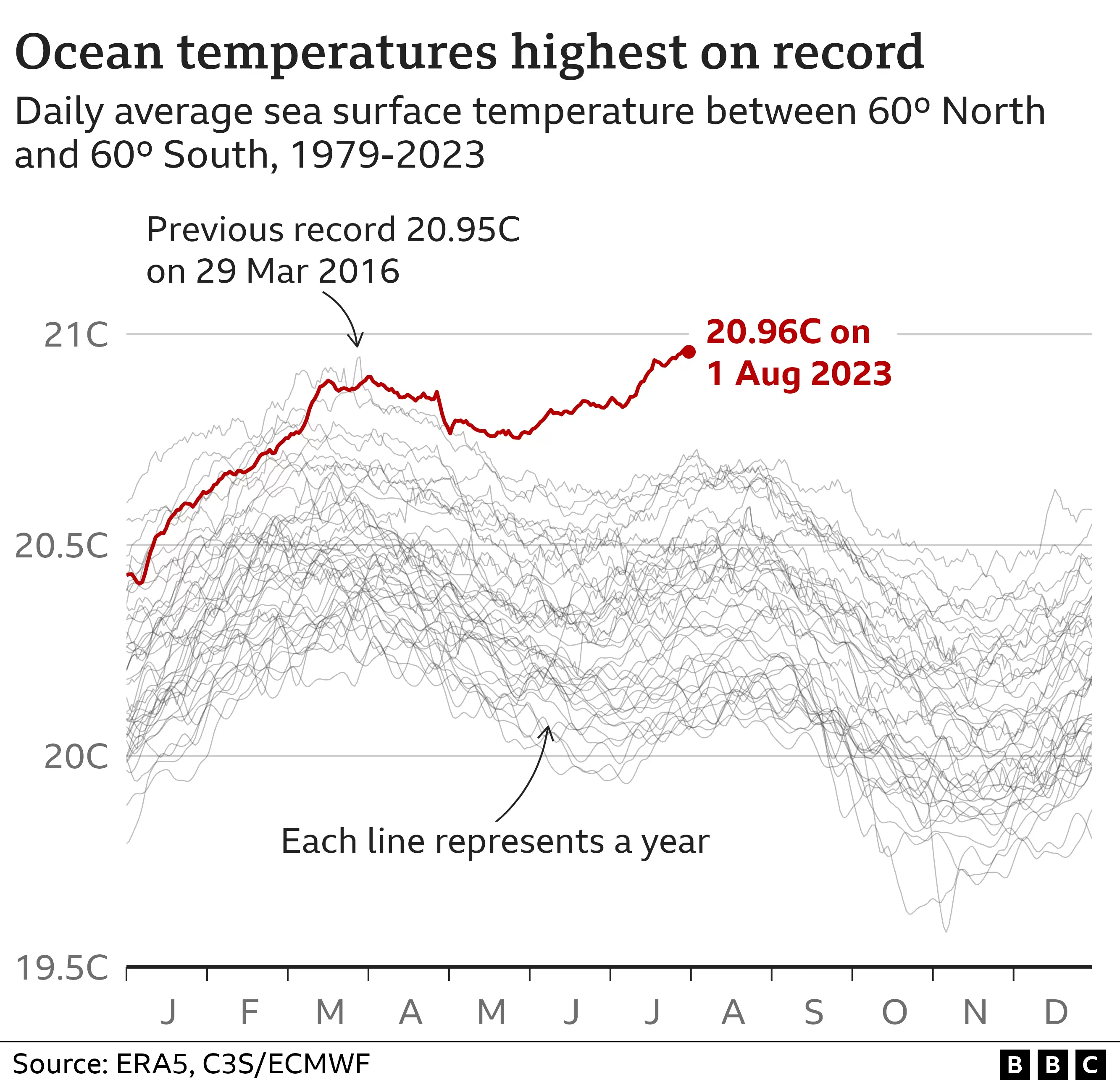

I've been on this planet for just over 30 years, and since I was a little boy I was told (manipulated?) that having things, better cars, better equipment, luxury, wealth, was the right thing to do.
This system produced and still produces many unhappy people, many poor and miserable people. On the other hand, it also left a lot of rich people in the middle of the road. but today, the press, big companies and the rich (multi-billionaires) accuse that, in fact, we are all to blame for our unbridled consumption (which they helped to build, by the way).
Even though I'm not stupid and I'm a big believer in science and the changes are real (after all, we're seeing this in our everyday lives) it's hard not to believe that there are SOME manipulation going on again.