The article skips over the obvious downsides of this sort of motor design, which are:
- It requires a high volume of rare earth magnets to get good performance. They should be comparing against similar motors with rare earth magnets and integrated drives, which will tend to be very high efficiency and power-dense machines, rather than low cost induction motors.
- Copper losses will be high because you typically can't get as good of a fill factor with PCB traces as with wound copper, so the phase resistance will be high, which impacts the efficiency
- PCBs are also not especially cheap at the large sizes, layer counts, and specialty copper weights demanded. At scale it may be better to just automate a high performance epoxied winding.
- The axial flux design scales somewhat awkwardly. At the inner radius (near the axis of rotation), the surface speed of the rotor is quite low, as is the developed torque from magnetic pressure, so most of the power is generated by the material near the outer radius. At the outer radius, the magnetic flux return path through the rotor backiron is quite long, and the magnetic pole faces are very broad, requiring the backiron to be quite thick. The centrifugal forces also get large there. The inner radius wants to be a high-speed, low-pole-count motor while the outer radius wants to be a low-speed, high-pole-count motor.
- Despite the claims about easy cooling, it doesn't seem nearly as easy to cool the stator as with a conventional motor that has the windings coupled to the outside stator where heat can be directly coupled to the environment.
- The front and back rotor sections have a very strong static magnetic attraction to each other (they want to clamp down on the PCB), which requires a fairly robust structure to resist.
Is this a running theme with IEEE articles? Do they tend to run along the lines of the University press release to science journalism content mill, feeding a presumptively educated audience gee whiz material outside the compass of their actual specialization, or do they tend to address actual engineering considerations a little more directly?
One wonders how long these will last give their lightweight construction. There are videos on YouTube of century-old motors still operating like new, and of course they can be relatively easily rewound and rebuilt for another century of service. They appear overbuilt compared to ones of similar power today, but that makes them very robust to short-term overloads.
The VFD also monitors performance, and the results can be reported via the cloud, if the user wishes. The motor’s software can also be updated in this fashion. Such remote monitoring offers a variety of ways to conserve energy, manage performance, and predict when maintenance may be needed.
More points of failure, more opportunities for attack, and more ways to enforce planned obolescence? I'm a software developer, and yet I don't think putting more software in everything is a good thing.
With this motor rewinding is even simpler. Just swap the PCB (which contains no electronic, only windings), the rest of the motor can remain in place. PCB manufacture is cheap and extremely efficient, far cheaper and more efficient than manual motor winding.
> makes them very robust to short-term overloads
There’s no reason to believe that these motors will be any less robust. Older motors are robust to overload by virtue of have lots of copper which take a while to heat up, but they have no real ability to detect that overload and prevent the heating effect in the first place. These motors require VFDs to run them, VFDs are perfectly capable of current limiting the power supplied to the coils, to ensure they can never hit a dangerous temperature, thus making them immune to damage caused by overload (they would just shutdown once and freewheel).
> More points of failure, more opportunities for attack, and more ways to enforce planned obolescence? I'm a software developer, and yet I don't think putting more software in everything is a good thing.
Basically every industrial motor that’s been installed in the last 30years (probably more) is powered by a digital VFD running clever software. The efficiency and control gains provided by AC motors powered by VFDs are unreal. No “traditional” motor can even get close. VFD powered AC motors are more energy efficient, more robust, have precise speed control, any zero consumable parts (bearing might be consumables is certain situations).
Unlike older DC motors that have things like carbon brushes that need to be replaced, have speed control achieved by ginormous variostats. Older AC motors are almost useless for anything except specific industrial applications, because you have no speed control, it’s dictated by the grid frequency. VFDs have changed all of this, and made it possible to create motors the size of watermelon that can produce over 300hp.
As for the cloud bit, industry likes the idea of equipment that can monitor itself. A network connected VFD can report all manner of interesting data that can help with health and maintenance monitoring, along with intelligent remote diagnostics. Potential allowing people to accurately predict failure not just in the motor, but also in whatever mechanical equipment it’s powering. Ignoring the security aspect for a moment, that an incredible capability to have built directly into your motors.
I would assume that they actually mean that the VFD communicates over I2C, Modbus, or some similar protocol, and that it could be interfaced with a SCADA system if desired.
Integrating a VFD with a motor makes a lot of sense. The VFD can be designed with the motor and can understand the motor’s characteristics. Also, the leads between the VFD and motor can emit quite a lot of EMI, and keeping them short is valuable.
(I’m not actually an expert on this, but I did recently evaluate an integrated motor-and-drive versus a separate motor and drive for a smallish application, and the integrated system was a clear win. It’s still embarrassingly low efficiency — there’s a tendency for industrial motors below several HP to be poor to mediocre. Nonetheless, the integrated system was superior. And no, it does not have an Internet connection.)
I'm not sure what the value is of a hunk of steel that can last forever, if it's wasting power that whole time, and needs to be rebuilt periodically anyway. In the end, all you save is not having to manufacture a couple of castings and a shaft again. Those aren't especially expensive materials or processes. And a lightweight motor is especially valuable in anything that moves.
This is precisely why most people abandoned old appliances, even if they “last forever”. Often the energy efficiency of newer devices is well worth the reduced lifespan.
Also, survivorship bias. Not every electric motor made a century ago survived until today; we just see the really well made ones that did.
Really well made or really well designed? Even a century ago, there wouldn't be that much variation between one motor and the next on a given production line.
Made, not designed. Mass production a century ago was a fundamentally manual process, and therefore would show much more variation per item than modern processes.
The only argument for it being designed for durability is that the designers assumed poor tolerances in the manufacturing process, and therefore designed with that in mind.
  > The only argument for it being designed for durability is that the designers
  > assumed poor tolerances in the manufacturing process, and therefore designed with that in mind.
Another issue was uncertainty. A century ago we did not have such precise ideas of metal fatigue and other material failures as we have today. Witness the DeHavilland Comet for and extreme but well-known example. Today, the oft-maligned term "designed to fail" actually means that all parts of a device can fail at once, instead of over-building some parts at the expense of cost, weight, and efficiency.
That variation would account for some premature failures, not a few motors randomly lasting 100 years by exceptional luck and skill. 100 years is just the performance you get when the thing is assembled correctly.
The variation would occur on both sides of the bell curve. A few motors will die prematurely, and a few will last forever. The classical bathtub curve of failures will skew the bulk of the failures out past a decade or so, but on the order of a century only the lucky few exceptionally-built, or exceptionally-maintained devices will last.
I don't think that rebuild would happen more frequently with PCB based windings though, the main failure mode of stators from insulated copper wire is that over time the vibration eats through the lacquer, especially near the places where the wire has been bent sharply, which then shorts out the stator. But if your whole winding is fixed in place in the PCB with space enough to prevent arcing then I don't see how short of gross mechanical damage or frying a winding you'd ever have to replace them.
Most of the motor drives running in industrial settings are so complex they at generally setup by the manufacturer (onsite or in the field) and not the OEM or customer.
My company specifically brings in a contractor (from the maker) to commission system parameters since they literally have 1000s within the drives.
I love the detail that this article goes into! I'm not sure if I understand the "25% less carbon" claim in that many motors (electric vehicle motors) are already efficient enough that you couldn't get that much improvement, but maybe you gain something in some applications because the motor is lighter or maybe this motor type can replace less efficient motors.
Or less carbon dust worn off the brushes since it's brushless :P All these articles promoting some technology and banging on about environmental friendliness are full of crap. Nobody will buy it for carbon emissions because there's no money in that even if it was genuine. It's just wankery.
This article really reads like a parallel dimension turbo encabulator. It hits all the same notes, has a similar cadence and uses many of the same words. This might be my first experience with the kind of media that was parodying.
Yeah, I was hoping for a really detailed engineering-heavy article from IEEE but it came across more like an ad.
> Fast-forward to today. My company, Infinitum Electric, of Austin, Texas, has developed a PCB stator motor that fits a wide variety of purposes.
It then continues to sing the praises of this company throughout the article. There's nothing special about this article to me, which makes me wonder why people like it so much it's #1 on HN right now (genuinely curious, not knocking other people's opinions).
Yeah - if I were to read a technical analysis of a new idea I'd like it to be not an advertisement from the people building said product. This is just an ad.
> Heat pumps, which heat and cool in one system, are another application in which the motor can save energy, ease installation, and reduce noise.
Assuming the efficiency gains are real, increasing the max COP ("efficiency") of heat pumps beyond their already astounding levels of near 5 (500%) would be a game changer for heating and cooling.
Even at quite cold temperatures (sub freezing), the latest heat pumps achieve a COP of 2.5 (250%), a level at which they beat the efficiency of gas furnaces even when powered by 40% efficient natural gas generated electricity.
TechnologyConnections is the best ;) I did indeed borrow his numbers.
But also, I installed a whole house heat pump about a year ago so also have real life experience with them, and with my electricity plan, it's even better from a CO2 perspective since it is 100% wind/solar/hydro based.
> The motor design is based on a printed circuit board [top], the thinness of which allows for a package that is far more compact than an equivalent motor based on a conventional iron core [bottom].INFINITUM ELECTRIC [0]
This is misleading. They are comparing the stator of a radial motor to their PCB. The coils of a copper axial motor just aren't that bulky.
The copper "wiring" to axial motors look much less complicated [1][2][3]
> Our motor generates as much power as a traditional AC induction motor but has half the weight and size, makes a fraction of the noise, and emits at least 25 percent less carbon.
This pull quote, which is discussing electric motors, makes no sense.
Per [1], even if dated a bit, the efficiency of motors can be improved by 20-30% - which means that assuming a fossil powered electricity source the amount of energy consumed and CO2 produced will be lowered correspondingly, simply because you need 20-30% less electricity for the same power output on the axis.
Additional energy and CO2 will be saved by lower system weight (especially if the motor ends up being used in a mobile application like a car or train) and by lower system size.
They're talking about less carbon being emitted by the generators of the electricity to run the motor, because the motor is more efficient than others of equivalent rotational power.
No idea if this is true, but I think it's what they mean.
The claimed weight savings are because the stator does not use any ferromagnetic materials, i.e. iron alloys, and because the coils are printed on a multilayer PCB instead of being wound on a heavier support.
The stator can be made e.g. of aluminum or plastic, so it should be much lighter than an iron stator.
In this motor, the only ferromagnetic parts are 2 discs that compose the rotor, which are made of iron alloy discs on which flat permanent magnets are attached. The 2 rotor discs are very thin in comparison with traditional rotors, so they should also be lighter.
So the claims about a much lower weight are perfectly plausible.
Whether this motor is good for other performance characteristics, e.g. efficiency (the arguments about lower ferromagnetic losses than in a conventional motor are plausible, but it is hard to make PCB windings with low losses at high currents), torque per size or power per size, is much less clear, because no relevant numbers are provided.
Interesting factoids in this article - electric motors consume a little over half of worldwide electricity, and there’s over 800 million sold every year.
Would be curious about maintenance on these motors. The bearings would be the first to go, right? Would that still be doable by a local shop?
Considering the finite nature of earth, everything is about logistics and moving stuff. It's not like we generate new resources and destroy them. We take resources in earth's crust and move them in our phones and then back to the earth.
Related interesting tibid - car companies made tons of people believe that electric motors are basically their invention, and they’re leading innovation in that area.
Haven’t seen anyone claim they invented electric motors, after all they were used before the ICE, but I don’t think there’s any doubt around how much innovation car companies have brought to electric motors? Almost every single one uses a custom design for efficiency / reliability reasons.
There's one electric car company that named itself after the inventor of the motor they used. And he died about 60 years before the company was founded so I don't see them claiming to have invented motors.
(Okay there's actually a second EV company that named themselves after the same inventor's first name, but they're a fraud.)
For large motors that work in air, electric fields are not competitive with magnetic fields.
The usable magnetic fields are limited by the saturation of the soft ferromagnetic parts or by the demagnetization of the permanent magnets at around 1 to 2 tesla, while the electric fields are limited by the electrical breakdown of the air at around 3E6 V/m. 1 tesla is equivalent with 3E8 V/m (multiplied by the speed of light), so the usable magnetic fields are 100 to 200 times greater than the usable electric fields.
So any large motor must be made with magnetic fields, otherwise it would need to be huge for the same torque.
On the other hand the motors with magnetic fields have large power losses in conductors (copper losses) and ferromagnetic materials (iron losses). Because of this, while large motors can have an efficiency above 99%, the smaller an electrical motor with magnetic fields is, the lower its efficiency is.
So below a certain very small size, the efficiency of a motor with magnetic fields becomes so low that the motors with electric fields become preferable because of their higher efficiency.
Another poster mentioned a motor with electric fields made to work in vacuum, which may use much higher electric fields.
A motor could be filled with oil, but the problem of preventing oil leaks through the bearings would be insurmountable.
Keeping vacuum inside the motor would be even harder. Enclosing completely the motor in a case and using a magnetic coupling through the wall might be a solution to avoid holes in the case, but it would greatly increase the cost and it would be complex to ensure lubrication for the through-the-wall coupling.
No such solution seems acceptable, so besides microscopic motors the only other possible application for motors with electric forces would be in some motors intended to be used in satellites, on the Moon, or in other such places where the motors could operate in vacuum.
> A motor could be filled with oil, but the problem of preventing oil leaks through the bearings would be insurmountable
Shouldn't be too hard for stationary applications if you stick to a vertical axis and allow gravity to help keeping oil and air separate. I guess neighbor post's viscosity counterargument will do fine in its own though.
For many structures of motors with magnetic fields, there are equivalent structures of motors with electric fields, which you can obtain by replacing each pair of windings that creates a north-south pair of magnetic poles with the 2 plates of a capacitor, which create a positive-negative electric pole pair when the capacitor is charged.
For example, you could have a stepping motor where the rotor has 2 metal plates at 180 degrees on the cylinder, and you apply a fixed voltage on them, so that one is positive and the other is negative.
On the periphery of the stator, surrounding the rotor, you have 2 or more pairs of metal plates spaced at equal angles. The 2 plates of a pair, at 180 degrees on the stator, are connected together forming a capacitor and you have as many capacitors as pairs.
Each stator capacitor will correspond with a phase of the stator. When you apply voltage on one phase of the stator, the rotor will rotate to allign with the plates of that phase (the negative rotor pole to the positive stator pole and similarly for the opposite pole).
To advance 1 half step, you charge the capacitor of the next phase and the rotor will move half-way between the plates (being equally attracted by them). Then you discharge the previous phase capacitor and the rotor will move to be aligned with the plates of the next phase, achieving a full-step movement. Applying a sequence of stator capacitor charges and discharges will achieve any movement you want.
The same transformation described above for a stepping motor can be done for any other kind of electric motors. Even the permanent magnet motors and the hysteresis motors have correspondents in motors with electrets, but those are unlikely to have so good characteristics as the motors with magnets.
In a motor with magnetic fields, if you want to supply the rotor with a current, you need gliding contacts, which have a limited lifetime, and you also have a permanent power consumption. These 2 disadvantages make preferable the induction motors, permanent magnet motors, hysteresis motors or variable reluctance motors, all of which are worse for other characteristics.
For a motor with electric fields, the rotor needs a voltage, but the only power loss is due to leakage currents, so the rotor could incorporate a battery to provide the voltage, which could last many years.
Unfortunately, the limitations due to electrical discharges make this potential advantage irrelevant, except maybe for use in vacuum outside Earth.
Shinsei corporation made a (macroscopic) electrostatic motor that operates on that principle. I guess they did it just out of curiosity because I don't think it has many advantages. It required high voltages and all the active surfaces had to be highly polished to prevent electric arcing. If I recall correctly it had to run in vacuum as well, for the same reason. But it was a pretty cool project.
Electrostatic motors have been around in some form ever since the earliest experiments with (static) electricity, so they predate even electromagnetic motors. The high voltages required and their relatively low torque has kept them from gaining much use.
Yeah, they are highly automated. Even a cursory search in Google shows that.
However, winding has been a cottage industry in many parts of the world. So, you still have a large ecosystem that uses tools, jigs and fixtures for winding works.
It's not the brushes because this motor doesn't have any. If it was about brushes they would have said "100% less." They're talking about GHGs produced by generating the electricity that runs the motor.


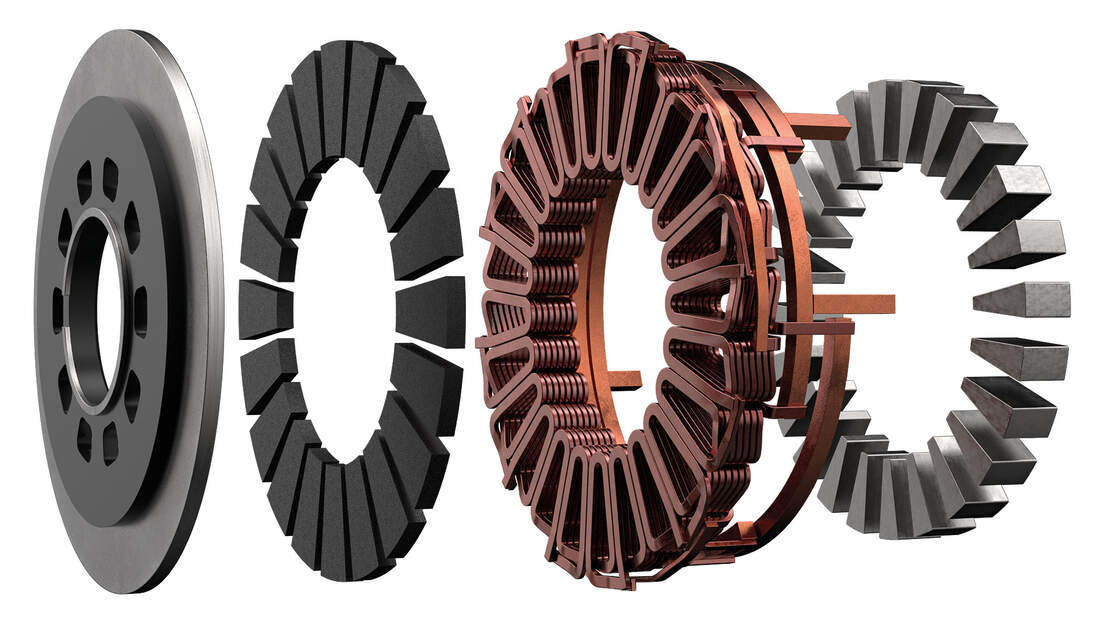
- It requires a high volume of rare earth magnets to get good performance. They should be comparing against similar motors with rare earth magnets and integrated drives, which will tend to be very high efficiency and power-dense machines, rather than low cost induction motors.
- Copper losses will be high because you typically can't get as good of a fill factor with PCB traces as with wound copper, so the phase resistance will be high, which impacts the efficiency
- PCBs are also not especially cheap at the large sizes, layer counts, and specialty copper weights demanded. At scale it may be better to just automate a high performance epoxied winding.
- The axial flux design scales somewhat awkwardly. At the inner radius (near the axis of rotation), the surface speed of the rotor is quite low, as is the developed torque from magnetic pressure, so most of the power is generated by the material near the outer radius. At the outer radius, the magnetic flux return path through the rotor backiron is quite long, and the magnetic pole faces are very broad, requiring the backiron to be quite thick. The centrifugal forces also get large there. The inner radius wants to be a high-speed, low-pole-count motor while the outer radius wants to be a low-speed, high-pole-count motor.
- Despite the claims about easy cooling, it doesn't seem nearly as easy to cool the stator as with a conventional motor that has the windings coupled to the outside stator where heat can be directly coupled to the environment.
- The front and back rotor sections have a very strong static magnetic attraction to each other (they want to clamp down on the PCB), which requires a fairly robust structure to resist.