Peak oil production (global): unknown, maybe 2020-2030
Peak Facebook: ??
That's an incomplete peer group, but I find it interesting that at some point, society does start to unplug from addictive substances. The tapering off is quite slow, though. Unclear whether heavy users cut back, or new generations just don't develop the habit as older ones die off
Facebook has been primarily displaced by Tiktok, which is considerably more addictive than FB. It's like zonking out in front of cable TV in the olden days, if the cable TV had access to an essentially unlimited content library of short-form dopamine hits, was capable of determining exactly what you like, and showing you exactly that forever.
Except TikTok’s also is controlled or controllable by a foreign government whereas we know all Facebook is after is more profit. One of these seems more malicious and abusable than the other.
Yeah TikTok has yet to convince anyone I know that there is a globalist plot to replace white people with Jews and blacks for um, reasons? One of these is more malicious and has already been more abused than the other.
Right because anti-semitism and replacement theory didn't exist until Facebook..
And uh, does the genocide of the Uigher population somehow not count as an evil? I mean I know they are Muslims and not Jews but seems like we should be concerned about them being forced into camps and sterilized...
Of course the lunatic cult existed before, but none of my relatives were at risk of getting suckered into the John Birch Society orbit before about 2010. And it seems like the PRC has been repressing Uighurs in Xinjiang since well before TikTok, and I doubt the leadership circles in China are swapping dance videos about the subject.
This is not to say TikTok is some wonderful, innocent thing. But the harm done by it compared to Facebook is just not remotely comparable, at least not yet, and that may be partially due to the nature of what the platform pushes and to whom.
Yeah, the CCP's finger on ByteDance isn't awesome and it's possible it feels less evil merely by chance (it hasn't been worth it to weaponize, nobody has thought that far ahead, etc).
I do wonder if ByteDance does really just want to chase profit here though, and letting TikTok be weaponized by the party would hurt that.
That's what I fear. I usually join social networks too late but I joined TikTok just in time to have a good time before it all turns to shit. It's already happening, my bubble is being slowly invaded by conspiracy/political/gamed videos even though I try to avoid them as hard as I can. I dread to see what new user experience looks like these days.
Early Facebook was wholesome as well, relatively speaking. It's the cycle of addiction. The early days of addiction are always nostalgic. It's only later that an addiction starts to produce anger as much as it produces relief. I see no safeguards preventing Tiktok from going down the same path, if not worse.
I get hypnotized by tiktok even by seeing it over other people's shoulders. HN and reddit already makes me feel guilty. I am not even starting with that one.
That's exactly what TikTok is. I've tried to use it several times, but it was just too dystopian for me to keep going. It was an intensely disquieting experience seeing the algorithm try to "addict" me to the product. I just don't see the appeal in being an utterly passive consumer of entertainment generated by an AI (yes, I know humans nominally generate the content, but the secret sauce is the AI playing conductor). It reminds me of Elsa-gate. Just surreal.
The difference is, the US population kept growing, so while per capita figures falling is noticeable, total coffee/cigarette consumption may not have fallen.
Facebook's numbers are falling despite a growth in world population, and I'd bet a larger growth in the internet-connected population. That's worse, especially for a platform heavily reliant on network effects.
I think it has more to do with alternatives (except perhaps in case of cigarettes which have direct measurable health effects) availability rather than society starting to unplug from addictive substances.
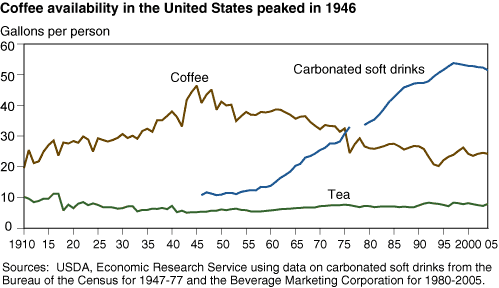
Peak coffee is in 1946, but what have consumers moved onto from then? Alcohol, Tea, Energy drinks, Soft Drinks ?
Here is an article [1] that shows consumption of coffee and soft drinks in 1946/47 and 2005. Adding coffee and soft drinks together there has been an increase of approx 32% in consumption since 1946.
Coffee 1946: 46.4 gallons per person
Coffee 2005: 24.2 gallons per person
Soft drinks 1947: 10.8 gallons per person
Soft drinks 2005: 51.5 gallons per person
Total caffeinated consumption in 46/47: 57.2 gallons / person
Total caffeinated consumption in 2005: 75.7 gallons / person
The chart seems to indicate tea has stayed relatively flat in the same time period. I'm not sure the history of caffeine pills or ADHD medicine, but those may also contribute to an increased consumption in 2005.
I'm genuinely curious: why are soda/pop/coke/soft drinks so popular? I've never liked them because they're too sugary, and they represent like empty calories (like I'll gain weight without feeling full) from drinks that aren't hydrating. When purchased in a restaurant, it costs money that could be saved or spent on a side dish. I'd much rather eat candy if I want sugar, or drink cold water if I want to hydrate myself.
I don't say this to condemn these drinks (if people like them that much, they're free to spend money on the little things in life they enjoy), but I'd like to square my experience of not caring for them versus their clear popularity from statistics.
It's about caffeine and carbonation as much as sugar. Caffeine and sugar are highly addictive substances, with obvious habit-forming potential. Carbonation is a unique effect that stimulates and satisfies people, and probably provides a physical "hook" for addiction, like how many heroin addicts crave the feeling of the needle.
I think the same way about cigarettes, weed, and coffee, wtf is so good about it that you go out of your way to get it?
But this is the thing about addiction, to the person who isn't hooked it seems odd.
As a kid I used to wake up at night and drink Coke. I just craved it, that's how it was. I still like something sweet to drink but I control it these days, and my taste is not quite the same as an adult. Still, there's no accounting for it, you want something because you want it. Best explanation I can find is that it triggers something connected to reward paths in a way that isn't how that reward path evolved.
> I've never liked them because they're too sugary
This is the crux of the matter. Whether something is too sugary is a matter of taste and habit. It tastes too sugary to you, but great to other people.
That also makes a lot of sense (my other hypothesis, which doesn't necessarily contradict, is that I wasn't introduced to much soda growing up). This could also explain a personal preference for salty food (taste and habit) that other people I've met don't seem to share.
I'm not sure about that. My mother was from a developing country and only tried soda for the first time when she tried it in a developed country as an adult, and fell in love with it immediately. She doesn't drink sugary sodas anymore but still loves sparkling water, champagne, and anything bubbly.
Thanks for sharing. From your and noah_buddy's comments, it looks like it was a treat from childhood that stuck.
My parents forbade me from soda growing up, but my cousin once snuck me some sugary orange pop once (I didn't like the fizz when I first tried it, but I liked it more when I tried it again). I still have a preference for it sometimes due to the memories (along with root beer, which I also tried when younger) if it's free, though just a small cup. I never tried Coca-Cola or Pepsi until an abnormally older age, so that's probably why these two never stuck for me.
Hard to explain! I think I picked up a taste for soda as a kid, I love me a Barqs, any sort of Cream Soda, and a cold Coke on a hot day. That said, I can't drink soda daily or I feel I'll, nor do I drink beer or other carbonated drinks frequently, maybe tops once a week. I drink the most tea out of anything (herbal, green, white) besides water.
I really enjoy carbonated beverages, the whole sensory package the bubbles bring to the drinking experience. I have had an easy experience substituting the soda I drank as a child for a more healthy carbonated beverage.
It's a lot but it is the total consumption so it includes all stuff that was sold not necessarily consumed. Fast food sells massive portion that people regularly throw away half full, auto-refills, expired stuff, hell just think of all the coke+menthol videos.
I find the coffee at 46 gallons stranger. 570ml a day of coffee? What's even more wtf is that in Central Europe during and after the war coffee was very expensive/difficult to get so people were drinking coffee substitutes (chicory root for example) while people in the US drank half liter a day.
Half a litre isn't that much in the grand scheme of things. It's maybe two decent mugs, or less than a pint. Especially when you consider American filter coffee is on the weaker side.
I'd assume it's all included. There is more than 1 way to brew coffee, and even those there is a standard for it, there would be no way to normalize consumption to it.
- Gatorade and similar stuff
- A movement to drink water (HydroHomies)
- High caffeine energy drinks (Red bull and the likes)
- Healthy alternatives (juices, smoothies, etc)
Wow I had no idea Americans used to drink more coffee than now. Surely serving sizes have grown and grown - absolutely nobody was having a 20-ounce coffee in 1946, but now that's normal. Doesn't seem to add up but I'm sure you're right.
I am assume this doesn't refer to "volume of coffee beverage" consumed. As far as I'm aware only the US seems to gravitate towards these extremely large coffee beverages. Other nations drink more coffee, but in smaller serving sizes less diluted by milk/sugar.
Perhaps the US used to drink espressos in the 1940s, I'm not sure. That's if this fact is even accurate.
US consumption in 1946 was apparently ~20 pounds of coffee beans annually per capita, or an average of around 2.5–3 (8 oz?) cups of coffee per day for the ~3/4 of adults who were regular coffee drinkers.
> Most people [in the UK] made coffee in a jug. You boiled the water and added it to ground coffee already in the jug. You let the ground coffee settle and it was ready to pour through a strainer and drink. Some people then boiled the coffee again.
My impression is that coffee preparation was comparable in the USA. Neither paper filters nor instant coffee were common until decades later.
The percolator is coming back into fashion. The two issues main issues are caffeine concentration and taste: a slow drip gets you crazy strong Vietnamese style coffee, a percolator can do some of that but you don't want to burn it.
This one interested me. We're at a local maximum in terms of coffee consumption in recent years. After WWII coffee fell off in popularity and due to the substitute of carbonated soft drinks. Most likely in simplest terms it was a cheaper energy drink for the poor.
Right, if anything -- coffee consumption has only gone down because we've moved on to more efficient stimulants. Either higher concentration/lower cost artificial substitutes or prescription drugs.
Hardly the best example of America getting over an addiction.
Big difference in comparing an entire product area with a specific company and brand. Individual cigarette companies, coffee shops etc. have been going in an out of fashion the entire time. Similarly, the total number of social media users is nowhere near its peak.
I'd say it is actually remarkable just how long Facebook (the site) has been able to maintain relevance, whereas people should have been bored and migrated to something newer and shiner a long time ago (as is now finally happening with apps like TikTok).
I think 2014. Just by looking at things like wall posts on my personal page, around 2015, things went downhill and after 2016, it became really quiet. Almost none of my friends (23 to 33) use Facebook anymore except for the occasional photo dumps. Most are on instagram but even the number of stories posted has gone down as well.
If you include Facebook then you may as well include all other social media platforms.
Facebook is the least of my problems when it comes to addictive substances. Youtube, Reddit, Hackernews, TikTok. They're all the same even if they don't go out of their way to insight addiction.
How is the coffee one even possible? I don’t drink coffee, but almost everyone else I know does. There is a Starbucks on every corner. Every coffee shack always has lines.


Peak cigarette consumption (per capita/US): 1963
Peak oil production (global): unknown, maybe 2020-2030
Peak Facebook: ??
That's an incomplete peer group, but I find it interesting that at some point, society does start to unplug from addictive substances. The tapering off is quite slow, though. Unclear whether heavy users cut back, or new generations just don't develop the habit as older ones die off