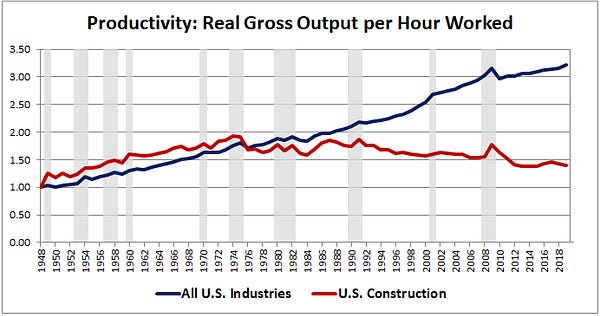
Thirty years ago when you needed to install new computers in an office I remember it took us weeks to get the cable (Ethernet) installed because one contractor had to pull the cable and cut it at each workstation, another contractor had to come and put the connector on the cable and yet another had to come and plug the cable into the machine. Believe me we were tempted to sneak in one weekend and do the whole thing ourselves but were severely warned about the consequences. So what could have been done in a day by one or two guys took over a month because you couldn't even schedule the second service until the first was done. I imagine this kind of thing is everywhere when it comes to building real infrastructure.
Yes, my partner was a conference planner and whenever they had one in NYC in the Time offices their team wasn't allowed to adjust tables by themselves, everything had to be done by formal work order tickets and only union hands could touch anything, even equipment they owned and brought in themselves.
Coincidentally, this new infrastructure bill has union requirements for any EV work.
Non American here, can someone explain to me what is unique about USA society that creates this situations? I mean, most of the world has unions, most countries to a much greater extant than USA, and yet we don't see those horror stories of loss of work efficiency from anywhere else. What is unique about USA unions that drive those?
Unions in the US have to be more defensive, because they're constantly under attack. Unions and management are pitted against each other as enemies, and the only way for the union to protect its members is to make and enforce rules. Each of those rules is in place to protect against some past abuse, and in that hostile environment, they know that flexibility on the rules invites a return of that abuse.
Not that everything in Europe is sweetness and light with unions, but they are more widely accepted. That leaves more room for amicable rule-making and flexibility.
The anti-union forces in the US, of course, put all of the blame for that on the unions -- which is exactly the kind of hostility that makes it difficult for the unions to negotiate flexible, reasonable contracts.
Not all unions are like that but some definitely are. Some unions seem to be connected to organized crime or powerful political players and protect their turf very strongly. eg Longshoremen in New York. The union is used as a make-work organization (hire my cousin for a high rate where he barely shows up and I'll fix $X problem for you). A portion of dues goes to political lobbying which gives them political power - eg in California the PG&E Lineman's union is one of the reasons PG&E hasn't been nuked from orbit given how badly they maintain infrastructure and how high their cost for electricity is - Silicon Valley Power charges $0.129c/kWh where a mile down the road PG&E charges $0.28c/kWh-$0.33c/kWh. If they were actually subject to a free market they'd have been liquidated long ago, but the union fights to protect them.
Others are more like European unions thus are more reasonable. In the limited times I've worked with IEW union electricians in the bay area they were reasonable people who did good work without any slacking, fake make-work, or outrageous prices.
Maybe it is just normal in those countries? Each country has things which seem absurd in other countries but are so normal in others as to rarely be discussed.
Its an interesting question. I'm not a union guy and spent my youth working in construction so I've encountered my share of plodding union tradesmen who took remarkably long to do small things that could be finished in a few minutes if you rushed. When I was young and foolish I'd often shake my head at the snails-pace they worked at.
I'm older now, and arguably a smidgen wiser. I've reacted with shock at hearing about old acquaintances who have been killed on the job or now endure chronic pain and are no longer able to work. Broken backs, bum knees, busted nerves, missing fingers, the list goes on. The plodding, methodical 55 year-old union guy is looking less and less silly the older I get.
In short, perhaps one reason a union might push back against performance-based bonuses is that it often ends up coming at a long-term cost to the worker that is difficult to foresee when you're an invincible 25 year-old trying to make a few extra bucks for the weekend.
Say you're laying rail track. It will be used for 50+ years. Better to lay it once, relatively slowly, and well than to do a shoddy quick job and have to repair it every 5 years.
Perhaps another argument for the plodding, methodical 55 year-old union guy's way of working?
But the union don't recommend things for engineering reasons though, do they? That's not their remit and they don't represent users of the railway or future maintainers of the railway. They represent the employees today.
In fact the incentive of the union is shoddier work so they have more work to do late to replace it.
Worked with unions before - some are definitely better than others and some are really great at their jobs, efficient and good quality work. Some are REALLY bad - all the slow inefficient protectionist BS you hear about, they're definitely out there and it's not because they're more careful about quality.
I really don't know the ratio, but in my highly incomplete experience it was about 50/50..
This is purely conjecture, but the real problem to me SEEMS to be the union management. Unions are super useful sometimes, but like any concentration of power, they get corrupt over time.
Well, it is not the first time I hear such stories. Not only from the US either. At my own job we sometimes work at unionized places and it is the same everywhere. Horrendously en ridiculously inefficient work practices. It certainly gives me a very negative image of unions.
Especially since no amount of technology has lessened the amount that most of us (especially those doing these jobs being complained about) still have to work to earn a living.
Maybe a US union thing. The reason why US unions (and also other workers) are so protectionist is that there are high risks connected with job loss. If you provide a good security net as a country, where people don't loose everything when they loose their job and can get back on their feet, people also don't go as far with shenanigans to keep their jobs. You rarely hear about this kind of things from unions in Europe.
It's more likely an elite capitalist thing. Some boss somewhere plays golf at an exclusive club with a regular foursome. He has some work to be done, and each of his three buddies get a slice. They have some friends that could also get a cut. The end result is the golden shower that trickles down. The shops might be unionized, but the contracts are signed at the clubhouse while a boy brings the single malt and cubans.
In real life it’s even worse. None of the suppliers actually show up, they ramp up the price and deliver a failing product. Then they all blame the previous guy.
30 years ago, I asked to see how the cable was made. In a hour I was making cable drops and running the cable. Using 25 conductor cable, configuring pins 2,3,7 it was nothing to cable 4 PCs in each of 2 offices in a day. Nevermind the cable ran across florescent lighting, etc. Later that week I learned to check the runs were less than a certain length from the computer room. But primarily I wrote software.
I was a management consultant ages ago and worked on large capital projects. In my experience (as the article mentions) it was a mix of:
1. Red tape & public "input"
2. Layers of contractors and subcontractors, each taking their slice
3. No real incentives for governments to be cost sensitive. Usually capital projects last well into the next administration.
4. Too many cooks in the kitchen and consultations
Yeah my first reaction to this was "Oh it's going to be the public". Because the US has strong rights and legal system basically anyone can come along and considerably screw up a project just by claiming some endangered bat is living in the path of it, or some economic harm will be done, or some community will be damaged, it's far easier to just to just stick planning notice on display in the bottom of a locked filing cabinet stuck in a disused lavatory with a sign on the door saying 'Beware of the Leopard.'
A great example of this is in the UK where the main road going east to west from london to cornwall is a single carriage way with 2 lanes going past one of the country's most historic sites (stone henge). It's a fucking disaster. So the plan is to build a massive tunnel under stone henge to help traffic and remove the blotch on this area of historic importance. It's expected to cost £1.7Bn but it's already been completely tied up in legal fights, it was proposed over 25 years ago (when it was already desparately needed). Essentially plenty of people either don't want it built at all (presumably just accepting that we'll never ever be able to have economic in england west of stonehenge) or they want a tunnel that is several times longer than the proposal sending costs and construction time soaring.
What you could do, if you were Turkey, you could just built a 12 lane motorway and shove stonehenge a few miles north. It'd be cheaper.
Stonehenge isn’t that big. I don’t know what the surrounding area is like, but isn’t it an option to build the road around it? With compulsory purchases of properties along the way, if necessary.
I confess to not having closely followed the issue, but every time I see it mentioned, my brain twitches. Is the choice between A) large construction project that overlaps with a site of immense historical and cultural significance, and B) spend the money for a couple extra miles of freeway, seems to be a very obvious one. The only reason I can see for B is a sort of aggressive anti-humanism.
These are all things, but they're things in other countries, too. France has strong unions and subcontractors and bureaucrats and all of that. And yet it costs less there.
On a recent episode of the Ezra Klein show, Jerusalem Demsas argued that part of the problem is that the bureaucrats in the US are too constrained in their powers, so e.g. when weighing an infrastructure project against wildlife protection laws, it's not a bureaucratic organisation making a final decision on how to proceed with minimal impact, but it's private organised interest groups litigating without any limits on re-litigation, and a ruling that does not necessarily weigh the public interest of having projects proceeding towards completion.
I think it's a mistake to think of european unions and american unions as "the same thing". Relationships with unions in the US seem much more adversarial than there, on average.
As you say, there are politics, labor relations, etc. in europe too - I wonder if they are just better at cooperating on this sort of project for some reason?
US unions are that way as a consequence of racism. No, really. There was a US union that wasn’t doing its duty to represent African-American members. So it goes all the way to the USSC and the gist is that unions have to represent every member or be decertified.
In contrast, in a country like Germany, the union and management can agree that Hans is a fuckup and it’s in everyone’s best interest that he finds a new job.
> Relationships with unions in the US seem much more adversarial than there, on average.
Depends. You have "red" unions, which tend to be more aggressive, have revolutionary ideologies, and see bosses as enemies to perpetually keep at bay.
Then "yellow" unions tend to be more centrist, conciliatory and, arguably, somewhat toothless.
Which kind of union is more present varies from sector to sector.
But in any case, if you've ever seen a CGT propaganda poster, you'll never be under any impression that these guys are feeling "cooperative" with management / the government.
What? This could only be so naively said by someone who has never lived in a heavily prop labor socialist country like France. Les grèves are terribly adversarial and a near constant aspect of labor negotiations.
The only way they could be considered better, in the way you imply, is that the unions are considered something to negotiate with instead of something to destroy.
Defeat, not destroy. Unions aren't destroyed in the US today and they're not sought out to be destroyed, no large government agencies or corporation is hunting them. In the Jimmy Hoffa days certainly there were some powerful people inside and outside of government that wanted the Teamsters destroyed.
The corporations aim to defeat them in the sense of keeping them voted down / out of the operations. John Deere for example recently came back with a rather lame offer for wage increases, the union went on strike, Deere capitulated and gave them a more fair wage hike, the union accepted; Deere didn't attempt to destroy the union.
Kellogs and their union haven't been able to agree to terms. Kellogs didn't attempt to destroy the union, they didn't send assassins or thugs to kill or rough up the union leadership. They replaced the union members with temporary labor and resumed limited operations. And that's entirely fair, the union can strike and refuse to work, the company can replace them.
Amazon didn't destroy the union in Alabama, that battle will continue; Amazon - at least temporarily - defeated them.
Germany is more cooperative yes. But their "workers council" concept is very strict. We've had several times we couldn't implement a global change in the multinational I work for because some workers council in a 10-man office in some German village didn't agree.
In Holland we used to have good union representation that really worked together with government and employers. The "polder model" it was called. However since we've had many neoliberal governments this concept has been hollowed out and the unions are now run as companies by the same kind of people so they no longer really represent the workers. They're just corporate puppets now. It's gone completely the other way from France or Germany. When it did work it was pretty good though. There was a decent balance between workers rights and efficiency and there was no need for many strikes.
French bureaucracy has the expertise in house to do high level planning rather than having a subcontractor do it. They're also a lot more insulated than US bureaucracies from the vagaries of political turnover. And they're more often dealing with laws written ahead of time rather than things that can't be decided without a court decision.
My broad impression is that in the EU and the US, a given project is a "meal" that all the interests involved will take a cut out of.
But in the EU or elsewhere, the "cut" the interests will take is just financial, the project will be designed for cost-efficiency by competent architects and engineers and it's just that the different interests will be paid off with money to make things happen.
In the US, the spread-out state and administrative structure results in a situation where each interest gets it's cut through its ability to make some small change or demand some particular process. A lot of this involves a lot of adversarial relations, some of them intended to stop corruption but which actually result inefficiency and corruption (complex bidding processes legal repercussions for failure to adhere to bid etc. etc.).
California spending $3 billion planning ("planning") a high speed rail system is good example. A lot of that involved buying land whose value had inflated.
I have seen some public transportation work up close in the USA -- "me first" and competition between different teams ate up quite a bit of the (expensive) time.. lots of very competent, skilled people and also quite cynical and profit-seeking management. The actions of management were sometimes directly contradictory to recommendations by hard-working staff. Worse, management that tried to get things done quickly were pushed out by others who were better at looking good (or something else I dont know about).
The old expression "we have the worst system in the world, except for all the others" .. comes to mind
edit- I would like to point to NORESCO in particular as a sponge-like entity with a long history of failed, expensive projects and a long pipeline of new funding, based on what I saw with my own eyes.
The old expression "we have the worst system in the world, except for all the others" .. comes to mind
That's what (I think) Winston Churchill said about democracy (might be true there). But here, I think you can just say "we have the worst system". Period. The US has a variety of sectors (public works, health care, etc) which aren't just bad but fated to get worse and worse through both through the particular way US ruling interests deal with each other. Each solution introduces more pork interests since each solution follows the haphazard paradigm.
For example; I think Yimby ("yes in my back yard") proposals have aimed to facilitate development in at transit hubs, a worthy seeming cause. But since there's no California state transit plan, this approach has to define "transit hub" haphazardly - "there's currently a bus stop there". This allows those aiming to sink a development to do so by removing the bus stop. Or oppositely, allows someone to facilitate a development by adding an otherwise unneeded bus stop. I'm not sure if this approach was implemented but just proposal illustrates the inherent problem of trying to solve transfic/housing/development problems by tossing random legislation at them.
> That's what (I think) Winston Churchill said about democracy (might be true there).
As E.M. Forster put it (from memory, so I'm sure less well-worded than the original):
"So, two cheers for democracy—there's no occasion for three, two is quite enough."
> But here, I think you can just "we have the worst system". Period.
Yeah, our system's about as bad as it could possibly be and have held together this long, true. And our country's too disunited to ever fix that without breaking apart to do it.
I think in-sourcing management expertise to the public agencies would save a lot of money. Management consultants are expensive and their incentives are in conflict with public projects.
In my experience with construction projects, legal costs and liabilities take the cake. Once something is in court, there is zero telling how long and how much money it takes to resolve.
This is interesting from a foreign perspective. I still follow urban planning in Helsinki, Finland. Major public projects always face opposition and go to court, but it's not a big deal.
Because zoning plans and similar project plans are decisions made by public officials, all complaints about them go to the administrative court system. Administrative courts don't care about the substance of the argument. (That's for elected representatives.) They only determine if the officials followed all appropriate regulations and decisiomaking processes. Going to administrative court is cheap enough and fast enough that the costs and delays are usually included in the project plan.
Sometime the court overturns the decision, delaying or canceling the project. Sometimes their justifications are stupid and sometimes there are unintended consequences. Regardless, the system more or less works most of the time.
That seems like a political culture issue rather than something inherent to governments. If you really care about doing good in the world (isn't that the whole point of politics?) then you have a huge incentive to save on costs as any money saved can be put to good use elsewhere.
Once the US had railroad companies that laid rail at a mile per day (mostly crap rail, but enough to count), that was when the incentives were all aligned, and a huge amount of resources were mobilized and ready to deploy.
Once the US pulled of the completely absurd task of putting a man on the moon and then returning him safely to earth, in less than a decade. All the incentives were aligned, it had public support, and a huge amount of resources were mobilized and ready to deploy.
We're not deploying huge resources on our infrastructure projects, we're piecemealing them. I've got a branch rail line going in at the end of my street. [1] The public input/planning process went on for years, and only now are they starting to relocate utilities, put up fences, etc. There's no one entity in charge of all the layers of the project, it's all hired contractors and inter-agency cooperation. It will be done, likely in 3 years or so. This line is a total of about 9 miles long for about $945 Million.
The worst part about it for me is the insidious nature of the funding they're using. They're doing "Tax Increment Financing" which means that any increase in property tax revenues theoretically caused by the "improvement" of my house go to pay off the construction bonds.
Let's say there is NO improvement, but inflation doubles taxes in the next decade. The town now gets the same dollar amount, but half of the funding it used to get, and the rest goes to the bond holders. This will strangle our schools which depend on local real estate taxes.
PS: Just across the state line is a defunct Country Club, which is in close enough to the station to qualify for "TIF" improvements, and the husband of the local State Representative pushing for the project, just happens to be the a real estate developer interested in said property.
> pulled of the completely absurd task of putting a man on the moon and then returning him safely to earth, in less than a decade
At a congressional allocation level, this was all pork, too. The vast majority of this project went to politically-connected contractors, subcontractors, etc. Not much has changed, except for one critical factor:
We were competent in the 20th century. All of the engineers, machinists, metallurgists, and yes, even management of the Apollo project had a job to do. Their personal political opinions, sexual proclivities, or social media clout had nothing at all to do with accomplishing the mission. And so, it got done.
Putting a man on the moon was relatively simple in comparison, actually.
All the resources focused down to a single task, a single vessel, and a single mission.
In comparison, there are countless jurisdictions and hundreds of millions of lives being effected, plus well established property lines that need to be redrawn all over the place.
I'm not saying I approve of how much it costs to do reasonable infrastructure related projects at all, but the meme of "things were so much better back then" has never not been old.
Purchasing goods and services from companies and universities who seek to be a part of the program is, logistically, a hell of a lot easier than buying millions of property rights across thousands of different municipalities from people who don't want to be displaced for what would likely be below market value.
I am of the opinion that continuing to build out all these long 'runs' of infrastructure to serve a even more spread out populace is a dead end. Where I live we spent tens of billions expanding highway infrastructure, and it has not improved the lives of anyone meaningfully, traffic is as bad as its ever been.
We need to spend more money creating better metropolitan areas that people want to live in, rather than using tax payer money to support fewer and fewer people.
The particular project highlighted in the article isn't one of those, though. Somerville (one of the cities reached by the extension) has the highest population density in the state of Massachusetts, and I think it's something like top 20 in the United States by that metric. This is not an "even more spread out populace", it's linking a reasonably dense bedroom community to a regional commercial hub.
Somerville is not a bedroom community. It's not even really a suburb. It's more analogous to a city neighborhood that happens to be under different jurisdiction for historical reasons. You can walk from Somerville to fidelity's headquarters, Harvard, MIT, all the FAANG offices, Amgen/Biogen/AstriskGen, etc.
There's definitely stuff more far flung and less dense within the city limits of Boston and/or on the Orange and Red lines.
The suburbs kind of start somewhere in Watertown/Newton.
The closest bedroom community to Boston, moving west, is probably Worcester.
Maybe I've been using that terminology wrong; I'd meant something along the lines of "primarily residential annex of a city". I didn't mean to imply that it's a long distance or low density (in fact, I specifically emphasized Somerville's relatively high density), or that it doesn't have its own identity -- it definitely does. Somerville (and to a lesser extent Medford/Charlestown/Watertown/Quincy) is just where you go if you want to live in that area but can't or won't pay Boston/Cambridge/Brookline rent.
I see. "Bedroom Community" typically means something more like Worcester or Lynn, at least from my understanding. A distinct hub beyond the suburbs from which people commute into the city.
This is one of the key points. The US isn't just spread-out but oriented to solving it's problem by spreading out more. And this paradigm has effectively become unsustainable.
However, that's not the only factor at play here. Part of thing that makes spreading out the population look like a reasonable strategy is the mess involved in building in existing cities. A lot here is "soft" corruption - local government treats public grants as candy to give out to their friends and particular processes described in the article are just ways to do this.
A lot of things appear unsustainable because the income of builders is inflated with fed money. I don't think much will improve until a normal person can afford to build a house again.
I could can buy a kit for a 3 bedroom house for say, $35K or less. But PG&E charges $20K+ to connect your electricity, the fire department charges $20k+ assessments and etc, bringing construction costs to $200K in a rural area and more in an urban area.
A lot of this is prop 13 bs - cities can't tax so they finance themselves with new home assessments. But prop 13 itself is all about protecting those who built yesterday from the costs of maintenance today.
The thing is, those costs are real. The "a normal person can afford to build a house" isn't coming back. The single family home system has diseconomies of scale (roads and electricity get harder as the scale of suburbia increases, think about it). A modern society can't afford to do things that way and it's continuing by because those doing it are pushing the costs onto other people.
Ah, I agree, but a lot of that is specific to CA. There has to be a way to fix it. Over regulation is a thing; a relative that is a civil PE related a story about how someone from CA was trying to push for these ultra-specific signoff requirements on buildings and everyone laughed at him.
> it has not improved the lives of anyone meaningfully, traffic is as bad as its ever been
The latter does not imply the former. If the increased infrastructure means that more people can live and work in an area, then even if the traffic for each person in that area is exactly as bad as it was before, it still helped those people who took the option to move there.
We do not build infrastructure that it might stay idle. Compare "we upgraded our internet to gigabit but we're seeing a similar utilization ratio, therefor the upgrade didn't improve the lives of anyone in the home".
Not really. Doubling your commute length is not an improvement. I have noticed places with heavier traffic tend to have shorter distances to your destination. So your total time is the same regardless.
Assuming the transportation is doing anything useful, which can be hard to gauge. Ideally, everyone would be conveniently near their workplace and the places they frequently shop.
NYC has much different issues with cost. You're paying for bad management that does long term projects as a series of short term projects and lets all the contractors go in between, for instance. You're paying the union for the right to use a tunnel boring machine, and you have an oiler watching your cranes because it's still 1910 and that's a full-time position. You're paying to move legacy infrastructure out of the way. You're paying to mine out cavernous underground subway stations through small shafts because apparently that's how America and America only designs the stations. I could go on.
My point is that OP's comment is not relevant. It's not like the costs are high per capita, the costs are high per mile. In which case, the population density doesn't matter.
> We need to spend more money creating better metropolitan areas that people want to live in, rather than using tax payer money to support fewer and fewer people.
I suspect the current trend is in the opposite direction. If self-driving cars ever become a real thing, it's all over for team urbanization.
If there was unlimited money, how would you even start to fix cities? A big part of the attraction to living in the 'burbs or beyond is cheap space and very little noise pollution.
> If self-driving cars ever become a real thing, it's all over for team urbanization.
Urbanization is more than just hatred of vehicles - Europe has managed to development walkable cities where cars are significantly less convenient than other modes of transport - even if the cars are automated they're going to continue to be suboptimal compared to well planned and zoned cities. At the heart of the issue is whether a city is oriented toward foot traffic or optimized for car storage - America leans the latter way and it's pretty darn weird since, outside of the central south (Arizona, Texas and such) - most people would prefer a ten minute walk to five minute drive.
That's an odd take. Most of the northern states (excepting the temperate coastline) get cold enough during the winter that a 5 minute drive is far better than a 10 minute walk. When the polar vortex comes through and it is a windy night, a 10 minute walk is short enough to get frostbite on exposed skin.
Then, 90-100 degree summer days aren't uncommon, except the humidity makes them more dangerous because you can sweat all you want, but it wont evaporate to cool you down.
Some cities- Minneapolis and St. Paul- have indoor walkways and climate controlled sky bridges for pedestrians, but they're pretty primarily used for business people's lunchtime, since they're fairly limited in where you can actually get to.
> even if the cars are automated they're going to continue to be suboptimal
That’s kind of irrelevant. The only thing that matters is what you can convince taxpayers to fund. If self-driving cars become a thing, people will move further and further out of the city. Who cares if they have a 90 minute commute to work if they can eat or sleep or work or play games during that time. Taxpayers will continue to fund big road projects and car storage is going to be more important in the future.
Or maybe remote work spreads more to even more jobs and being in a city matters less. People may drive less often and live in a place where they can have (and afford) more space to build exactly the home they want to live in. Lots of us enjoy having room for hobbies like gardening, woodworking, outdoor cooking, etc…
That's because public transportation, as it's run today, is generally a pretty awful experience. In my own vehicle I'm going point-to-point, I can reroute for coffee or food, I can play the music I want, set the temperature to what I want, etc... Also, a big factor these days, using public transportation puts you in contact with a lot of people and your chances of picking up COVID are higher. Although, maybe by living in a high density area you have to accept greater risk during this and future pandemics.
Self-driving vehicles could change a lot of that. Every bus system could morph into something closer to a shared fleet model.
>That's because public transportation, as it's run today, is generally a pretty awful experience.
Where you live, maybe. Where I live, it is pleasant, practical, and affordable.
Yes, private vehicles have the advantages you list. But the disadvantages: expense (borne both by the owner and by the taxpayer through subsidies), immense space requirements, parking, congestion, noise, pollution, pedestrian fatalities, encouragement of sprawl development patterns, and so on. EVs and autonomous vehicles only solve a few of these. As for COVID -- hate to break it to you, but you're going to catch it no matter what, if you haven't already.
Why is it that people dismiss the idea of making public transit (and other transportation modes) better, and hang their hopes on fantastically complicated and unproven engineering and software efforts like self-driving vehicles? There are plenty of examples of cities and whole countries achieving the former, while the latter is a -- well, I don't want to say a pipe dream, but there's no concrete proof it would work as advertised at scale.
The part about replacing buses with a shared autonomous fleet seems crazy to me. You have 20 people in a single bus, replaced with 20 people in 20 individual autonomous cars. That's at least an order of magnitude more space taken up on the roads. AI or not, they're gonna make more traffic!
I don't know how much I believe that car travel is so drastically superior to public transit. Cars are definitely more comfortable, but I still think that most people prefer a moderate walk to a short ride. We do have one thing we can look at as a comparison: trains. People still don't like long train rides where you have pretty convenient access to food and drinks - along with a comfortable temperature and spacious seating.
>We do have one thing we can look at as a comparison: trains. People still don't like long train rides where you have pretty convenient access to food and drinks - along with a comfortable temperature and spacious seating.
Part of the problem can be frequency. You have to factor in the time spent waiting at the station and changing between trains. If you can just walk to the station and not have to consult a timetable because you know there'll be one coming by within 5-10 minutes, that's a much more attractive proposition than having your whole day ruined because you arrived too late and the next one isn't for 2 hours. It could be the most comfortable train in the world and it wouldn't make up for that inconvenience.
Nearly all of the noise pollution in cities is due to cars and trucks. Reducing the number of cars and trucks on the road in cities by developing viable alternatives to driving (like walking and biking and light rail), allowing cities to build denser, and then restricting non-emergency, non-delivery car traffic in those dense areas would pretty much fix the affordable housing crisis and traffic and the sprawl problem all at the same time. All while keeping the city nice and quiet, and cheap.
Lol. Car horns and engines add a fair bit, but from my experience, sanitation trucks, delivery trucks, light Rail and busses make the most nuisance noise, followed closely by morons blaring bass as they drive.
It'll be pretty hard to have a city without most of that, and anyone who likes blaring bass from their car will just go old school and carry it with them.
Oh, and neighbors throwing their monthly party, complete with bouncy castle and loud music, loud arguments, and dogs barking, and construction crews, and all sorts.
Sharing walls is torture if you are sensitive to noise pollution.
IME traffic was pretty far down the list of city noise pollution that actually bothered me.
Every time any land is going to be developed where I live (Denver/Boulder/etc.), there is always a thread on Nextdoor advocating for people to stop it by raising environmental concerns and putting in a ton of comments. If 1/10 projects get canceled due to individual objections that means a lot of time and money gets wasted. Another 4/10 projects might eventually get built but only after long drawn out discussions and after many iterations to address individual concerns making the project less standardized and more expensive.
The remaining projects that built aren't really infrastructure projects rather they are statement pieces. Instead of building a $200M subway station we build a $1B community gathering area that includes a subway station. The optimistic hope is that these larger projects will encourage public adoption and support for more of these types of projects but in reality their costs spiral out of control and construction takes far too long at which point the public is just tired.
It's things like this that make me yearn for the government of yore that just fucking did it, no questions asked i.e. the federal government laying out the interstate highway system. They didn't care it tore apart neighborhoods, they did it because if they didn't, the evil Soviets would eventually build a better highway system and the US couldn't have that embarrassment. A shitty motivator? Sure, but it was a motivator. Now in the 3 decades since the end of the Cold War, what accomplishments has any government done that rivals what happened during the Cold War era? None.
But isn’t a lot of the bad infrastructure and urban sprawl a consequence of those very decisions? Perhaps a more considered approach would have worked better in the long term. For instance, in Amsterdam, local people fought back against plans to put highways through the city which has resulted in a much more pleasant urban environment.
The article hints at this NIMBYism. Many of the other things that factor in are not unique to the US. Government waste, bureaucracy, etc... are all things in other wealthy countries too, but NIMBYism and 'public input' seems to carry more weight in the US.
NYC recently opened the first stage of the Second Avenue Subway. This is a project that was initially started ~90 years ago and has been started and stopped multiple times in the intervening years. I believe the final version used none of the original tunnels however. It cost ~$6B for 1.5 miles of track [1]. The budget was padded at probably every level (eg [2]). There are a bunch of other contributing factors.
Now compare Crossrail [3]. This is a hugely ambitious project to build some 117km of track and 21km of tunnels under London in an east-west direction connecting Kent, Essex, Heathrow, central London and the Thames Valley. This was in the planning stage in the early 2000s (possibly earlier) and construction commenced in 2009 or so. It is near completion, only 2-3 years behind the original schedule (that I recall from 2003 at least) with cost overruns of around 20% (IIRC) coming out to ~17B pounds.
The UK and US are similarly developed industrialized nations. NYC and London are large cities with all the problems that entails. Actually, London is far worse because it's been for literally thousands of years, including some ~500 years of Roman occupation.
The scale of Crossrail (adjusted for cost) compared to the Second Avenue Subway is unreal. It's basically an order of magnitude.
The reasons for this are complex. There's no single determining factor. There is failure all the way from the Federal through the state and local governments as well as with the companies that build these things, the oversight of those projects, how the bids are awarded and the people who are actually doing the work. This should at least convince you that there is a problem and it's absolutely massive.
See also West Coast Mainline: "By May 2002, the projection of the program’s final cost had risen from £2.5 billion (in 1998) to £14.5 billion but had delivered only a sixth of the original scope."
Why aren't contracts to build the projects tightly written to avoid cost ballooning?
When a service is to be provided at a certain cost, it should be provided at certain cost. Some contingencies should be built in (if something gets discovered that was unexpected) but how on earth does every municipal project seem to have so much invested in budget oversight and contractors overbilling or needing overtime to make things happen.
If someone is painting my house, I get a quote for the job and the date it will be completed. I don't find myself paying them more unless its for something outside of what we specified together and they quoted.
Building on government contracts should be solid money but it seems like every time the taxpayer gets fleeced and the end result is barely functional/impactful.
Big projects have almost unlimited liability. The entities involved can get taken to court for pollution concerns, environmental concerns, get caught up in local politics. And once something is in the courts, the whole timeframe is completely up in the air.
One of the places I lived had Walmart wanting to build a Walmart Supercenter, and convert their current Walmart into a Sams Club. The non Walmart grocery store (which was garbage in terms of quality and service) and a Sams Club competitor tied up Walmart in court over the status of some endangered garden snake.
It was obvious nonsense, but it would have taken so long to untangle legally that Walmart said screw it and moved on.
Firm fixed contracts seem like the way to go, until you try it. What happens is you get a bunch of contractors in a bidding war trying to undercut each other until the actual bid is below cost. That's not sustainable so what happens then? The winner will cut every possible corner to try to make a profit margin and read the contract in the narrowest way possible so they can hit the government with a fat change order. Quality of the product takes a nose dive and final cost still isn't controlled.
On the other hand, time and materials contracts have exactly the problems you would expect.
I honestly don't know how these things should be done so that taxpayers get the most value for their dollars. But I do know it's more complex than just "fixed price contracts."
Those things have legal remedies, the US legal system has just decided that the investor class should be absolved of any risk or liability. If you intentionally underbid to win a contract, you've committed fraud and are supposed to go to prison to disincentivize the next guy. If you are a contractor and are incapable of giving a good faith estimate of your costs, you're supposed to go out of business. If you cut a bunch of corners to stay under budget and do not render satisfactory performance, you're liable for breach of contract (and are supposed to go out of business).
The first two options have been removed from the toolbox of American government almost entirely.
An investigation, and the legal system. Corporations exist because they make a deal with the state. In exchange for limited liability, they're required to respect the corporate form which entails things like meeting minutes, preservation of certain business records and communications, conducting audits, imposing oversight, etc. If they don't abide by these rules, plaintiffs can sue the company and bypass the limitation of liability to recover from individuals in their personal capacity.
This system of incentives and disincentives does work, and the US had a better handle on it in the past.
It's not as hard as it might seem. If you are actually held to the contract and you have underbid, you either have a plan to continue the fraud (using substandard materials or illegal labor to save costs) or you will be forced to take a loss or go out of business. If your investors, employees (or their union), or client(s) are unhappy with that, and there is any evidence of intentionally underbidding to be found (and there generally will be, these are decisions made by teams. There are emails. There are notes) those people will have incentive to find it.
Maybe have the military operate as a contractor as well and any 'profits' they'd make go towards the general federal budget? At the least it's then a bid by an open party with incentives that should be aligned to public service to compare all the other bids against.
Where's the evidence that contractors will bid below-cost? Even if some do, they'll just go out of business, and the contractors who know how to do basic math will live another day.
Which seems like an improvement, given the current failure mode is projects get cancelled after a billion dollars are spent on them anyways. At least it was partially finished.
How often in software do we see a half finished product or product not designed to scale and we have to start over from the beginning to get it where it needs to go?
You think this doesnt happen in construction projects too? Half building a bridge that you then need to tear down is awful and should not happen. You are just assuming its possible to finish the rest of the bridge later and that critial parts will be available later and that it being in a half finished state for a period of time doesnt cause major issues to the whole thing.
For firm fixed price contracts you can write in requirements for passing independent inspections. And incentives for quality measures. For example I've seen road paving contracts that paid a bonus for achieving a certain level of smoothness. Of course writing a good contract requires deep technical and legal expertise which some local governments simply lack.
The contract should be ironclad on acceptable quality, consider including a term for longevity of the product in its acceptable state (bridge can't collapse in 10 years or something)
The US has one of the most well-funded legal industries and we are worried that we can't write a complicated and thorough legal contract to do work? Doesn't really make sense.
If the winner cuts the corners and doesn't deliver, they get sued in US's extremely thorough courts. I also think the bar for applying for these contracts should be higher. Firms with liquidity, track record, etc. get the best jobs.
Another model is having a government run project, with all the employees direct hires of the relevant government department. Though that has its own downsides.
One model I haven't heard of, is the government as general contractor, hiring and managing the subs directly. I could imagine a hybrid mode like this could work.
> Why aren't contracts to build the projects tightly written to avoid cost ballooning?
Because no legitimate construction firm will take on a project where they are saddled with 100% liability for overruns.
Not without very generously padding their estimated costs, that is.
Which will make them lose the initial bid.
A fly-by-night operator may want to take that project, and when things go sour, they'll leave you with a half-built bridge, and an empty shell of a corporation that you won't squeeze a dollar out of.
One alternative would be to have a public works department which does the work itself. It would hire people, plan, write specs, buy or lease equipment, buy materials, do the work.
That, however, would be socialism, so it can't be done, even though it's done on a smaller scale in every US city for issues starting at road repair and going on up.
One of the tricks Robert Moses had when he was basically building modern NYC was he had on staff a top-notch crew capable of the end-to-end implementation of whatever project proposal he came up with. Designers, engineers, project managers, accountants, even down to the guys digging the holes.
Not sure what happened and why cities stopped having all these capabilities on staff (seems obvious that e.g. NYC will eternally need a huge amount of people like this).
I think there's a real argument for the efficiency of outsourcing many aspects of public works projects. But I think you make a good point, that doing things in-house is sometimes the right move. Obviously this applies to more than turnpikes :)
This is what I'm also wondering. What is the point of making a contract in the first place if the price quoted is not binding? If the provider needs more material or manpower or whatever than expected, then it should be their fucking problem and not the clients. The possibility of unexpected stuff happening should, of course, also be taken into account in the initial price quote since the provider should be much better at estimating the probability of something happening than the client.
The problem when dealing with government or public works is that the provider simply isn't better at estimating that probability, since they aren't empowered to bulldoze ahead.
The contractor can accurately price in (and insure against) technical risks like the risk of accidentally striking a cable while digging, and they can mitigate this as well (looking at the quality of cable mapping data, using detectors etc.)
What the contractor can't factor in is all the (local) government politics and bureaucracy. Where things fall on the financial year calendar, whether they will have to spend the money before or after April, whether they will have to pause works because a resident legally challenges the works, whether the client has even asked for the right thing, or if it will emerge while planning the work that they have made major errors etc.
When dealing with a well-specified, fixed-scope piece of work, you are right - the provider should eat that. When dealing with an uninformed non-expert customer (i.e. most public sector or government contracts), nobody in their right mind would take on that risk, except some of the big government outsourcing contractors, who would all quote insane prices based on past "actual costs" after factoring in all the nonsense from previous work.
And there will be bias. The contractor will be optimistic about their own abilities and excited about the project. The client will become emotionally attached to the end goal. And everyone will underestimate the overhead of communication. Human factors apply and cannot be engineered away.
Moving away from cost-plus contract funding is something that is needed but is an enormous fight. Every government contractor loves cost-plus. Bid low on cost to get the contract then just keep amending the contract with added cost.
I agree that all government contracts should be fixed bid. It is wholly the contractor's responsibility to determine if they can be profitable on the contract or not. We should not be on the hook for added cost.
It's fine for most infrastructure projects to be firm fixed price (with bonus incentives for early completion or higher quality). But there are other projects for which cost plus is the only viable option. Sometimes there's so much technical risk and uncertainty that no sane contractor would even submit a fixed price bid.
As the article goes into detail, a big factor of costs ballooning is that the municipalities explicitly ask for much more stuff than initially planned - as you say "unless its for something outside of what we specified together and they quoted", which is the exact thing happening in the examples provided by the article.
You ask for A, get quoted $X; but if then after the public input (which, as the article states, can't be avoided or its suggestions refused, because votes and politics) you decide that you actually want A+B+C+D+E+F+G (it's not an exaggeration, it's common for the "add-ons" to require multiple times more work than the initially requested thing) then you're not getting that for $X no matter how you write the contract.
If someone is painting your house and halfway through the process you discuss with your family that it needs to be a different color (redoing the already painted parts) and the kids room also needs to be painted, and oh, they should fix the porch before painting it, that's going to result in cost ballooning far above the quote.
It makes a lot of complex analyses using the best cost information available, and compares projects across countries, states, geography, politics, etc. I'm impressed by the technical engineering analyses. We IT people could learn a thing or two. ;)
Like, "this subway project in NYC cost $N billion USD, which cannot be compared to this subway project in France, which cost $M billion EUR, because of the diameter of the tunnel used and the composition of the dirt under the ground."
I still remember when Oregon paid $175M to plan the new I5 bridge across the Columbia River, only for the entire plan to collapse. That is close to 40% of what the nearby Glenn Jackson I205 bridge cost in total.
$114M of that went to one contractor (and their subs).
Strange question, maybe? I'm an expat living in Romania and I always appreciate and marvel at the efficiency of Romania to have/enable providers to sell an unlimited 4G mobile service plan, that (for me) also works in the middle of nowhere here in RO for 5 euros per month. Thoughts? BTW, it makes buying a service plan in KS, USA that barely works in various areas feel a bit like a scam...
That's a lot bigger area than I thought! Great point. Out of curiosity, I looked it up and the USA is actually 2.3 times bigger than the EU in terms of land area. The land area of Europe is much larger than the land area of the USA, so if EU service plans cover more land area than just the EU they could still have more coverage...
Some reasons that almost certainly contribute to the ballooning costs of US infrastructure, although I cannot really tell what the impact is:
1) Not Invented Here syndrome. This pervades the US, not just in infrastructure, but it stands out in infrastructure simply because of how backwards US infrastructure is relative to most of the rest of the world (and not just rich countries). US infrastructure planning seems to exist in a vacuum, and pretends the rest of the world doesn't exist. Heck, it gets even worse and one district will pretend that a project conducted in a neighboring district didn't exist. Therefore American infrastructure planning never learns best practices from the rest of the world, repeat mistakes everyone else has made, refuses to use standard parts and products leading to much more expensive customized parts and products, refuses to use standardized plans, requiring expertise to build out customized plans, etc.
2) American infrastructure supporters are so starved of any infrastructure investment that they've made the spending of money an end in itself. So unlike infrastructure supporters in the rest of the world, who in addition to lobbying for more funding also try to ensure better plans so they get the most bang for the buck, American infrastructure supporters spend most of their time in just raising money. This has been shifting, thankfully, but it's still a process that's moving too slowly.
3) Not building infrastructure. The US simply hasn't built infrastructure in a while, so it lacks the expertise, logistics, and manufacturing capabilities to do this cheaply. Combined with #1 where the US refuses to seek help from outside, this is a recipe for bloated costs.
4) Patchwork of Regulations. But not the way you think. The US has far fewer regulations than many countries that build infrastructure at a fraction of the cost of the US. But the US has random regulations spread across every level. A tiny neighborhood will set standards based on no expertise whatsoever. Navigating this patchwork of regulations and approvals, etc., is a nightmare. Americans like to defend it as "democracy", but it's really a parody of democracy.
I always reference the Power Broker when it comes to urban planning, but in particular I'd like to reference the language Caro uses to describe how Moses built his creations: driving, ramming, pushing. Getting something built in New York is a process of force, of sheer will, of political domineering. It's a nice sentiment to view building as a collective effort where we all come together in a democratic process and build something that we all love. But that's just not true. It's a process by which some will lose and many will win. It's a process that, for better or worse, will have long term effects that are only understood years after the fact. It's also a process that is not suited to an electoral system with candidates who leave office after a few years. You need someone who will sustain the effort for decades, who will not buck or bend, even to public will, and who can offer the institutional knowledge that the article mentions.
This does provoke a rather tricky question: Is too much democracy bad for public works? Because someone like Moses was ultimately a dictator. And granted, Moses caused horrific damage to many neighborhoods, carved racism into the city's structure, and irreparably shifted the city in favor of cars. But he also got stuff done and it's debatable that a more democratic system would have accomplished even half of what he did.
Both of my parents are in civil engineering and construction in NYC. As an outside observer, what I see is that the management of projects is not set up in a sustainable way and is just bad. The heads of important departments are political appointees. Most of the time, appointments go to political friends, not to competent managers with extensive knowledge of the field. Also, the assignments are constantly changing as elected officials change.
I have worked on government IT projects. A long standing joke for writing quotes was "For local/state government, add a zero. For the feds, add two zeros". This wasn't entirely accurate, but often close.
How was China able to blanket their entire country in high-speed rail in less time than it'll take to a build a single line in California? Is it just more manpower?
California has an extremely cumbersome legal baggage that drags against public projects. Strong public unions, poorly implemented environmental protection laws, and a legal code that enables rampant NIMBYism are, IMO, the main limiting factors for Californian growth.
We could today pass legislation that circumvented all of this nonsense, and we would see HSR rapidly built across CA.
I would guess that for these sorts of projects the actual building part is relatively cheap and simple: it's the endless legal battles, plan changes, and political maneuvering that balloons cost.
China doesn't have this problem. If the CCP is unified on some policy, no local protectionist politicians can slow them down.
Yeah, and I know China + civil rights etc. I wonder what specific civil rights abuses occurred in building their HSR? Was it similar to the US use of eminent domain to acquire land for building the interstate highways? Maybe we should bring that back.
I'm seriously in awe of the Chinese government these days. In 30 years, they went from a raw labor and manufacturing country, to landing rovers on Mars. They built new hospitals in days during the pandemic, and will soon be deploying brand new nuclear reactors. They'll probably have a dozen by the time we approve one. In the US, we're having national debates over whether horse dewormer cures COVID. We sound like a laughingstock of irrational, argumentative kids. I can't believe it.
I see China had a HSR crash that killed 40. That seems comparable in governmental fuckups to the FAA oversight with the 737 MAX (killed 346).
I am from India and the sheer scale and speed of China's development is astonishing to watch. India as a whole is just a big mess as far as living conditions are concerned. Pre-pandemic, I traveled across the country and it was the same sight pretty much everywhere - squalor, run-down and dirty public utities, streams and rivers filled with sewage and garbage etc. Our rabble-rousing politicans screech nonstop about nonsensical issues and then publish some cooked-up numbers to placate people. These days, I just search for 'china walk' in Youtube and watch videos that show a country that seems to be opposite of what I read in mainstream media.
I think the American individual pursuit of happiness is not compatible with Chinese good for society approach. Now it feels good to think that one can combine all the good stuff from different systems and make a best system but somehow it is not possible.
Our (American) lack of HSR actually _decreases_ individual choice. Instead of having the extra option of convenient rail connections, we have to suffer through long drives or airport transits. Insofar as public infrastructure enables individual freedom, I believe China is currently out-America-ing America.
America puts a premium on the freedoms of current landowners.
All the land has been allocated already. The price required to obtain the necessary land for nationwide HSR would be a nonstarter in the current legal system.
Only a top down system where the individual land owners get less than what they expect like China would make it possible.
Even the interstate highway system would not work today. It only worked in the 50s to 80s because it cut through minority neighborhoods who could not afford and did not have the knowledge of being able to use the courts to prevent it without earning top dollar for giving up their land.
America _currently_ puts a premium on freedoms of current land owners. However, as land ownership demographics shift I would imagine the political calculus changes in-kind.
That being said, the rural-urban divide also divides this issue: rural counties have higher levels of property ownership. Given America's political geography (heavily favoring rural areas), land-use reform will likely take longer to enact, regardless of (urban-driven) necessity for reform.
I could see actors at the state level implement measures to more fairly regulate land-use though, so perhaps change could come to more urban states sooner.
Big picture answer - because the U.S has very little constituency for economical, timely, and competent construction of actual working infrastructure. Vs. political posturing, profiteering, NIMBYism, etc. - all of those have large, savvy, and highly motivated constituencies.
It’s dysfunctional on purpose. Media is busy with identity politics and trumpism, no checks and balances with efficiency of the government. Doesn’t bring in the clicks. Local media is extinct so local municipalities get a free pass.
The internet sort of centralized journalism. Local newspapers couldn’t keep up.
I remember my dad reading local printed newspaper and always keeping abreast of what issues impacted local infra, municipality effectiveness, elections and general know how about how the local gov functioned.
No one cares about it anymore. Instead, a friend of mine is asking me about Cuomo’s sexual assault case - mind you, he lives in Perth, Australia. Who cares!
So how do we go back? If our problem is human nature, perhaps we just have to survive long enough, and the human organism will self-correct.
I want to overtake small cities and make an escape rout for people who feel trapped in society, like me. The problem is that you need money in order to make jobs in those cities. Basically we are just stuck waiting for culture to change again.
One "obvious" solution for the issue of building projects while still respecting citizen rights would be to have them all given public approval votes. If approved that mandate could shield it from disruptions that could turn it entirely into a waste or make lawyers the biggest expense. I believe that the grounds for lawsuits against passed ballot initiatives are limited mostly to constitutionality. Even if it just resulted in civil engineers drawing up every possibility to try to solve the issue that would at least support the proper expertise.
If you are interested in this topic, a good follow on Twitter is Marco Chitti--he compares reasons for high costs of infrastructure in US to other countries:
https://twitter.com/ChittiMarco
The NY ex-governor Cuomo. He's not without dark spots, but a lot of infrastructure projects have been running during his time in the office: Moynihan hall train, LIRR double-track to Ronkonkoma and so on.
Nevertheless, it was decided that moral qualities of the governor are more important than his ability to push projects to completion.
So nope, Mr. Cuomo, you're not perfect. Get out. And there is a queue of smart, nice, efficient and highly moral people lined up outside to become NY governors.
Cuomo literally harrased his own highly competent NYC Transit director into resigning, for disagreements and stealing the spotlight. The LGA airtrain is an expensive boondoggle that is thankfully looking like it will be canceled. He was into large statement projects he could slap his name on regardless of actual need because he was clearly a huge narcissist.
The sensible way to get to LGA is to extend the N/W line. You get ~two more stations in the local neighborhood, plus the station at the airport itself, and it's a direct stop on the local subway anyways, no interchanges required (except as necessary to get to the N/W).
By contrast, the LGA Airtrain idea is to go the wrong way. This extra detour means that existing transit (i.e. buses) is likely to still be a faster way to get to the airport. It also requires a separate transfer, with a separate, steep (IIRC) fare for what it's doing.
Actually... Giving it another thought: Cuomo's salary is $250k annually.
Who - but the power seeking maniac - would agree to manage something bigger than Focker&Son corp in their right mind for such a humble amount of money?
I don't like the idea of having to hire staff to monitor someone 24x7 to ensure he stays on task and doesn't drive away coworkers and employees with harassment just because "he's good at" part of his job. That doesn't make any sense.
It all comes down to the ease of suing people in the US. Because of that, everyone gets insurance, the insurance companies mandate all kinds of inspections, all vendors need to be certified and bonded, and go through a 4000 hour licensing process, etc.
Probably 500 fewer people die a year of workplace accidents and similar because of all these rules, but hundreds of thousands die of air pollution and economic distress due to the low return on the dollar.
there a vicious circle here - the more it costs, the less you do, the less experience you have of doing it, the more it is going to cost when you do do it.
It is the equivalent of getting first time software engineers to build an enterprise wide system via Waterfall - of course it will screw up, take years, likely won't work as specified, which will then increase risk aversion for a future effort.
> Dialing back citizens’ rights to participate in public projects would seem politically unfeasible.
So is having design processes decoupled from project budgets.
Just restrict the participation to budget neutral things. The political decision to build something and what it can cost can’t be followed by another process where it snowballs to 5x the cost?
>MBTA’s dearth of staff capacity and project management expertise was a thornier issue. Despite GLX being Boston’s costliest rail project in history, only a handful of dedicated staff members were working on managing it at any given time, the researchers found.
What’s a handful? A fist sized amount is how many?
or its for similar reasons rewriting existing software can take so much time and money. It's way easier to build a subway (or software) when you don't have to worry about the existing needs of the customer or people who live in or around the area.
Just as with health care, when everybody is accusing someone else of gouging us, chances are, everybody is gouging us. I'm curious, do other countries handle as much of public construction with as many layers of private contractors as we do?
At least the GLX is a little further along now. The location in the photo at the top of the article is near my house, and the new trackbed there is complete.
Doesn't help that people have short memories. Remember the big dig? Textbook pork filled boondoggle in every way.
Yet here we are 10yr later and there's no shortage of people with goldfish memories trying to defend it because "well the greenway is kind of cool".
Government isn't idiots. They know that you'll forget. So they spend money without a care in the world and then give non answers when asked. Time works its magic and they get off scott free never being held accountable for wasting public resources.
This misses a fundamental point - the goal of this is not to fund infrastructure - it's to fund people who vote for people who vote for infrastructure. There is zero incentive to run on time and on-budget, and every incentive to milk more government cash, so that people in power can get election contributions, that stay in power.
If you also deny money to people who didn't vote for you, then all the better as well. See the union restrictions on EV money in this bill. Why help GM, when you can help GM and hurt Tesla, all in one!
Doesn't matter if it's (R) or (D), or union versus non-union. It's profit-seeking across the board.
I've seen these cynical rants many times, but can you back any of the claims up with anything substantive? For example, that there is no difference between parties? It's important, because it disarms us; if we don't differentiate between the more and less corrupt, we can't improve the situation.
There is greed and corruption in the world, but that's not all there is. There are plenty of people who want to do a good job, who want to achieve things for society. More precisely, everyone has a little bit of all those things, and we have the free choice of what we pursue, the greed or the good.
The US ranks pretty well on the scale of corruption. It's a good way to get voted out of office (recent phenomena not withstanding), or go to jail.
Maybe unrelated but there was a report about the construction related corruption in Quebec. I read it back in the year 2015 and there was a lot of interesting information.
For example, many construction projects are given to favored parties and government engineers who take care of those projects will make sure that outsiders do not get the tender offer. Occasionally someone from outside of the circle makes a competent bid so there are multiple stages to persuade such party to withdraw the bid: 1) The engineer in charge phones the party, 2) Shady characters riding on motorcycles throw garbage at the door of the said party, 3) I forgot what the 3rd stage is.
But how corrupt could it possibly be? The comments are comments are comparing US infrastructure cost with Turkey's. Is the US (or Quebec for than matter) really orders of magnitude more corrupt than Turkey since its infrastructure costs orders of magnitude more?
Absolutely. When people have aligned incentives, the appearance of organization may emerge from the system even when nobody has actually conspired or coordinated with anybody else. Manufacturing Consent describes something like this in the context of media and the government, but I think it's broadly applicable:
> Institutional critiques such as we present in this book are commonly dismissed by establishment commentators as “conspiracy theories,” but this is merely an evasion. We do not use any kind of “conspiracy” hypothesis to explain massmedia performance. In fact, our treatment is much closer to a “free market” analysis, with the results largely an outcome of the workings of market forces. Most biased choices in the media arise from the preselection of right-thinking people, internalized preconceptions, and the adaptation of personnel to the constraints of ownership, organization, market, and political power. Censorship is largely self-censorship, by reporters and commentators who adjust to the realities of source and media organizational requirements, and by people at higher levels within media organizations who are chosen to implement, and have usually internalized,the constraints imposed by proprietary and other market and governmental centers of power.
> There are important actors who do take positive initiatives to define and shape the news and to keep the media in line. It is a “guided market system” that we describe here, with the guidance provided by the government, the leaders of the corporate community, the top media owners and executives, and the assorted individuals and groups who are assigned or allowed to take constructive initiatives. These initiators are sufficiently small in number to be able to act jointly on occasion, as do sellers in markets with few rivals. In most cases, however,media leaders do similar things because they see the world through the same lenses, are subject to similar constraints and incentives, and thus feature stories or maintain silence together in tacit collective action and leader-follower behavior.
I don’t think arguing both parties are corrupt disarms us. Instead, I see it as a rallying cry to either upend the system or to work outside of it.
Some examples of political action (that work!) outside of the party system:
- participating in a climate strike
- unionizing your workplace
- voting for local candidates that aren’t tied to the 2 party system
- voting for candidates that the mainstream (ie: rich donors) of the party largely reject.
I hear what you’re saying that it sounds cynical on a surface level, maybe we need to do better on the messaging for what actions to take _after_ you’ve decided everyone in power is beholden to capital.
That certainly helps, but the two party system is the power structure, so that's how things get done. While I support change to that system, I am not waiting for it - we need to accomplish things now.
> everyone in power is beholden to capital
That is lazy analysis. I agree that far too many are beholden, but not everyone and not everyone to the same degree. It's like saying 'all software is too buggy' - that's too true, but that's not a reason to abandon all software until we engineer and develop something better.
We need to differentiate and become expert in their individual strengths and weaknesses, strategically make the best of it we can, all while we improve things. If that sounds like a lot, look at what our predecessors did! They gave us a very easy hand, relatively (and we've FUBARed it).
It sounds to me like we have a difference of opinion on how to make change that’s unlikely to be resolved over a hn discussion. That’s okay! My point is just that people who say “both sides are bad” aren’t throwing up their hands in defeat. We’re working on this stuff too, you may just disagree with how effective our work is.
One slightly supporting evidence is a higher correlation for budget percentage being road infastructure as opposed to other areas. Not causing it but likely because it is easier to slip corruption and kick backs in those budgets than say education budgets, so it winds up inflated for worse results.
Interesting, but I see other reasons for it: in an era where thins are much more politicized - health research, education, etc. etc. - roads are so far apolitical.
Also, is it more prone to corruption? I don't know. What about military budgets, for example?
> can you back any of the claims up with anything substantive? For example, that there is no difference between parties?
Corruption doesn't have a party.
What matters is the candidates. Rand Paul and Liz Cheney are in the same party, but they're not the same. Bernie Sanders and Adam Schiff are in the same party, but they're not the same.
It's a broad statement, but with no evidence. If you mean 'no party is perfectly clean', that's not meaningful, like saying 'nobody is perfectly honest': some people are far more honest than others. If you don't hold the parties to account for their organized behavior, then they have no incentive to stop.
Some parties tolerate or use corruption more than others, and by far the worst I've seen in the US is the current and recent GOP, following its de facto current leader. That doesn't make the Dems pure, and we do need to focus on individual candidates too. But if you elect members of party A, then party A gets more power, especially if they control a legislative house or executive branch, and especially elected GOP representatives vote almost strictly party line, regardless of the candidates.
> Some parties tolerate or use corruption more than others
Evaluating this is inherently politicized. Is defense spending keeping the country safe from China and Russia and funding the creation of things like the internet, or is it a giveaway to defense contractors? Is government healthcare spending saving lives, or is it a giveaway to drug companies? The answer is complicated and subjective and people will believe what they want to believe.
But it's telling that both parties receive big money from big corporations who don't give altruistically. If one party is more corrupt than the other, it's not for lack of competition.
> If you mean 'no party is perfectly clean', that's not meaningful, like saying 'nobody is perfectly honest': some people are far more honest than others.
Some people are far more honest than others is the point. We have some idea who the dishonest people are. Let's get rid of them independent of which party they're in.
> If you don't hold the parties to account for their organized behavior, then they have no incentive to stop.
So go focus on defeating the specific Republicans who are the most corrupt instead of the ones who are the most vulnerable.
And you don't have to replace Adam Schiff with a Republican. Go replace him with a better Democrat. But spend your resources getting rid of people like him instead of trying to destroy some incumbent moderate in a swing state who was one of the few people doing the right thing in a party doing the wrong thing.
And hey, if you remove some corrupt and dishonest people from the party you like, maybe they'll win the majority more often.
I think you missed Mouse’s point and reframed his statement in terms of false deductions and the statement structures are entirely different; laterally but missed the dart board.
You both have entirely different points here, both valid but for very different reasons.
There is only one political party, you can see it in effect of their governance. Locally they might do things differently, the “land/city” way regardless of their party.
You can't see the difference between the current Democratic Party and GOP? I heard that argument for years, but now it's like saying there's no difference between day and night.
> Russell Republicans approached Mr. Dole in 1950 to run for the Kansas State Legislature — they saw the hometown war hero as an easy sell. But he had not yet picked a party, though his parents were New Deal Democrats. He said later that he had signed on with the Republicans after he was told that that’s what most Kansas voters were.
>He opposed many of the Great Society programs of President Lyndon B. Johnson, but he supported the Civil Rights Act of 1964 and the Voting Rights Act of 1965.
> He was most proud of helping to rescue Social Security in 1983, of pushing the landmark Americans With Disabilities Act of 1990 and of mustering a majority of reluctant Republicans to support Mr. Clinton’s unpopular plan to send American troops to Bosnia in 1995. (Mr. Dole was not wild about the deployment either, but he long believed that a president, of either party, should be supported once he decided something as important as committing troops abroad.)
Politics has become increasingly hyper-partisan since the 90s [0]. It has become been more about your team vs my team + purity testes and less about politician's policies. As a result, conservative democrats and moderate/progressive republicans of the yesteryear are becoming increasingly rare nowadays.
For example, 13 house republicans voted for the infrastructure bill b'c their constituents will benefit from the bill. Shortly after, Trump and the ultra-right wing members of the house republicans publicly called them traitor, RINOs, and even democrats [1]. Additionally, they've received angry messages and death threats from their constituents b'c one of the house ultra-right wing republican shared their phone numbers on her twitter account.
Both-sides-are-the-same is lazy analsysis that avoids the difficult and essential question: Where is the problem?
Moderate Democrats dominate the party, as can be seen in the people in the White House, leading and controlling Congress, and even the next mayor of NY. In the GOP, arguably the most radical candidate ever was elected to the White House and dominates the party, with much of the party at the national and state level taking unprecendeted, radical steps to gain power, such as attempting to overthrow the will of the people: Most Republicans in Congress voted to overturn election results. You won't find both sides doing these things.
If it’s so different what changed? Many Obama voters voted for Trump, and then Biden.
Did blaming Russia for the entire time not count? Everything you blame a “party” for the other “party” did the same thing, it’s just a political class.
Apparently you don't see (don't want to see) the point of the discussion. The context here is not about their ideology or superficial talking points. It's about the mechanism of the power structure. No matter which party gets in control, it will always want to increase national debt, always go for more money and more concentration of power. This is the same mechanism applies to everybody, anybody who doesn't want to play the game would have been excluded from the game long time ago. Anybody who doesn't want to play with the established power structure will be easily destroyed.
Broad brush social issues like "trans rights" or "traditional christian values" have approximately zero effect on how politicians from each party deal with city and state level economic issues like transit.
It kind of does though. The modern Republican Party despises almost all government spending, including infrastructure. Infrastructure, and trains in particular, are communist.
"[T]he real reason for progressives' passion for trains is their goal of diminishing Americans' individualism in order to make them more amenable to collectivism."
The republicans are happy to spend money on infrastructure where their constituents are. Of course they hate rail transit because it benefits blue cities. Look at what state and local republicans actually do and not what people say for effect.
I'm kind of inclined to agree that federal infrastructure spending is shit. The fed takes a bunch of money then gives it back with strings. The states should just be keeping that money and spending it as they see fit. This isn't exactly an uncommon opinion either.
To be fair... and I really don't want to be fair to a lunatic who believes forest fires are caused by Jewish space lasers... Rep. Greene was stripped of all of her committee roles by unanimous (including Republican) consent due to her supporting political violence against Nancy Pelosi and the FBI. So she (at least) isn't likely to be influencing policy any time soon absent an actual Trump second term. Even the article you just posted mentions her being ridiculed by Republicans, who voted for the bill mentioned there anyway.
that said, I remember similar things being said about the Trans-Texas corridor when it was being proposed years ago, that it was just a secret way for Democrats to allow NWO troops into the US through Mexico to take over. So there definitely is a weird fear of mass transit infrastructure being some kind of socialist/communist plot among the American right. It still seems to be fringe, though. Rural voters want and depend on infrastructure spending, and it's an easy way to be seen "doing something."
From the article, Istanbul gets things built a lot cheaper, partly because:
> Whereas Boston might only build one new transit line every few decades, Istanbul builds dozens.
Seems like building dozens of times as much would even more effectively "fund people who vote for people who vote for infrastructure." So why aren't we like Istanbul?
Contrast all of these issues with a city like Istanbul, where the M5, an 18-mile subway line, was built in seven years and for just $630 million.
-
That is roughly $35 million per mile. And it is one of the deepest subways in the world. Almost as deep as Moscow's. Meanwhile the 2nd Avenue Subway cost $2.5 billion per mile. That is a difference of 71x.
The big bogeyman that is ignored is the incredible corruption involved with the politicians, contractors and "consultants" who rig these absurd outcomes.
And let's not forget the incredible corruption in Boston and the Big Dig that became a smaller dig with massive cost overruns and delays:
One other thing is that in countries like Turkey they build a lot of infrastructure with private funds who run it like a concession for a certain period of time (say 2 decades) and then it reverts back to the government. The private contractors have an incentive to build build inexpensively and quicker as their IRR is ticking.
Examples of such Public Private Partnership projects are:
By the way the awesome website of the quoted and mentioned Alon Levy which I discovered years ago when we had a discussion on the disparity of subway costs per mile between the US and places like Prague:
The more regular an activity is the more likely you're going to have people specialized in it - you'll have much more accurate estimates around costs and time to deliver since people will have more recent experience getting it done and you'll have infrastructure around building infrastructure. When these projects are rarer it becomes infeasible for a company to dedicate itself to the labour so you end up with residential construction firms digging tunnels and laying road foundations - and needing to learn a lot as they go or bring in consultants.
The more you build - especially the more you commit to build in the future - the cheaper it will be. If everything is billed as a one-off then the specialized labour doesn't settle in the local market and you end up paying large costs over and over.
Yes, that's why doing so many projects helps Istanbul do them cheaper. But my point to GP is that doing so many projects would fund the politically-powerful infrastructure contractors even more effectively. Yet we aren't doing it, which seems to imply that maybe GP's explanation doesn't actually explain our situation.
I want to point out that The Netherlands has a similar dynamic. They build a lot of infrastructure all the time. Very little corruption. I suspect there is a healthier relationship between the private sector and government. (The US is weirdly anti capitalistic when it comes to government. In the Netherlands, so many public services are delivered by private companies, by concession. Like, the equivalent of Amtrak is a private company. Also, private companies selling coffee/beer/ice cream in parks, which for whatever reason rarely happens in the states)
I’m an expat, but maybe a local could explain how/why the Netherlands has the best infrastructure in Europe?
This is stupid af because there are plenty of other countries with similar incentives & similar levels of corruption who don't have this problem. This sort of low-effort "lol everything bad" adds nothing to the discourse.
It's not just vote-buying, it's also buying support for the project. They cite an example where some transit stations started simple and became more and more complex. I've seen this happen with local transit projects where basically some NIMBY or supposed "community group" shows up and places all kinds of demands that wildly increase the costs of the project. There is either a lack of appetite or a lack of authority to tell these groups to fuck off, which results in enormous cost overruns.
This seems needlessly cynical. While I don't doubt there is some actual corruption and plenty of rent-seeking from political donors, the cited factors of poor project management and little expertise also play big roles, as you can observe the exact same thing in private construction projects that are self-funded by bad builders. I'm in a neighborhood that has been sort of the last Dallas neighborhood near downtown still "up and coming" and have seen this ever since moving here, from my own builder and also from effectively everyone else. They seem to have no relationships with tradesmen or subs, no ability to schedule or budget. Everything is late. Work happens in fits and starts, sometimes with nothing at all happening for months. Projects frequently outright fail and the project sits idle waiting for some other builder to come along and purchase it.
It's totally different in exurbs where they throw up new cities seemingly overnight. Working in pre-existing cities is an entirely different animal. There seem to be a lot reasons, but at minimum:
- Skilled tradesmen don't exist in large enough numbers to meet demand
- Subcontractors willing to do urban work are less skilled and scrupulous
- Onerous compliance at many overlapping levels of government that all have jurisdiction over the same land
- It takes forever to run new utility lines through a city because of how disruptive digging is
- Neighboring property owners fight you every step of the way
- Historical preservation and community culture councils come out of the woodworks with new requirements and restrictions on what you're allowed to build
That's just to build on existing empty lots you already purchased and have a permit for. For something like this infrastructure bill, now we're talking new roads and rail and you need to worry about clearing whatever is already there plus getting those permits. And work stoppages can happen for ridiculous reasons even in the middle of nowhere. It makes me remember being in the Army, when we trained at the National Training Center out in the Mojave desert, we had to constantly be on the lookout and stop if we saw an endangered desert tortoise we weren't allowed to touch, and basically just wait for it to get out of the way.
Japan has what amounts to the retired civil service concrete construction complex. Lots of civil servants in their retirement get involved in the lucrative and salary cow that is pouring concrete everywhere including bridges to nowhere… yet, construction and infrastructure costs aren’t extortionist the way American infrastructure projects after the ‘70s have been.
Same old both sides argument. It’s getting old when the republicans are authoritarian snakes and are efficiently gutting this country and filling their pockets. The modern democrats are ineffectual and that’s their only crime.
> This misses a fundamental point - the goal of this is not to fund infrastructure - it's to fund people who vote for people who vote for infrastructure.
You say this like wanting to repair/replace infrastructure is a bad thing. Are collapsing bridges a good thing?
Don’t agree with Elon Musk on many things but this one hit home:
"…it does not make sense to take the job of capital allocation away from people with a demonstrated great skill in capital allocation and give it to an entity that has demonstrated very poor skill in capital allocation"
I respectfully disagree. A lot of the capital projects mentioned in this article (like NYC subway station) are municipal or state projects, which don't have the ability to print money like the feds.
Local government officials have no real incentive to get the most for their money. They "get the job done", but I really doubt they are anywhere close to efficient
They would, if our democracy worked better. People care deeply about where municipal tax money is going.
Unfortunately, most of the time, municipal governments are entirely controlled by an unholy alliance between local real estate moguls, and the town's chamber of commerce, so 'what their constituents want' is rarely a priority for them.
What the US does not have though, is an unlimited supply of time, and these increased program costs also drive longer project schedules. I've been watching Seattle's light rail system as it has been under development for 2 decades now - the construction itself is really quite fast! But a 20 year delay between voter approval/funding and breaking ground on the new construction is untenable. Example: South Kirkland extension breaks ground for construction in 2035, it was approved by voters in 2016.
How even smart people have started to buy this 'Modern Monetary Theory' nonsense wholesale. The same old terrible idea resold in a new package for 1000s of years. Everytime a government runs out of money the charlatans come out and start claiming you can just magically print money without any issue.
US infrastructure spending is heavily cost-constrained though. Your argument would hold up if we were building loads of new infrastructure at enormous cost, but instead we are not building enough because the costs are too high.
Having worked on software to track the mountain of paperwork for NEPA compliance of road projects I agree. But, I would expand it to just say bureaucracy or over-regulation. We can't build a damn thing without getting approval or licenses from multiple agencies after satisfying their every whim. Every regulation doesn't just make the project cost more. We are also paying for the administration and enforcement of those regulations. We pay on both sides when it is a State DOT doing the project. Residents of the State pay for staff to make sure they are satisfying all the NEPA requirements and Federal staff to make sure that the State DOT is in compliance.
In other words, every infrastructure project is required to prove that they are not harming habitats or disturbing native cultural sites or any of the myriad other types of sites that are protected.
>If history is a guide, President Joe Biden’s $1.3 trillion investment may not fund nearly as much transportation as it would in much of the rest of the world.
The article and comments seem to align in that it's portrayed as 'inefficient' but missing that the bill doesn't have much infrastructure in it.
The best example of this is how the NYC Second Avenue subway project is cited as an example of costs out of control. This project was initially proposed around a hundred years ago and over time was repeatedly rejected as being far too expensive to ever make sense and then raised again and again for consideration. At the time the work started there was a hundred years of literature going into detail about the many complexities involving other power, water, and sewer infrastructure as well as multiple other subway lines and difficult geological constraints. Well before any work was done it was extremely well established that a Second Avenue subway could only ever be astronomically expensive.
Taking a project that was refused for a hundred years because of the apparent extreme difficulties and using that as an example of how US infrastructure costs too much is blatant manipulation. The nearest popular comparison I can think of would be saying that American military efforts cost too much because D-Day was shockingly expensive. Military conflicts don't work that way and neither does infrastructure construction.
Reading comprehension. They may or may not have picked an unfortunate example to make their point, but that by no means refutes their initial statement:
> Mile for mile, studies show the U.S. spends more than all but five other countries in the world on public transit, and more on roads than any other country that discloses spending data.
Replace the second avenue subway with any other major passenger rail line built in the US in the last ten years, look at the costs per mile of track laid, and see that this is not some unique geological issue with manhattan but a national issue with the ability to cheaply and quickly construct capital improvements.
That makes no sense. Most subways are built with cut and cover. The Second Avenue was only made possible with the very latest in tunneling technology. And that meant a path being dug carefully around multiple existing subways, lots of other infrastructure, and the relatively delicate foundations of old buildings.
Furthermore, as I pointed out, the extreme impracticality of the Second Avenue subway was documented starting from the first proposal around a hundred years ago which was rejected as being too expensive to make sense. And that was the first of many such studies. Yes, we need to figure out infrastructure and have some problems, but a project that was known to be essentially impossible for a hundred years is being used as a way to bump the averages here. It is not possible to effectively or reasonably generalize based on the most extreme exception available.
Again: Reading comprehension. Reread OPs comment again, he wasn't referring to some averages over all projects, he was telling you to take any project and you will see similar issues.