Awesome, after reading through the first time contributions I can see my first albeit pretty minor patch is included in this release!
Overall contributing has been very pleasant and the people on Mozilla's matrix channels have been helpful getting me on track. But better than taking my word for it, you should try contributing for yourself :)
To be honest firefox community is way better than chrome. They got lot of helpful people in matrix channel. Someone from firefox community does twitch live stream titled Joy of Coding. I am also looking forward to submit my own patch in firefox for implementing some cdp related thing..
I started looking into it a little while back, and didn't get much further than pulling the source - my laptop was not up to the task of working on a project that size.
Slightly off-topic but John Gruber has been writing about the new version of Safari[1] (and it's tabs and how they do or don't work) - and he linked back to some posts of his about Camino, which I'd forgotten about.
Camino was the Gecko engine from Firefox in a "proper" Mac UI (unlike Firefox at the time, which was their cross-platform XUL UI). I used to use it as my primary browser and I really liked it.
What killed it was Apple launching Safari - which didn't use Gecko, but instead used KDEs QT-based HTML engine. They named it Webkit, Google later used it for Chrome - then forking it - and leading to the situation we have today where the two QT-derived engines (Blink and, because of iOS, Webkit) dominate.
Personally, I still use Firefox, mainly because I would like there to be another option, but I also use Safari (and I quite like the colour in the header thing).
I'm with you. I used to use Firefox for "everything but videos and gmail", which went in Chrome. But after v92 I think, I stopped going to Chrome for ... anything. My CPU has been happier!
I actually prefer videos in Firefox because of picture in picture. But yeah, with Gmail in Firefox you've had to basically switch to HTML mode. It's gotten a lot better though in recent releases.
I'm not sure how you arrive at Safari "killing" Camino. It was frankly always marginal. You had Mozilla, Firefox, and IE all available on OSX contemporaneously.
If you mean ⌘1, ⌘2 for activating the bookmarks in the favourites bar, you can still do that in Safari by “Use ⌘1 through ⌘2 to switch tabs” in Safari‘s preferences. Im still using this daily for bookmarklets – remember those?
Gecko wasn't really designed or made for embedding. For years using it without XUL has continue to be a struggle. Mozilla dropped support for embedding Gecko so Camino had to switch to WebKit, and in the end it just wasn't worth the effort given Camino offer no advantage to Safari using the same engine.
Give me a way to pay for Firefox, please, and use the proceeds to hire a full development team that can hopefully catch up and overtake Chrome? Please?
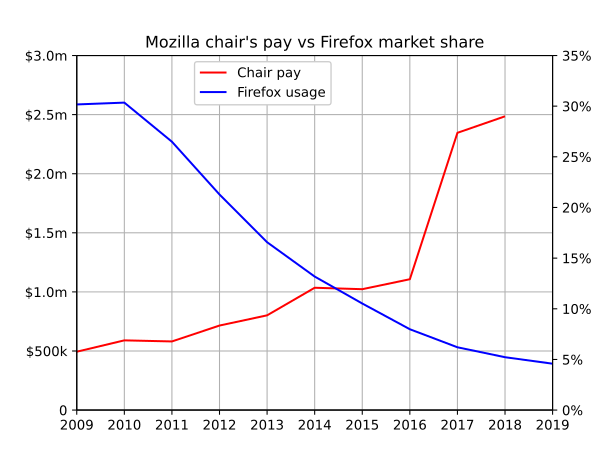
Mitchell Baker (Mozilla CEO) makes 3 million a year. It's actually very profitable for a nonprofit organization, isn't it?
"On the same period, Firefox marketshare was down 85%. When asked about her salary she stated "I learned that my pay was about an 80% discount to market. Meaning that competitive roles elsewhere were paying about 5 times as much. That's too big a discount to ask people and their families to commit to."
This lady then goes on and on talking about "social justice".
"By 2020 her salary had risen to over $3 million, while in the same year the Mozilla Corporation had to lay off approximately 250 employees due to shrinking revenues. Baker blamed this on the Coronavirus pandemic."
i find the role of a "ceo" in mozilla as offensive as anything. for that matter any "management" role because it should be devs earning a buck while building cool software. nothing more, no paper pushing "managers" and ceos. why does mozilla need them anyways? who is forcing them to have one?
Mozilla needs a CEO for the same reason all companies need one. I find it disappointing how people grill open source or charity projects over spending money on management or marketing like it’s a waste. Do you think every other company spends this money just for fun? Or that it actually provides value to the business and helps them succeed?
Where's the value for Mozilla? A >80% reduction in userbase? A staggering loss in their ability to compete and recover their lost userbase due to laying off many of their highly-skilled technical staff?
If this CEO is providing value, I'm not seeing it.
It's possible that the CEO is right and the position is going for 5x less than market rate so only the bottom tier people want to take it. But also that Firefox is doomed no matter what they do. Chrome, Safari, and Edge are now all very good browsers that come by default. No one has a reason to install a different browser. An even cheaper CEO may not even be able to preserve the slow burn Mozilla is at and may just immediately crash it.
Whataboutism or whataboutery (as in "what about…?") is a variant of the tu quoque logical fallacy, which attempts to discredit an opponent's position by charging hypocrisy without directly refuting or disproving the argument.
As someone who works on the digital payments/processing side of the house for a charity, I can tell you that accepting designations is a can of worms that smaller charities would certainly want to avoid.
Their nonprofit is already accepting donations and they are already selling services. I can't be that hard to "sell" a cosmetic Firefox Premium upgrade, although it might not be used enough to be worth it.
Why would you think that funds from firefox premium would only go to development for firefox? Do you think money you spend on Azure is ringfenced for Azure development and isn't ever spent on Microsoft Gaming (for example).
There are several legal precedents that say otherwise. Regardless, when you give money to a charity with a restriction or designation and they accept the money but ignore your request that generally doesn't go over well.
I am waiting for the day it will be (either for Firefox or a replacement). Mozilla Inc. has shown again and again theat they do not have their user's interests in mind.
Could almost just get a patreon together, and then fund a developer from it? Because I think if you put out a job posting, working on firefox independent from Mozilla someone would take you up on it.
I meant not a fork, but just a developer. I would love to work on Firefox full time without actually working for Mozilla. I'm sure you could find much more qualified candidates than me who would also do so.
>"hire a full development team that can hopefully catch up and overtake Chrome?"
In an ideal world the best browser would win but marketshare doesn't work that way.
Microsoft has full time development teams working on Edge and it is just barely chipping away at chrome's dominance. And, in no small part because they pester Windows users to make Edge the default at every opportunity.
Really? So every time you bring in a dependency on a library written by someone else, your software is just a theme or wrapper? I guess that's one way to look at it.
1. It doesn't really matter. Most users don't even know what a browser engine is much less care, so whether it's a fully independent browser or not is irrelevant to their adoption in the marketplace.
2. The story was no different even when they were still using Trident as their engine.
Pocket Premium and Mozilla VPN are about the closest you can get to money that goes into the coffers of Mozilla Corporation (instead of the Foundation).
Mozilla is not the same as Firefox, unfortunately. If I remember correctly Mozilla itself is relatively flush with money (through a deal they have with Google) and doesn't really need the money. Their chair is paid extremely well, in any case [1].
A lot of Mozilla's money seems to be spent on executive pay, overhead, and questionable side projects. Not so much (or not enough) on browser development, it seems. I'd MUCH prefer Firefox to be a product organization with its own budget and perhaps a yearly contribution from Mozilla. I have more faith in Firefox than in Mozilla.
This is on the right track but a bit confused. There are two entities:
1) The nonprofit Mozilla foundation
2) The Mozilla corporation
The foundation owns the corporation.
The corporation develops Firefox and is primarily funded by the Google search deal. It also develops pocket and the VPN and gets some funding from their sales.
The foundation is funded by grants and donations, both from individuals and from other organizations (including from the corporation).
> Contributions go to the Mozilla Foundation, a 501(c)(3) organisation based in San Francisco, California, to be used in its discretion for its charitable purposes.
This goes to the Mozilla Foundation and not to the browser's development. As far as I know there is currently no way to donate to the browser's development.
A browser has long been not a saleable product and buying side products is the closest thing you can do to fund its development. Not that it is satisfactory, but if you aren't doing that already then your complaints sound less credible IMO.
The Enterprise™ spends insane money on security products, lots of which are bordeline snake-oil. There's no reason a browser couldn't be part of that, especially considering it's at the front line when it comes to threats and could actually make a real difference.
Electron is also popular and Mozilla could produce a Firefox-based alternative (whose selling points could be performance/memory usage/battery life) and provide commercial support.
Is it going to sustain extravagant salaries & bonuses for the C-suite? Debatable. But it can absolutely be a suitable business paying reasonable salaries.
Do you mean in market share or the actual product? Because I use Firefox daily and honestly feels less bloated and better to use than Chrome. I do use Chrome daily also, for some work-related apps
I have seen jobs at Mozilla that I'm interested in, but I'm just too afraid that they'll do more eng layoffs that I don't want to go through the hassle of applying.
This. Only paying for a browser aligns the incentives of the browser company and the user. As long as customer of the browser != user of the browser, there is ample opportunity for conflict of interest.
I've been waiting for this for a long time. The last big hurdle for this was that color spaces weren't applied correctly.
If you haven't taken a look at AVIF, do. You can get a similar looking image in AVIF at half the size as a JPEG. I find AVIF's image artifacts preferable to JPEG's.
I kind of doubt it. JPEG is good enough, and is pervasive. JPEG XL is better, but removing an incumbent file format requires more than just being better. We'll see.
JPEG XL has a party trick where you can losslessly transcode JPEG files to JPEG XL for a ~20% size savings. I imagine that every CDN out there will enable transparent conversion of JPEG to JPEG XL and that will drive adoption just by itself.
Dropbox quietly replaces the insides of JPGs with a better compression system (lossless change) to save their storage costs, and then returns it to normal when the file is read. (It may be they do a JPEG XL transform, for all I can remember about the article which explained it).
I wouldn't be too surprised if every big CDN already does something like that internally as a competitive advantage, and if so then the incentives switch around and there's no benefit publically switching to JPEG XL - when everyone has it, there's no easy way to do better than everyone else.
CDNs would love to bill customers 20% less for bandwidth used? Customers will be able to move to storing JPEG XL files on CDNs and reduce their own storage and bandwidth costs, but I was responding to the claim that it would be in CDN's interest to hurry the transition, and I think it will be a loss for CDNs.
JPEG XL supports a recompression and bit-perfect reconstruction of JPEG(1) files, so once it got universal support it does have the biggest potential to completely displace JPEG.
Worse... When you are forced to support IE11, and keep limited to the old good JPEG.
At least, JPEG-XL offers a solution on this side, like store as JPEG-XL and serve as old JPEG to IE11 users. Now, if only there was a JPEG-XL implementation for Java...
Firefox 93 doesn't seem to support animated AVIF images. I have few AVIF examples animating correctly on Chrome 94 but only showing stills on Firefox 93.
> AV1 Image File Format (AVIF) is an image file format specification for storing images or image sequences compressed with AV1 in the HEIF file format.
I've found AVIF's spec to be massive and overly complicated to implement in its entirety. Four years later, ffmpeg doesn't even support AVIF/HEIC encoding or decoding yet, despite those formats arguably becoming ubiquitous thanks to Apple.
If you mean the container format, AVIF uses it natively.
If you mean the image format, probably never. It's based on the HEVC/H.265 licensing minefield. For that reason, I don't expect it to ever be supported on Chromium or Firefox based browsers.
I thought that .heic has patents on it and is thus not free in some cases. Which I think is an overwhelming reason to bury it and not use unless you have a very good reason to.
Having fewer browsers support .heic format would be a benefit -- as it would decrease the chances of the format surviving.
Hmm, I really like live photos(the moving pictures of the iPhone) and the advantages that brings. Damn, Apple got me again. I'm going to read up on advantages of Heif and maybe set up script in Nextcloud to auto-convert, so I do have a free format of all my pics.
I am currently trying Ubuntu for the first time in a long while and it comes with Firefox as the default browser.
My problem is that Firefox has a "snapping" scroll behavior that I find very annoying. When I move my fingers on the touchpad of my laptop, that does not immediately move the page. Instead, it waits until I moved a certain distance and then moves in one big swoosh.
Starting Firefox from the command line like this solves it:
MOZ_USE_XINPUT2=1 firefox
Is there a way to make this permanent or accomplish the same via a setting in about:config?
You can make it "permanent" by editing the .desktop file your Firefox is launching from when you click it in Ubuntu. You can change the Exec= line to be Exec=MOZ_USE_XINPUT2=1 firefox, or maybe Exec=env MOZ_USE_XINPUT2=1 firefox
Although the scroll is more fine grained now, it looks kinda wobbly. Almost as if there is a raster interrupt at play, lol. As if the screen gets repainted mid scroll and then needs another round until the whole screen is updated.
No that's not how that works. Environment variables are inherited from parent processes. If you just put that in a sibling process (like a terminal), it won't run firefox with that variable if you run it from the GUI.
Your .bash_profile allows you to set up the environment for your entire session.
So environment variables on Linux are tricky business; basically, the answer depends on how your desktop session is set up.
Usually, PAM will load environment variables during session initialization; I'm pretty sure that's the thing that reads /etc/environment. See man pam_env; though whether it works depends on whether that module is enabled in your PAM configuration.
You can also have other things read environment variables. If a user systemd instance is launched that starts the rest of your session, that will load environment variables from various places (it also affects things launched indirectly through it, eg. via D-Bus, that can't inherit your environment from the shell)
The "last" level in a typical GUI session is the shell in your terminal which will read the "traditional" files, but they aren't usually very useful for GUI applications because the GUI applications generally aren't started from any process that has a shell in its ancestry nowadays.
Yes. But does it matter? That envirornment variable doesn't sound like it'll hurt anything. If you only run firefox via a desktop icon or the os menu, you could target it there instead if you prefer.
Here's what I desperately want from Firefox, which I currently have from Chrome: isolated browser profiles tied to an account. I have two browser windows open at all times, one for my personal stuff and one for my work stuff. I want to keep those two windows totally isolated, where I log in with all my work accounts in one window, and all my personal accounts in the other window. Chrome does this by tying the window to a Gmail account, I'd happily sign up for two Firefox accounts if I could do this.
But Firefox has a much better feature: tab containers. You can attach a label to a tab, and only tabs sharing this label will share states, such as cookies, cache, localstorage and so on. This means you don't need to open a new window. You can have 2 HN accounts with each a different user logged in, in 2 tabs, next to each other, distinguishable with a color.
Multiple browser profiles also let me have one profile for work, another one for personal stuff, and yet another one only with stuff like vue/react/svelte dev tools and remote debugging enabled, and _then_ decide which one to open at any given time. This instead of opening every container at once, or something like selectively opening a bunch of bookmarks manually into a specific container (I use buku to manage and sync my bookmarks too, so no tab container support there).
Firefox has supported this for decades, it just doesn't have a very nice UI for managing it.
Simply start it with "firefox -P" and create two separate profiles (call them "work" and "personal"). Then just start two instances of Firefox, with "firefox -P work" and "firefox -P personal". They will be totally isolated - cookies, history, addons, everything.
The UX for profiles is fairly awful compared to chrome. There's a web extension to make things better but it requires a companion application.
Ideally they'd expose more options through web extension APIs or build in a native profile switcher in the main ui rather than as a command line flag and a dedicated about: page. It'd also be cool if the account containers could be customized to behave like profiles e.g. isolate history, but that gets a classic "we need to do this yak shave first" response whenever it gets brought up.
Firefox has an "official" add-on called Multi-Account Containers. This isolates website state (cookies etc.) but not history/settings/extensions.
Alternatively, you can start Firefox with `--no-remote -ProfileManager` flags to get a totally separate instance, like Chrome does.
Personally, I use Multi-Account Containers together with the Temporary Containers add-on, to by default get a fresh cookie jar for each new tab, but I do have some websites tied to a named container for session persistence.
You can do this with Firefox's containers. Containers are a Firefox built-in feature, but without a UI; install the "Firefox multi-account containers" extension to get UI for containers. There are also a variety of other plug-ins that do useful stuff with containers; search for "container" in the Add-ons Manager to see what's available.
I hope we can turn off the "unsafe download" thing. I download files every day that I know are perfectly safe, precisely because the file will only ever be downloaded once, by me, because I just built it in Gitlab.
If you click through the learn more link, you can see an example of the new warning. Instead of starting the download, it shows a dialog with a warning and there are two buttons, one of which is "Allow download".
The second part of this feature is that for <iframe sandbox="..."> elements, regardless of HTTP/S origin, Firefox will no longer allow the iframe to initiate downloads unless the sandbox attribute explicitly includes allow-downloads
It appears that there are a pair of preferences in about:config to govern these: dom.block_download_insecure and dom.block_download_in_sandboxed_iframes
I'd love to move to FF, but it has a virtual desktop bug dating back to 2007 [0], which is a showstopper for me.
When reopening FF, e.g., after restarting Win or Linux, all FF windows are restored to a single virtual desktop, even if they were on different desktops previously. Chromium-based browsers don't seem to have this problem.
They tried fixing it a few times [1,2], but the bug persists, and I am not aware of any add-ons that could serve as workarounds.
All the bugs you linked are marked as fixed, so unless you open a new bug with clear steps of reproducing your specific issue, it's probably never going to happen.
There a few more bug reports that I didn't link to. I have just found one saying that the bug will be fixed in FF 94. I don't have high hopes because this bug seems to come back from the dead soon after being fixed, but fingers crossed!
It seems like both that and "Introducing a new referrer tracking protection in Strict Tracking Protection and Private Browsing" link to blog posts that are supposed to exist but maybe haven't been switched to "published" status?
When available system memory is critically low, Firefox on Windows will automatically unload tabs based on their last access time, memory usage, and other attributes. This should help reduce Firefox out-of-memory crashes. Switching to an unloaded tab automatically reloads it.
This is why I can't switch to firefox, chrome is better at this, doesn't wait until 'system memory is critically low' and supports all platforms not just windows.
I am just glad that all major browsers besides IE now support the input type. Granted, you still likely want compatibility with Firefox ESR. But it is nice to know that the polyfill will gradually become less and less necessary.
I wish browser makers gave more attention to implementing form widgets. Natively accessible widgets optimized for the device it's being displayed on? yes please
I've been waiting for some of the more advanced options of <input type="range"> for ages. <input type="color"> is supported but often a bit clunky in its implementation. Hence people don't use them, hence they don't get improved.
Some sort of drag and drop reordering widget would be really nice as well
I'd wish Firefox wasn't locked to an old lts version on my work laptop; it's bad enough some websites won't open (like regex101 or twitter) and I have to switch to chrome for those
It's yet another thing to install & configure manually. For a browser that boasts about privacy at every possible opportunity I'd expect something as standard & essential (in this day and age) to be included.
> It's yet another thing to install & configure manually.
Once. Coming up on 5 years ago now for me. Every time since, I log into sync, and it appears with all of the proper configurations already set up to my preference.
Considering the fact that Firefox has had less than 5% coverage of the browser market for years now, this is not very reassuring. It's also quite frankly missing the point.
It shows a clear case of mission statement in conflict with business model and shakes my confidence of Mozilla as the champions of privacy and freedom they paint themselves as.
Keep in mind that they don't even need to make it built in, they could instead bundle ublock origin as a preinstalled add-on and provide a little bit of money to the developer. It would simultaneously improve the security and browsing experience of many of its users while attracting many new ones and funding the fight against invasive online advertising.
But big daddy Google would get so cross then and Mozilla would be forced to adopt an actually privacy respecting alternative like duckduckgo and lose a lot of their funding.
I don't want to main Brave as I currently do, both because of its use of chromium and my ill feelings of the CEO's donations to political movements against the LGBT community but Mozilla management have lost my confidence over the years despite the actual deveopers remaining world class.
I don't think Google would be as mad as every other publisher on the internet who relies on ads for their living. They would go on campaigns to block Firefox from their websites entirely. They already rail against adblockers with full-site popups and blocking content until you disable your adblocker, making adblocking a default would escalate the situation exceptionally quickly.
Firefox's marketshare would drop even more quickly if people couldn't visit their favorite sites with it (and were likely directed to Chrome or Edge).
Without an alternative, readily available method of monetizing websites, it's realistically going to have to remain opt-in (i.e. installing uBlock).
Except there are already anti-anti-adblockers out there like REEK which work very well. Their campaigns might escalate but so would the efforts of the adblockers and in a fight between an established tech player like Mozilla and even a very large old media conglomerate, I don't fancy the latters chances at winning that tech arms race especially with all the bad press their efforts would generate.
This whole argument is largely invalided by the mere existence of Brave anyway. You could argue that their crypto based mode of monetisation is not the absence of rather the reimagining of ads but regardless of how you feel about crypto, it's definitely superior for the end user and offers effective monetisation that is optional.
Regardless of your feelings on crypto, it absolutely is superior than the default. With Brave, you only need to trust them. With Firefox, you need to trust every Tom, Dick, and Harry with access to Google Analytics.
Also, you can choose to disable all the crypto and still get the built in adblocking. With Firefox, you can only turn to add-ons.
And I shouldn’t have to think about it. Why even build a browser if I have to understand the concept and reasoning of installing an extension myself? Does Mozilla think I have the seconds it takes to do this?
uBlock Origin blocks by default every single ad, even if they add the extension with other default setup, its just unrealistic to imagine they are gonna make even easier to block all google ads while a significant part of their revenue depends on that.
That's cool, but I'm on an M1. Everything is fast.
How's it do on battery life? How often does it turn out to be the culprit behind system-wide performance problems, if you've just got it sitting open in the background while you're doing other stuff?
M1 users also reported performance degradation.
Second line: do you mean Chrome? I don't know, Safari is my main browser, which might change after v15...
My journey from FF to Safari started back in 2012 or 2013 when I noticed Chrome didn't make my whole system slow, like FF did, so I switched to Chrome. Then I realized that I'd gain like 2+hrs of battery life if I used Safari, and it was even more respectful of multitasking and system resources, so that's what I'm on now. The iOS integration is great too, but I'd switch if someone beat them on overall system resource use (not "speed"—I know Chrome especially has loved that metric for a long time, but I do not care if it runs Quake compiled to WASM at a higher framerate or whatever)
[EDIT] FWIW, FF user since Phoenix & Firebird, haven't loved it since IIRC FF3 (yes, 3) when it started to bloat itself into being the sluggish, huge thing it replaced. I still use it on my Windows gaming desktop, but that's because I barely use the browser on there, and it's plugged into wall power. Safari 15's UI is god-awful though, so I'm primed for a switch.
Safari’s meteoric rise for me started by the time Metal was introduced ca 2014. It smoked the competition consistently until this year’s v15. I wish the performance drop was scrutinised as much as the UI issues, which are also terrible.
This would be massively annoying for my local network. I trust that I do not mitm myself for malicious reasons and really do not feel like setting up certs on my lan...
Talking about certs, nowadays it seems browsers want to make you believe that self signed certs are some diabolical work straight from hell. Using self signed certs with websockets on Firefox is actually nearly impossible [1].
I do wish there was a way to disable all those https-only protections in a browser for development on the local machine. Yes I know for localhost they are sometimes disabled (but not always, like e.g. samesite=none cookies), but sometimes you want to test cross-domain interactions using a tool like dnsmasq, and it gets to be a real hassle
> Targeted users in Turkey and Syria who downloaded Windows applications from official vendor websites including Avast Antivirus, CCleaner, Opera, and 7-Zip were silently redirected to malicious versions by way of injected HTTP redirects. This redirection was possible because official websites for these programs, even though they might have supported HTTPS, directed users to non-HTTPS downloads by default.
This absolutely can happen. A few years ago I discovered [0] Atlanta Airport's public WiFi was injecting ads into non-https pages. A malicious actor changing download links is not a far fetched possibility.
At least it can't be an HTTPS link to the same domain. But even if a user notices this, it's not worth a lot in the age of CDNs on weirdly abbreviated separate domains...
They can be MITM'd by anyone on a hop between you and the server, and unless they're an authenticode-signed exe they could also have been subtly tampered with at rest
Mind you, HTTPS doesn't mean downloads are safe. Not remotely so. HTTP just means they're way less safe, and if you're on a HTTPS website it definitely should not be serving downloads over HTTP
Yeah how dare Mozilla force sites to pay for TLS certificates! It’s a racket I tell you! If they’re going to be required in order to be on the internet they should be free
Let me see if I understand this, SSL is bad because one very well known to be shitty hosting provider charges lots of money for it? And we should hold back securing web traffic on the internet until such time as GoDaddy changes their pricing structure?
Look I get it, if I hosted sites on shitty providers and couldn’t change because of corporate BS I would be frustrated too. But “everyone else should change to accommodate my problems” isn’t the right response. It’s the same with crappy SSL middleboxes, I feel for people who have to deal with broken sites because of them but breaking TLS as a workaround can’t be the way forward.
I think you misunderstood me and are reading a lot more into my post than I intended. I was just making the point that godaddy's annoyingly large fee is an example of a contributing factor to the plague of non-SSL sites.
Time is money, I'm sure some users visiting websites that don't have the luxury of being maintained by multinational corporations will experience issues as a result of this change. TLS certificates are also not trivial to set up or renew if you require a wildcard certificate.
Wildcard certificates are the much much easier case. You don't have to mess with your web server or routes at all. You just hook up certbot with your DNS provider and say "get me a cert for '*.mydomain.business", run the renew in a cronjob (which certbot does automatically by default now) and never touch it again. I've had certbot running for like 4 years with no interruption with this setup.
The Venn Diagram of people who forgo managed hosting with SSL built-in and set up their own servers to host HTML pages on the internet and the people capable of following a guide to configure certbot is a circle.
Not all DNS providers are supported by certbot, so sometimes it's impossible to automate. It's not infrequently that I come across sites with expired certificates nowadays.
And what of those who have left their old site (that has no need for TLS) online for years without ever knowing 'insecure' HTTP is being deprecated? I don't think their sites breaking and showing warnings should be acceptable when the security benefits are so marginal.
It doesn’t really matter if all DNS providers are supported because you can just delegate your _acme_challenge zone to any DNS provider that is, like Route53 or to your own DNS server.
I don't care if they 'dragnet survey' my users who are just looking for 20-year-old data sheets. Fact is, not everything needs unbreakable encryption, or a warning label for lacking it.


Overall contributing has been very pleasant and the people on Mozilla's matrix channels have been helpful getting me on track. But better than taking my word for it, you should try contributing for yourself :)