With the exception of a few (very important) services (e.g. college tuition, healthcare, childcare), increases in income have actually outpaced inflation for most other goods and services over the last 20 years [0]. This is something I almost never see discussed; almost everyone seems to believe that real incomes have totally stagnated.
That said, given current inflationary trends, it will be interesting to see if this still holds up in a decade or two.
> This is something I almost never see discussed; almost everyone seems to believe that real incomes have totally stagnated.
Real people need to pay for tuition/childcare, housing, and healthcare, so what would be the point of excluding those from the calculation of real income?
The point of Gwern’s article is to highlight specific things that have improved since the 90s. I’m pointing out that this is supported by looking at inflation stratified by various goods and services. Nowhere in my post did I say that “inflation is fine”; I’m just saying many goods and services have gotten dramatically cheaper since the 90s, which is still counter to the prevailing narrative.
> almost everyone seems to believe that real incomes have totally stagnated.
suggesting that this is a false belief. I think this can easily be interpreted as you saying "inflation is fine" (even though that may not have been your intention).
Not always, but a lot of times people pick the number that supports their conclusion. For example, worker pay. If you want to make it seem higher, include the executives and do a mean average. Life expectancy works the same way. It's not that adults typically died at age 30, it's the number is a mean and includes child deaths which was a lot at the time. If you have 4 people, 2 are 60 and 2 died at birth, the mean age is 30. (60 + 60 + 0 + 0) / 4 = life expectancy of 30.
Yes, I cannot see any non cynical reason why the source of the data would want to only release the average. And even then, they usually do not specify what kind of average!
Sidenote-- is average === mean the standard lexicon now?
When I was in grade school we learned that average was a generic term for mean, median, or mode. So when I see average conflated with median in discussion (as it often is), I assume it's intentional. But others seem to interpret it as a synonym of mean.
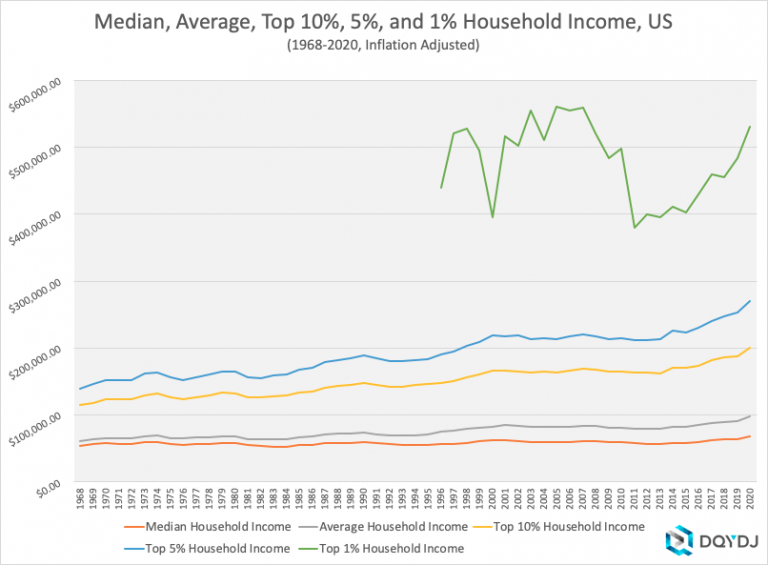
That is much better and it shows that median household incomes hadn’t grown much until recently (as the tight labor market and years of boom have pushed up wages).
I still think it’s crazy our minimum wage is so low ($7.50/hr today vs $11/hour in late 1960s in today’s money). IMHO, it should be pinned to productivity growth since the 1960s (the question is: should we have higher or lower inequality than in the 1960s? The most conservative answer would be “the same”, in which case you tie the ratio of GDP per capita to minimum wage to the same level it was in the 1960s.), which would put the federal minimum wage somewhere north of $20/hour. (Or perhaps a regional approach where a minimum wage of $15/hour is universal and then above that, minimum wage at 40hours/week is three times what it’d need to support a two bedroom apartment rent at median local prices.)
I’m also convinced that stagnated wages has caused stagnation in productivity growth, because as minimum wage becomes cheaper through inflation, it makes less sense for companies to invest in productivity enhancing automation and efficiency as they can just hire cheap workers and fire them as needed.
Isn't the fact of rapidly climbing, market-driven compensation for typically-minimum-wage jobs such as food service, hospitality and labour sufficient to dispense with minimum wages all together? Yes perhaps the market takes X years to adjust, but it does in fact adjust. Why not just wait the years and save all the bureaucracy.
> they can just hire cheap workers and fire them as needed
But doesn't increasing the minimum wage just price these people who were formerly being hired/fired completely out of the labour market?
No, because usually we aren’t in such an extremely tight labor market driven by high federal spending.
If you want to argue for indefinite high federal spending to guarantee a tight labor market for decades, then sure, a higher minimum wage might not be necessary. Is that what you’re arguing?
Because if a tight labor market is transitory (and minimum wage keeps dropping due to inflation), then businesses won’t be given a firm enough pricing signal to make productivity investments.
I'm not arguing for indefinitely high federal spending, but I would make the case that spending money on infrastructure is a much better use of money compared to pretty much anything else the federal government can do with it.
I'm arguing that labour shouldn't be specially exempt from markets fluctuating between tight and loose. I'm also arguing that raising the minimum wage hurts the very poorest of us the most, by making them unable to complete in the only way they can: lifestyle compromise. Indeed, they end up worse off when they are priced out of the labour market and forced into joblessness.
The problem is that in times without a super high labor market, employers are able to maintain a monopsony on labor and therefore suppress wages. This has caused massively increased inequality and wage stagnation. That’s why the minimum wage is good. But using federal spending to maintain a tight labor market can accomplish the same goal.
This doesn't make sense. Anyone who purchases labour is an employer. "Employers" are not a single entity and therefore cannot maintain a monopsony.
It seems more likely that wages lower or stagnate when the supply of labour exceeds the demand. Minimum wages actually hurt this process by banning the demand for labour below a given, fixed wage.
> massively increased inequality and wage stagnation
Increased as compared to when? Before minimum wages there were all sorts of service and labour positions in the economy that simply don't exist now. It used to be that unskilled labour was available for much lower cost. Think gas stations being able to afford multiple attendants, middle class families being able to afford domestic service. These positions simply aren't tenable at "minimum wage".
Was this a more unequal world? You can certainly make the case for that. Was it objectively worse than the world today, where it is tenable not to participate meaningfully in the economy and still be supported by society? I'm not so sure.
Household income doesn't track household prosperity, because household sizes have gradually declined.
>>as minimum wage becomes cheaper through inflation, it makes less sense for companies to invest in productivity enhancing automation and efficiency as they can just hire cheap workers and fire them as needed.
There is a finite number of workers. Once they are all employed, only investment into productive capital raises productivity.
Looks like that despite the top <=10% seeing a disproportionate increase in their income, the overall average and median are still growing relatively proportionally, though not to the same degree as 5 years ago.


That said, given current inflationary trends, it will be interesting to see if this still holds up in a decade or two.
[0] https://www.aei.org/wp-content/uploads/2021/01/cpi2020.png?x...