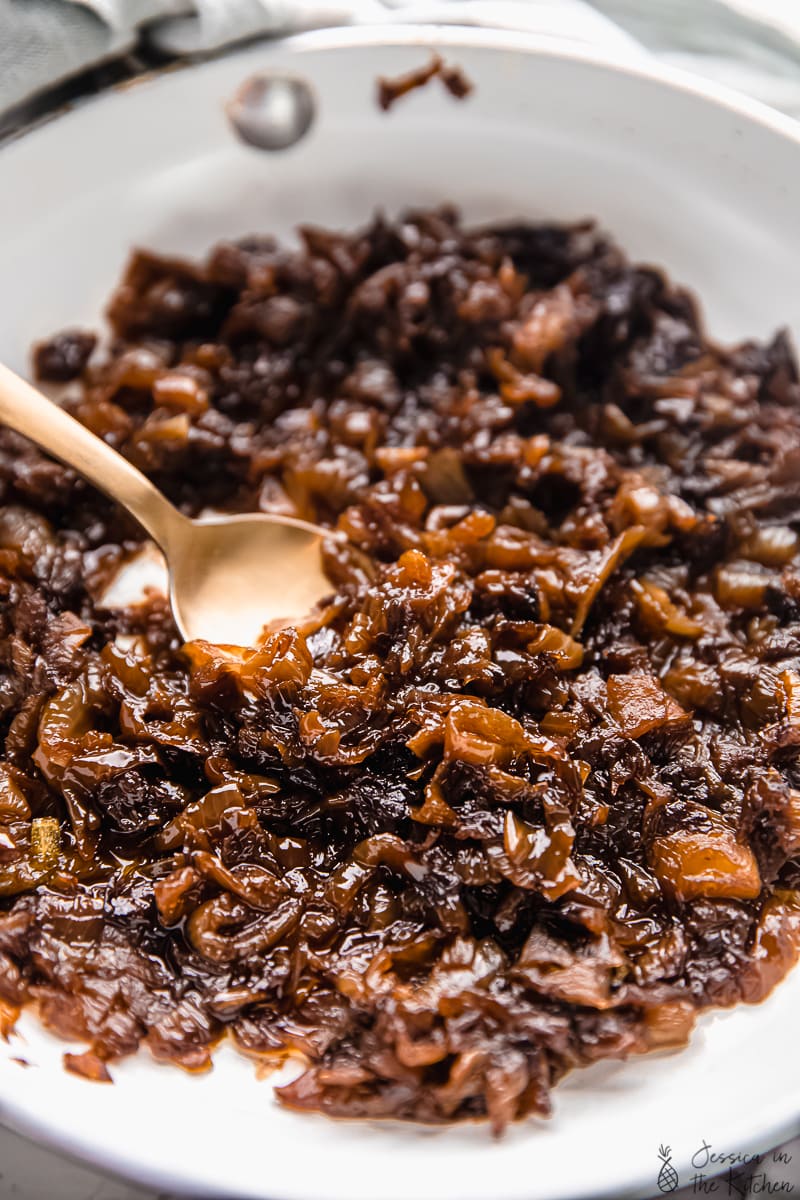
It looks like different people (probably including recipe writers) mean different things by "caramelized onions", which could be the origin of the issue. I'm not saying one is wrong and the other is right, just that there's obviously disparity.
I will tell you which is wrong and which is right. Caramelized onions are caramelized. It’s not a vague definition that varies across cultures, it’s right there in the name. Caramel, it’s deep walnut brown and almost candy sweet. Just look up any photo of French onion soup.
This guy is frying onions, might as well prepare a bowl of Froot Loops and you’ll be just as close to caramelized onions.
Except caramelized onions aren't caramelized. Or not meaningfully anyway. The color comes from Maillard browning. The sweetness comes from breaking down larger sugars into smaller, and concentration through evaporation of water.
Caramelization products aren't sweet, they're primarily bitter. Sweetness in caramel products comes from residual sugar that hasn't been caramelized.
OP's video looks like fried onions with slightly burned sides.
Just like you can't bake a cake at 1000 degrees for 5 min instead of 200 degrees for 25 minutes, you can't caramelize onions in 5 or 10 minutes no matter the heat
Many people confuse fried and caramelized onion. What the op showed is definitely not caramelized. Any recipe book in the market wouldn't confuse them.
> I'm not saying one is wrong and the other is right, just that there's obviously disparity.
As other replies hints at, "caramelize" is not a judgement call or varying definition; it's specific thing, a particular chemical reaction on sugar. if it hasn't happened then the onions are not "caramelised" and they actually are wrong.
It's similar to the debate about "begging the question.". Enough people misuse/misunderstand the phrase that the intended meaning becomes vague: did the author really mean "beg" or "raise"?
It doesn't make the incorrect usage correct, but it does mean correct interpretation of _intent_ requires acknowledging incorrect _vocabulary_.
That reminds me of the pronunciation of GIF. There's enough people pronouncing it incorrectly that the incorrect version became an acceptable alternative.
There are differences. Linguistics is more "descriptive" than "prescriptive", meaning that "it seeks to describe reality" of what people say - if we actually pronounce a word one way and are correctly understood, then that is a valid way that the word is pronounced, whatever it is.
In chemistry, validity is not so subjective. it seeks to describe reality by measuring presence of clearly definable chemicals. The question of "what percentage of the sugar in this food item has been converted via caramelisation (or the Maillard reaction)" is not something that we can choose different but equally correct measurements of.
if you're referring to the "long debate" here on HN, then no, it doesn't mean very much about the facts of the matter.
original article doesn't debate the definition of caramelize, rather is about how it can be achieved.
Some things such as "pleasant music" or "good food" do not have crisp definitions. However, chemical reactions are far more clear-cut. They can be described and measured accurately, and debate settled. It doesn't matter how "long" the debate is, there are correct answers.
The only debate that IMHO I can see is "what percentage of the sugar has to be caramelized before it counts as a caramelized onion" ? Are there terms for partly and totally caramelized onions?
There's probably little if any actual caramelization of sugar happening in "caramelized onions" despite the name. "Maillardized onions" would be more accurate, if awkward sounding.
Haha. I read larsrc's confident comment and thought, ah, the blogger must have been wrong. Then got to the equally confident replies and realized everyone's confident and coherent on HN (vs confident and ranting looney on the general internet) and I need to calibrate my gullibility :P
No, it's precisely the opposite. The issue is exactly that recipe quotes frequently write "caramelized" when they mean "browned."
Yes, there is a technical definition of "caramelized." No, not every recipe writer uses this definition.
Look, when a recipe says "caramelize the onions for ten minutes" then there is something wrong, right? It's either the time or the word. Why does everyone learn the "true" definition of "caramelize" and then start assuming that the author must have used the right word and the wrong time, and that what they actually want you to do is sit there tending to onions for 45 minutes?
The VAST majority of recipes, particularly Italian or French, neither require nor want caramelized onions. Unless it's a recipe like French Onion Soup, the vast majority of such recipes want softened or browned onions. Take this from someone who has cooked in Italy and France for nearly 35 years.
“Exponentially more”, “decimate”, and “increased by 200% [to mean doubled]” are also standard terms which are used in a variety of contexts, often (usually?) incorrectly as compared to their actual definition.
If I'm a Roman general, and I have two captains, each with 1,000 soldiers, and I tell them their troops lacked discipline in the last battle, and I order them to decimate their troops, and one of them comes back with 100 soldiers and the other comes back with 900 soldiers, I am going to have a long conversation with them about how words have meanings.
If I'm a chef, and I have two line cooks, each with an onion, and I tell them that their onions will need to be prepared for French onion soup, and I order them to caramelize their onion, and one comes back in 10 minutes and the other comes back in 45 minutes, I am going to have a long conversation with them about how words having meanings.
This isn't a random context, this is the context where the term "caramelize" is technical jargon.
That’s exactly my point. Far more cookbooks and subscriptions can be sold to “people who cook” than to “professional chefs who rigorously and precisely follow the literal definition of terms which once had a specific meaning and now colloquially encompass a much broader range of meaning”.
(Imprecise language bugs the hell out me as well, but it seems like it’s easier for me to bend than to attempt to fix all the humans.)
I can be mowing my lawn when it's 110F outside and say, "Gosh, I'm boiling." But if a recipe tells me to "boil" something, and it means anything other than put it in 212F water with heat applied in such a way that the water is bubbling, then the recipe is a shitty recipe, and I will diagnose the author with a confusion of the mind. The fact that the term now encompasses a much broader range of meaning in other contexts is completely irrelevant: I am not in those other contexts, in this context, it is a word with a very specific meaning.
The Slate article and this very HN discussion (broadly, not this sub-thread) are evidence that the phrase “caramelized onions” does not appear to have a singular, very specific meaning in this context. If it did, cookbooks wouldn’t make the claim and the Slate article and this discussion wouldn’t exist.
> to “people who cook” than to “professional chefs
You have a point here, there is a "context collapse" happening, when this definition is necessarily precise for professional chefs, and less so for "people who cook to eat".
However such recipe books typically claim to bring some of the professional techniques and results to the home cook, and as such are sowing confusion if they encourage "semantic drift"