Using Fibre-Reinforced Polymer for pedestrian bridges isn’t new, is it?
A few minutes of googling gives me https://www.fibercore-europe.com/en/projects/, which has dozens of FRP bridges. I doubt that’s the only producer in the world. I don’t see what’s special about this one (but feel free to educate me)
That leaves the shape. I would guess the corners in the road are there to avoid having to use land that isn’t owned by the railway. If so, what’s left is the specific design. That’s nice, but other nice designs are possible.
Now, as to the idea of making a pedestrian bridge over a railway: it’s better than no pedestrian connection, but the stairs on such bridges necessarily are fairly high. Train tracks often lie above ground level, and even if they don’t, the total height to the top of the overhead line, plus some safety, plus the height of the bridge’s deck means you’re easily going two floors up and down.
In the UK pretty much all stations have bridges, so this will mainly be about being able to put them in place much more quickly when you are making changes to a station, or putting a new bridge in somewhere (i.e. there may not be one that's inside the ticket barriers on some smaller stations).
Looks more like a design for footpaths in open countryside or between housing estates. Stations have a lot more to build around and on even if existing bridges need replacing
No, these are very much for rural applications, hence why they don't need to include any provision for ramps or lifts (which most new crossings must), given the paths they connect are themselves typically at best a mud track (and often just a scarcely marked crossing of grazing land).
Eh, unless you spend much time walking in parts of the UK anywhere near a train line, it's not too hard to be totally unaware of such bridges (or even just footpath level crossings).
only a relatively small percentage of the UK network is electrified using a third rail (it is essentially a deprecated technology)
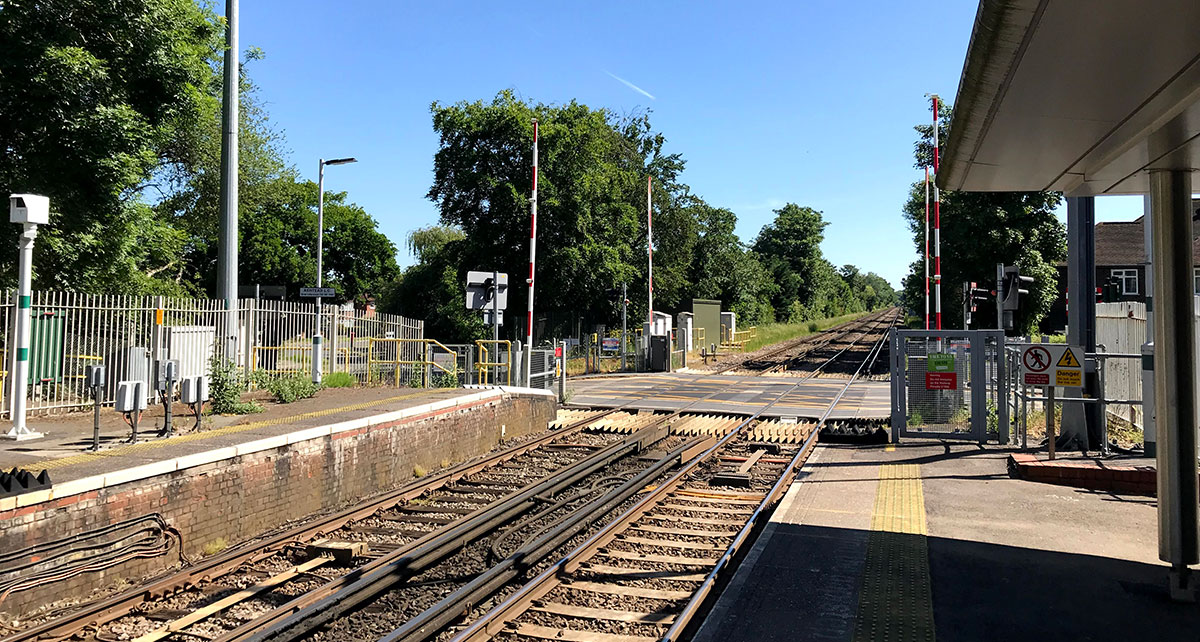
regardless, level crossings work perfectly well: they simply have a gap in the electrified rail over the crossing (and the train is longer than the gap)
One of the key drivers for cheaper and easier footbridges is to close level crossings. In the UK we have tons of crossings - footpath, private road, and highway - dating back to Victorian times, and Network Rail would like them gone. They're one of the biggest remaining sources of injuries and deaths on the network, especially on 125mph fast lines, and are operationally awkward.
They got rid of a bunch of private farm crossings during our Foot and Mouth Disease outbreak by going door to door with desperate farmers and offering wedges of cash to give up their private crossings. They care a lot.
I don't feel like the downvotes are justified. Composite structures using FRP is hardly new or novel.
A quick search on Google Scholar showed up this article on FRP footbridges, which mentions that the first FRP footbridge in the Netherlands was constructed in 1995.
The white boats and yachts that you see are typically glass-fiber-reinforced epoxy, and they seem to be holding up just fine. "Carbon fiber" products are CFRP (carbon fiber reinforced plastic), where the composite matrix is fibers in epoxy, and those look fine after decades as well.
Fibreglass boat hulls have constant ongoing maintenance and repair cycles.
Hell, just last week I was watching a video about how abysmal the material has been for the wind turbine industry after it tips apart from hail stones.
Sure, theyre moving at 100 mph but I don't see why people would think building bridges out of this stuff is a good idea.
I think your mental model of wind turbine sizes is a bit off: the rotation speed is basically dictated by the need to keep blade tips moving slower than the speed of sound, which is why you see newer/larger turbines going slower than older/smaller turbines.
Most modern turbines operate with tip speeds around 200m/s, corresponding to around 450 mph.
About half the boats at my marina are fiberglass. The only maintenance they need is cosmetic, and there are many who skip it and many who polish it.
The other boats are metal. As I write this I am trying to remember if it’s aluminum or galvanized or stainless. There is a popular brand, anyway. The metal boats are popular because it is a fashion thingy to not keep them clean.
The more expensive marinas have bigger proportions of polished boats and teak decks.
Anyway, as a fiberglass boat owner, I’m not recognizing the constant maintenance thingy. Nobody’s told us boat owners! :)
The amount of work that goes into maintaining a yacht far exceeds the financing available to public infrastructure. Of course, bridges are not normally sitting in salt water. Either way I'm not sure the comparison is very meaningful.
> The amount of work that goes into maintaining a yacht far exceeds the financing available to public infrastructure.
This reminds me of some family members that lived on a boat. As soon as they finished maintaining one thing (e.g. painting), they could immediately start over again. It was an endless cycle of doing maintenance to the boat. They really wanted to live on a boat. Eventually they sold it and bought something else, though unsure if the maintenance was the cause.
That work typically is highly parallelizable, so you could do it in half the time, too (a year of maintenance, wait a year, a year of maintenance, etc)
From an operations viewpoint, it’s easier to pick a degree of parallelism that makes this a continuous operation.
You don’t have to close down and start up maintenance work, you don’t have to scale up and down the number of workers, etc.
(On farms, there’s an opposite force at work. Farming itself is highly cyclical (not much to do in winter, relatively), so maintenance was done cyclically, too)
>The amount of work that goes into maintaining a yacht far exceeds the financing available to public infrastructure
I don't know about your jurisdiction but every bridge in my area gets inspected by qualified bridge inspector at least every 3 years, and if there are potential issues more often.
>Of course, bridges are not normally sitting in salt water
Again, not sure about your jurisdiction, but many jurisdictions use chlorides for winter ice melting.
> The white boats and yachts that you see are typically glass-fiber-reinforced epoxy, and they seem to be holding up just fine.
They really don't hold up at all. FRP degrades rapidly when exposed to UV light, and boats not only are not subjected continuously to high loads but they are also not subjected to vandalism.
Serious question - do you really think the team of engineers who designed these bridges aren't aware of the existence of solar radiation or climate on planet earth?
Counter question - do you think the team of engineers would scrap their whole, hard-earned design because e.g. they found out that after 20 years it would stain to an ugly yellowish hue in sunlight?
Oooh, they are aware. Keep in mind that Boeing's also was aware about possible issues with the MCAS in the 737 MAX and it went flying (and crashing) anyway.
It will get painted. FRP is a very common structural material, been in use for decades. It’s more expensive and tough to work with, but a great solution for difficult scenarios, like when fitting around odd shapes or when weight is a major concern. We use FRP regularly for seismic bracing of existing structures, for example, wrap an old concrete column with FRP so it will better survive an earthquake. In this case, I imagine the appeal is the extreme light weight simplifying foundation work. Pay a lot more for FRP, pay a lot less for everything else. That’s usually how we end up installing FRP.
The most necessary pedestrian bridge near me has what look like metal gutters running up and down the stairs. In fact they mean when you dismount a bicycle it becomes fairly easy to go up and down the stairs pushing your bicycle.
The at-grade crossing there is closed for up to 40 minutes per hour, because the railway carries both freight (to/ from a major port) and passenger trains. If you're in a vehicle too bad, "Long Queue. Turn Engines Off" as the signs say but if you're on foot the bridge means you don't need to care too much about that.
You might be wondering: Why isn't there a road bridge? It's an industrial estate, so any road bridge needs to carry large goods vehicles, articulated trucks and so on, which means a fairly large concrete structure with up and down ramps occupying a large footprint and there's nowhere to put that. It's also next to a tidal river, dig down and it'll flood, further into the city they just tunnelled the entire railway under the park, but that is not cheap.
I feel like a lot of people are commenting without much context. These bridges are for legal footpaths. They’re usually in the countryside. The paths aren’t maintained they’re just a legal right of way through the countryside and they have a legal obligation to put a bridge so as to not obstruct it for people on foot. It’s not like a trail as in the US. The paths aren’t even remotely wheelchair accessible for miles either way they’re usually mud. You would have to climb over stys to get to the bridge. The bridge would be the least of your problems.
And the point of this is to be able to close high-risk at-grade crossings of the line, especially those with relatively poor sight lines or where the necessity to maintain sufficient sight lines is an impediment to increasing the line speed.
It wouldn't matter. In (most of?) the US, anything you so must meet all the latest code, so if you aren't rich you line in a tent (I'm exaggerating slightly, but you are forbidden from a building a 1970s car, house, etc)
The US ADA requires reasonable accomidation, which is wishy washy, but lots of new construction nature paths in hilly terrain just have steps, because there's no room for a ramp and an elevator would be unreasonable.
Even new construction train stations don't always get an elevator to go over or under the line to the other platform... although they do get a long ramp and a ramp on the platform to load if the car floors are above the platform.
If these crossings are really in the middle of nowhere along muddy footpaths, I think you could get away with no ramp in the US, too.
If the government built a train station on the middle of the trail, then they would literally be required to build ADA-compliant ramps down to the mud.
I understand your feelings but engineering is an iterative process, what they created here was a prototype with 3 goals:
- Lower cost
- Quicker install time
- Aesthetics
Now the team can go back with the lessons they learned and modify the design.
One thing I noticed upon a second reading is how much they were emphasizing the remote monitoring capabilities.
>is that the bridge will feature built-in monitoring to monitor usage and maintenance needs.
The cynic in me reads this as yet another step in cutting staff for inspection but it may possible that they are planning on deploying this style bridge to more rural locations where there may be unofficial crossings of hiking trails.
The previous comment was about not handling bicycles in the Netherlands. For the Netherlands it's important that it handles bicycles properly, by being able to cycle. Pushing a bike or getting off isn't an acceptable solution (for NL).
Though doubt making it less steep and longer would really be an issue.
That seems quite reasonable for the NL. At least for myself, here in the States, I'd be happy to push my bike for a few feet rather than have to go miles out of my way or ride on a super busy street to cross a railroad. Of course, if we still had railroads in the US. But crossing busy roads is an issue here.
Why would you expect to be able to bicycle over a footbridge? They follow footpaths. You shouldn’t be cycling on a footpath. They’re for people on foot. It’s not a bridleway or cycle path. Clue is in the names!
In the UK a "footpath" is a legal right of way for people on foot. It's often muddy, goes through fields with animals, and there usually are many gates or stiles [0] you need to cross. You probably could cycle over parts of it, but some of the footpaths near where I grew up are even hard to walk as the hedges between fields are often overgrown. You only have the right to walk along a footpath, any other use - including cycling - without the land owners pernission is considered trespass.
Often they are hundreds of years old, so any new construction needs to allow the public to cross over them. When I was growing up, one of my neighbours did a lot of research into footpaths in the area, and uncovered a lot of forgotten footpaths. Some of them even went through people's back gardens, and as they were legal rights of way, they had no choice but to open them up (apparently there's a way to move them now for cases like this now).
I think you're possibly missing a whole lot of cultural context.
These bridges are needed because a legally mandated footpath crosses a railway line. That's why so they're lightweight - because they're often very rarely used - they're there mainly for legal compliance.
You can't cycle on these kinds of footpath - both legally but also literally because they're usually just mud and across agricultural fields and you would have to cross stiles. You couldn't cycle to them even if you wanted to.
So no there is no cyclebridge, because nobody would be trying to cycle over them.
First you berate someone for talking about bicycles because "footbridge" is in the name, then you ask how people would get to "this bridge", which makes no sense because there was no specific bridge in the first place, then when asked what bridge you are talking about you jump to "cultural context".
> which makes no sense because there was no specific bridge in the first place
The context is that nobody would want to bicycle over these bridges in general because where these bridges are generally used it is not legally or physically possible to get to them on bicycle.
The point therefore is your question doesn't make any sense if you know the context.
Look at the other comments saying the same thing as me if you want another perspective to help you understand if you're struggling.
Network Rail had a competition in 2018 for a new footbridge design.[1] This isn't the winner. It's not even one of the entries. It is, though, much simpler and probably cheaper.
It seems the competition was for station foot crossing designs and this is a design for less urban area's in which you just need a foot crossing and no station. Which would explain why it can accommodate a longer ramp up and down and less rigid in design limitations as you would get in the urban or main stations.
So maybe cheaper, though if they was able to use this design in the more urban area's, would certainly have a larger footprint and that aspect may make it more expensive.
> These bridges are made from lightweight Fibre-Reinforced Polymer
> In just 11 months we have developed a prototype bridge that is stunning in design, environmentally friendly and will take days and not weeks to install and thereby causing less disruption for the surrounding community.”
... How exactly is this environmentally friendly?
FRPs don't tend to be recycled easily or cheaply[1], not to mention the fact that they are often derived from oil-based products and require high-temperature curing.
I'm looking at the design and living in the UK, my first thoughts are - BMX riders are going to love this.
I'd be interested in seeing it in more detail as whilst the design does seem to possibly be wheelchair accessible, it does seem to have some stepping upon the up and down slops.
Though nice design on many levels, feels like the railway foot crossings may leap out of the Victorian era designs into something a bit more tomorrow. Which if you want to see what many footbridges look like - https://www.railadvent.co.uk/2021/03/victorian-footbridge-re...
will tick many a quaint and tourist box but for daily use or those less able to climb such gradient stairs, not much fun.
> I'd be interested in seeing it in more detail as whilst the design does seem to possibly be wheelchair accessible, it does seem to have some stepping upon the up and down slops.
It looks like it's steps on either side, not sure how they're gonna make that wheelchair accessible without dramatically reducing the angle of the slope.
i'm curious what problems these bridges are trying to fix?
i guess that current pedestrian bridges are expensive.
it makes me think -- wouldn't a crossing at grade (at the ground level) be cheaper? better? allow wildlife to still cross easily? fit more nicely with 'the environment'?
i guess having a bridge could be safer. at least statistically. maybe?
Are you American? Rail in the UK isn’t like you’re probably imagining. It’s fast and frequent. Level crossings (what we call a ‘crossing at grade’) has historically been a big source of accidents.
I get that UK prob have more competent rail than US (not saying much)
But I'm thinking practically
You build some huge walkover bridge
You build a massive fence along...
how long a segment of track to prevent any large-ish living things from crossing it?
Kids tear down the fence so they can cross
The fence becomes yet another barrier between neighborhoods
It's prob super ugly
And all of this is done for the benefit of locals along the tracks?
No
Its done to allow speeding rail commuters access to what is rightfully theirs -- unconstrained ability to haul ass through all these neighborhoods without regard for the safety of the people who live there
Slow down the trains?
No way -- those are important people on those trains
There's zero redundancy in this design... I'd give it a hard pass. If any one of those triangles broke, it would fall, derail a train, and cause a disaster.
Did anyone else go read the article to see actual train bridges? Like the kind the train drives across? Especially titillated because train bridges have been pretty train bridgey for the last +150 years and the promise of something new was exciting?
"Stunning design" it is not, and what if you're approaching from the other direction? Now you've gotta do this awkward S-shaped motion just to cross the bridge
What's stopping this from being incorporated into a more traditional bridge?
I'm guessing it's to minimize the space taken up on the sides of the tracks. Train tracks are often next to things, so I assume that's what's stopping it -- not having available space.
Yes; the current (semi-modular) standard design is typically built as a U-shape for similar reasons. Minimise the span over the railway and minimise land-take on either side (which for the intended application is typically the edges of fields).
> Nicknamed "The Trembling Lady" because of its tendency to vibrate when large numbers of people walked over it, the bridge has signs at its entrances that warn troops to break step whilst crossing the bridge.


A few minutes of googling gives me https://www.fibercore-europe.com/en/projects/, which has dozens of FRP bridges. I doubt that’s the only producer in the world. I don’t see what’s special about this one (but feel free to educate me)
That leaves the shape. I would guess the corners in the road are there to avoid having to use land that isn’t owned by the railway. If so, what’s left is the specific design. That’s nice, but other nice designs are possible.
Now, as to the idea of making a pedestrian bridge over a railway: it’s better than no pedestrian connection, but the stairs on such bridges necessarily are fairly high. Train tracks often lie above ground level, and even if they don’t, the total height to the top of the overhead line, plus some safety, plus the height of the bridge’s deck means you’re easily going two floors up and down.