The Metro UI is great. The tiles are smart, the apps are beautiful, the solution to multitasking is promising, but this whole new approach cannot coexist with a Windows desktop. I almost fell out of my seat when the demonstrator nonchalantly switched back to the Windows 7-style desktop, complete with start menu, taskbar, and maximized MS Office.
This the old curse of Windows backward-compatibility in a new form – not in system-level cruft this time, but in incompatible UIs from completely different worlds. You can't put a new tablet UI and a traditional desktop UI next to each other on the same device and expect users to use them together.
It's as if Microsoft is attempting its own "Back to the Mac," only they never actually left. Apple got it right, starting fresh with a new form factor and adapting appropriate elements of it to the desktop. Microsoft is also starting fresh with a new form factor, but then trying to shoehorn the whole thing onto the desktop.
Of course, this is just a preview. I'm sure things will change a lot between now and the next preview, let alone the final release. But this isn't starting off on the right foot.
I don't know if I'd say he switched back. It looked more like the win7 UI was contained in it's own tile, and only came about because he ran a non-win8 app (Excel). Pretty smart way to maintain backwards compatibility.
One thing that did jump out at me was that it seemed to be best suited for a tablet and NOT a desktop computer. Hopefully MS keeps building on it and the new desktop doesn't turn out to be Bob 2.0 :)
Absolutely right. There are some really really crufty bits of Windows in there, and they don't ever fix them, or at least do little things to update the interface to current standards.
The first thing I try with any new Windows release is to add a font using their interface (not just dragging it into the fonts folder). The "Add font" dialog box is STILL circa Windows NT/3.1 era.
This annoys me too, for example, Windows 7 has this flashy 'aero' GUI on the top, but as soon as you descend below that, for example when setting environment variables or adjusting TCP/IP settings, you're back into Win3.1 prehistory and those cramped windows aren't even sizable so you have to scroll a square inch of visible space around with both horizontal and vertical scrollbars on a friggin 30" screen to find that specific network adapter.
There's no 'Install New Font' in the File menu in Win 7 64-bit, and you have to press Alt before you can even find the menu there! Are you sure those instructions are still valid?
I wonder if they've thought about a Kinect interface so Air Gestures can be used for those who intend to have an upright screen mostly for keyboard-heavy work.
It might be good for extremely passive users for whom a computer is just a fancy TV. Tap the screen, sit back and watch stuff.
This is one of those features that seems really cool in a demo, but in practice...well, even decades later my shoulder hurts just thinking about the hour I spent using a "light pen" interface on a vertical "touch" screen.
I think one of use misunderstood him. I assume he meant that using a touch screen that's in front of you (vertically) is unfeasible (nothing to do with x/y-axises).
Actually I was under the impression that Excel was the Emacs(I'm an emacs users :) ) of the non power users. They spend their entire life in there. If Microsoft would just embed IE into Excel(I know someone will point out how this is already happening ;0p) then they would never have to switch app.
My dad spends minimum 4-5 hours of his day in Excel. He's an accountant and uses it to organize all types of info on clients.
On the other hand I almost never use excel. About the only time (and I use google docs anyway) is for managing bills.
Agreed. It's a good effort, but there seem to be many UI problems. e.g. when he launches Excel 2010 under Windows 7, focus has to be in the Excel context otherwise touches on the right side will bring up the task switcher instead of scrolling. And what's with the virtual "Control" key being in the default keyboard? That should only be exposed to Emacs/shell users etc.
I also agree. There are so many fundamental issues with Windows that do not seem to be being addressed such as
- the entire desktop metaphor (tired, outdated, can be improved upon)
- the entire hierarchical filesystem metaphor likewise
- application installation
- the registry
- WinSxs - seriously, take a look at how much space this directory "wastes" (increasingly important with virtualisation and SSDs)
- the start menu - it's not useable, honestly
- ribbon UI (don't even get me started)
- the whole look and feel of Windows (more akin to Fisher Price than polished glass and aluminium)
- the quality of bundled applications - notepad and paint - seriously? in 2011?
- I could go on and on and on. If it weren't for the quality of the .NET stack and the jobs market for .NET I would be on Linux/OSX in a flash
IMO, Windows merely reflects the beuraucratic uninspired organisation that creates it. This will never change, so really, I shouldn't get so upset, but I have to work with this goddam OS, so it grates a little.
Many of your comments are accurate, but it doesn't mean they are not being worked on.
I would be surprised if we don't see new/better bundled applications (particularly for photo/music management, as their other platforms do this better), a different application install paradigm (more akin to OS X or iOS installs), the ribbon was not shown...
What they're showing here is intent. That's all. They've shown their intent to do something different. That might well mean they have intent to start changing things under the hood, which was not spoken about at all in that video. It's too early to judge anything but the intent.
I think that this is definitely a step in the right direction - I just wonder how far they will take this. I think it was very obvious that what we saw was a far from polished demo and hopefully they will bridge the gap between the Metro UX and the classic Windows UX.
And in defence of the bundled apps, 7 does come with both Wordpad and Notepad. So much better than what OS X bundles.
Seriously? I mean, don't get me wrong: I love OS X and it does pretty much everything better than Windows, and its other bundled apps beat Windows hands down (Mail.app for example), but I really can't say that TextEdit can beat Wordpad
On the off chance you were NOT being snarky, yes. PowerShell is actually pretty great. A lot of bash-e-ness (I can 'ls' for example), and it's a really powerful programming enviornment.
I guess the easiest one-liner to describe it is: In bash, you can build tiny apps and pipe textual output from one to another.
Where did you expect them to start from? Build the kernel from scratch?
That actually wouldn't be a bad idea. As someone pointed out, I also feel that filesystem hierarchy, window frames and the desktop metaphor is now outdated and overly stretched. Imho, they would be better come out with a whole new OS with no backwards compatibility, while keeping developing windows for the time necessary (10-15 years) to allow most of its users and software a 'transition' to the new system.
That's not how their market works. They need to keep enterprise (which requires backwards compatibility) and consumer unified if they want to throw their weight around the way they need to (particularly with hardware vendors). This may not be the right strategy, but it is theirs and I see that as much more entrenched than even the most legacy features windows.
I do like the Metro UI, and I find it awesome in a lot of ways, but it mostly seems forced and not that effective if you are using keyboard/mouse.
As a developer I doubt I would use the Metro UI a lot, so it would mostly be a shiny thing to randomly switch to.
It also worries me a bit that so many OS:es are moving away from keyboard-based navigation. One can always hope for good keyboard shortcuts, Win 7 has some good quite hidden keyboard shortcuts after all.
Also, how does it scale to my 3-display development machine? Multi-monitor may not be the standard, but it is quite common with monitor-prices going down. Mac OS X is quite random when it comes to scaling to multi-monitor.
I guess we'll eventually figure these things out, but a lot of uncertainties so far.
I agree with you 100%. It seems as though the UI team came up with this concept, which is a cool prototype, but naively misses a lot of the functionality that the standard interface has evolved over time. As such, it either needs to be better integrated (e.g. just an active desktop + widgets all over again with some flashier task switching) or purely for mobile devices (say a special edition you can install). As it stands it's an ugly hybrid of both UIs that just screams "we don't know how to make this work well for regular daily operations (e.g. file management)".
To me it looks like a more versatile and updated windows media center. When using a PC I found it much easier to access my media files without media center, I wonder if this will follow suit as a flashy tool that goes unused.
With apple you have to buy/carry/maintain two physical devices (ipad, notebook) and here you potentially can choose/switch within the same device. Way smarter and more environment friendly too.
I'm pretty sure Julie Larson-Green came from Microsoft Office during the overhaul of that product, which was an amazing leap forward in UI design for Microsoft. The "ribbon" certainly had/has its detractors (and I was one at first), but I soon realized what I didn't like about it was that it wasn't the old, broken system I had learned to use over my lifetime. For nearly everyone I worked with in customer service, approaching the system as an "Office Newbie" was several times easier under the new system.
She also led the Win 7 overhaul, for which I'm forever thankful if only because of the changes to how title bars work (being able to drag to maximize or cover 1/2 the screen, for instance). It was so intuitive that one day I was complaining about how Windows DIDN'T do that, but was on a Win7 box and it worked. I know Jobs likes to use the word "magic", but that was the first time I experienced it with a UI.
I'm wary of the changes I see outlined here, but I think that might, again, be the consequence of having adapted myself to bad design that's been prevalent. Past experience has me hoping I'm wrong to be wary, and I'll be delighted if I am.
> I'm pretty sure Julie Larson-Green came from Microsoft Office during the overhaul of that product, ..
Perfectly correct. She even had a blog up about it IIRC and was pretty interesting to read. I echo some of your sentiments and W8 is looking pretty slick - it's teetering on the fine balance of being too Metro like, too tablet like, too gimmicky, etc. - if the people at Microsoft pull it off, it will be damn impressive.
My concern is did MS just Osborne itself? I was just thinking my wife's current laptop is 3 years old -- maybe time for a new one. Now I'm thinking I'm waiting until next year and getting a Win8 touch laptop (ideally a really slick convertible).
Wow, this looks great! For the first time that I can think of, I'm actually excited about a new version of Windows. Even moreso, I'm actually excited about developing for Windows as a platform. This is huge.
Sure, I'm curious how the standard mouse and keyboard interface will work, but I'm not really worried. It looks like the standard Windows 7 interface is still there, just working behind the scenes and collaboratively with the new UI.
Agree that it looks good at first blush however it's key that the "OS" is a true OS and not a touch based shell on top of Windows7. HP has shipped a number of computers with these touch-based shells and while they demo well they aren't deep enough for day-to-day use. I do love that they are pushing the desktop platform and creating a product that is clearly different in user experience. I also like the idea of HTML as a rich platform but this was said back in the days of Windows98 so I'm waiting and seeing. (Disclosure I worked on the Windows team during 2000 and we had some similar explorations that never saw the light of day so it's great to see)
"...it's key that the "OS" is a true OS and not a touch based shell on top of Windows7....(Disclosure I worked on the Windows team during 2000 and we had some similar explorations that never saw the light of day so it's great to see)"
Do you know something that wasn't shown? It could just a full screen app that runs on top of the existing shell not a replacement shell with a sub process of the old shell. Or by having the quotes around OS when you say "OS" do you just mean a new interface?
What they showed was primarily the UX though. Nothing about the capabilities of the new "windows 8 apps". Though given that it has a powerful OS underneath it should have all the capabilities that windows provides.
It would be exciting to develop for this. Glad I familiarized with the metro look and feel developing for the Windows Phone. I can reuse it.
As someone who said good riddance to the Windows platform about 10 years ago (for Mac OS 9, which ought to tell you how fed up I was), I have to say that I'm genuinely excited to see Microsoft coming up with fresh UI conventions, both with Windows Phone and now with Windows 8. They could have gone the Google route and copied iOS, but they didn't. Likewise, they could have gone the Apple route and rested on making modest changes to their existing desktop OS, but again, it looks like they aren't.
I followed a similar path to you (OS 8 was where I joined Apple), and I am also intrigued by some of the ideas presented here (split keyboard for thumbs, good job!). I am a little disappointed that I didn't see any examples of touch interaction on what are traditionally desktop applications though. It's all well and good to champion how tiles improve a weather application, but how will they improve Photoshop or Visual Studio?
The premise of an HTML5 and JS based desktop is simultaneously promising and terrifying due to bad memories of the Active Desktop days (and the exploits that brought...).
Android has multi-tasking which is a pretty fundamental difference in how the phone behaves -- it seems odd to call it a copy of iOS. It also doesn't look that similar.
It's not just a picture replaced by text, those are LIVE tiles, they can be updated to show timely relevant information.
Metro is quite innovative, if it came from Apple, we'd be reading Gruber's fawning over here about how chrome-less UIs are a paradigm shifting move by Apple.
The interface is beautiful but I think it will prove to be nothing more than eye candy veneer for an increasingly out-of-touch piece of software.
Let the desktop metaphor evolve respectively until it's no longer needed (by most), do not sap it's identity by tearing users between two very different modes of interaction. Once my brain is working in the desktop metaphor will it want to "zoom-out" to yet another layer of abstraction and back and forth? Surely this is a recipe for experience-degrading cognitive dissonance. When I stand up from working on my mac, pick up my iPad and then read a blog on the couch I have, subconsciously, switched to a drastically different set of interaction-metaphors for iPad use. ("Design dissolving into behavior." - Naoto Fukasawa)
If this interface found it's way on sub $100 20"+ smart screens (lcd or laser projected) with kinect-like interaction than you have a compelling product. Put it on Xbox and media center devices/tv's and you potentially have a new interaction ecosystem.
This Windows 8 concept is fighting reality and for it's eventual users it won't feel nearly as natural as their smartphones do today.
If they do it right, Windows 8 would be on the smart screen, on the Xbox, on the netbook, on the tablet, and on the smartphones a few years in our future when they're even faster than they are now. The UI may not be identical but it'd be the unified "Windows Everywhere" type thing Microsoft has seemingly always wanted to do.
If Microsoft can retain and gain mindshare you may very well be right, going forward I just doubt Microsoft's ability to "capture people's imaginations" (http://www.youtube.com/watch?v=GvskEGWMLp4).
If you buy a computer in 2012 it's gonna have Windows 8 on it (unless you buy a mac). Microsoft don't need to 'capture imaginations', they have the market share already.
I don't doubt Microsoft's ability to get Windows 8 into consumers homes as much as I do not doubt their ability to shoot themselves in the foot by pushing yet another half-baked product out the door.
Sure in 2012 millions will experience Windows 8, I would only add that 2012 may be the tipping point with OSX, iOS, Android, ChromeOS, PalmOS and others aggressively vying to inherit their share of consumers who choose to move on.
I'm ambivalent to Microsoft's success or failure, I'm simply extrapolating from current cultural undercurrents, the sentiment even long-time Windows user's now hold towards conventional Windows PC's is haggard at best and they're more open now than ever to exploring alternatives.
The cost structure of computing product manufacturers is changing, there is no longer a dire need for manufacturers to sacrifice margin to Wintel. Windows/office lock-In is dissolving. Any network-effect of being a Windows user is dissipating. As software capability moves to the cloud, and open-standards are adopted there simply isn't room for a bloated/expensive OS.
Decades ago I would not have bet against Windows, but today you can sense a perfect storm of competition approaching their gates.
If in 5 years Windows is still a dominant piece of software I will be surprised. However, I won't be surprised if Microsoft is still a main technology player in 5 years.
Windows will dominate business for at least 10 years.
Office isn't the lock in. It's all those Line of Business (LOB) Apps that run on Windows. Ironically many require internet explorer and are built in...Java, oddly enough.
Marketing departments could switch tomorrow. Operations (depending on industry) are locked in for years. Some are lucky enough to web based options, some are stuck on what they have.
A combination of the ever-lower barriers-to-entry for software development and increasing adoption of open standards.
Nearly all my friends (many non-techie) have switched to mac without a hitch. Some use Office for Mac, some use iWork.
The only users that are tied to Windows/Office are probably corporate/business users and that's certainly Microsoft's last stronghold.
The I.T. workforce has been programmed into the Microsoft ecosystem with a technical education of proprietary standards BUT what happens when it's developers who run the show? As the cloud decreases the need for much of the I.T. staff of your average company the leverage is shifted to web technology companies (and there developer ecosystems).
As we speak, somewhere in the world, an I.T. guy who used to maintain the email servers looses his job and in place Google offers the company hosted Google apps for a fraction of the cost. Google develops it's suite of office apps to be adequate MS office replacements within 3 years and easily convinces the company not to renew it's Microsoft Office licensing. Google Apps marketplace offers web-based alternatives to many legacy Windows software like the tightly integrated Salesforce Suite (with it's own web developer ecosystem). Without the need for Windows applications the company switches to a managed enterprise linux OS.
All the ducks are lined up, now hundreds of capable tech companies are beginning to execute their to-market strategies.
I'm not saying there is no Windows lock-in, what i am saying is that the Windows/Office lock-in strategy is becoming ever less defensible in a highly competitive market with lower barriers to entry.
When you realize that more and more VC capital is going into non-consumer web technologies, once you see that pool of dispersed rapid research and development you begin to see the force Microsoft is up against.
I pretty much disagree with you entirely. I think you're looking at it from your own technical perspective, which doesn't accurately reflect the average.
The growth figures in the article are sourced and you're right Apple only went up a few "degrees" (which because of Apple's relatively small enterprise market share results in a big growth percentage).
I never asserted it was "soooooo hot now", surely I.T. guys everywhere are still smitten with Microsoft and cleverly seeing Apple as rather toyish.
I only brought up Apple's headways into enterprise to prove to 'georgieporgie' that Microsoft's enterprise lock-in strategy is not insurmountable but instead increasingly ineffective.
I don't know why I use url shorteners, i guess they don't break-up the body of paragraphs as much and that makes me feel winning. No this is not twitter.
Being condescending and sarcastic to those whom you share affinity is not cool it merely tends to reverberate a rather toxic attitude throughout an otherwise friendly online community.
Your annoyed sentiment would suggest I came into your home and made disagreeable remarks, only we're in a commons and i was already in a conversation when you decided to balk in protest against misleading information.
BTW a push notification to my iPhone alerted me of your response so I got on my macbook to type this... does that make me a fan boy incapable of seeing apple's short-comings or microsoft's good? Do fanboys make you angry?
then our problem, my friend, has nothing to do with technology and everything to do with philosophy. i recommend you click this shortened url: http://bit.ly/ig2aLF
Seems to me that standing up from your PC, picking up that same PC and pressing a button to switch to Metro, then reading a blog from your couch is a much better experience than doing the same thing with 2 different devices.
I think even Apple is going in this direction with it's Back to the Mac stuff, albeit much more slowly (and will be lavished with praise when it completes the transition).
Interesting. I guess it will all come down to execution, attention to detail but no matter how i play it in my head i can't see the Metro display as anything more than a Flipboard-type utility- good, cool but limited.
It doesn't look bad. In fact, it's nice. How it will work when you're using it to do real work will be where the rubber meets the road but I commend them for doing more than copying Apple. OS competition might now get interesting as it may no longer be an Apple to apples comparison (pun intended heehee.) As an Apple guy, I'm looking forward to what innovations they can bring with W8 and push the industry forward.
> How it will work when you're using it to do real work will be where the rubber meets the road...
That's where I wonder how well received this new interface will be. I wonder if this shell will just become something that most people skip past to get to the familiar Windows desktop. Granted, my experience as a power user (read: I'm a developer writing code and using the terminal--not on Windows but on OS X or Linux) is vastly different from that of a normal consumer, but I still think there is a common ground of using the computer to create rather than purely for consumption.
Still, very interesting concept. I'm definitely looking forward to seeing this released.
Yea, it was a thought I had too. It's similar to the Front Row and Media Center experience that most people probably don't use.
But I could see this having a different fate if it doesn't feel like a drag on the system and it can be made useful (as I think external developers will make it.)
Thinking about it a little more, it really seems odd to combine two very different modes of operation -- one touch heavy and probably best for a tablet or some sort of mobile device and the other is the standard Windows UI operated by keyboard and mouse. Having both modes on the same hardware seems like an odd situation. Usually, a device naturally maps to one or the other mode. I suppose hardware manufacturers might build tablet/laptop hybrids or convertibles (they definitely have been trying, but I don't think any are popular) and Windows 8 might be a huge win on these devices. However, aside from this narrow subset of devices, I'm still guessing how this will play out.
For instance, the device used in the demo (assuming it has no other mode of operation) seems to me that it would be a nightmare for using Excel.
Yea, it's the same trap that Win Media Center fell into. 2-feet mode versus couch mode. Though touch is different. The largest segment of computers from what I understand are laptops. If these laptops are fitted with a MacBook Pros style touchpad that would be sensitive as iPads, it could introduce a whole new dynamic that we can't fully understand until we truly experience it.
For example, imagine a version of Excel that you could do the sum of a set of numbers by speaking "sum up these numbers" and swiping your fingers over the set that you wanted to do the sum on. Excel as it exists today may not be the best user of touch but tomorrow's Excel may provide much smarter ways of getting better milage out of it. It truly will be dependent on how well MS developers can imagine.
Media Center is pretty limited in what it can do, though. You can't browse the internet or browse the file system from it for example - two things that were shown in new-style Win8 touch UI in this video.
This looks great, but isn't this pretty much what Microsoft always does - they decide that a particular technology or feature is THE feature, and they go way, way too far with it. The thing I am thinking of is when they decided that the internet and XML was it, and decided to make everything XML (ie Avalon). Another thing was .NET and the CLR, when they decided to throw their old VS codebase away and start over simply because now, ALL programs released HAVE to be CLR-based. And this time it's touch.
Microsoft is like a kid with OCD. Touch! Touch is great! I love touch! Everything is touch! Can I touch this? Then it sucks! Give me touch! More touch!
I mean... yeah. Touch is cool, touch interfaces will probably be the main way to use computers eventually.. but as usual, it feels like they are going at it in the wrong way. It doesn't improve Excel to put it in a touch environment. Apple did try that and discovered that it wasn't what people wanted.
Then again, this video focuses on the new stuff, so it's hard to tell just how much they've moved things around.
Also, another part of the video that I instinctively reacted negatively to was the swipe to switch apps. Not even while using a touch interface do I want to pull something in from the left side of the screen without knowing what will pop out from there. To find the app that I want I have to flip through all of them? That seems that the worst possible way of organizing / not organizing different running apps.
What makes it even stranger is that they pass by a much better implementation of the same thing in passing while demoing IE 10, where he pulls down to reveal thumbnails of all the open tabs. Something like that in the main interface would have been much better than having to swipe, swipe, swipe, accidentally pausing videos, replacing views and causing all kinds of frustration just to locate the particular app I was looking for.
This is great. I've been waiting for a while to see some sort of good desktop UI that got away from the classic icons + sidebar widgets design. While this provides the same functionality, it gives the user a lot more information at a glance, plus it looks nicer (IMO).
I really hope that store becomes some sort of primary distribution channel. After using Linux for so long, I've become so used to repositories that it makes me cringe to go find some obscure nagware application when ever I need to get something done on Windows.
From a UI design perspective, I think this will alienate lots of existing Windows users, which might lead them to sticking with Win7 (XP anyone?) or moving on to OS X Lion (to which Win8 is surprisingly similar).
Microsoft is taking their phone UI and scaling it to the desktop, which is a big risk given how many people use that phone.
I give them credit for taking a risk, but IMO, this is the last nail in the coffin of Windows.
So you are saying that when people see that Windows 8 is different to what they currently use, they won't buy it, and instead they'll purchase a whole new, even more different operating system (OSX Lion)? I'm not sure I agree with that train of thought.
I'll reserve my judgement about OSX Lion until Monday when Apple talks about it along with iOS5 but I'd take this windows interface over the iOS like Icon Grid in Lion any day.
Isn't taking a phone UI exactly what Apple is doing with Lion too? The large icon matrix and "full screen apps" are exactly what you see on an iPhone/iPad. Though it does feel more "optional" on the Mac relative to this video.
If Apple didn't have large multi-touch trackpads on their macbooks with a slew of natural gestures for navigating things like launchpad and mission control they WOULD be mindlessly scaling the iOS UI to the desktop... but alas, they have discernment and strong design.
based on the demo, underlying it is still the same old Windows.
At the point where he fired up Microsoft Words, it actually pulls up the usual desktop view.
So it is basically adding another layer of Metro UI to adapt to touch devices.
But yeah i guess you are right, if that's the only new thing in Win8, then perhaps some may consider sticking to Win7..
Another Windows Media Center.
It was nice, but it seemed always a little weird to reduce the functionality when there is the normal Windows underneath it. In the end did i click my videos in the normal mode.
It's not that bad, but just a little layer over their Win7 is a little disappointing. There will still be the annoying virus scanner in the background who makes noises and you will browse the files the same way like you did in 3.11.
From the end of the video: "This is the new version of Windows. It's gonna run on laptops, it's gonna run on desktops, it's gonna run on PCs with mouse and keyboard, it's gonna run on touch slates, it's gonna run on everything. Hundreds of millions of Windows PCs powered by this new interface and new platform."
If people are swtching because the UI alienates them then I understand them sticking to Windows 7 but why would anybody switch to Lion given that its even more alienating than Windows 7.
Besides, it looks like the OS will still have the old UI if people need to use old apps.
If people are swtching because the UI alienates them then I understand them sticking to Windows 7 but why would anybody switch to Lion given that its even more alienating than Windows 7.
If you're being forced to basically adopt a new product, then you start to consider all the possibilities.
But that doesn't mean when people want to buy a new car they go out and get a boat instead. Change from Windows 7 to Windows 8 is a marginal one. Change to another platform is much larger.
Meh mixed feelings. First the whole Metro UI seems to run on top of a normal Windows as an alternative glorified launcher. He mentions that Apps are written in some kind of new HTML/Javascript framework - now I don't know exactly how its gonna work but a lot of people were hoping that MS was finally settle on .NET in terms of API design. If this was a spin off of Windows, I'd probably be a lot more happier, but as it stands, I see a lot of Window 8 PCs, where the first thing people (and companys!) will do, is disable the new "MetroUI" and have the usual taskbar/explorer layout with all the "legacy" app(lication)s like .. for example .. Office2010.
7:36PM Is Microsoft worried that enterprise users may see this and think it's too consumer-focused?
Not really -- employees are consumers too, and the lines have blurred somewhat. That has definitely been a recurring theme throughout D9, starting with Eric Schmidt's line that traditional IT is dead.
I agree, it's the long game that Apple has been playing... when all campus graduates have pretty much used Macs, and they use Macs at home, they start clamoring for them in the office too. I'm fairly sure I saw numbers indicating Macs making headway in enterprise.
Isn't that Chrome OS? Just enough OS to get your employees on to the websites that they use to do their job. (Only applicable for certain types of jobs, though)
While much of vender software has migrated to the web, purpose-built IT is still heavily reliant in old applications that date back decades.
Even something as simple as a time management system may take several years and tons of money to transition from decade-old WinForms app to new web app.
Did anyone else notice the Store icon on the start screen? I wonder if that will be the primary distribution channel for apps using the new UI. With any luck they'll sandbox apps like they do on Windows Phone 7. No more registry + dll hell.
It's also interesting that they only mentioned HTML5 + JS. Right now Silverlight is the only option for non-games on Windows Phone 7. Given how similar the UIs look, it would be a shame to be unable to share code between mobile and desktop versions of the same app.
I'm sure there will be some kind of a store for these dashboard apps. It's really not that different from a new skin on sidebar gadgets, is it? They're developed using HTML+JS and distributed through an online store. This UI looks great though and will definitely be beneficial to tablet/touchscreen computers.
There will still be registry+dll hell because the core operating system and applications will be running on the traditional windows environment in the background.
I think there was mention of how easy it will be to install/uninstall apps in the All Things D presentation earlier today. Registry+DLL hell might just die with 7.
How will this work for people doing real work on their PCs? Apple (with Lion) and now MS seem to be treating power users as an afterthought after trendier tablet users. Don't get me wrong, I love the new stuff MS is doing on WP7, for example. But I still need a PC (or a Mac) for most of my work.
I'm a developer. A touch screen UI doesn't benefit me too much, just like I think it won't most business users. But maybe I'm wrong. We'll have to wait and see :)
The one thing that really jumped out at me was that "thumbs" keyboard. I would LOVE to have that option on the iPad.
The rest of it looks cool enough, better than expected. For me personally I can't imagine going back to any version of Windows. Fool me once, shame on you, fool me...uh, you won't get fooled again.
But for those still on Windows this will be an interesting transition.
The thumbs keyboard was one of the few things that made me think "UX red flag" -- since you can't really type on a touch screen without looking, the user will have to constantly dart their eyes from one side of the screen to the other. That would give me a headache.
After enough time I think you will be able to type on a touch screen without looking (given a decent autocorrect which is a must for a touch screen anyway).
I've owned an iPad for about a month now and just typed this comment without having to look at the keyboard (sans the parenthesis)
:) I swear I went over the text twice to make sure it didn't have any embarrassing typo that disproved my point. Oh well. In my defense I make similar mistakes on a normal physical keyboard as well.
Yeah, good point, hadn't thought about that. But would that be different from now where you have to move your eyes from the text area to some point in the lower half of the touchscreen?
There's an app that features a similar keyboard, http://radialapp.com. I think I'll get it and see if what you're saying holds true in my sample size of one.
Edit: so I downloaded the Radial version of the thumb keyboard and it totally sucks. I'm typing this on my iPad keyboard and I don't think I realized that the iPad keyboard is pretty dang easy to type on.
This isn't meant to solve touch typing, although it may. It solves the issue where you have to move to awkware, hold the tablet with one hand, and then hunt and peck with the other, when you're standing.
If anyone remembers the Productivity Future Vision (http://www.youtube.com/watch?v=HvA9lA7_5FE) video, it looks like Microsoft is staying true to its beliefs about the future of interfaces in computing.
I can see this being very nice for tablets, which was demonstrated, but I'm far more curious to see what kind of innovations they throw into a standard desktop version.
I would've thought that the widget/tile implementation technology would be Silverlight, not HTML5/Javascript. Didn't we also see a playing down of Silverlight at MIX11? Has Silverlight fallen out of favor?
I did some quick overlays, and I applaud them for apparently paying attention to color blind users in their interface design. The colorful icons and sidebars all seem to provide contrast to the 8% of us dudes who are color blind.
I have to say I'm really impressed. This exactly what i was hoping for after the introduction of the metro UI in windows mobile 7, though i didn't expect microsoft to have the guts to do it. Glad to see they did.
One thing though: I really hope they don't keep the explorer in it's original windows 7 style. It breaks the metro experience and i can only assume that this was in the video because of the early developement stage.
Well, this won't make me replace my mac, but it looks very promising.
That is pretty awesome. Was a little worried about the integration with traditional Windows apps, and I still am, but it looks like they just might be able to pull it off.
This actually looks like a great touch UI, and it would make a great tablet UX too given that users will never have to see the standard start menu and icons (at least for tablets).
I know it might be fashionable to bash Microsoft, but this demo looks great. While I'm at it, the Metro UI and Windows Phone 7 are actually good. Current market adoption is not equivalent to "goodness". I use it personally and I'm very satisfied .. even as a Linux user and an iPad owner.
Wow, somewhat offtopic but that page is very well done. I browse in Chrome with Javascript and Plug-Ins turned off (except for a few whitelisted sites), and I think this is the first site that has ever had a working video for me. Usually I have to open the page in another browser or something.
Lends a little credence to their claim of incorporating HTML 5 apps.
This is pretty exciting, seeing as how it's the first major UI rethink for Windows since Win95.
I like the idea of simplification of the UI for the average mom and pop user. For them this will probably be a great fit with the large buttons and having one application that fills up the whole window. It almost allows people to think more abstractly, in terms of activities rather than apps for a lot of things (i.e. 'what do you want to do' vs. 'how do you want to do it').
I do not like the idea of having to switch back and forth between the legacy Windows Shell and this new shell. That, in my opinion, is what I would call as a developer, a 'lazy implementation' - probably easier to implement for the developers, but not the right way when it comes down to usability. I hope they are planning some kind of tighter integration that will make that more seamless...
I think this is a really nice thing they're trying. Yet I'm a bit astonished by the many comments here that say the UI looks beautiful. Because I thought the opposite - when the tiles screen first came on I thought it was a print ad for an insurance company or something like that. It's the kind of image my brain was trained to ignore. I also thought the colors were too much.
Don't get me wrong - I really think it's great that they're courageous enough to try something new. They're obviously trying to create a new style and not a Mac OS rip-off, which I think is the right way to go, too.
But I'm curious whether the design will undergo major rework before Windows 8 comes to the stores.
I think this is looking really cool. I'm also quite happy that web standards is the new trends at microsoft, even if it will certainly be less ideal than one would picture it.
I also find it funny how much this looks like a tile based WM with visual sugar. I hope they dont gloss over features on the split screen view because ultimately that's gonna be a very important thing.
And also, they'd probably need a better way to integrate native regular apps than what is shown in the video, provided, for some users, this might represent 90% of the time they spend with the OS.
Interesting...but I can't see using it for a desktop system. As a heavy user of a number of engineering and software development tools I just can't imagine how this is any good.
For example, I don't see using Solidworks or AutoCAD with my fingers. I also don't see using any CAD/EDA packages like Altium Desiger (electronics circuit design) with my thumbs. The same applies to firmware, software and web development tools (Keil compilers, Altera/Xilinx development tools, Dreamweaver, Komodo). For that matter, I can't even see using Photoshop or Illustrator that way. I could rattle off dozens and dozens of applications that would be seriously impaired by touch. It's cute and sexy, but it is the slowest and most cumbersome way to interact with a computer.
I don't even see using the Office suite like this.
An on-screen keyboard might be the thing to do today...but...and there's only one way to say it...they suck in a big way. Useless for anything non-trivial, even on a tablet. Typing on an iPad with a bluetooth keyboard is orders of magnitude more productive than poking at the screen.
Then there's the question of multiple screen behavior. All of our engineering workstations have a minimum of two large (24in or more) high-resolution monitors. A good number of them have three. There are engineering design applications (like Altium Designer) that use multi-screen environments very effectively to greatly enhance productivity. I need to know how this new UI will affect these scenarios.
In my not-so-humble opinion I have always thought that MS really needed to fix and enhance XP rather than what they've done with Vista and W7. As a power user there's so much in Vista/W7 that makes you say "really?". They've also just about ruined the Office suite. If you were an expert user of the prior generation of Office and had a code base of routines and tools they pretty much made you look like a complete newbie with the new UI and approach. Productivity with Office definitely took a big hit for most tasks for quite some time.
Despite criticism, Windows is a workhorse OS used across thousands of different industries. I really hope MS is very careful about not damaging this user base for the sake of being "trendy". Tablets are great fun, but I don't see doing my day-to-day work on tablets any time soon. Wrong UI.
Great. Microsoft is going down the same rabbit hole Ubuntu and Gnome went down in by assuming that a mouse driven desktop should have the same UI as a touchpad. I was worried that Ubuntu made a step backward with the Unity failure, but now Microsoft will eagerly follow them, so Ubuntu's failure will not be that bad. In fact if the folks in Canonical overcome their egos and realize their failure soon enough, perhaps they can get ahead of MS.
Looks really nice. I really enjoy Microsoft's 2D designs. It started with Whistler, then Windows Mobile 6 (even if I liked nothing else from it), and continuing on to WP7 and now Windows 8.
Even if ARM consumes less power than Intel chips, I hope that the desktop underpinnings of Windows 8 don't bog it down and destroy battery life. I also hope there's an OEM that can build hardware that's up to snuff.
This looks like the same kind of thing as "Windows Media Player." A skin on top of the OS that hides complexity. First problem, if I'm am app developer why am I going to build for the Win 8 UI and then rebuild again for the other 95% of Windows machines that don't support the new touch interface? I can build for the old standard windows interface and it will work everywhere.
But that's the point. There aren't 1B Win8 users and there won't be for a very long time. With iPad you have to build in Apple's eco system but with Win8 you have the option to build a standard Windows app. How many people are still running Win95 or XP? It will be a long time before Win8 reaches anywhere near 1B users.
I think this isn't necessarily about using a tablet or phone interface on the desktop, it's about using either one depending on what peripherals you are using. One configuration is a separate OS instance per device, but a more interesting configuration is basically a phone that you can hook up to a monitor, keyboard and mouse. So basically you get a mobile interface in one mode, and a desktop interface in another. I'd much rather have a single small device i can lug around everywhere I go instead of separate devices for home, office and mobile. Given how quickly cpu speeds are progressing on mobile devices and the prevalence of cloud hosted applications, this could be a possibility sooner rather than later..
And regardless of that, this is about having a single application platform for all the form factors. This video shows a tablet interface, I don't think they will force you to use it on the desktop, at least as shown here. I think the point was the same apps can run everywhere.
Pre-Windows 8 apps won't fit into the new Windows 8 model without being rewritten for new APIs/style. If we assume Windows compatibility is then no longer what drives Os marketshare for PCs (a big leap, but one Microsoft seems to be making), then this would be the perfect time for Android or WebOS to make the bid for the desktop and business users. Obviously OS X is limited by being Apple-devices only, so where is the next big x86 compatible OS that desktop manufacturers will sublicense?
On the interface, I absolutely think Microsoft can have Metro UI conventions and complex applications without compromise, but it seems ill thought-out to believe you can scale a phone interface up without greatly increasing the density of information or ability to interact with data, of which the preview seemed devoid.
The "wall-mount problem". What looks great on a wall-mounted monitor is not the best interface for my actual desktop computer.
All this functionality requires a touch screen, thats fine on mobile devices, but what about on a desktop pc - what will be the cost of big touch-screen monitors?
I guess a really cool idea is to have a small touchscreen you use for control, in combination with an existing/bigger screen for the actual display.
I totally agree with your concerns, and I also love your small touchscreen idea. A full touch interface gets really awkward, not to mention expensive, once your screen gets bigger than 10-15 inches.
All these full-screen apps with touch functions are optimized for laptops and tablets. Apple did it, Ubuntu did it, and now Microsoft is going to do it. Maybe that's where everyone thinks the future is. But as the proud owner of a 24" widescreen monitor who is always looking for an excuse to upgrade to 30", I am very disappointed with this inspired-by-tablets-but-also-fits-the-desktop nonsense.
I don't want full-screen apps, dammit. I bought a big monitor because I want several apps and all of their content to be simultaneously visible at all times. I shudder whenever a member of my family "borrows" my PC for a few minutes and goes on to maximize all the windows without even thinking twice. And I certainly don't want to wave my arms all across the big screen like an idiot. There's a very good reason why we have a small device (mouse) that can be manipulated with the flick of a finger to control an arbitrarily larger interface. I don't know how a small touchscreen might be used in a similar role while retaining the intuitiveness of a touch interface, but we're definitely going to need something like that or our arms will begin to hurt very badly after 10 minutes.
This fits well with all the earlier talk about Windows 8 supporting ARM.
Microsoft isn't scaling Windows Phone 7 up to the tablet, they are scaling Windows 8 down to the tablet. By the time Windows 8 is released, it might be viable to run this OS on a phone. Will the mobile and desktop OS's merge?
My first thought was "are you serious?" But then I remembered the Win8-on-ARM promise. I'm not sure I'd want to use a desktop (to me 'desktop' means 'workstation') like this, but it's interesting for sure. The more I think about it, the more the seems like a product of MS's unreleased Courier UI work.
This reminds me of a recent article about how Linux is inventing the future of the desktop experience. I disagreed immediately, and this UI is an example of why. I do prefer the Linux desktop experience to others, but it is a refinement on a core of existing ideas with a few small but important inventions. So it's more like a limo than a bus, which neither KDE nor Gnome are driving.
Ironic that after years of promoting their own complex software UI stacks they're going HTML5 + Javascript for this one. One more reason why JS is quickly becoming the most important programming language.
Does this strike anyone else as little more than a shallow skin for Windows 7? HTML5 and javascript? How is this different than my browser? Apps in Windows 8 . . . kind of like apps in Chrome?
More and more, I realize we're nearing a big crisis in computing - touch vs. non-touch.
I really fear seeing the world moving towards a place where you have to either choose one platform/metaphor over the other. Or where you have to port every single application to support all different input types. And the thing is, touch is just so good for so many things, but so impractical for certain kinds of work.
Whoever manages to reconcile touch computing with boring old office computers, will have a huge market for them.
The 'snap' feature is pretty neat. That reminds me of how you could drag entire program fullscreen windows up and down on an Amiga. Like if you could show parts of your different displays on X11 on the same monitor. I know MS's system is just for different running applications here, but since they're fullscreen it serves a similar function.
I admire Microsoft's attempt to experiment with a different Windows UI, but it will take quite some time for users to get accustomed to this new tile format after accumulating decades of experience with the desktop interface. These informative tiles may be better suited for some sort of screensaver or login screen alternative initially.
A nice fantasy would be that Windows 7 replaces XP as the new "business OS" line for the next decade (XP has served in this role since ~2002). Windows 8/9/onward would then be free to deviate from backwards compatibility in favor of a better consumer (non-business user) experience.
Full screen apps look awesome. I can only think of how the web apps will look on Windows 8 devices now. Hopefully there will be no need to learn a new SDK and leveraging the Web technologies for building great apps that will work across all devices will be enough.
Corporations seem to be only adopting every other Windows version now, so it would be interesting if Microsoft decided to alternate the targets of their Windows versions. Windows 7 was good for enterprise, Windows 8 will be good for consumers.
My first thoughts after showing the old windows desktop is... as a PC user (non tablet) that Metro UI is gonna get really irritating with a mouse; so you'll end up just using the Win7 looking part.... what's changed?!
i'm so glad they've come up with something that can be considered new, and seemingly somewhat intuitive..
but i can't help but see that things aren't how they should be. i suppose this is a very early preview, but ms have got to go a lot further than simply creating an "on top of windows" application that looks pretty.
their benchmark for success has got to be the intuitiveness and the usability of OS X, without copying any part directly.. something i feel that has always come second place in windows.
I think I'm a forward thinking fellow but I don't see developer tools moving away from traditional keyboard (and usually mouse) environment for a long time. This seems like a slimmed down Windows Media Center layer powered by HTML/JS just like Windows Sidebar gadgets. It'll be great for tablets and touchscreen PCs but I don't see it being too beneficial to business users.
Vista and Windows 7 had sidebar widgets that were/are also HTML + CSS. Before that (Win XP) you could put arbitrary HTML widgets anywhere on the desktop using activedesktop.
Dammit Microsoft. I'm rooting for you but you just don't get it, do you? Someone that tries to please everyone, ends up pleasing no one. Touch + mouse does not compute. It's like mating a horse with a donkey. Do you really want your next product to be a mule?
This looks suspiciously like some sort of Media Center for Apps that's running atop the Windows OS. Honestly, that's fine with me. All I really want them to do is fix all the dysfunctional, inconsistent stuff in Windows 7. If they want to put an app launcher over that, fine by me.
I just love how Microsoft has started to (desperately) embrace all the "cool stuff" that the actual "cool cats" and underdogs have come up with and been doing for a very long time now... and how Microsoft likes to present themselves as a hip, cool company almost like a small software shop... ever since competitors have gotten significantly more successful and Microsoft has been losing market shares. So transparent.
I mean, trying to start Windows 7 launch parties around the world?? Posting on reddit to market some product and ask for "feedback"? Non-chalantly talking about "cool stuff"? Please... do you really think people will forget how you dealt with competitors back in the day? Will forget your FUD and zero open standards? Will forget what a humongous multi-billion dollar corp you really are?
I can just about guarantee most current touch and tablet devices couldn't process heavy duty dual app/dual screen/ picture in picture/what have you. Yeah sure a twitter feed and word let me see a HD video and adobe illustrator with 10 or 20 apps running in the background on a tablet device...this is ridiculous, its a silly toy. this is like that MSN keyboard for your TV back in like 97. The puny Microsoft ship swirls in the ocean about to be gobbled by Apple, Google, etc


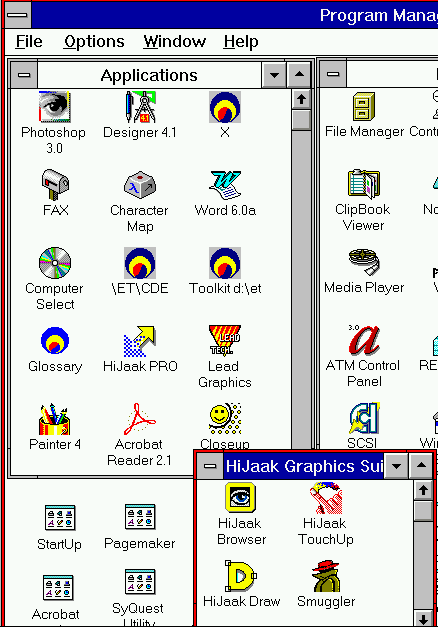
The Metro UI is great. The tiles are smart, the apps are beautiful, the solution to multitasking is promising, but this whole new approach cannot coexist with a Windows desktop. I almost fell out of my seat when the demonstrator nonchalantly switched back to the Windows 7-style desktop, complete with start menu, taskbar, and maximized MS Office.
This the old curse of Windows backward-compatibility in a new form – not in system-level cruft this time, but in incompatible UIs from completely different worlds. You can't put a new tablet UI and a traditional desktop UI next to each other on the same device and expect users to use them together.
It's as if Microsoft is attempting its own "Back to the Mac," only they never actually left. Apple got it right, starting fresh with a new form factor and adapting appropriate elements of it to the desktop. Microsoft is also starting fresh with a new form factor, but then trying to shoehorn the whole thing onto the desktop.
Of course, this is just a preview. I'm sure things will change a lot between now and the next preview, let alone the final release. But this isn't starting off on the right foot.