Interestingly it doesn't even discuss the obvious solution: Let people who buy real meat pay for the externalities. (Interestingly even in places where there's some form of carbon pricing - like the EU - this often doesn't cover a large share of emissions from meat production, as methane emissions are very relevant here - I'm not aware of any methane pricing scheme anywhere.)
Even if we ignore externalities and pollution costs, just stop outright subsidizing animal meat production so much. The reason meat is so cheap is because our government puts a lot of effort and money into making it cheap.
I don't know why more people aren't trying to sell this to the "free market" crowd as government overreach. The reality right now is that plant-based protein is gaining popularity despite the market being artificially biased against it in terms of price. Animal meat should cost more than it does, not just in the sense of "you're not paying for the true environmental cost", but also in the sense of, "you're not paying the actual monetary cost it takes to produce this product."
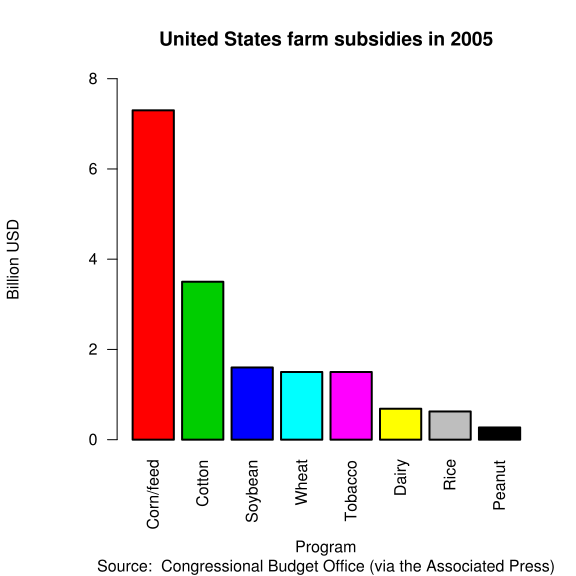
The US government throws billions of dollars into subsidizing meat and dairy production every year. Plant-based protein's growth is restricted in part because our food prices and production aren't determined just by the free market. That's not necessarily bad, but if we're going to be messing with the market anyway we could choose to subsidize other things.
And we could obviously do more than just lowering subsidies, I'm not saying we should ignore externalities or that we should just completely abandon all subsidies entirely. But I am saying we shouldn't pretend that meat actually costs what we see in the store. Meat is cheap because (for various reasons) as a society we've all collectively decided to spend tax money so that we can pretend that it costs very little to produce.
It's a reasonable argument that government subsidies for farmers reduce prices for the consumer, but I don't think it's necessarily a correct assumption.
Subsidies help the local farmers to compete with farmers in low cost countries. Transportation costs are usually insignificant.
So without subsidies the consumer might pay the same price, but the store just ends up sourcing the product from a different country. However, having a significant amount of food production locally has obvious strategic benefits (and I don't mean just war, even a draught could create sufficient shortages)
While you guys throw tariffs on food here and cut subsidies are any of you aware that for some 10% of American's having food on the table is not a given?
Now I'm not saying that subsidising farmers to produce huge crops of the same 3 crops is the best way of continuing to ensure no one goes hungry, it self evidently doesn't work given the current status quo.
However, to talk about making huge changes to these systems without stopping to consider what impact it will have on that part of society is an incredibly rose tinted view of the world.
That is due to extreme levels of inequality in the US and one of the stingiest welfare systems in the whole developed world. It is not due to food prices. If that was the deciding factor then Norwegians and Japanese would be starving.
A lot of the low food prices in the US also contribute to this poverty. The low prices come at the back of people in the food industry doing long days for shitty pay. If the “solution” to people not getting food on the table was to keep pushing food prices down then one easily end up in a situation arguing against minimum wage and workers rights.
One has to look at the whole system and not just a tiny sliver of it.
> While you guys throw tariffs on food here and cut subsidies are any of you aware that for some 10% of American's having food on the table is not a given?
So let's funnel that 25% import tarif or money we save from not subsidizing the meat industry into the federal food stamps program.
You're missing the part where those government subsidies are being issued to growers who provide products certified for the SNAP and WIC programs. You remove the subsidies and mess with the tariffs too much and now you're into a whole other problem of growers now refusing to participate in either program.
Why would a grower refuse to participate in either program? They wouldn't get the option to not not-get subsidies. Their incentive to participate in getting their products certified for SNAP and WIC is that their costs are now higher so they have to raise their prices, and so then it'd be more important for them to get their products certified so that SNAP and WIC recipients can purchase them (thus expanding/retaining their customer base).
I'm skeptical about tariffs and I'm not necessarily opposed to subsidies (although I do kind of question whether they are actually an efficient way to help income-challenged Americans) -- but we could still distribute those subsidies differently in order to cheapen healthier food that's in our better interest to encourage. We could also, if we're getting rid of subsidies, consider giving income-challenged people money directly, which may or may not be comparatively cost-effective to working directly with the industry.
So there's a lot of avenues that we could take, and yeah, eliminating food subsidies entirely and not giving any other kinds of aid would probably be a mistake. I'm not disagreeing with you. It's just... there's a lot of things we could change or try that wouldn't leave people to starve. Recognizing that meat is subsidized opens up doors for us to talk about whether our current system is efficient, about what behaviors our current system incentivizes. If nothing else it at least acknowledges that we are currently messing with the market, that meat prices aren't naturally low, and that we if we're comfortable with that kind of intervention, then we could at least mess with the market in different ways to promote more diverse foods.
Right now, we are artificially boosting a few segments of the food industry to frankly unhealthy levels of consumption (at least in most of the US) in order to help people afford food. It is worth considering if it is possible to help those people without propping up industries that are at least indirectly responsible for a nontrivial number of health risks and environmental challenges in the US. I don't think most people here are saying we should leave income-strapped Americans to starve (or at least I'm not), but like you said, the current status quo isn't really working, and it has some some pretty big downsides.
Even if you don't want to touch subsidies at all, at the least we could talk about stuff like checkoff programs. I find it much harder to argue that government intervention into how food is advertised is for the benefit of low-income Americans, and I think the advertising that comes from that forced tax on food is responsible for some increase in consumption.
If you remove subsidies you got more money to spare for other things. As a general rule, and policy affecting consumer prices should look at its effect on consumers and combine such changes with other measures.
Money saved one place can be spent other places. Instead of spending it on more tax breaks for the rich it could be spent on the poor providing a net gain for them.
It is not naive. What is naive is to leave to market to its own devices and assume everything will work themselves out beautifully.
You always make a proper analysis and do multiple changes money earned on price increases on one category of foods could be spent to reduce another category of food.
You could e.g. tax sugar and junk food and use those earning to subsidize healthier foods , making healthier food more accessible to poor people.
We import those products like garlic and broccoli from China as part of a trade deal where they import corn and other grains even though they can and do produce their own. They have many more mouths to feed, so on their end, getting all of this extra grain in exchange for shipping over a select variety of vegetables and fish is a net plus to them, and to us, it provides an established return on government provided grain subsidies that allow them to issue more grain subsidies.
Tariffs are a much worse idea than direct subsidies to farmers. If you want people to buy American garlic, pay US farmers to sell it for cheaper than the Chinese garlic. A tariff is a regressive tax that makes life harder for the poor.
Taking your argument at face value and assuming you're right, I still want to point out that those subsidies are applied primarily to a subset of foods, especially feed crops for animals.
Our government isn't spending nearly the same amount of time and money trying to subsidize fruits and vegetables. Shouldn't we be just as worried about those products being sourced from other countries? Why are we treating animal feed so specially over other crops?
If you take the point of view that we're just trying to keep food production domestic, then it's still pretty clear that we care mostly about keeping some foods domestic -- primarily the ones that are necessary for a thriving beef and dairy industry.
From a strategic perspective grain is the most important thing in a food shortage. People can live a year or two without fruit or vegetables, but without the calories in grain things will get violent fast.
I'm not going to dismiss it outright, but I am mild-to-medium skeptical of this theory. Take a look at some of the recent years of subsidies listed on https://farm.ewg.org/region.php?fips=00000&progcode=total&yr.... It's not just that we prioritize feed crops more than oranges, we also prioritize feed crops more than potatoes and root vegetables. Our corn subsidies are on average over twice as high as our wheat subsidies, and over 7 times as high as rice subsidies.
Even dairy consistently gets more subsidies than fruits and vegetables. Are we really just optimizing for a worst case scenario where we literally run out of food? Does it really make sense for us to say that during a famine or a drought that milk will be an efficient use of resources? Nobody is baking bread with canola seeds, is it really more important during a famine that we have canola oil than potatoes?
Maybe this is the result of a highly researched government program about how to survive a worldwide famine. But the numbers I'm seeing aren't doing a lot to convince me that famine planning is a more likely cause than lobbying.
The strategic goal of having domestic food production and growing specific foods don't necessarily go hand in hand. While it makes a lot of sense to counter a famine with potatoes, in normal times you want to mostly produce what your population consumes. The corn subisides are much higher, because the corn production is much higher. The US produced 330 million tonnes of corn in 2009 [1] and just 55 million tons of wheat in 2012 [2] (that's the numbers I could easily find, and unfortunately they seem to use slightly different types of tons which differ by ~10%, metric system anyone?). Taking this into consideration, wheat subsidies are actually a bit higher per ton produced than corn subsidies.
The US consumes a lot of corn, either directly through corn sirup, or indirectly through meat. So it does make sense to have a significant amount of domestic production of what your population actually consumes. That corn might not be healthy is another important topic on it's own.
So subsidizing local farmers isn't the same thing as optimizing for a worst case scenario. In case of a large-scale multi-year war that triggers a famine, you could still order your farmers to switch to growing potatoes, when you have enough actively harvested farmland to begin with. That means subsidizing what is actually consumed during times of peace.
But I'm not saying that's the only reason for the subsidies. Lobbying definitely plays a big (the biggest) role and the largest industries have the strongest lobbying power. But when you have the strategic argument in hand, lobbying for subsidies becomes a lot easier, especially in a country that spends more on the military than any other.
> The corn subisides are much higher, because the corn production is much higher.
Is it that our corn production is naturally very high, and so we subsidize it more? Or is it the other way around?
My understanding is that a lot of corn uses were developed in part because of corn subsidies and requirements around ethanol. As corn became an extremely cheap material, people started looking for uses for it. And you can quickly enter a spiral there, where as corn becomes more useful, we subsidize it more, which encourages more companies to figure out how to make more stuff out of corn.
> That means subsidizing what is actually consumed during times of peace.
It feels like this has looped around and that the current balance of subsidies are no longer about disaster planning. If your starting premise is that we're trying to keep production local (or at least, production capabilities local), and you're also saying that during disaster periods we can pivot to more necessary crops -- then what is the problem with changing how our current subsidies right now are distributed to encourage different crops? What do we lose?
I am skeptical that a dairy farm is going to be able to quickly shift to planting potatoes or grain, it probably doesn't have the equipment or the right land to do that. But taking your argument at face value and assuming they can make that pivot, then we could also collectively decide as a society that we produce too much meat/grain as a nation during times of peace, and we could collectively decide to subsidize local production of more diverse foods. We could subsidize the same number of farmers to produce different things.
I think you'll find it's largely due to historical precedent and lobbying.
Very much the government altering the free market. Corn subsidies are not without their consequences. Cattle do not live healthily on corn. People don't do so well on corn syrup either.
I'm not a huge fan of reducing my own meat consumption but think the government should stop subsidizing these industries.
The UK quite correctly determined during WWII that to feed the population during a blockade, it was much more efficient to eat potatoes and peas and so on directly and make bread from wheat, than it was to feed livestock for meat and dairy.
That is as true today as it was back then. Especially when you're feeding the cattle soybeans, which are perfectly good food for humans.
>Maybe this is the result of a highly researched government program about how to survive a worldwide famine. But the numbers I'm seeing aren't doing a lot to convince me that famine planning is a more likely cause than lobbying.
Your skepticism is warranted. After all, we had a highly researched government program about how to effectively tackle a worldwide pandemic, and... well.
"That means corn averages roughly 15 million calories per acre" "wheat comes in at about 4 million calories per acre, soy at 6 million" "Other vegetables, while much more nutritious than corn, wheat or potatoes, are far less energy-dense. Broccoli yields about 2.5 million calories per acre, and spinach is under 2 million"
Some of the subsidies are entrenched and strongly lobbied. There is no reason at all to be wasting water on almonds or cotton in California, for an example.
The farming industry in California would be non-existent without constant subsidizing both of the crops and the extraordinarily wasteful and expensive importing of water from numerous other states to prevent the farmland that was originally desert from reverting back to it's natural state.
> Even if we ignore externalities and pollution costs, just stop outright subsidizing animal meat production so much. The reason meat is so cheap is because our government puts a lot of effort and money into making it cheap.
The same applies to plant based subsides, by the way. I'm in favour of doing away with them entirely in a gradual phase, and offering new farmers low interest loans (lock these current historical rates for first generation farmers) on land and equipment and help much of the dienfranchised and under/unemployed youth into sustainable, organic Agriculture and its ancillary businesses and let them set and the make the market for their products. Not hedge funds and wall street speculators!
This at scale could help make environmentalism profitable like nothing else.
Crop insurance could be offered privately and locally by a series of brokers and established companies and a resurgence of farmers markets as a hub of local communities could do so much good given how destroyed the food Industry is after COVID which would be ideal to ensure we don't repeat the same mitakes.
I'm a 'free market guy,' and also did horticulture Ag and focused on the 'Rolls Royce' of food (Biodynamic) in the EU and then in the US that commanded a significant premium on price and exclusivity. I understand this topic very well and has been focus of most of my adult life. By the way: Free Markets are entirely incompatible when coupled to Central Bank based fiat currencies, and impossible when the very unit of account is manipulated by centralized entities.
I could break down your entire post, but I won't, but suffice it to say your argument is missing that it's not just distorting the market and sweeping the externatlities of livestock (meat) raising but also crop and specific commodities--corn and cotton being the highest culprit on that list that use the most pesticides and poison the soil and water which should be regarded as the crime that it is: Ecocide. Which is done to feed a growing populace, which also includes vegetarians and vegans.
Do you have any links to sources or further reading material regarding this current state of affairs? It seems not entirely obvious, nor easily checked for a casual reader. (Maybe that's part of the issue of why this is not a more popular topic yet.)
Kind of a tangent but Michael Pollan's books always open my eyes about these topics. In particular for this subject https://en.m.wikipedia.org/wiki/The_Omnivore%27s_Dilemma gives a good overview of why fast food (and all highly processed food) are so much cheaper than eating whole food. In the process you start to understand the role corn has on it and why it's the biggest crop of grain in the world.
> Maybe that's part of the issue of why this is not a more popular topic yet
I do think it's kind of under-discussed (it's not the only thing, a lot of niche topics like this, especially around food, don't really get covered much unless they're popular). The thing is that the people who do talk about it are usually in opposition to the meat industry, so most of the articles you find online are going to be written with a pretty obvious bias. As someone just looking for more information, that might bother you or it might not.
The vast majority of subsidies are towards "feed" products like corn and soy. In a lot of ways, corn's impact in particular has been a lot bigger than just on meat -- we saw a big shift towards corn-based products (including ethanol) that came as a result of this massive increase in resources towards both producing corn and researching uses for it.
You can also see the impact in products like soy, which, coincidentally with being one of the second-most subsidized foods in the US, is pretty cheap in the US. If you're looking for a meat "substitute" that is actually easy to find at much cheaper prices than meat, tofu can be a very cheap replacement, at least in my experience. I'm being a little bit deceptive there, because most soy is used for animal feed, it's not like we're just throwing funds into tofu. Even there, the primary reason we're subsidizing soy is to make it easier to raise meat. But it does still have some impact outside of the meat/dairy industry.
In comparison, our subsidies towards vegetables and fruits are basically nonexistant (I think ~50 million a year for "specialty crops", but I might have my numbers wrong). It's actually kind of startling how cheap fruits and veggies in the US are given how few resources our government puts into encouraging their production.
If you're curious, you can also look into checkoff programs (https://en.wikipedia.org/wiki/Commodity_checkoff_program) that basically boil down to a mandatory tax on commodities like beef/dairy that is then redistributed to organizations that promote those commodities wholesale, rather than specific brands.
Checkoff programs are not a direct subsidy, but they raise their own set of concerns about free speech and government involvement in advertising and direct promotion of commodities that might not be in the public's best interest to be so heavily advertised.
Sorry, I know that's not the same thing as just listing an easy-read casual resource, but there aren't many neutral casual resources online, at least not that I'm aware of. Because it's a niche topic, most of the explainers are being written by people who specifically want to draw attention to the problem and are writing from a vegetarian/vegan perspective. Which is what you would expect from a topic that doesn't get brought up very often, but it does mean that if you don't want to rely on those sources, you have to do a bit of digging.
Have you considered why we do this? How would our society be different if only well-to-do people could eat meat regularly? Would a regular guy be content with wealthy people eating steaks while jet-setting around the globe because of climate change?
I think a populist uprising would occur almost immediately and we’d see heads on pikes with their decapitated mouths stuffed with cabbage for all to see. It would be super easy for a party to take advantage of this and they would.
> That's not necessarily bad, but if we're going to be messing with the market anyway we could choose to subsidize other things.
I'm saying we shouldn't pretend that meat is as cheap as it is on its own. We should acknowledge what the reality is: meat is cheap because as a society, we choose to use tax dollars to make it cheap.
We could do the exact same thing with plant-based meat. We could shift some of those subsidies so that meat and plant protein were equally subsidized. We could balance them out. We can talk about the logistics.
But I think sometimes the conversation gets stuck entirely on "how could we make artificial meat cheaper" when the reality is that animal meat is expensive, and the big difference between animal meat and plant meat is that we pretend that animal meat costs less than a free market would otherwise dictate. Of course I want to artificial meat to be cheaper, but I'm also not going to pretend that it's a fair fight.
The reason why this matters is because I do see arguments from people that say that it's just too expensive to have a social shift towards vegetarianism, and it can't possibly scale, and it's government interference to try and prop up plant-based foods. And yeah, we can have a values conversation about whether society wants us to make meat cheap. But most of the rest of those objections are crap. There are a lot of people that do think that meat is actually priced realistically based on what it costs to produce. They don't realize that it's just that our government chooses to make very specific farming outputs cheaper.
That's a separate issue to whether we should value a free market. Or is it? If we're only going to support a "free market" in spots where it's politically convenient, but be enthusiastic about stripping any regulations that are politically viable, then what we'll see is a systemic stripping of regulations that protect people without power, without touching regulations of people with power.
And they'll replace their meat with what? More sugar? Bread? Sugary bread? I think you underestimate how big of a deal food is to people. I believe that any change will be towards food that's even worse for people.
Because of how much of it is added into every alternative meat replacement product, and it's a shockingly high amount if you read the labels on some "organic" and "plant-based" products.
I have a few issues with this. As far as I know health concerns related to meat replacements aren't to do with sugar levels, probably more likely with saturated fat and sodium (which exists in regular meat too). Also I don't know why you bothered to put organic in there as well since the we're talking about meat replacement. Finally I think you're making the assumption that if we don't eat meat we need meat replacements at all.
If meat is the trigger to generate real social change then great! I don’t want to see heads on spikes, but if people are genuinely bought off by cheap meat that’s kind of sad.
I’m not sure it’s the type of social change you’re anticipating.
I think the fact everyone has access to the food they want and is part of their culture is a major reason we generally have a peaceful and free society.
I can only imagine the resent from the middle and lower classes when “the elites” eat steaks on airplanes and they, the plebs they are, are forced to subside on processed alternatives while being forced to become a proselyte to a cause that those that can afford to ignore do.
If you wanna go down that route selling this to the “free market” crowd, than Id love to let the free market settle itself out in healthcare too and pretty much everything else that the government controls pricing on.
As much as I would love to see subsidies ended on animal products, it couldn’t happen overnight without huge backlash.
Lowering the subsidies over time and eliminating the power that the animal agriculture industry has over politics would do a lot to increase the number of plant-based eaters.
There are proposals for carbon tax schemes that go like "we'll pay back all the income from the carbon tax to all citizen directly". You can imagine the same for methane. Pretty sure such a proposal would be popular.
A carbon-tax funded UBI would be popular, but ideally wouldn’t funding from a carbon tax go towards sequestering the carbon and other green initiatives instead of giving it back to consumers to spend on high-carbon goods and services?
It’s essentially what we do today. High tax payers consume more and their tax revenues subsidize things like Ag which make things like meat affordable to poor people.
So yeah, get rid of subsidies and replace with UBI and we’re probably in nearly the same place. Maybe a good deal of people would forego newly expensive meat and spend their UBI on the lotto?
I don't know every carbon pricing scheme in the world, but I have never heard of any that would involve agricultural methane.
The EU ETS, which is not a carbon tax, but an emission trading system, but which is the largest carbon pricing scheme in the world, does not include methane at all. The EU has just decided that they want to start monitoring methane emissions, but that's about it. They have no plans right now to regulate or price methane emissions.
You get rid of subsidies and then poor people can’t eat meat. Good luck dealing with the political fallout from that. Subsidized meat is a special kind of a American socialism where the wealthy tax payers fund the subsidies so everyone else can eat meat.
Honestly, so many of the ideas for addressing climate just prevent poor people from participating. The upper middle class who are most concerned with these issues (and have the most political power) simply wouldn’t be affected much at all by things that make access more difficult and/or expensive.
Rationing in the name of “equity” won’t happen because these same people will actually be affected so the line is drawn there. We need more housing development but not in my backyard, etc.
I don’t offer a particular solution other than giving people incentives to eat plant based diets and using tax revenues to invest in engineering the problem away as much as possible.
> You get rid of subsidies and then poor people can’t eat meat
So stop subsidizing meat and spend the same money augmenting the income of the poor, then poor people will be at least as able to eat meat and be at least as well off when doing so as they were with the meat sibaidies, while those who choose not to will be even better off than they were with meat subsidies.
> So, I pay the same taxes and then I also get to spend a lot more on food for my family?
Well, no, not necessarily. You pay taxes right now to subsidize meat consumption across the board, to everyone, even rich people.
Under a system like UBI, you pay the same taxes, your food costs more, but you also get a check in the mail that balances out the extra food cost.
Or under a targeted system that is designed to specifically benefit the poor, you pay more for food but fewer taxes, because you're only paying taxes to subsidize the poor instead of (currently) also paying additional taxes to subsidize the meat consumption of rich people.
It's a mistake to say that your food costs less right now because you pay taxes. It costs the same, you're just paying part of the price in your taxes. And part of the 'problem' is that the money you're paying to the government is going towards subsidizing everyone, including people who are more well off than you but that get to enjoy cheap meat prices anyway. That's not necessarily a very efficient way to help the poor.
There are lots of different schemes and complications here, it's not as simple as I'm making it out to be. But the very basic idea is that it would cost less money to subsidize just the poor, and then you could keep some of your tax money that's currently subsidizing rich people and you could spend it on meat instead.
> Why would people that pay taxes prefer that model?
Because they actually want to control (or, at least not encourage through subsidization) the externalities of meat consumption?
What economic group so you think that concern comes from?
> Good luck getting support for that.
If it wasn't possible to get something that didn't serve the immediate narrow financial interests of the wealthiest, the developed, democratic world would never have abandoned laissez-faire capitalism for the modern mixed economy.
What's wrong with poor people being unable to afford a luxury item based on animal exploitation and suffering?
Usually people respond to this pointing out some supposed nutrition advantages of meat as if the USA, with the cheapest meat in the world, is somehow the paragon of health and cuisine. Though I'd be down for a government sponsored, optional multivitamin.
The problem is that people in the US (and really most of the western world) have grown up eating meat, been told that they should desire meat, that meat is an essential part of their diet and, to a certain extent, that not eating meat is unmanly and weak.
Meat consumption is so ingrained that any attempt to curtail it is met with fierce opposition, because people feel as if it's an attack on their identity.
I don’t think that’s the case. Look around the world and you’ll see that as a country has become more prosperous that their meat consumption has increased. I don’t think it’s because people suddenly became more “manly”. It’s because of a simple fact: most humans love meat.
Food is more than a personal identity. It’s a major part of people’s culture globally and meat plays a primary role in many cultures. I think most people would eat more meat if they had the means to.
Only about 3.5% of Americans are vegetarian. Designing policy that favors this group would be ridiculous. Subsidizing meat and democratizing access to it is good policy since nearly everyone benefits from it.
Saying that I hope “plant meat” continues to improve and finds a market outside the novelty it mainly is today. But this can’t be forced on people.
>"Look around the world and you’ll see that as a country has become more prosperous that their meat consumption has increased. I don’t think it’s because people suddenly became more “manly”. It’s because of a simple fact: most humans love meat."
I think it's much more likely that people in countries with rising prosperity are seeing the high meat consumption in affluent parts of the world, and now that they themselves are becoming affluent, they want that diet/lifestyle themselves. It's aspirational, more than anything else.
There is certainly a biological appeal of eating cooked meat, just as there is with fatty (and sugary) foods in general: It signifies high caloric density, which is hugely important for a hunter/gatherer/subsistence community. That base desire is still there, leading to overeating and health issues, since excess calories are often abundant and easily affordable.
Modern Americans (and Europeans) eat a lot more meat than any other culture[1] past or present. The eating of meat every single day at every meal is a huge historical aberration and the clearest possible proof of our destructive overconsumption.
Just as with many other things like candy, sugary drinks, tobacco and alcohol, it would be wise to reduce consumption significantly. Rather than simply indulging base desires, we can choose to cut back and introduce some moderation, a wiser and more enlightened choice, not least because lifestock farming is an ongoing massive environmental disaster.
Currently the US is heavily subsidizing the meat industry, including by massively subsidizing corn. The wise move would be to cut that back and subsidize environmentally sound farming practices and ending the practice of feeding human food to animals. Farm what animals can be sustainably farmed on grass, hay and other plants unfit for human consumption, use the corn and soy and grains for food directly.
We in the western world have to realize that our wildly luxurious eating habits are completely unsustainable, and accept that meat will again be a once a week, maybe twice a week treat.
[1] Save a rare few very specific outliers, such as the Inuit, who in some areas subsist almost entirely on meat.
That depends. Do you plan to start breeding them relentlessly until 60% of all mammals on the earth are deer? As long as you promise not to do that, we won't have a problem.
More to the point, this seems like a misreading of GP's comment. Wyre specifically says that they don't want to impose taxes, that they want to very slowly cut or redirect subsidies instead. So I guess a followup question is, is the government currently giving you money to let deer fart in your pasture? Because if not, you'll also probably be OK.
> That depends. Do you plan to start breeding them relentlessly until 60% of all mammals on the earth are deer? As long as you promise not to do that, we won't have a problem.
The number of cows in the world is immaterial to the stated concerns though, since it's not the number of cows that determines the amount of methane produced — it's the amount of biomass they are digesting. So if the number of cows is reduced but the amount of biomass consumed stays the same (being digested by deer, rotting in the field, etc.) there's no net impact to the methane produced.
A) different animals produce different amounts of methane. Even among cattle animals, there are efforts to decrease the amount of methane they produce[0]. And nobody is laughing at those scientists and saying, "this is silly, they're still going to eat the same amount of feed so this can't possibly work." It's not just what's digested, it's how it gets digested.
B) if we have fewer cows, we don't need to replace them with the same number of another animal -- the point is we could have fewer grazing animals entirely, because our agricultural industry does not exist in order to feed wolves. We don't need to increase the number of deer by however many thousand times to sustain that ecosystem.
That was kind of my point. If you are planning on keeping the total number of grazing animals constant by massively scaling up the amount of deer, then maybe we have a problem. But why are you doing that?
If you're proposing that the current volume of cows/biomass consumption we have is a natural constant, and that other animals would just move in and take their place -- that's just not the case, we are artificially boosting the number of edible animals in the world, and by extension, we are also artificially boosting the amount of feed produced and consumed. Before the agriculture industry scaled up, we didn't have the volume of corn we currently produce lying around and being mass-consumed by deer. We started producing a lot more corn/grain and then breeding a lot more herding animals that we then fed it to.
What!? By this logic would we then give subsidies to the land where a pack of coyotes prays on the deer? This is just silly. Wild deer should be close to carbon neutral in a healthy ecosystem, as it gets prayed on as much as it pastures. Don’t be silly.
The goal is to fix the current phenomenon where human activity dumps enough co2 (and other greenhouse gases like methane) into the atmosphere to significantly alter the global climate and cause massive problems.
By the way, deer are not a meaningful contributor to atmospheric greenhouse gas levels.
If you’re raising the deer, then you’re responsible for the externalities produced by your economic pursuit. If you’re not raising the deer, then they’re the responsibility of humankind as a whole, who is already paying for those externalities (by having to suffer from climate change). The point of a carbon (or methane) tax is to ensure that you pay for your externalities, both to disincentivize you from having them and to repay everyone else for the cost that they’ve been dealt by you.
Suppose you set up a polluting machine that solely emitted carbon, perhaps for art. That goal may be reasonable, but by engaging in it you’re hurting others. A carbon tax makes them whole (by either paying for carbon capture or by direct compensation) and disincentives you from doing it in the first place. If instead it was a naturally occurring polluting machine (a herd of deer, say) then we’d either want to remove it or do something to counteract it, and that cost is paid by everyone. In this case, we’d probably choose to plant trees, rather than killing the deer. (Although the deer population in North America is out of control, so perhaps killing them might be the right choice.)
You know, I wonder if a meat-based production system is a hedge against catastrophic/extinction events.
For example, let's say we have another potato-famine style event. Even a bio-engineered attack that takes out a crop or crops.
We could scale back meat production and use the crop capacity we use to support the "meat pyramid" to feed people directly until the crisis has passed.
Subsidizing crop capacity might make strategic sense. Sort of like how the just-in-time production pipeline ran into a wall with respect to mask shortages at the start of the pandemic.
This seems to suggest that you think our meat comes from animals who kinda exist and compete mutually with crops when actually we feed most of our crops to animals.
If there was an ecological disaster that killed crop production, we wouldn't waste it by feeding it to animals for a grossly inefficient luxury item.
It's like when people try to make a "pro-meat" claim by pointing out how much water it takes to grow a pound of almonds, only possible because they never looked up how much water it took to grow a pound of beef.
> If there was an ecological disaster that killed crop production, we wouldn't waste it by feeding it to animals for a grossly inefficient luxury item.
This is what I interpreted the parent comment as saying.
Most animals can feed on wild grasses which we can't digest. They can serve us with a lot of resources and stay alive too (milk, wool, eggs). But if the event is so severe that even grass is gone, then rats are left and canibalism.
There's also strong logic in having hay as part of crop rotation, which as we know, is vital to reduce the need for fertilizer.
On top of this, there's loads of land useless for anything other than grazing. Too dry, with no irrigation (only usable for grazing in the spring). Too rocky, too much of a slope, soil quality not right (too much clay, etc, etc), yet still able to support grasses.
There's a lot of grazing done, in and outside of the US.
Lastly, and this was mentioned GP, it's vital to produce more than we eat each year. Extremely vital. Part of all the subsidies we have, is to ensure farmers DO grow more than required.
To ensure that the free market, doesn't bottom out pricing too much, because we have farmers over producing. If you want to start removing subsidies, then you should first ensure people have a year's worth of canned emergency food on hand.
If people get hungry, that's where the knives come out. If your kid is hungry, you're going to feed it.
Government encouraging overproduction of food makes absolute sense. It's this or to store backup because to run food production at an efficient "only as much as I needed" models a disaster waiting to happen.
Historically, governments would operate grains silos and be an intermediate purchaser, to control the cost of grain - keep it slightly higher in good years, and keep it stable in bad years by dipping into reserves.
IIRC a lot of countries were forced to abolish these price controls by the WTO, and then were screwed over when they got a bad harvest and poor people had no food.
That's an interesting question: how much would it cost to keep 3 years of food (let's assume the bare minimum - refined white flour) in reserve for the entire United States? What is the cost of food subsidies over the same period?
OTOH shifting away from meat consumption would probably force more species diversity in our food production. I think corn and soybeans account for most of the crops grown for livestock feed, but humans eat a more varied diet. I image that would improve robustness against blights or whatever.
I fully support this. I think it would result in a lot of good innovation - e.g. ways to raise meat while reducing carbon (including methane) emissions.
But ONLY if externalities are also fully priced & included for all other products - cars, plastic crap shipped from China, aircon, ... otherwise that kind of legislation is simply discrimination against meat-lovers.
> But ONLY if externalities are also fully priced & included for all other products - cars, plastic crap shipped from China, aircon, ... otherwise that kind of legislation is simply discrimination against meat-lovers.
Meat has a victim [1]. Respectably, how would you price in the cost of death?
Personally, I don’t consider the death of (most) animals any different to the death of plants. Only killing conscious entities (be they meat-based or potentially digital in the future) is immoral.
>Interestingly even in places where there's some form of carbon pricing - like the EU - this often doesn't cover a large share of emissions from meat production, as methane emissions are very relevant here - I'm not aware of any methane pricing scheme anywhere.
The problem is that most of the cows in the world live in India, Africa and South America, regions which have relatively low carbon intensity per capita. In the developed world, agriculture accounts for on average ~10% of carbon emissions, half of which is from cows. Targeting methane makes a small difference in rich countries and on a global scale places an unfair burden on the poorest countries, and politically, severely hurts the perception of climate protection advocacy among farmers, who are no doubt smart enough to know that fossil fuels are responsible for eight times as much greenhouse emissions as they are, and who are generally an extremely sympathetic constituency, cf. recent Indian protests.
In rich countries, transportation and thermal processes based on fuel burning account for the lion's share of greenhouse gas pollution and rightly deserve the spotlight. The outlier is China, which is rapidly expanding meat production along with its transition to a more industrialized economy. Purveyors of meat substitutes might consider taking the Chinese market more seriously, since they have an opportunity to get in on the ground floor.
True, but I think it was focusing on things under the control of the producers of this product... of course, I suppose spending more on lobbying to try to reduce subsidies or tax externalities for meat is under their control. It seems like a kind of unwinnable battle though doesn't it?
The OP does touch on the subsidies by suggesting the producers rely more on soy and corn, which are heavily subsidized, and as are used as animal feed and thereby constitute a pretty major source of the meat subsidy. While not about externalities, I think they could have pointed out the reasons corn and soy are so cheap compared to other plant sources are in large part a result of government policy.
The externalized cost of carbon released into the atmosphere is an interesting problem in that we need to define where and when it should be paid. As an illustrated early sample of this, the burning of biomass is considered carbon neutral because all the carbon released was once absorbed by the plant when it grew.
In agricultural, we have added carbon which starts out as natural gas. It then get used to create synthetic fertilizer. The fertilizer is used to grow feed crops, which then the animals eat. The manure is then either dumped or kept for creating new bio gas or sold to organic farms that uses it as an alternative to synthetic fertilizer. The organic farms can then sell feed to more farms, but at lower and lower yields given the same input carbon from the first synthetic fertilizer, or crops that people eat.
One alternative is that each instance pay for carbon it handles, in which case we don't care if carbon is added or not. We could also tax the first instance where the carbon is introduced to the system. A different system could attempt to tax what we find to be the incentive for the system.
Personally I would tax the externalities of synthetic fertilizer because that is instance where extra carbon get added, and it solves part of the controversial issue of biomass production being labeled as carbon neutral when using fertilizer. It will also make animal feed more expensive for factory farms, while grazing animals farms in low population areas can benefit from being more ecological to the environment.
>> Interestingly it doesn't even discuss the obvious solution: Let people who buy real meat pay for the externalities.
Are we going to have people paying for the "externalities" of all the products they consume?
For example, the people who buy a new phone every year or half (this habit causes a significant amount of pollution, so-called "e-waste"). The people who drive their car everywhere. The people who fly a few times a year. The people who use computers (more e-waste). The people who wear clothes made of synthetic fibers and use plastic-based implements. The people who burn wood, coal or oil for central heating. The people who use electricity (the major producer of greenhouse gas emissions is power production). The people who read books printed in paper produced by felled trees. The people who consume plant-based products whose production is responsible for deforestation, soil depletion, acidification of soil, etc etc. The people who eat fish. The people who eat soy (major contributor to the destruction of the Amazon rainforest). etc etc.
Are we only going to make meat eaters pay for their "externalities"?
> Are we going to have people paying for the "externalities" of all the products they consume?
Well, yes, we should. Considering that notion is baked into every part of the economic models we're using to determine how we're structuring the rest of the economy, absolutely, the bare minimum we could do is make people actually pay for the damage they're causing. I'd go so far as to say a substantial part of the reason we seem unable to reasonably address things like pollution, climate change, and biodiversity is because people aren't paying the full cost of their actions.
One way or another, it's the only way we get a society that can live on the planet indefinitely without making it less and less fit for human habitation.
How you do that is not necessarily trivial, but we should start doing what we can figure out how to do now, yes. You don't have to do it for everything for it to be valuable to do it for what we can figure out how to do it for.
For meat, simply ending subsidies would be a good start.
Cell phones and other electronics as you point out are another obvious target, yes. Some have proposed that the cost of disposal/recycling should be built into the purchase price -- one practical way to do that, is require manufacturers to take back the products at end of life for recycling or disposal at no charge (and ban them from municipal waste stream).
I’m on my phone at the moment and can’t break down that list line-by-line, but in Canada you already do pay surcharges for many (not all) of those things. E-waste is nominally priced at the cost of recycling for various device types; electricity, natural gas, and gasoline, and aviation all have a (not insignificant!) carbon tax associated with them.
I'm an EU citizen. I don't know that I'm paying taxes for e.g. the e-waste produced by electronic devices. Can you point to relevant information please?
Well someone is paying for all those externalities. At least let's try and make it the person who benefits from it. Why not start from meat and go from there.
Of course people should pay the true cost of what they buy or use. I can’t see how anyone could argue against that on moral grounds. You might disagree for financial reasons, but hardly out of principle.
Should people who eat vegetables also pay for externalities, like ground water pollution with pesticides, decreasing number of insects and bee colonies collapse because of insecticides, destroying natural diversity with huge monocrop cultures, destroying top soil, diverting rivers for irrigation and so on?
Would that really make a huge difference though? I’m all for people paying for their externalities but I wonder how significant it would be, are there any calculations?
It also would be worth at least studying the subsidized production of insects for food.
I would think it’s more efficient to get protein from bugs than to go through all the complicated manufacturing process to get “fake” meat, which is very far from being a raw/natural product.
Like the average EU citizen, I don't remember ever voting for anybody who represents me in the EU and I don't know any of the structures of power of the EU or how they work.
I learned the political structure of the European Union in school, several times, once in middle school, once in high shool, with many repetitions in between. If you haven't learned you might either be older than me (I'm near thirty) or the education system in your country has worse issues than mine, or just not interested in Wikipedia ?
This is an absurd big lie which is so often repeated. Germany has great influence because it pays so much for the EU but all member states have the veto...
Turnout in Spain for the 2019 election was pretty high at 60%, compared to average of 50%. Counter to your (somewhat xenophobic) remarks about France and Germany, the most engaged countries by this measure are Belgium, Luxembourg, Malta and Denmark.
In most European countries, people don't elect the national government directly as well; it's formed taking into account parliament elections. It is true that in the EU the appointment of the commission is a bit more removed, with the national governments involved in the choice of the President and the commissioners, but in any case the European Parliament must still approve the commission.
EU Comissioners are proposed by the Council of the European Union, a body composed of EU member state ministers, themselves directly elected by the citizens of their respective states in national elections. Appointment of Comissioners follows the suggestions of national governments.
I don't know of any EU country in which ministers are elected as ministers. Many are elected as MPs and then appointed ministers, but this is typically not a requirement, and you can easily have unelected ministers. Even if 100% of all ministers were always elected as MPs, you couldn't just argue "was elected for position X, must therefore automatically be considered democratically legitimized for position Y".
>> Many are elected as MPs and then appointed ministers, but this is typically not a requirement, and you can easily have unelected ministers.
OK, I don't know that. Is that the case in EU countries? If so, which ones?
Anyway I didn't say that ministers are elected as ministers, but to my knowledge for someone to be appointed a minister they must be elected into parliament. Again, if that's not the case please explain.
> Anyway I didn't say that ministers are elected as ministers, but to my knowledge for someone to be appointed a minister they must be elected into parliament.
That might be the case in certain countries, for example, https://en.wikipedia.org/wiki/Cabinet_of_the_United_Kingdom says: "In the United Kingdom's parliamentary system, the executive is not separate from the legislature, since Cabinet members are drawn from Parliament."
It's not the case in other countries. Recent examples from Italy: https://en.wikipedia.org/wiki/Monti_Cabinet and Austria: https://en.wikipedia.org/wiki/Bierlein_government. Admittedly these are interim governments formed entirely from non-politicians, so a special case. But there are also examples of individual non-party people being ministers in "normal" governments. Again Austria: https://en.wikipedia.org/wiki/Kern_government (the "Independent"s were never MPs). Of course this is rare, since usually there is an expectation of party members to get the posts.
Are you sure this is the case, about the Austrian Independents? It's not very clear from the wikipedia articles on the persons and on the institutions.
In any case, it looks like the Austrian ministers are figurheads without real political power, or so I gather from the relevant artice on wikipedia:
Austrian presidents gladly accept that their role is that of figureheads.
You misread "president" as "minister" and ignored the fact that (at least) Italy often has expert cabinets, and this whole discussion is pointless anyway since at most what we would be able to establish is that the EU Commission's democratic legitimacy, if any, is through three levels of indirection, which is not a lot of legitimacy.
I did indeed misread "president" as "minister", but I don't agree with you that "indirection" (i.e. appointment of officials by elected officials) is "not a lot of legitimacy". It may not be "a lot of directness", but I'm not concerned about this any more than I'm concerned that, e.g. police officers or judges are appointed, rather than elected (certainly in the places I've lived).
Edit: I don't agree that there is as much indirection as you say, either. You brought up two examples of interim governments where ministers were not elected. You haven't given any examples where this happens in er, ordinary? governments and I don't believe there are any in the EU. But I'm happy to be corrected if I'm wrong.
There are plenty of very healthy meat-avoiding people in the world. Malnutrition is also a problem in the world. Malnutrition from people eating fake meat? So far, not a problem.
Good point. I'm not sure expensive meat is that healthy either. We'd probably eat more cheap meat than expensive meat though, so if it's all unhealthy then we might want to think of cheap meat as more-unhealthy.
Vegetarian food that isn't straight up dried commodities like beans either costs a lot of money or takes a lot of time to prepare in comparison to meat, and the working poor of this country have neither.
It takes exactly the same amount of effort to make vegetarian food as it takes to make a dish with meat, cooking some lentils with vegetables and cottage cheese takes literally twenty minutes for example. And we're currently discussing why meat substitutes are expensive and how to lower the prices.
I can make a complete surf-n-turf meal for a shorter amount of time than that, on top of the fact many people hate things like lentils and cottage cheese. When discussing meat replacements, you have to not just look at cost, but what people are actually willing to eat and take time making when given any choice whatsoever (and most people will choose things that take less time and do not taste like lentils and cottage cheese).
Many people hate surf and turf. How about we don't start a pointless discussion about individual foods when there are endless variations at all levels of preparation complexity both with and without meat?
The question is how feasible it is? Is it a trivial change in lifestyle? Is it more expensive or cheaper? Can you make it work with the basic fare that you find everywhere, or do you need to shop around for plant products that are more exotic?
I’ve been vegan for 5 years. I was raised vegetarian, but I also cooked a chicken the night before I went vegan. It is feasible and as time goes on it gets easier and easier.
Only recently have I started spending more than $200 a month on groceries and that’s because I’ve started weightlifting. I can get by on much less.
Is any change in lifestyle trivial?
I’m able to go to my local grocery store for everything I need. I go to my local Asian market because I like the noodles and spices though, but that isn’t necessary at all.
Food deserts exist but that is a bigger problem with general accessibility to food, and is not a good argument to a plant-based diet, imo.
a poster addressed that, and now you have 4 more questions, none related to nutrition - and, hilariously, prefaced by the common but ridiculous "the question is" (implying there's one) rhetorical device.
All the questions are related. I am aware that some people can make it work, but if you remove cheap meat, who do you affect? Poor people. My question is, can poor people also eat a plant based diet with minimal malnutrition risk? All the questions are in reference to that.
All I see about plant based diets say the same shit without answering the though questions. They always say, "it's possible to be a health vegan if you watch your nutrition". Well that says precisely nothing. It is a carefully crafted message to not upset militant vegans.
The impression I get from that message is that it is far easier to be healthy if you don't avoid meat. You don't have to watch your nutrition much. You just have to use common sense.
It’s very easy to eat healthily and cheaply on a vegetarian or vegan diet. In the UK I used Quorn or lentils as a major protein in a lot of my cooking, now I’m in Berlin I’m alternating between soy chunks, seitan (both of which I have to flavour myself), lentils, tofu, four types of preprepared tinned beans, soy milk, and cheese.
Most of these options have cheap subtypes. The most expensive part of my cooking is the fancy stuff that isn’t strictly necessary, like fresh basil or pre-made pastry, and even those are not hugely expensive.
> The impression I get from that message is that it is far easier to be healthy if you don't avoid meat. You don't have to watch your nutrition much.
The obesity crisis in the developed world, combined with the low rate of no-meat diets, rather contradicts that.
> You just have to use common sense.
How do you define “common sense” such that this sentence differentiates between the effectiveness of meat and non-meat diets?
The idea that meat needs to eaten in the quantity and frequency that it’s currently eaten in the west to maintain a healthy diet is a recent idea. For my grandparents growing up most meat, especially things like chicken was a luxury reserved for special occasions. It’s also always interesting to me that when this argument comes up people are suddenly very interested in standing up for “the poor”, there are a whole host of other, more important ways inequality can be addressed at it’s root.
Historical diets were nothing like modern vegetarianism. They also were not super heathy, oftentimes missing nutricients and causing diseases from the lack of them.
In my experience (omnivore -> vegetarian -> vegan), going vegetarian is not too difficult. Going something like pescatarian, or even just eliminating red meat -- that's downright easy. I am not a particularly great cook, but my grocery bill dropped noticeably when I went vegetarian because I was buying more vegetables for the first time in my life. Even when eating out I had to make very few adjustments. Most restaurants around me have great vegetarian menus. I feel like it's not a particularly difficult transition to make.
On the other hand, going vegan was harder. Part of this is how good you are at cooking. Part of it is that you have to research a bit more. I take supplements (D3, K2, B12) as a vegan. I never worried for a second about my nutritional input when I went vegetarian. And again, if you're going pescetarian and still eating a fair bit of cheese/eggs, I just really doubt nutrition is a concern for most people. But after going vegan, suddenly I had to actually think about some of these nutritional questions that I was able to ignore before because I just ate a lot of eggs and cheese.
You can make veganism a lot cheaper (and plenty of people do), but I'm lazy and bad at cooking, so I buy more specialty vegan products, which are expensive. I put up with it, it's fine, it's doable, but being vegan is annoying sometimes, and it requires more work.
Again, it's doable. It's fine, lots of people make it work, I make it work. You can be vegan and healthy. But in terms of effort/work to be healthy and to keep costs down, I think that veganism and vegetarianism are in separate categories.
But importantly, you don't need to go vegan to see improvements here. If you're talking about "meat-avoiding" in general, just getting rid of red meat from your diet will have a positive environmental impact, and will probably be both healthier and cheaper as long as you put at least a tiny bit of effort into not just eating only Impossible burgers and mac&cheese. You can already in many places get raw tofu significantly cheaper than red meat, and after that it's really just learning how to make stir fries and figuring out 'new' foods like mushrooms and beans.
Part of the benefits here are that in general, most people who aren't following a specific diet probably shouldn't eat as much meat as they do anyway. So if the end result is that you eat one serving of plant-based meat alongside some eggs/veggies/beans, instead of three servings of steak, that's very likely to be both healthier and cheaper.
>> Malnutrition from people eating fake meat? So far, not a problem.
Because there aren't that many. For people eating a vegetarian or vegan diet, keeping well-fed is a real concern and not everyone is pulling it off. For example, the following article is about infant nutrition but some of its comments apply to adults:
Vegetarian diets in childhood and adolescence : Position paper of the nutrition committee, German Society for Paediatric and Adolescent Medicine (DGKJ)
In Western countries, vegetarian diets are associated with lower intakes of energy, saturated fatty acids and animal protein and higher intakes of fibre and phytochemicals, compared to omnivorous diets. Whether the corresponding health benefits in vegetarians outweigh the risks of nutrient deficiencies has not been fully clarified. It should be noted that vegetarians often have a higher socioeconomic status, follow a more health-conscious lifestyle with higher physical activity, and refrain from smoking more often than non-vegetarians. The nutritional needs of growing children and adolescents can generally be met through a balanced, vegetable-based diet; however, due to their higher nutrient requirements per kilogramme of body weight, vegetarian children have a higher risk for developing nutrient deficiencies than adults. With a vegetarian diet, the mean intakes of some nutrients, such as the omega-3 fatty acid docosahexaenoic acid (DHA), are lower than in omnivores or those eating fish. For other nutrients, such as iron and zinc, the bioavailability from vegetable foodstuffs is reduced when the intake of phytates and fibre is high; thus, the prevalence of iron deficiency can be increased despite high vitamin C intake. In addition, vitamin B12 is only found in animal-source foods. Vitamin B12 should be supplemented in people of all age groups who follow a strict vegan diet without consuming animal products. A vegetarian diet in childhood and adolescence requires good information and supervision by a paediatrician, if necessary, in cooperation with an appropriately trained dietary specialist.
Vegetarian diets during pregnancy: effects on the mother's health. A systematic review
Note well: Data are scarce, often inconsistent and not homogeneous for many of the topics we considered, mainly because only a few studies have been performed in developed countries, _whereas other studies have derived from developing countries, where vegetarianism can be a proxy indicator of malnutrition._ (my underlining)
Vitamin B12 Deficiency Is Prevalent Among Czech Vegans Who Do Not Use Vitamin B12 Supplements
B12 and vegan supply of omega 3 fat is still a concern, especially for children and infants.
For example, if you use plant sources for your fat supply of DHA, you'd have to ingest enough ALA to make most people sick. So supplements are necessary for health, especially in children (vegan algae based supplements do exist).
Another question is soy reliance. Last I checked, we can reasonably assume that a "normal" amount of soy in a diet is a non issue. However, results during pregnancy and childhood are apparently lacking, and studies in rats show potential problems [1].
"Further investigation is needed before a firm conclusion can be drawn. In the meantime, caution would suggest that perinatal phyto-oestrogen exposure, such as that found in infants feeding on soy-based formula, should be avoided." [2]
Just to be clear here: I am a vegetarian. However, I never went full vegan because I think it does require a very mindful and conscious handling of nutrition - and a lot more research [3]
By extension, I do not think it is appropriate as a recommendation for the general public at this stage.
So we need research and educational efforts into plant based nutrition instead of pumping all tax money into marketing and subsidies for the meat and dairy industry. Big surprise.
I’m raising two perfectly healthy vegan kids. They are above average on most factors that matter and continue to amaze people around us when we tell them they are vegan.
There is so much misinformation out there, and extrapolating from cases where parents fuck up isn’t helpful. All kinds of people fuck up, vegans or not, be it due to ignorance, incompetence or negligence.
Indeed, my understanding of the scientific consensus is that a healthy vegan or vegetarian diet is perfectly possible. However the question is what happens when such a diet is forced on a large fraction of some population, either because meat becomes too expensive, or because plant-based alterantives become much cheaper. Are most people who can scarecely afford good nutritious food right now going to be able to maintain a healthy diet when they have even fewer alternatives than currently?
Edit: just to clarify in case I'm misunderstood, I'm talking about poor people because I don't worry that I won't be able to afford to eat as much meat as I like (which isn't that much anyway- I'm Greek, so Mediterrannean diet and all that. Like, ~60% of our cuisine is vegan or vegetarian only we call it "food").
There absolutely isn't a scientific consensus. If anything, several cases have come up recently to counter the wild acceptance that anyone can live vegan just fine, and further investigation is still necessary. Just recently, the carnivore diet has taken off for multiple people, and even just significantly reducing plant-based foods in favor of animal-based foods is showing to help many people. There's also the theory of anti-nutrients and the importance of genetics which we still don't understand.
If there is one field that's an absolute mess, its nutritional sciences. The only thing one can trust is their own experience with any particular diet, their overall well-being and regular health check-ups. What works for one person can be absolutely disastrous for another.
Our livestock is given chemically manufactured b12 supplements because the soil is being depleted of the microbiology that produces and leaves it on plant material which is the natural way to get it. So everyone, including meat eaters are consumers of b12 supplements, unless they live in regions where modern agriculture does not have a strong foothold.
Similarly, modern western foods is full of supplements via “fortification” so to say that vegan diet is unnatural because of the need for supplements is a mute argument, so long as those supplements are part of everyone’s diet, and meat is just a carrier.
My point is still that the debate over plant based diets are too simplistic and based on anecdotes (on both sides). If we spent all the tax money we now spend on meat and dairy subsidies instead on unbiased research and education on general nutrition, I am convinced a lot of people would be surprised at the outcome.
The only supplements in our household are b12 and vitamin D. B12 is a supplement in everyone’s diet in the western world already, as I have argued, and vitamin D is universally recommended supplement in the northern region anyway due to lack of sun exposure in winter. Instead of getting it through fortified milk or fish oil, we take a pill, and we feel a lot better about it.
>> There absolutely isn't a scientific consensus. If anything, several cases have come up recently to counter the wild acceptance that anyone can live vegan just fine, and further investigation is still necessary.
Please note I didn't comment that "anyone can live vegan just fine".
Well to address the point you are making about poor people. Looking at the current poor population of North America, the cheap meat based diet is nothing short of a disaster to general public health ridden with all sorts of dietary caused diseases such as obesity, diabetes, coronary diseases and so on. Surely, a shift towards plant based diets for this demographic couldn’t make things any worse than it already is.
My understanding about the problem with the diet of "the current poor population of North America" is not so much that they don't eat enough plant food, but that they eat all kinds of over-processed food, full of saturated fats, sugars and salt, and that any kind of food they get, meat or plant-based is of poor quality. Removing meat from that diet, even the poor quality meats they can afford right now, sounds like it would hurt their diet even more, not improve it.
Yeah I was raised (American) vegetarian from birth, and my parents did not consider the nutrition I needed when they cooked and I had anemia, underweight, etc. I was healthier after starting to eat meat at age 14
It shouldn't have been, because many plant-based dishes do not include the same amount of nutrients if they are cooked as opposed to consuming the raw vegetable ingredients, and people are either unaware of this entirely or completely neglect taking it into account in regards to actual nutritional value. That's before we even address nutrient bio-availability of ingredients pre-and-post preparation. You will always see tons of people crow about how many vitamins and other nutrients certain foods have, but they rarely if ever mention that with many of them you'd have to eat a dump truck full of it to even approach your daily recommended value because your body simply refuses to process much of it and passes it on as waste.