While I have to agree with you, your theory fails to explain why people in Europe (who have the same access to calorie dense and convenient food) are less obese (in proportion) than North Americans.
I believe that culinary customs AND some additives used in industrial food play an important role.
Just check out High Fructose Corn Syrup : this is in very product in the USA and is (almost) never used in Europe.
Picking a nit, but: I generally agreed with you up until you referenced HFCS. HFCS is a bogeyman and is nearly identical to sucrose (to be precise, HFCS-55 was formulated to replace sucrose by providing a nearly identical mix of fructose and glucose (yes, it's 55/45 rather than 50/50; blow); see http://en.wikipedia.org/wiki/High-fructose_corn_syrup).
The problem with HFCS is not HFCS, it's that the US government has subsidized corn production, lowering the price of corn, lowering the price on a sucrose-analog and increasing the total amount of sucrose-analog in the American diet. See Earl Butz [ http://en.wikipedia.org/wiki/Earl_Butz ].
I'd say "people in Europe" is way too general, I'm sure there are regions such as the UK where obesity is as bad as the US.
I've dealt with vendors from southern France and Western Italy and when they come here they are shocked at portion sizes and how much pop people drink, it's all anyone drinks. Even I see the difference from many years go portions are huge even people are huge, it's hard to find clothing that isn't over-sized and baggy.
Claiming corn syrup is bad meanwhile people drink it morning, noon and night seems to indicate it's equally the fault of a culture that is comfortable with eating so much crap but seeing it as normal then blaming it for their problems.
At work we have a pop machine which up until a few years ago due a provincial law could only dispense glass bottles, all carbonated beverages had to be in a glass container. The glass bottles were about 315ml, then the law changed (because people wanted cans) and the next day the pop machines was stocked with the modern plastic bottle but they were nearly 600ml. The fridge at work was full of half bottles of pop because people couldn't drink their 600ml beverages in one sitting but gradually over the next month or two people adjusted and now drink the entire 600ml in one sitting almost double. HFCS or not who is to blame for that? The person drinking it.
The fridge at work was full of half bottles of pop because people couldn't drink their 600ml beverages in one sitting but gradually over the next month or two people adjusted and now drink the entire 600ml in one sitting almost double. HFCS or not who is to blame for that? The person drinking it.
The person drinking it is "to blame" for what, precisely? Being a creature which can adjust to its environment? Why does any blame need assigning? Who benefits from assigning any blame?
Ask for a coke in almost any bar or cafe in Europe and you'll be served a 200ml bottle. Buy a portion of french fries from a snack bar and you'll usually get a palm-sized portion on a paper tray.
French schools serve real food on real plates - a portion of moules marinière or escargot would be completely familiar fare to most french kids. Even lardy Britain is changing school meals from mere fuel to an integral part of a child's education.
American food culture is one of abundance - eating large quantities of the richest foods. The humblest of American meals are based around meat in great quantity. Italians still eat a prima piatti of something cheap and filling before a relatively small secondi piatti of meat or fish, a cultural legacy from harder times when meat of any sort was a treat.
The tide is certainly turning and obesity rates are soaring, but the difference in rates is largely accounted for by cultural difference. The French rightly see it as a crisis that students don't want to sit down for meals anymore. Most of Europe sees food as a vitally important political and social issue.
Great question, I've often wondered about the same thing. I think it's probably a combination of factors, the most important being, in my view, culture. I suspect that other countries may have more homogeneous eating traditions than the U.S. If most people around you are eating the same sorts of foods, and eating occupies the same space in their lives, its probably less likely to occur to you to go buy a bag of fritos or a pizza or something.
If everyone around you is behaving in varied ways with respect to food, you may be more likely to make decisions based on price, convenience, or the "food buzz" you get from eating something. It may also be that buying everything based on price and convenience is itself a cultural norm in the U.S.
It might be economic factors as well. If the U.S. is the world leader in corn production and industrial-scale agriculture, the market for food products in the U.S. might just be very different from what exists in Europe.
Finally there is the possibility that the U.S is not alone in the obesity epidemic, merely ahead. I'm not totally sold on that, but it's a possibility.
I'm a Canadian currently living in the US; our two countries are culturally very similar, and diet-wise practically identical (save poutine, sweet sweet poutine). But the obesity epidemic hasn't swept Canada nearly the same way it is commonly seen in the US.
I just got back from a trip to Canada, and I can say with absolute confidence that the typical restaurant dish in the US is more than twice the size it is up north.
It's this way in Asia too, and probably Europe (though I haven't been, shame).
It doesn't matter how much you exercise (or don't), nor does it matter if you're eating steaks vs. granola bars. If you're eating twice as much as the rest of the world, you've got big problems.
The US needs to halve their serving sizes in restaurants, and reduce the appetite of the general population. You can improve what you're eating, and you can exercise more, but none of that will do diddly squat until you cut down on intake.
"The racial make-up of the two countries might explain some of the differences, as research has shown that obesity rates vary by ethnic origin. Nonetheless, when obesity rates of White Americans and Canadians are compared, White women in the United States were significantly more likely than those in Canada to be obese: 30.3% versus 24.8%. However, the percentages of White American and Canadian men who were obese did not differ."
For myself and my wife, typical US serving sizes constitute 3 meals, though nowadays, we generally only eat out occasionally, and at local non-chain restaurants that serve decent quality food.
Anecdotally - I'm from europe and when I was in the US I only ate one meal a day. I simply didn't feel hungry for a whole day after a typical American meal.
My scariest experience of American food was on my first night in the country. I was in the lobby of the hotel and kinda peckish, so I ordered the nearest thing I could find to a ham sandwich, a montecristo.
Despite it being actually fairly cheap, what arrived, was a MASSIVE batter encrusted mountain of about 50 sandwich quarters...
Agreed - though in Europe (though maybe not the UK these day) food isn't marketed as agressively, people eat main when they are hungry not for something to do, and home cooking is a way of life and is held in high esteem.
Also more of Europe is plain old walkable or bikeable. When I lived in Oslo I didn't even own a car. In the states there are very few spots you can get by without a car. Even if I wanted to bike from my house to some places there flat out are not sidewalks in a lot of places. Walking is looked down at. There are plenty of blog entries of guys that go without a car even though they could afford it and find dating near impossible not because they live in a city, but because it is such a powerful signal here.
"The International Obesity Task Force estimated that Finland, Germany, Greece, Cyprus, the Czech Republic, Slovakia and Malta have exceeded the United States figure of 67% for overweight or obese males."


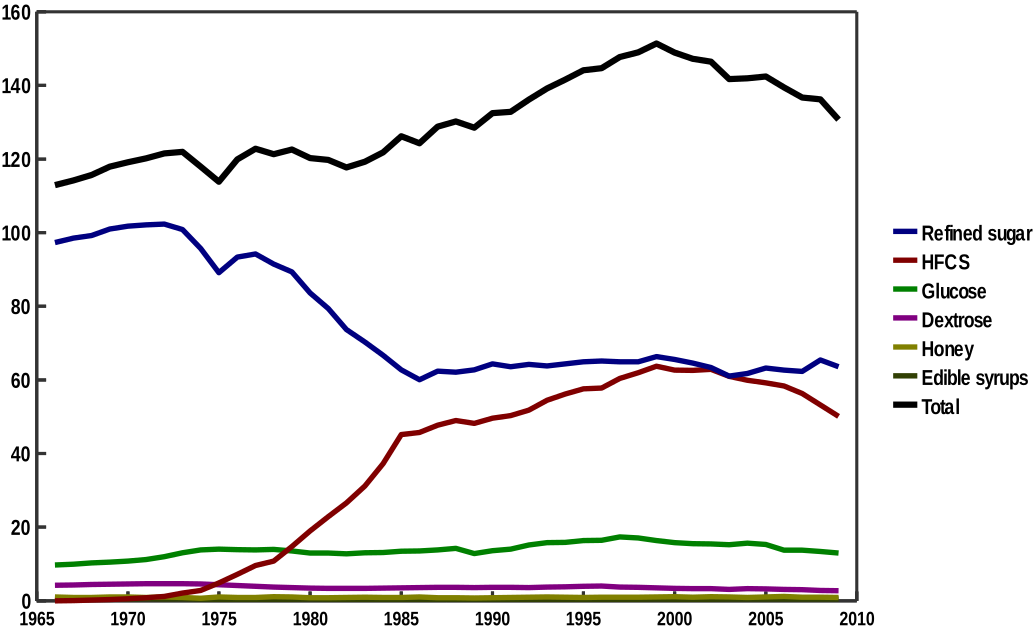

I believe that culinary customs AND some additives used in industrial food play an important role.
Just check out High Fructose Corn Syrup : this is in very product in the USA and is (almost) never used in Europe.