Contrary to what most people I know think, I think Xi Jinping and company are really scared. And the more scared they are, the more authoritarian they become.
They are afraid of Taiwan because Taiwan is the living example that China can prosper without the CCP.
They are afraid of Hong Kong because it's an example of resistance to the regime.
They are afraid of religions because no matter how much you punish someone, you won't be able to make them worship you instead.
They are afraid of wealthy people because they can taste freedom and they can vision a China without the CCP.
If you compare this subthread to the much higher-quality—because more specific, and specifically about this story—comments elsewhere in the thread, you'll get a sense of why we have this rule.
No, I don't think Xi and his friends are scared at all. That's almost like saying the US government is keeping a dozen carriers because it's scared of Russia (or China).
Xi is rattling his saber against Taiwan because he can and he will face no consequences.
Xi is sending police to Hong Kong because he can and he will face no consequences.
Xi is clamping down on religion because he can and ...
Maybe Xi is a bit paranoid, but you don't become a lifelong dictator of a billion people by doubting yourself. If I have to guess, Xi is convinced that he's leading China into an age of unprecedented glory, and he's surrounded by people who talk the same and mostly think the same.
I'd love to have some sinophiles explain Xi's strategy, what motivated him and his cohort to accelerate their time line.
China has Hong Kong. Full assimilation, normalization would eventually happen. The local's were onboard and content. Why make a fuss now?
Taiwan also wanted full normalization, eventually. So much upside. Wait another generation and few people alive would even remember what the fuss was about. Call it reunification, cousins remarrying, federation, whatever.
China's subjugation of Tibet and the western provinces were fait accompli. The critics were completely impotent. Why prove them right, breath oxygen into their opposition?
Harassing foreigners, thereby pushing them out of the country.
My guess is Xi felt compelled to act aggressively now to head off upcoming crisises. Something the insiders see better than is yet publicly discernible. One or more things that will rock the legitimacy of the ruling party. (The upcoming demographic bust is even worse than expected. Public finances are terrible. To forestall any correction of official GDP measurements. Widespread accounting fraud and corruption. Environmental degradation leading to food shortages. Exodus of manufacturing to Vietnam, Malaysia, others is faster than admitted. Probably a dozen other credible threats.)
> I'd love to have some sinophiles explain Xi's strategy, what motivated him and his cohort to accelerate their time line.
The timer on him is still ticking. He himself may well secured an n-th term, and party's temporary obedience at gunpoint..., but I feel he is very desperate, and have sleepless nights in anticipation of 2022.
Any fault of him, whether it is flagging economy, or any concession on the foreign front, or him not scoring just enough of political capital on that, would be 1000% used to undermine his position by whomever wanting to unseat him.
Unlike the oligarchates of ex-Union, CPC has very real internal conflicts. CPC's size ensures that there will never be enough posts, titles, and entitlements for every member of the establishment.
Xi will never be safe from the party. The moment he runs out of steam, and presents a chance for power to be taken from him, someone, out of many millions of ranked party cadres, is just ought to take advantage of the situation.
Remember, both Kruszev, and Deng were relatively small fish at the time they seized power, as was the case for power takeovers in a lot of single party regimes.
The central weakness of closed, authoritarian regimes is poor signaling.
Kruszev and Deng wouldn't have been able to seize power without substantial supporter.
The way I see it, the failure of those in power (from their perspective) was of not recognizing that well of support as it built.
Or, put another way, this is why authoritarian regimes are always paranoid: they have no objective methods for gauging public / party / military support, as dissent is always private.
Maybe I'm missing something as my history isn't excellent. Didn't Stalin rule until his death? So in the context of this thread, yes, that strategy worked out exactly as Stalin wanted it to?
Older generation in Hongkong and Taiwan tend to identify themselves as Chinese, but the younger generation tend not to. This is mostly due to exposure to western media which rightly or wrongly accuses the authoritarian CCP government for every bad things happening within its border.
CCP leadership might still think they have a chance for true reunification, or maybe they're just saber rattling. Personally, I don't think full reunification is possible until Chinese propaganda is able to compete with American ones.
> Older generation in Hongkong and Taiwan tend to identify themselves as Chinese, but the younger generation tend not to.
I see this, but I also see the "We're [Taiwanese] the real China, and the mainland isn't" mentality as well (they'll get upset if you call them Taiwanese). It does get a bit complicated, especially if you think back to what happened during the cultural revolution and the people that stayed in mainland vs those that went to Taiwan.
Rarely will you run into anyone with this “we’re the real China,” 外省人 identity that would be offended to be called Taiwanese. Descendants of mainlanders that came to Taiwan after 1949 are a minority and Taiwanese identity is very popular here. Both Taiwanese and Waishengren will quickly point out that ROC is the original China and of course they are independent because how could they not be independent from a country that split from it. Then Taiwanese will disagree about whether China (ROC or PRC) has any right to colonize their island.
Another generation and hardly anyone will have Chinese identity, I imagine. An example I hear a lot is that the Vietnamese and Koreans also used to be Chinese.
It's interesting that you would characterize anyone who disagrees with your interpretation of Xi JinPing's geopolitical strategy as a "Sinophile." Understanding his motivations is more useful for his enemies than followers.
Xi acted aggressively against Hong Kong right now because he wasn’t expecting any pushback from the US. The UK tried, but the UK isn’t powerful enough on its own.
Look at how the US responded to Chinas aggressive actions against Hong Kong. They imposed sanctions which basically treated Hong Kong the way the US did the rest of China. The punishment is exactly what Xi wanted!
> I'd love to have some sinophiles explain Xi's strategy
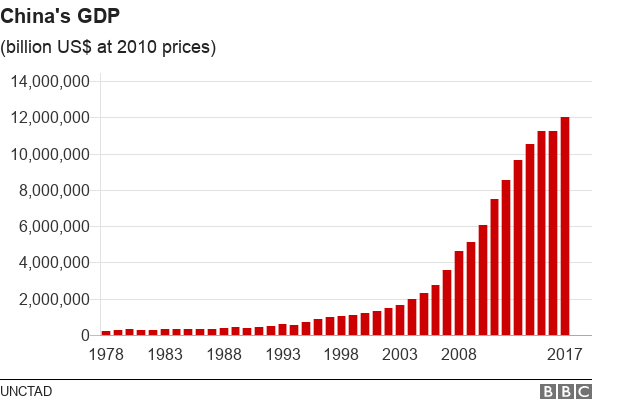
I'm not a sinophile, but I have pro CCP friends (we get in a lot of arguments). I think the reason to support Xi is very simple. Look at Shanghai in 1990 and 2010[0] and GDP[1]. While many are still poor in China, it is nothing to what it was in the 80's and 90's. Many families went from living in impoverished conditions to being wealthy. Living conditions improved dramatically for the average Chinese person and cities appeared out of nowhere and many of them are quite successful. This is just fact. But when you look at it through this lens it is easy to understand why people support Xi. Their lives got better. Then think back to Mao, where no line couldn't be crossed if it was for "the greater good."
It is important to keep this in mind, because it is easy to ignore things like human rights violations, racism, colonialism. I mean the same thing happened in America. It is also easier to not compare things on a spectrum but discritized (e.g. you're either "racist" or "not racist" there is no more racist or less racist)[2]. So what do you see in China? Your country is booming. You see America talking shit. You see Americans revolting and complaining about their own government. You see George Floyd. But you don't see Xianjiang. You don't see Hong Kong the same way we see it in the west (it's just a few protestors). You see "We, the powerful China are trying to help our fellow Chinese people gain a better life" and the average mainlander doesn't understand "why they don't want our help" (something my Mandarin tutor said to me). They don't see HK as successful, they see it as falling behind the rest of China.
So my understanding is that it is more about that they fully trust their government. They have real evidence to point to too. The other issue is that the viewpoint is different as well. Uyghurs are seen as terrorists and the term "reeducation camp" is not synonymous with "concentration camp" for them. There's a high level of nationalism and sense of being a part of something bigger. You can also see this in how the history of China has been taught differently through history and how the definition of "Han" has changed (as well as what "China" is and called). The terms China and Han have become great unifiers for the country and people (there's something to say to creating less racial division points). It really comes down to perception and flow of information. And I'll be honest, seeing a lot of this makes me question a lot about the flow of information we have here in America.
To be honest, watching China (and America, Africa, Europe, Russia), I've come to believe that political support more comes down to human psychology and emotional appeal than it does to logic and morals. That might be why the current state of the economy is a good predictor of the next president (not 100% accurate, but pretty good). If you weren't doing well before and you are doing well now, well it must be the leaders, right?
[2] I'd say that this binary thing is an important aspect (one that has also become a problem in America). But like I have friends that say that America is hypocritical because it complains about censorship in China but not about it on Twitter. There's no nuance. There's no taking into account if an individual is expressing consistent ideology (complain about censorship in China and in the US) vs hypocritical (complain about censorship in China but not in the US, or vise versa). There's also some confusion that complaining is an essential part of democracy as criticizing your government in the west is seen as a way to improve and iterate as opposed to tearing it down.
The characterization of Hong Kong, Taiwan, Xinjiang and Tibet being content with Chinese Communist Party rule may be an exaggeration. Furthermore, Xi's hardline was a reaction to 1) rampant corruption of the communist party as a result of market liberalization. 2) democratic movements across the world, including the Arab Spring, the 2011 Chinese Jasmine Revolution, and the Umbrella movement.
Basically Xi's nightmare is the disintegration of the Soviet Union and he's running the opposite playbook that Gorbachev used.
I'm just a westerner reading reports from other westerners. I'm relating my perception, as gleaned from western media.
"The characterization of Hong Kong..."
IIRC, I read there's a huge swing in the self identification of HK residents from "Chinese" to "Cantonese". Slim evidence, I know. But maybe directionally correct?
"Xinjiang and Tibet..."
I didn't say that. Western media has related that ethnic Tibetans and traditional Muslims have struggled, since I began reading the news in high school (80s).
> Basically Xi's nightmare is the disintegration of the Soviet Union and he's running the opposite playbook that Gorbachev used.
This is certainly what it looked like from Russia in the 90s, when China was just starting to meaningfully rise. I think Gorbachev's main mistake was that people were given political/personal freedoms before economic ones, and it was done way too quickly. After some 70 years without these freedoms, people did not know what to do with them, so a lot of bad shit happened in late 80s and "wild 90s". Economy was decimated, Soviet Union collapsed, and Russia itself was close to falling apart as well. Just read any US geopolitics text from late 90s or early 00s - they all prognosticate that Russia will be no more, salivating to divvy up the spoils. What got in the way of that was Putin, or, to be exact, Russia's national security establishment which installed Putin, since nobody knew who he was 6 months before he became president.
So the way the Chinese policy was perceived from Russia, it was something more sane. For one thing their stated timeframe for the transformation of the country (50 years IIRC, but I might be wrong), seemed more realistic. For another they started introducing capitalism first, rather than give a bunch of dirt poor people completely unrestricted political freedom a-la early 90's Russia, which could only lead to anarchy and disaster.
And I do believe they will succeed in the long term. The best analogy I have is the current obsession in US corporations with quarterly results, leading to suboptimal long term outcomes. This is what the US itself behaves like, except the "quarter" is 4 years long.
China doesn't have to worry about that, they live on a different time scale and can enact consistent policies spanning many decades. This is both a blessing and a curse. It's easier for the US to course-correct, which can be beneficial because most long term plans do not survive contact with reality. But if China gets the big picture right (which to me it seems like they do), and is able to course correct on the margins, they don't really need the randomness that the US system has.
I just wish they'd knocked it off with the concentration camps and child labor at this point. It undermines their own progress.
As to Ma, oligarchs with political aspirations need to be periodically reminded who runs the country. This is why Khodorkovsky ended up in prison for a decade. He got way too powerful, exerted a lot of ifluence in Duma, and thought taxes were optional. None of those three things were acceptable to the Kremlin.
No, that's not why Khodorkovsky ended up in prison. He gave money to Putin's opposition, that's why. As to taxes, its laughable, the ruling mafia in Russia steals $trillions from the till and not even trying to hide it.
Re-read what I said. Dude bought half the Duma by the time Putin went after him and was writing his own laws. And you're right about taxes, but do observe that taxes are only optional in Russia as long as you are an oligarch who doesn't have political ambitions. If you delude yourself into believing you can buy the parliament, they become very non-optional indeed. Selective application of justice can be a powerful thing.
> Basically Xi's nightmare is the disintegration of the Soviet Union and he's running the opposite playbook that Gorbachev used.
I find it funny by how hard people of Western upbringing try find some "higher meaning" to what villainous characters do, the more powerful, and scarier they are.
And they do not want to take the most obvious, explainative, and floating on the surface explanation, because according to them, "it can't be that simple!"
A phrase I hear often is "I don't believe in cartoonish evil characters!!!"
And that despite much of 3rd world dictators very much being such, and their actions being very well explainable by "evil guys, doing evil deeds, because they are evil, arrogant f..ks," and that being their primary motivations, with all their "roleplay" obligations, and nominal official duties coming second to that.
There's quite a lot of evidence that the CCP values social stability (their own definition of it at least) extremely highly, above almost everything else.
I don't agree with you about Westerners not seeing the villainous wood for the evil trees, but I think it's moot when there's an even simpler explanation: they do not want to lose control.
That is it, but that does not preclude arrogance, and evil nature from being a primary driver of such person at the same time as rational desire for self preservation, and, sometimes, even a rare genuine brilliance in political matters.
It kind of does preclude it. Your argument seems to be "they do bad things primarily because they're just evil" and mine is "they do bad things primarily because they can't bear losing control".
I feel like you just want to make a point about the CCP being evil. Fair enough, but that doesn't really have any connection with what you were trying to say about Western critical thinking.
> Fair enough, but that doesn't really have any connection with what you were trying to say about Western critical thinking.
Western critical thinking seem to be hell-bent on thinking that some grand totalitarian regime cannot be just "dumb evil," and it must always come with some kind of equally grand conspiracy, secret agenda, maybe even some semi-valid point, as they probably think "it must take some brains, complex motive, and talent to run you evil empire at such scale."
It's beyond them to concede that their grand political theories are not the case, and the man is driven just by your regular arrogance, greed, and cowardice, aka lust for power, even if his ways of achieving those may be quite sophisticated at the time.
Even 3rd world dictators are only cartoonishly evil on a surface level. Gaddafi is a prime example. His "Amazon guard" sounds like it came straight out of a comic book. However, after a decade of civil war in Libya, it's clear that he was the only thing keeping it together in the first place.
Believe or not, CCP studied French Revolution and fall of Roma, and the boom and bust cycles in 2000+ Written Chinese history... And many stuff people should be studying... Nothing fancy, just learning from history.
Western people are not misunderstanding China, they just are content with a myopic tiny view, and happy to apply whatever judgement they can at the whim of the moment.
Discussing any China related issues on HN is like arguing with mobs. You either are drowning in downvotes, like saying Mr. Xi is not just a dictator; or arguing with someone who questioned any minor details you raised as a Chinese, often make me questioning did I lose touch with China so much that a random HN visitor actually knows better than myself...
> No, I don't think Xi and his friends are scared at all. That's almost like saying the US government is keeping a dozen carriers because it's scared of Russia (or China).
I'm sorry, but the US actually is scared of Russia and China and it's whole point in having a large Navy with carriers and such is to counter them. Those two countries are the only adversarial countries to have any meaningful naval presence, so there really wouldn't be any treason to maintain such a large carrier fleet unless they were scared of them.
No, we have carriers because they are costly. The point of the military-industrial complex, like any cancer, is to consume vast quantities. They admit to spending three times what China spends (the actual multiple is higher), and the last yearly increase was larger than Russia's total.
For some idiosyncratic definition of "work", one supposes. (Some would argue that at least the "agriculture complex" puts something approaching food on the shelves.) I live in a blood-red state, and I'm kind of an asshole so I have political conversations with everyone. I haven't this year talked to a single person who thinks that any of the wars fought in my lifetime were good wars to fight, or who "desire" any more of them. (There are some dead-enders who still defend the idea of Vietnam; before my time.)
The average citizen, however, may fall under your "accepts" criterion. It doesn't matter what nation I suggest, indeed I have made up nonexistent nations before, and most people will allow that, yes, given sufficient winding-up on the part of "news" organizations and politicians, they would accept bombing them to hell and back. In the long view of history, this will be why USA and Germany are discussed together in the same chapter. The public does not desire ruinous horrific ridiculous pointless endless war, but it does accept that, after enough gaslighting by MIC's paid employees in government and media. That's on us. I don't really like my team.
China (Russia can't even entertain the dream of it any more) doesn't have a dozen carriers, it's a totally different side of the geopolitical scales.
> Maybe Xi is a bit paranoid, but you don't become a lifelong dictator of a billion people by doubting yourself.
It's worth citing Nixon as an example of someone who while maybe not doubtful of themselves but was utterly paranoid and belligerent towards any and all dissent and opposition, but still made to the very top of the world.
While I strongly dislike authoritarian regimes and wish the CCP would just disappear. You have to admit that China in the last 20 years has been an absolute growth machine. I often see it argued that it's "fake" because the party subsidizes a lot of economic ventures, but even then they are building one hell of a domestic market.
Trying not to do the apology of a terrible regime, but I can see why Xi would see himself as "leading China into an age of unprecedented glory".
For what is worth many dicators had "golden" years. The issue is that at some point you get a bad dictator(or the current one turns bad) and you have to live with him your entire life. Not to mention that even within the golden period you still have freedoms taken away but that's a different story/trade off.
China isn't ultimately ruled by a dictator but by a party. You seem to think that the party would allow an incompetent person to assume the top position and stay there, which I don't see evidence for.
It looks like you don't understand how one party systems work. Just look at Trump and GOP and consider this is a democracy. Once he got the power the whole party(with few exceptions/undesirables that would be eliminated if it were a one party system) got behind him regardless if they liked him or his policies. There was bone to chew and they didn't want to loose it.
If things go south there are plenty to blame(i.e China, Russia, EU, rebels, etc). It is never the leader to blame. As the party leader controlls the police and the millitary there are really very few that would dare to consider a coup/leader change.
Even North Korea's Kim is "officially" supported by his party members but we already know what happens when they question him.
FWIW I really hope that you are right, a somewhat democratic and more collaborative China would be such a great partner to have, developing advanced tech and stimulating the fight against climate change.
China's political system is nothing that a good old style capitalistic bust can't take out in a decade or so. The USSR never recovered from the inflationary late 70s. Japan's state-induced credit boom economy never recovered from the early 90s deflationary bust. Dictatorships/state controlled economies are still economies.
As Hyman Minsky would agree - there's only one way to handle volatility, take it in your face. You can't suppress it.
>You have to admit that China in the last 20 years has been an absolute growth machine. I often see it argued that it's "fake" because the party subsidizes a lot of economic ventures, but even then they are building one hell of a domestic market.
It's not so much "they're pumping the numbers by cooking the books", it's more of the regime being at the right place at the right time. Other east asian countries industrialized at the same time without the CCP, for instance.
It’s a weak third world economy that is modernizing. Of course the growth is tremendous. The west (and Japan/Korea) went through this in the 19th and 20th centuries, this will happen all over the world this century across Africa and Asia. You can’t give too much credit for growth in comparison to the rest of the world when the backdrop is being behind. There are over a billion smart people to draw from, it’s just inevitable and draws from the strength of Chinese culture before mao suppressed it with the cultural revolution when schools were destroyed. This is in spite of the authoritarianism, and based on Hong Kong and Taiwan, would have happened decades ago without it
Not a lot of that could be credited to dictator for life Xi though.
In fact, by making himself basically dictator in life he has added the potential for tremendous instability in Chinese politics that did not exist before he took those actions.
Chinas growth is mostly due to the handiwork and frameworks set out by Deng Xiaoping. It’s easy to look successful coming in when the long-term investments his admin made starts to sprout.
You can use this logic with Stalin and Lenin, too. They went from a agrarian feudal society to a world superpower, helping defeat the Nazis and being the first in spaceflight.
Of course, you'd have to be wearing rose-colored glasses to take that portrayal at face value, and you'd also have to ignore significant atrocities the leaders were responsible for.
No, I don't think Xi and his friends are scared at all. That's almost like saying the US government is keeping a dozen carriers because it's scared of Russia (or China).
I agree that the US isn't scared of Russia or China, but I think the US is afraid of the idea of not having military dominance.
There is a long history of massive uprisings against the establishment in China. Tiananmen is just the most well known example of something that happens every year. I doubt Xi is ignorant enough to _not_ be afraid, though I agree with you that he probably is very confident as well.
> Xi is clamping down on religion because he can
My source may be dated, but as of 1988 policy making in China was a protracted, incremental process involving negotiation among numerous different groups (central and provincial governments, bureaus and departments)[0]. Things may be more centralized now, but I think it's safe to say that if something is happening in China, it's because multiple government entities at different levels have agreed to it. Who knows what the reason is.
a. There are not "massive uprisings" "every year" in China.
b. China has substantially centralized post-2000.
I would go so far as to say it is close-to-useless to cite a 1988 book on modern China unless to reference its history, that's how fast things have changed.
There are hundred of riots happening in China every year without even "China watcher" media telling a thing about them.
My own experience was seeing a huge commotion right in the city centre of Guangzhou, a megalopolis bigger than New York, without single mention in the media the next day besides some random youtube uploads.
I can co-sign that there are often incidents of civil unrest in China that are not reported in the media. However, from what i can gather, these are not explicitly anti-establishment. Most of them appear to be localized labor disputes or middle class NIMBYs making a fuss about development that inconveniences them.
For reporting on the former, you can check out China Labour Bulletin[0].
When I was there in 2014 there was a HUGE protest in Changsha. None of these are reported in the media inside or outside China.
I concede that my source on policy-making is dated, but I highly doubt the the functioning of a country as vast and complex as China can be completely transformed in forty years. Still, I'm not sure, so I emailed the author to verify.
I think there is a world of difference between protests (usually over eminent domain related concerns, not always) and an "uprising." I've tracked to track down some of these claims of 180,000 protests a year (following the links) and it's been hard - I find it hard to believe that these are very large protests.
I think you're caught in short term thinking. China's cultural character has been developing over 1000s of years. It's DNA hasn't changed meaningfully since 1988.
Sure, some of those values shine through, but I think you're underestimating how quickly change can occur and how values can be changed when your population scales up from 75 million (1000 years ago) to 1.3 billion.
The OP comment posits Xi acts based on fear. This comment posits he acts based on zero fear. No where do they posit a rational basis for action or a concrete analysis of power relationships.
> If I have to guess, Xi is convinced that he's leading China into an age of unprecedented glory, and he's surrounded by people who talk the same and mostly think the same.
For what it's worth given the ... disastrous state of the US, the deep rifts in the EU and the total retreat from anyone not China from Africa, that is a very valid, yet frightening, assessment of the future.
...that escalated quickly. Ant's business model is under the hood good old lending and banking, where their "innovation" excels at minimizing the barrier to spend your future money. This is not like Google or Microsoft, whose products are purely technology, this is a glorified financial company. And the more money they raise, the larger / crazier scale their lending will affect. Just to give you a hint, their "savings account" equivalent has way higher interest rate than the national banks, but with same level of account numbers if not more, that would need consistently piling money to sustain. Essentially they will become "too big to fail" if the IPO goes through, and you know how that went in 2008.
Yeah I guess Xi and co are scared, but for a different reason. Nothing about the foreign policies or whatever you think "freedom" is.
Ants lending business has doled out 1.8T on 36B of cash from Ant itself. That's 50 times the leverage they financed through ABS. A term that was very relevant in 2008.
Everything will be fine until the central bank raise interests, or if economy goes down the shitter. The new regulation limits the leverage cap from infinite to about 15, closer to bank's 10. This limits risk, and is considered a reasonable move.
A truly desperate move would be to allow these bubbles to go ahead and IPO. Which almost happened, everything will be fine and dandy for a while, until it's not. Whether it's due to Xi's insecurity or not, I'd say that China dodged a bullet here.
“Xi shows his power by punishing a powerful businessman” is a much better story for him than “Xi limits size of over leveraged company over fears it could wreck economy”
Exactly. This whole discussion about China suppressing Jack Ma is nonsense. It seems nobody here even knows what Ant was doing. And they’re all typically ignorant about whatever happens in China, and will just superimpose their biased views on them.
Ant was running some really shady and risky lending practices. They were not relevant when they were a private company, but once they became public, it instantly became a serious matter. The risk of failure is very high, and it risks bringing the whole system down.
What the government told Ant to do, was to have more collateral on their books. To increase it from 2% to 30%. Plain and simple. Then they can go forward with their IPO.
I think the reason your opinion is different than most people you know is because you really know nothing about china unfortunately.
> They are afraid of Taiwan because Taiwan is the living example that China can prosper without the CCP.
Not really, 20 years ago maybe? but now that the first tier provinces have mostly caught up economically it's really just a matter of time before rest of china catches up.
> They are afraid of Hong Kong because it's an example of resistance to the regime.
again, most chinese think the hongkong riots as a bunch of misguided youth manipulated by western media. you may not agree with it, but that's the view held in china right now.
> They are afraid of religions because no matter how much you punish someone, you won't be able to make them worship you instead.
or maybe the fact religion has been the main drivers for a whole bunch of wars?
> They are afraid of wealthy people because they can taste freedom and they can vision a China without the CCP.
is that why more and more wealthy chinese people are expressing their support for ccp abroad, but are instead labelled as brainwashed?
> Not really, 20 years ago maybe? but now that the first tier provinces have mostly caught up economically it's really just a matter of time before rest of china catches up.
This isn't even remotely true. Taiwan has a GDP per capita of $54,000.[1] The two wealthiest administrative division in China are Shanghai at $38,000 and Beijing at $37,000[2]. Moreover it's not an apples-to-apples comparison because those cities are consistently drawing the best and the brightest from the entire country.
> the first tier provinces have mostly caught up economically it's really just a matter of time before rest of china catches up
Prosperity doesn't have to be economically. It can simply mean financial and overall governing independence. OP's point is not that Taiwan is better than China, but to point out that Chinese people can do well without CCP and this is what CCP doesn't want people to know. Also Taiwanese economy has many sections from CCP so I'd imagine it'll do well above current standards without them
There is a very big difference between what the average person in China thinks and what the leaders of China think. A revolution doesn't need a majority to happen, just a single to low double digit percentage to happen. OP was talking about the leader of China, your post is talking about the populace of China.
> or maybe the fact religion has been the main drivers for a whole bunch of wars?
More likely that they consider religion a powerful fictional structure competing with their own fictional structure. No natural law dictates that either of them should dominate, so they chose to suppress the competition.
> Contrary to what most people I know think, I think Xi Jinping and company are really scared.
Contrary to what most people think, I think Xi Jinping and company are really scared, but not for the reason you mention.
Xi is said to be very afraid of Shanghai clique, and this is the reason they are still around, and not crushed like everybody else.
Who owns Ant? Speculations are that a number of people from the Shanghai clique are, with the biggest one being public knowledge: grandson of Jiang Zemin got Ant's shares for noticeably less than market price.
I believe, this explains why this case was handled remarkably tactfully, and why Ma still walks in one piece. Anybody else would've been disappeared the same day for much less in today's China.
I've heard it said they are afraid of religion, not because they want to be worshiped, but because it's scary to them for people to have a 'higher' authority than the state.
Exactly, centralized religion has historically been a source of power in competition to the government, military and so on. So authoritarian governments either try to co-opt it or get rid of it.
In the West, centralized religion historically was the government. They collected taxes, managed large scale projects, handing down justice, maintained postal networks, etc.
There's a reason that England's split from the Catholic church lead to a civil war and eventually the 1689 Bill of Rights: it was a coup.
Centralized religion has historically never existed or even anything close to it in China. And Xi has actually been a big booster for revival of the religious traditions that they do have.
Every one of these threads is full of people doing a ctrl-f find/replace Russia/China on their cold war propaganda lessons.
China's a different country, with a billion and a half people and a few thousand years of history that most Americans are completely ignorant of, but that doesn't stop them from being supremely confident in their takes.
And none of them are super-prevalent in China. They have a non-abrahamic tradition that's a weird localized mashup of buddhism, taoism, local city-gods and crazy statues.
This thread is full of people who've never seen any of it confidently asserting How China Feels About Religion.
The fastest growing community of Christians on the planet was in China for the last 20 years or so. China is large, so it's hard to argue how that equates to prevalence.
But in the next five years, the number of Chinese Christians is projected to grow to half the population of the entire United States—150 million. That may only be 15% of the population, but that's still significant.
It's hard to put the blame solely on Communist China when Christianity's main attempt to take hold led in the Eight-Nation alliance invading China and massacring Christians.
CCP-as-a-religion has definitely played a huge role in the stability of the Chinese regime, tremendously in the past and certainly a substantial amount in the present.
Wealth inequality is crazy in China (not as crazy as the States in terms of standard deviation, but crazy in terms of the scale: as of 2020 China has over 600 million poor with 140 USD monthly income[1] i.e. almost twice the population of the States)
Since I was young, my parents (both born and raised in mainland China in the 50~60s i.e. had experienced Mao before he died as well as the Cultural Revolution) would tell me that back in those days this whole communism bullshit managed to operate itself in such a large popullation because it was like the religion of the people. And properganda [2] is the way to reinforce that, in those time as well as in today.
You will immediately start seeing giant properganda billboards about how great Xi Jingping is when you visit countrysides in China. The poorer the places the more billboards there are, and the more worshipping you would see.
Even to these days you would find espeically among long-distance driviers little Mao Zedong ornaments in their cars as protective talismans because people (esp the older generation) actually thought of Mao as some kind of deity, one which they would seek blessings from. (It's often hard to tell if they are joking or they actually believe it. That's one aspect of this CCP-as-a-religion culture. And the true victims are the poor and uninformed.)
[2]: In tier 1 cities like Beijing and Shanghai, you would certainly find less properganda today simply because it doesn't really work against the well-educated. But dezinformatsiya is still rampant. If you can read Chinese, you would see that so many news articles people consumed on WeChat, Toutiao, Douyin, Baidu, etc, are just full of shit. Sometimes they are state-sponsored (showing false information about HK during the protests), and sometimes it's just sensationalism in its worst form (e.g. reporting on covid protests in the States and in EU with gifs that were not from those protest but somewhere else)
I think the difference between the U.S. and China is that in the U.S. corporate power controls the government, whereas in China the state has control over the corporations.
I don't think Xi is scared per se, but he definitely doesn't want China ending up like the U.S.
Do you think China suffers from a collective inferiority complex? By that I mean: Any attack or criticism is fiercely resisted because it challenges the party narrative that the party can do no wrong?
> Do you think China suffers from a collective inferiority complex?
Might have something to do with loss of face perhaps which is an important concept in many asian countries [0]. From my understanding you have to be very careful with criticism in many Asian countries, especially with regards to authority. If someone has higher authority than you (e.g. boss at work) he can generally do no wrong or if he does wrong in some way (e.g. makes bad business deal), you don't confront your boss.
I'm not a fan of cultural explanations for behavior versus realpolitik, especially when the alleged cultural characteristic can be distilled into a single phrase.
Couldn't it also be that criticisms are resisted because people literally remember the last 40 years of economic improvements in China, and attribute (whether reasonably or not) that improvement to the CCP? I'm not saying that's a good reason to fiercely resist criticism, but it's certainly an understandable emotional response.
> think China suffers from a collective inferiority complex?
You couldn't have said it better. But it's much more attributable to the now waning elites, than anybody else.
Those are people who grew up being spoon fed with success for life, and are envious beyond measure of people who got to succeed without paying a dime for party membership.
They are taught they are amazing with a long history (that they are trying to erase in real tie), but that is hard to reconcile how amazing they are with having sat out the scientific revolution the last 200 years or so.
They’ve managed to crush Hong Kong. And they are on their way to beating Taiwan at its own strengths.
Even if they are running scared, it looks like they’re running extremely successfully.
Of course, it helps that the only country that could have put pressure on them was led by a moron who though mispronouncing China’s name was the heights of showing them up, while not taking any effective long term actions.
It is the total opposite. Xi Jinping is keeping all the key holders to the kingdom satisfied impeccably well.
They aren't afraid of Hong Kong, the other perspective is that Hong Kong has much less relevance than it had during the handover, 20% of GDP down to 3% of GDP. Hong Kong is an example and cautionary of tale of "late stage capitalism" that all cities around the world experience, high rents and living costs and no consensus on how to help. Whereas mainland China gets large living spaces and welfare for all while inheriting exposure to high growth market based systems and its working extremely well right now, Beijing's state capital system is working. They can deal with Hong Kong as is for the next 17 years no problem.
Taiwan is just there. They can saber-rattle about that for a long time too.
The status-quo in China is good enough, some people get their money out, others provide services in mainland. That status quo involves the implicit threat of party members doing anything to you if you fall out of favor.
Chinese unity and territorial sovereignty is the primary common denominator of everything Xi does, if you do or say anything that can be seen to harm the state or the idea of China, then you've done it wrong.
I read the transcript of Jack Ma's speech, it wasn't very egregious, but all he had to do was skip the thoughts about the current state of how debt is negotiated in China.
If you can quarantine 1B people in two weeks, that means Xi's power has reached an unbelievable level. He can start a war if he wants to, no one in China can object to that.
Alibaba is nothing but a pawn to him. The fear created by halting of Ant IPO will ensure no other entrepreneurs will publicly challenge the authority as long as Xi is in power.
That Jack Ma said anything at all surprised me. Ma's had always been wholly obsequious, in public at least.
I guessed that Ma's spoke up for one of the reason's I've done so in the past: Ma was done and decided to stop playing. He felt he finally had enough juice to make some kind of a power play. He felt that Truth and Duty were principles worth dying for.
Whatever the reason, I'm sure he now wishes he hadn't.
I'll be doubly surprised if Ma doesn't have an exit strategy. Opting for that seaside villa and teaching poetry to local school kids.
Being able to finance high interest lending by selling subprime debt securities are principles worth dying for?
Or are these Truth and Duty? I'm very confused. Ma criticised the regulators for 'holding back innovation', innovation we've seen and paid for in 2008.
I am the last person to ask about the merits of Ma's argument. I'm firmly in the castles in the sky camp, that all finance is intrinsically suspect, and that all the belligerents retcon their dogma as needed (went up because I'm a genius, went down due to unforeseen circumstances completely beyond my control).
Like I tried to say, poorly, I'm just surprised Ma spoke up, and can only guess why.
This articles speaks of Xi Jinping as if he is taking all the decisions. There are a lot more people behind him that are assessing the situations based on merits rather than personal whims. It's only the Western ignorance that makes us see every economical, fiscal and foreign decision to belong to one man be it Putin or Xi Jinping. It also reinforces us the ideas that were sold to us by our own government: China is ruled by a dictatorship and everything they do must be wrong. Everything China does must be wrong because it's not a democracy and people are not free.
The internation banking rules force the banks to adhere to a set of conduct, regulations and rules that make the banking environment predictable for all actors. Looking at money flow: speed, volume and diversity, it is in China's interests to have a predictable and understandable banking landscape rather than continuing on this path of reinventing the wheel. The more Western banks trust the banking system within China, the more predictable and easy it will be to keep the economy growing. ANT's move is only establishing a state within a state and certainly hurts national security by creating a gap in one core service within any modern country: the financial system.
Actually I'm very doubtful that Winnie the Pooh thing was decided by him. Pretty sure that's just decided by lower level censors and Xi himself has no idea that the Pooh controversy even exists.
People have been saying the CCP is on its last legs for over 70 years.
In those seventy years it has led a country which grew to have the second largest GDP in the world.
-- writing this from the USA, where Covid is spiking, where there are armed right wing Covid open for business riots at statehouses, as well as against police kneeling on black men's throats killing them leading to nationwide blm antifa riots, where the president won't concede the election, where U3 unemployment is currently 6.9% etc.
(I heard about the Hong Kong riots in the US News until the open-business/blm/antifa riots happened with a much higher body count)
I believe that some systems are more moral than others.
That said, it's pretty clear from many comments on HN that people have no clue how far along China is, perhaps stuck in a early 2000s mindset. Nor do they seem to have any serious understanding of Chinese government.
I mean do you see China becoming the next world power? I do myself, though not nearly as long as a reign as America had, I foresee a 15 year thereabout hold from China until the country falls into the typical issues that the Western world has faced + Japan faced since the 90's.
> I mean do you see China becoming the next world power
I don't see there being a next clear world power because I don't think the world works that way anymore.. capital is way too trans-national at this point.
China is a split society. Many are still in poverty, per capita gdp is very low. However it’s a huge country and several hundred million now have western standard of living.
This is definitely true, although it is worth noting that many of those in rural poverty have also seen huge improvements to their condition (number making under $2 PPP/hr has gone from 700 million to 2 million in a matter of 2 decades) and many of the cities in traditionally rural provinces are booming.
I am usually fairly relativistic on moral questions but, it's too long to really do it in a comment, but I think you can devise a good (ex vacuo) argument for - in short - the good parts of what we in the west would characterize western ideals to be.
I feel the same way when Peterson-types try to say it's impossible for atheistic ethics to "exist" logically, the argument is again just too long to do justice outside a monograph.
Civics classes are not the intellectual battlegrounds of the past or future.
Whether those ideals are destined to prevail is not really a scientific question.
This is also true of the far left in the US. Their attempts to increasingly censor, deplatform, ban, cancel, and so forth suggests that they are scared that people do not think like they do. And with that comes a bend towards authoritarianism and fascist control, the very things they claim to be against.
But just like with the chicken and the egg, I cannot rightly tell if either the CCP or the American far left are acting out of fear, or if they are just exercising newly-gained power. It may simply be that they're putting new power to work, testing the waters to entrench their positions further.
>They are afraid of Taiwan because Taiwan is the living example that China can prosper without the CCP.
You can not compare the racially and culturally homogeneous Taiwan to the whole of China. A country like China has 0 chance of remain whole without authoritarian leadership.
>They are afraid of Hong Kong because it's an example of resistance to the regime.
They are not, they crapped their pants and with time things will get worse for them.
>They are afraid of religions because no matter how much you punish someone, you won't be able to make them worship you instead.
They just don't want the west of China to become a playground for Islamic terrorists.


Contrary to what most people I know think, I think Xi Jinping and company are really scared. And the more scared they are, the more authoritarian they become.
They are afraid of Taiwan because Taiwan is the living example that China can prosper without the CCP.
They are afraid of Hong Kong because it's an example of resistance to the regime.
They are afraid of religions because no matter how much you punish someone, you won't be able to make them worship you instead.
They are afraid of wealthy people because they can taste freedom and they can vision a China without the CCP.
And so on...