On the other hand, in North America, massive amounts of freight are moved by rail, extremely efficiently, and railways are generally pretty profitable. A train might be a mile long (as a child, you count the cars as you go past on the highway, and 80 or so was pretty standard). The freight companies own the rails and their trains get priority over passenger trains. Via Rail has exactly the same problem in Canada.
In contrast, in Europe, while some cargo is moved by rail, the focus is on passengers. Freight trains (all trains) are short, and passengers have priority over freight.
A quick google brought this up, though I haven't read through it in full:
The US picked a different optimization. The combination of transportation modes from Rail, Truck, and Barge are amazingly important to the health of the country. Passenger rail had a brief time of importance but was passed by plane and car travel.
When the fully automated, electric car and buses arrive, I would imagine that passenger rail in the US will disappear entirely except for nostalgia operations and metro systems already in operation. It is much easier to be B2B or B2G than deal with individual customers for any of the railroads, and getting passengers off the rail will be a bonus for them. The nodal nature of rail will always be a handicap compared to roads.
>The US picked a different optimization. The combination of transportation modes from Rail, Truck, and Barge are amazingly important to the health of the country. Passenger rail had a brief time of importance but was passed by plane and car travel.
The US could have “chosen” to do both (there’s no single policy decision or document to point to), as it had done in its railroad heyday, and as other countries do (e.g. Switzerland, China, Russia, etc.). It was and continues to be a failure of public policy and political system that passenger rail is so bad, and even freight rail is as underinvested in. That’s not a knock on the other forms of transport, all of which form a vital part of a larger interconnected, intermodal transportation network, but rail should be an important trunk of that system given its capacity and efficiency. Yet rail has had the least amount of public financial and policy support. By comparison, the US has invested trillions of taxpayer dollars in building and maintaining millions of miles of publicly owned roads (almost all non-tolled), airports and Air Traffic Control (ATC) system, and seaports, canals, dredged harbors and navigable inland waterways, Vessel Traffic Service (VTS).
>When the fully automated, electric car and buses arrive, I would imagine that passenger rail in the US will disappear entirely except for nostalgia operations and metro systems already in operation. It is much easier to be B2B or B2G than deal with individual customers for any of the railroads, and getting passengers off the rail will be a bonus for them. The nodal nature of rail will always be a handicap compared to roads.
We do need autonomous, electric buses and trucks, but fully automated, electric railway technology exists now and has for many decades, and well over century in the case of electrification.[1][2] Standards-based electric trains and related technology are available for purchase off the shelf from multiple vendors, do not need to carry large battery packs in the vehicle, and no pie in sky hope for future automation of an insanely hard problem. Electric railways are the most optimized form of land-based transportation, and arguably the most overall.
“The first rule of any technology used in a business is that automation applied to an efficient operation will magnify the efficiency. The second is that automation applied to an inefficient operation will magnify the inefficiency.” - Bill Gates
The US could have “chosen” to do both (there’s no single policy decision or document to point to), as it had done in its railroad heyday, and as other countries do (e.g. Switzerland, China, Russia, etc.). It was and continues to be a failure of public policy and political system that passenger rail is so bad, and even freight rail is as underinvested in. That’s not a knock on the other forms of transport, all of which form a vital part of a larger interconnected, intermodal transportation network, but rail should be an important trunk of that system given its capacity and efficiency. Yet rail has had the least amount of public financial and policy support. By comparison, the US has invested trillions of taxpayer dollars in building and maintaining millions of miles of publicly owned roads (almost all non-tolled), airports and Air Traffic Control (ATC) system, and seaports, canals, dredged harbors and navigable inland waterways, Vessel Traffic Service (VTS).
I don't really think that was in the cards. The car was already prevalent before the interstate system was built, and the military was much more about a road solution than rail.
As to cost, look at California trying to add high speed rail, as they have failed badly for what was a very modest set of served areas.
Rail does cargo very well. It's very easy to setup the factories and elevators on the rail line. Rail has some serious problems with terminal delivery of people in the US. You still need another form of transportation to get people home. Without fundamentally changing where people live or work, it needs something else.
We do need autonomous, electric buses and trucks, but fully automated, electric railway technology exists now and has for many decades, and well over century in the case of electrification.[1][2] Standards-based electric trains and related technology are available for purchase off the shelf from multiple vendors, do not need to carry large battery packs in the vehicle, and no pie in sky hope for future automation of an insanely hard problem. Electric railways are the most optimized form of land-based transportation, and arguably the most overall.
Electric, Automated trains still don't reach people's homes. You are not going to change the fundamental idea of living in suburbs or the country. In fact, current events make living away from the cities a good option. The cost of rail in the USA is too high even for states that really want it. It will be much easier to alter how the USA builds roads to add cues for automation than try to add rail everywhere. Electric, automated buses will replace passenger rail and be much more flexible for changing trends in where people are going. Automated cars will make personal transport to individual destinations much more efficient and easy. Other than the metro systems that exist, there won't be much place for passenger rail.
>I don't really think that was in the cards. The car was already prevalent before the interstate system was built, and the military was much more about a road solution than rail.
These are policy decisions. Other countries chose to invest in rail. The US chose to invest in other forms of transportation and created adverse policy conditions in which rail largely withered and nearly died. I made another comment [1] where I talk about the political milieu that likely contributed to this.
I would also call out the fact since WW2, the US has lost more than half its railroad route-miles (300,000+ to ~147,000 today). Other countries had to rebuild their infrastructure after the destruction of the war. No bombs were dropped on American railroads. Aside from figurative bombs of bad policy by political leaders, competitors in automotive/airlines, and the deeply ignorant idea that railroads and trains are an obsolete 19th century technology.
>As to cost, look at California trying to add high speed rail, as they have failed badly for what was a very modest set of served areas.
I am well aware of the California HSR project and its many failings. It has nothing to do with anything inherent to rail technology. I view it as symptomatic of and the inevitable result of a broken political system, poor project management, a Transportation/Construction-Industrial Complex (similar to the Military-Industrial Complex), monied special interests like construction and engineering contractors run wild with no oversight, capturing the agencies they work for and transferring as many public dollars into their bank account.
Alon Levy’s blog Pedestrian Observations [2] covers transportation construction costs extensively, and generally calls out Anglo countries (UK, USA, CAN, AUS) as the most troubled. There’s also the Caltrain-HSR Compatibility Blog [3], Systemic Failure [4], and others in the technical transportation commentary space.
>Rail has some serious problems with terminal delivery of people in the US. You still need another form of transportation to get people home. Without fundamentally changing where people live or work, it needs something else.
>Electric, Automated trains still don't reach people's homes. You are not going to change the fundamental idea of living in suburbs or the country. In fact, current events make living away from the cities a good option. The cost of rail in the USA is too high even for states that really want it. It will be much easier to alter how the USA builds roads to add cues for automation than try to add rail everywhere.
There is an access problem or first/last mile problem, but rail does not exist in a vacuum. It can work in concert with buses, taxi/rideshare, friend/family pickup/dropoff, biking, walking, etc. as part of a larger comprehensive transportation network. Rail can act as the high capacity core of the network. A pair of optimized, electric, modern signaled rail tracks with has the transportation capacity equivalent of a 8-10 lane highway. This should be taken advantage of, then use lower capacity/higher flexibility transport for the first and last mile problem. Otherwise we continue have a congestion problem with transportation network centered around single occupant vehicles (SOVs), or even zero occupants with autonomy. Autonomous vehicles do not fix that, if anything it makes it worse.
Without getting into third rail politics unique to post-WW2 American suburbs/rural life and notions of “freedom,” historically trains were one of the primary form of mechanized land transport for about century, from the mid 1800s to well into 1900s. Suburbs were originally enabled by rail during this period (e.g. NYC, Boston, Chicago, LA metro areas), many of suburbs grew up around a local railroad or streetcar system, and their historic downtowns are often next to a rail station [5][6]. It was only later, we got auto oriented suburbs where you need a car to get anywhere. These were decisions, we could choose to create transit oriented communities, including suburbs.
That is at least for Germany not entirely correct. If some train from some logistics provider embedded in some just-in-time supply chain scheme is delayed for what ever reason, it is prioritised (Though this is new, since maybe about 5 years?). Which means you are standing still for maybe 15 to 20 minutes somewhere 'out there' between stations, and can enjoy 3 freight trains overtaking you, and maybe horses, cows, or just the noise protection walls.
Chaos!
Anyways, this chaos is self inflicted by building back switches, which would enable a more granular partition of the tracks, and more flexible passing of trains.
All in all, our railways are indeed "'ne Lachnummer"(laughing stock).
OTHO not so ridiculous at all, considering the massive build back of infrastructure.
The long trains you mention are called unit trains. They move from point A to point B as one unit. Typically the unit trains will be of all one type, e.g. tank, grain, container.
The trains with mixed types can be unit trains but they can also have intermediate stops where cars are added or dropped off.
The optimizations the rail companies perform to maximize the freight movement (and profit) is very interesting.
Correct! American freight railroads are the most efficient in the world, Europe by contrast, chose to move passengers, but this has meant that more freight has been pushed off the rails onto the road.
By cost per ton mile, in which US freight rail is cheaper than almost any other country in the world, including China.
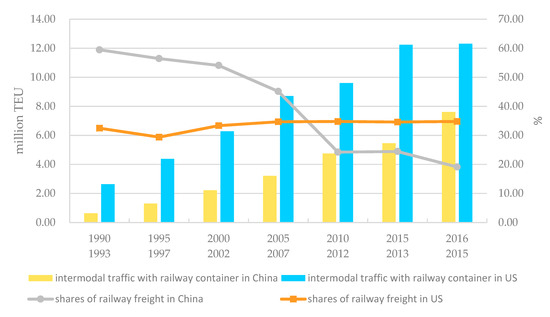
China's rail freight, as a percent of intercity freight has been steadily declining [0], in large part due to development on high speed rail, which has hurt freight rail networks.
Hm. Ok. Seems like almost everywhere, when road freight grows in relation to rail freight, even when rail freight grows by absolute tonnage transported.
I think it slowed a little bit because "change of management" due to imprisonment of
Imagine what would happen if Warren Buffet suddenly got jailed (for instance caused by Cancel Culture), along with about 40 to 50 others from higher management in connected companies, leading to break up of Berkshire Hathaway, Inc? Not exactly bye bye BNSF, but not good either (for a while).
>By cost per ton mile, in which US freight rail is cheaper than almost any other country in the world, including China.
That likely won’t last assuming it is still true. China’s rail network is largely electrified, providing inherently lower operating costs over diesel-electric [1]. They also have more widely deploy advanced train control systems, safely enabling more capacity and future driverless operation.
>China's rail freight, as a percent of intercity freight has been steadily declining [0], in large part due to development on high speed rail, which has hurt freight rail networks.
That’s a very flawed interpretation. Excluding Covid-19, China freight volumes have been growing dramatically for many years and is expected to continue; while US growth is smaller, and generally mature/steady-state. China’s growth in land-based freight volumes has been largely captured trucks on roads, hence the falling relative mode share of rail freight, even though absolute ton-miles/TEUs/railcars/etc. by freight rail have grown significantly year-over-year. This trend will continue and relative mode shares will likely turnaround eventually.
China is investing hundreds of billions of dollar equivalent in their railway systems, both high speed passenger (300-400+ km/h) and “standard speed” passenger (up to 200-250 km/h) and freight (up to 100-130 km/h). There is also large investments in “dry ports” inland intermodal rail facilities. While high speed passenger lines capture a lot of attention and dollars/yuan, there are still large direct investments in the “regular” rail network improving freight capacity. And where high speed lines parallel standard mainlines, standard speed passenger services are reduced or eliminated, freeing up capacity for more freight in an indirect manner by separating them.
China has made a strategic decision, at the highest levels of government, to invest in railways and to mode shift as much possible to rail, passenger and freight. Tens of thousands of miles of railway have been built in just the last decade. It is likely the largest rail expansion in a century. More trackage of high speed lines than the rest of the world combined twice over, and it only started in 2008 (0 to 22,000+ miles; 0% to ~67%). They continue to plan and build major expansions in the decades to come, there does not appear to be a slow down. [2][3]


In contrast, in Europe, while some cargo is moved by rail, the focus is on passengers. Freight trains (all trains) are short, and passengers have priority over freight.
A quick google brought this up, though I haven't read through it in full:
https://www.freightwaves.com/news/railroad/us-and-european-f...