The unsaid detail is tha the he’s using E36 (slide; positive image) stock.
I don’t understand why the C41 (negative) process/product became default for consumer grade color photography. I know there’s professional negative film that’s tuned for the human skin. But as an amateur that happened to snag a lot of really high quality (mostly 135) film in bulk on eBay, I’ve always felt overall happier with my legible developed film, the highly contrasted and colorful images and the noticeable flavor of different product lines.
> I don’t understand why the C41 (negative) process/product became default for consumer grade color photography.
Much better dynamic range, which means you can throw a c41 roll in any camera with an half working meter and you'll get an usable picture. Over or under expose a slide by 1 stop and you're already asking for troubles.
Negatives are also much easier to scan than positives, and possibly easier to print but I'm not very familiar with that.
>possibly easier to print but I'm not very familiar with that.
As of now they're pretty much the only way to dark-room print from color film as there is no more paper or chemicals for color-positive prints being made anymore. There used to be Cibachrome/Ilfochrome which was apparently highly regarded, but production of that ended a couple years ago.
Apparently there's a way to reversal process regular RA-4 color paper, but I never tried it. Essentially you expose your paper, then process it in black&white chemistry. After that you wash the paper and expose it again with white light. You then process the paper in RA-4 color chemistry. What's kinda cool about the second processing is that you can do it in the light.
Tetenal Colortec has a product for E6. Their C41 chemistry was very smelly at 100F but it worked first time in my kitchen sink. Their E6 kit might be worth a try:
Beautiful shots, I particularly like the double-exposure self-portrait at the end, knowing it was made in-camera. I used to do B&W star tracks because getting a mechanical tracker to work accurately was so fiddly before. I like the idea of using pole-finding and star-tracking digital cameras and software, I know satellites and some planes use it, but I didn’t realize it was available off-the-shelf.
Amazing. I got into film photography in college with Holga cameras — toys, essentially, which had the wonderful upside of using medium format film, as well as introducing all kinds of “happy accidents”. It was not a cheap hobby in terms of developing costs, etc. But film is pretty magical. Waiting to get negatives back was exciting. (This “lomography” — Holgas, etc — inspired apps like Instagram in the beginning.)
Really cool to see artists keeping these formats alive. I do a lot of digital work, and I don’t think format alone defines the art — but again, there’s some real magic in film.
If you don't mind shooting in B&W, Fuji Acros has relatively little reciprocity failure. Fuji claims no correction is needed up to two minutes of exposure (I've never tested that myself, I should say!).
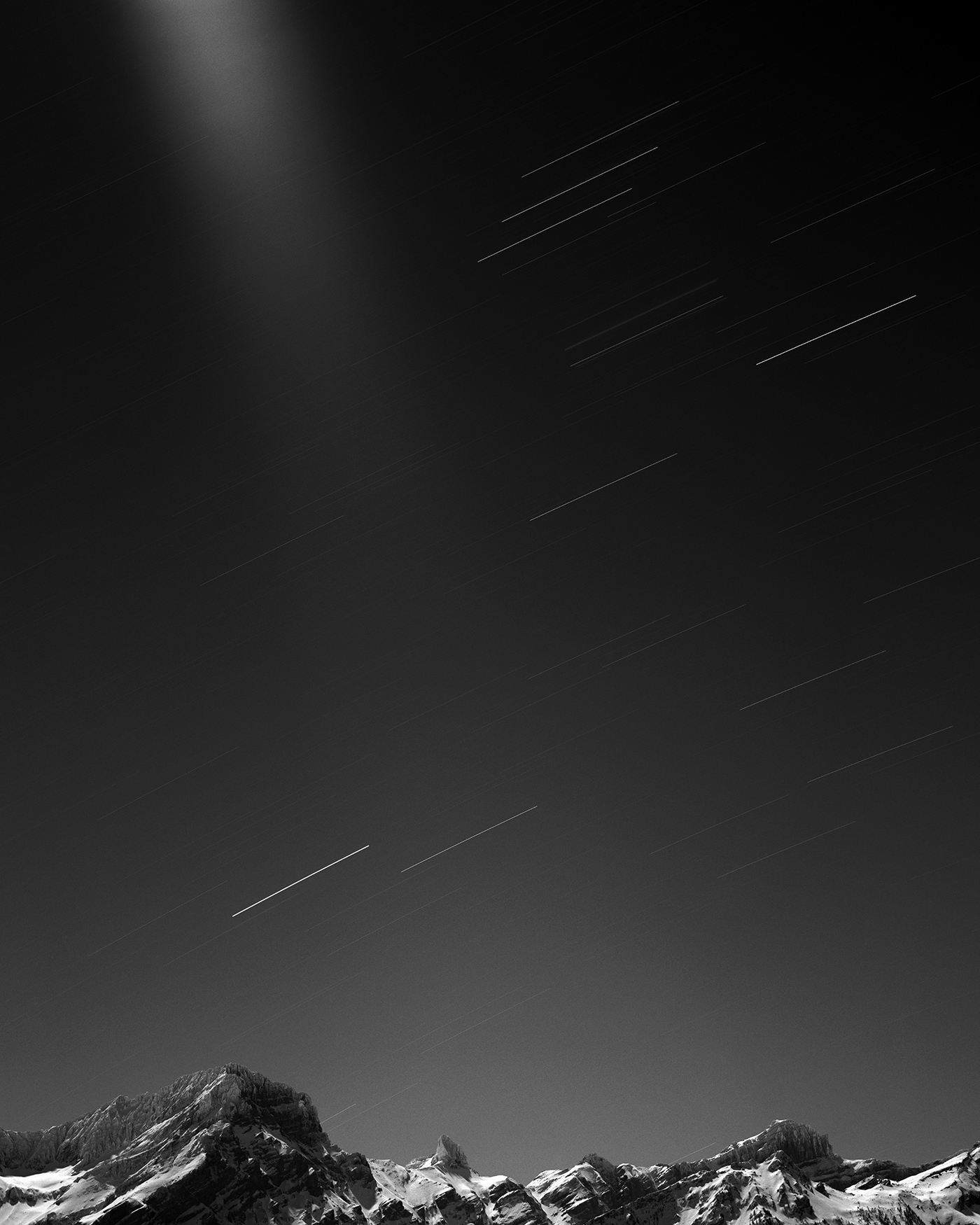
Can confirm. Here's a 20 minute exposure of Orion + moonlight over the Grand Muveran I shot in the village a couple of years ago: https://leejo.github.io/images/2018/large_format/36_muveran_... # this is shot on 4x5 film, and unfortunately Fuji don't make Acros in this size anymore (fortunately I stocked up on it).
Devleoped in my sink using an SP-445 tank. B&W chemistry is pretty straightforward. I do prints (check my site for contact details). There's a couple more examples of 4x5 work on my Instagram (ha!) haven't got much of it up on my site yet.
Oh I know, but your shots specifically are lovely! I will check it out :) I imagined you did it at home... have wanted to do the same but haven’t had space, so use the mail-in services which are not bad.
> "a star tracker, a mount that precisely rotates your camera at the same rate as the Earth"
It's called an equatorial mount! GAH!
Incidentally that setup they post a picture of looks pretty sketchy, looks like the counterweight will bonk the table if you expose for too long and you also have to move the table rather than the mount to point in another azimuth.
I don't see any issues with caling this mount a star tracker that precisely rotates your camera. It's Sky Watcher Star Adventurer and it tracks automatically. If you call it just EQ mount you have to add that it does automatic tracking ;)
Admirable dedication! It feels like a crime to go so far with medium format and not show large resolution scans, though. Maybe it's to avoid hurting the sale of prints?
Understandable I guess, but considering the amazing resolution you can get from medium format, this just really leaves me itching to see a large image.
Most of the guides for digital will concentrate on post-processing, as the actual shot is quite simple, and you can tweak everything as you have instant feedback. If you can see the milky way with the naked eye, you need: tripod + wide lens (24mm on full frame is ok) with wider aperture, manual focus (using the display zoom function for best results) as autofocus on stars doesn't always work, manual exposure for something like ISO 1600-3200, around 20 seconds exposure on f/2.8, 10 second timer exposure, press the shutter and leave the camera to stabilize on the tripod.
The key is to find the places where you can see the milky way and to plan ahead - a moonless and cloudless night is important. There are websites[1] and tools[2] or that.
Some results based on the above, with minimal post processing (as I'm not good at it): https://miahi.ro/photos/perseide-2017/. The first series is at ~1500m altitude and 70km distance of any large city.
Adding to that: at least historically, full frame DSLRs took better low-light pictures; smaller sensors had more noise because of the density. Not sure if this is still true.
It's definitely still true, but the difference is getting smaller as sensor tech improves. My DSLR is a Nikon D80 from 2006. While it's not full-frame, its sensor is much bigger than the one on my iPhone 8, yet my phone works far better in low-light conditions. The highest non-expanded sensitivity on the D80 is ISO 1600, which is already very grainy. Bump that up to the highest possible ISO 3200 and you're in for a lot of touch-up work.
There is a huge volume of literature for astrophotography - I think most random hits you'd get on Google will be OK (the vast majority will be digital oriented). For example: http://www.astropix.com/html/i_astrop/toc_ap.html
I can probably give a better recommendation if you have a particular goal in mind. There are plenty of guides on how to take photos of the Milky Way with an SLR, but astrophotography is a broad (and quickly very expensive) field to get into.
If you're interested in a more technical angle, you can look at the Handbook of CCD Astronomy (Howell, 2006) which also discusses noise issues in detail. Nowadays we're moving to CMOS though. However when you go for astrophysics books they tend to focus more on measuring intensities accurately (photometry) rather than getting pretty pictures.
Although one nitpick with the article - tracking mounts do not follow the rotation of the Earth, they rotate in the opposite direction.
> Although one nitpick with the article - tracking mounts do not follow the rotation of the Earth, they rotate in the opposite direction.
Maybe I missed something, but I don't see where the article contradicts what you wrote above. The one thing I did find seems correct (as it doesn't specify the direction):
"With film and these very long exposures, the Earth’s rotation is a big problem — you’ll end up with star trails (which is a fun type of photo to take). The solution to this problem is a star tracker, a mount that precisely rotates your camera at the same rate as the Earth (known as sidereal rate)."
Digital has other issues like hot pixels and more noise on longer exposures, they usually do a couple (dozens, hundreds, ..) of shorter exposures and stack them in post prod. It's basically the same process otherwise.


I don’t understand why the C41 (negative) process/product became default for consumer grade color photography. I know there’s professional negative film that’s tuned for the human skin. But as an amateur that happened to snag a lot of really high quality (mostly 135) film in bulk on eBay, I’ve always felt overall happier with my legible developed film, the highly contrasted and colorful images and the noticeable flavor of different product lines.