Check out the “Tucker Sno-Cat” that was used by New Zealander and British explorers in early (1950s) Antarctic expeditions, several of the historic vehicles are in the Canterbury (Christchurch) museum.
Tucker Sno-Cat is still in business too, still making snow crawlers. There's something to be said about businesses that don't try to diversify, they just keep making one line of good product.
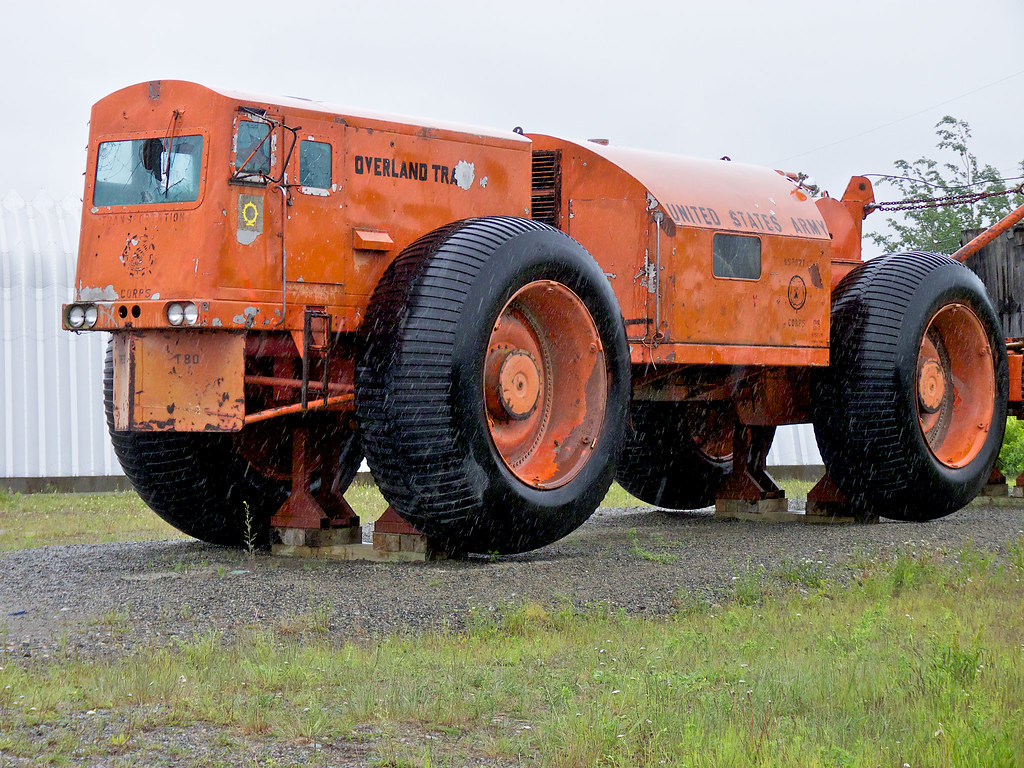
They were designed for swamps, where apparently this tyre design works well. On snow, treadless tyres are essentially useless, and this was a large part of why the cruiser failed to achieve much of anything.
I suspect that at the time producing and transporting suitable tyres was extremely difficult, so they weren't able to try swapping the original tyres for something more suited to the conditions.
probably all that was available in that size plus a lack of understanding. or maybe they thought chains would be fine. but in the pictures there are just four chains! need another 20 or so i would think.
> [...] It was his son, Harry E. Sipe, who popularised the use of sipes in the USA for the new low-pressure balloon tires around 1939.
> The process was not applied to vehicle tires on a large scale until the 1950s, when superior tread compounds were developed that could stand up to the siping process. [...]
We forget, with the advent of digital photography, how pivotal access to a darkroom used to be for all sorts of endeavours.
Facility for developing Black and White photos is not very complicated. Usually you just need an enlarger, some chemical tanks and a room with no light. If you want to do slides (rather than prints), and use the right film, it's even simpler as you just need to develop the film.
Yeah I'm about to setup a darkroom in my bathroom. I already develop myself but I want to get into printing. Doing that on the go during an Antarctica exploration seems like a pain in the ass though.
It's simpler with slides because you skip the print process, but developing slide isn't nearly as easy as b&w. It's 10+ steps process [0] and temp is critical vs 3 steps for b&w. You can also make slides from b&w film if you're adventurous: https://www.bhphotovideo.com/explora/photography/tips-and-so...
> By the way, recognize those tires? Bob Chandler bought four of them from a Seattle junkyard and fitted them to Bigfoot 4 to capture the title of Tallest Monster Truck.
From what I have read elsewhere this was where the monster truck idea started.
4 free articles per month that they track in a cookie in your browser. Surprisingly common tactic these days... Good thing there's a Firefox extension keeping track of which sites do that and declining the cookies.
Horsepower (which has many definitions) is the torque output multiplied by the engine RPM (divided by some number to make it equal to the strength of an average horse). Since these engines operate in a relatively low RPM range, the HP number is not that high. Most countries switched to using kilowatts as a measure of vehicle engine power.
Also remember that these are diesel engines from the late 1930's. This was before the development of 2-stroke (blown) or even turbocharged diesel engines. These engines were a lot less powerful compared to modern diesel engines.
Kilowatts are also a multiplication of RPM and torque - one horsepower is 0.7457 kW, no RPM factor required. High-redline gas engines compared to diesels will have more kilowatts than torque regardless of which system of measurement you use.
You need low-speed torque with low fuel consumption to work at relatively high power output efficiently for long durations.
That is correct. kW is used the same way as HP, except that kW is better standardized.
There are many definitions of how much power a horse has, and just one definition of the watt.
For example: the 'mechanical' HP (commonly used in the US) is the equivalent of 0.7457kW, but the 'metric' HP (commonly used in Europe) is 0.7345kW [0].
They are both units of power the fact that they have different numbers does not have bearing on the question asked, power is power, torque is torque regardless of units.
The engine actually only made 150hp, but luckily there were 2 of them.
Yes, they were certainly less efficient than modern engines. However, ICE engines have always had trade-offs between power output per size, mechanical efficiency and reliability, and for this vehicle the last one was certainly of most importance.
You can multiply torque with gears, can't multiply horsepower. An engine with lots of torque is important because you can make a lot of horsepower at low rpm, important when you need to make a lot of horsepower for a long time, efficiently.
More than double the horsepower mainly due to turbo charging.
That level of power is for commercial use, an 11L diesel can easily put out more than 1000hp based on the amount of boost but the longevity of the engine suffers and the power is not need for the application.
> Wheels and tires retracted into housings where they were heated by engine exhaust gases. This was to prevent low-temperature cracking of the natural rubber compound.
Long front and rear overhangs on the body were to assist with crossing crevasses up to 15 feet (4.6 m) wide. The front wheels were to be retracted so the front could be pushed across the crevasse. The front wheels were then to be extended (and the rear wheels retracted) to pull the vehicle the rest of the way across. This process required a complicated, 20-step procedure.
More research seems to indicate that continuous tracks do have significant maintenance drawbacks compared to tires (a tire can be expected to last significantly more miles than a track between repairs/replacement).
However, it definitely was a design defect as the cruiser was unable to travel reliably on the snow, and Byrd had previous success in Antarctica with tracked vehicles...
Should have used Agile development to iterate on an MVP snow cruiser. Let's have a standup to talk about any blocker re: the wheels getting stuck and [spike] a quick solution.




[1] http://www.spiritofmawson.com/objects/tucker-sno-cat-antarct...
[2] http://forrestmccarthy.blogspot.com/2016/03/commonwealth-tra...
And some amazing video footage here (sorry about the music): https://youtu.be/NA4pUalceVE