In my opinion, AB5 went too far. I do not believe we should interfere with the market when it's working. It's like burning a pile of cash. Whatever you think about gig economy companies, they have created flexible work that has served as a lifeline and supplemental income for tens of thousands of people across America. It feels like a step backwards to mandate that these people have bosses and strict schedules (that's the second order effect of AB5). That's to say nothing of the immense consumer surplus generated by a workforce that fluctuates with demand. It is much better to increase our social safety net with Medicare for All than to mandate that companies like Uber provide health insurance.
The argument against this is that it absolves corporations of the responsibility to provide a minimum standard of living to their employees. The same argument in favor of having a minimum wage instead of a basic income or negative income tax to offset substandard wages: it subsidizes corporations that underpay their employees.
Ditto with socializing healthcare instead of making sure corporations provide it.
It’s not an argument that I agree with at all, to clarify.
I don't agree that companies should have a responsibility to provide a minimum standard of living. Not because I don't think people should have a minimum standard of living, but because I don't think it makes sense to push that responsibility onto tens of thousands of entities that have different financial situations and structures.
Far better would be for the government to take care of this (via single-payer health insurance, possibly even something like UBI), and tax companies an appropriately higher amount in order to fund it. This would of course require a major overhaul of the tax code in order to eliminate loopholes that allow companies to hide revenue/income and dodge paying their fair share.
Given all the issues around this in the first place, it is clear that expecting companies to provide for their employees isn't working. AB5 is just a band-aid that treats the symptoms and not the cause, and comes with a ton of negative unintended consequences.
As much as I don't like how Uber/Lyft run their businesses (and yet I still use them), they have completely revolutionized (in a good way) how I get around my city. Every driver who I've talked to about AB5 has reacted negatively to it. Either they believe it'll be the end of Uber/Lyft, or they just point out they won't want to drive for them anymore because their flexibility will be destroyed.
But to some extent this was the deal business made with government during the construction of the “military-industrial-complex”: the private sector will employ people at wages and benefits that allow them to be supported during work and retirement in exchange for the govt providing tax breaks/incentives and business/work. Unfortunately the tax breaks and business is still around but industry has slowly wheedled its way out of its social responsibility which you can see in things like contractors everywhere and pushing health and retirement responsibilities back to the govt.
Having employers provide health and retirement instead of just paying higher wages was always one form of scam or another. It started off as a tax dodge (wages were taxed but not benefits), and then it became a way for corporate execs (and governments!) to commit accounting fraud by attracting workers with pensions without actually funding them. We should be rid of them and just have higher wages so people can choose what they want for themselves.
Interesting. I wonder if that's why it was never purged when they did everything else.
There used to be a long list of benefits companies would provide, like company cars, that all went poof right after they started getting counted as taxable income.
>"Interesting. I wonder if that's why it was never purged when they did everything else."
A combination of the endowment effect and inertia/status quo bias. When a Big Medicine lobbyist shows long government wait lines, that can be as effective, and as insidiously misleading, as a picture of immigrants waiting to gain admission to the country.
Corporations shouldn't have the responsibility of providing a minimum standard of living to their employees, they should have the responsibility of paying their employees what their employees agreed to work for.
If their employees have their back against the wall and are literally unable to do anything to change their situation, that is a more general societal problem.
UBI is, in my opinion, a monumentally superior solution than trying to micromanage the nature of contracts that people are capable of negotiating between one another.
This is true in a vaccuum. Unfortunately when you look at the history of the U.S., it's the corporations that have taken the burden of providing for U.S. workers. Other developed nations have their government supporting it's citizens, not corporations.
Corporations have no such obligation. This is an imaginary and destructive construct. Destructive because mandating this, forcing it, does nothing less than destroy jobs and even entire industries. How much more evidence of this do people need before they realize we are destroying ourselves from the inside?
The consequences of the $15 per hour minimum wage will be felt in due time. Anyone running a business in the context of a global economy knows this with absolute certainty.
This isn’t about greed, it’s about a mathematical reality and a destructive positive feedback loop: We keep doing one dumb thing after another to push jobs, businesses and industries towards China. Our consumers lose jobs and income and, as a result, apply downward pricing pressure to the goods and services they consume. Sector by sector, over time, pricing structures become such that it is impossible for these businesses to exist in the US or Europe. The Chinese government knows this, they apply further pricing pressure and very soon they own one sector after another. And so continues our positive feedback loop, deepening economic wounds that assure bad long term outcomes.
I really wish we actually taught kids from K-12 and into university a lot more about business and entrepreneurship. It is truly sad to watch young adults get behind some of the most destructive ideas this nation has had at the table in quite some time.
Simple example: Medicare for All.
Despite what people believe, this is already the largest private property grab by a government in, perhaps, world history. It certainly will be if we end up with Medicare for All.
Why?
Because Medicare is NOT insurance!!! After 55 years if age YOU OWE THE GOVERNMENT FOR EVERY PENNY OF MEDICAL CARE YOU RECEIVE.
Don’t take my word for it, read this and do your own research:
So, if everyone was on Medicare/Medicaid the government would eventually have liens and the power of asset forfeiture on EVERY ESTATE IN THIS NATION.
Now, stop and think about that for a moment before you support politicians using the general ignorance of facts by the public to generate votes. This is a travesty, and everyone supporting it is a participant in what would be the largest private property grab by a government in history.
I'm not so sure this accurate or argued in good faith considering the article you linked clearly states..
"Some states are fairly conservative about what they will try to take -- they have the right to recover costs from real estate, personal property, and other assets only if they are included within the deceased person's "probate estate." A probate estate includes only assets that were owned solely by the individual at the time of death, where there is no beneficiary or joint owner designated. Joint accounts, payable on death accounts, and contracts that have designated a beneficiary are not included in the probate estate."
This clearly sets aside assets that are dedicated to a beneficiary or if the assets are jointly owned. I'm not a lawyer, so if someone is please chime in, but this would exclude pretty much anyone has a will or is still married.
I think this not a valid reason to exclude Medicare for all as an alternative to our disjointed and dysfunctional system of medicine. Also what about this precludes us from changing this feature if it was rolled out for everyone?
Check their link again. They're conflating Medicare and Medicaid and clearly did not read their own article. Medicare isn't mentioned a single time in the entire article, not even in passing.
Go research how things work. Clearly --to echo your sentiment-- you do not understand how these programs are interrelated.
-Medicare does not kick in until 65+
-While you are on Medicaid you accumulate debt after age 55
-Medicare has an expenditure limit, after which you are kicked back into Medicaid, which is, effectively, after 55, a debt you have to pay and the State has the ability to place liens on your estate and grab your property for payment. In fact, they are required to do so by law.
As I said in another comment one of my friends is dealing with exactly this scenario right now. In fact, I just spoke to him a few minutes ago and learned his father died this morning.
While he was on both Medicaid and Medicare (due to the aforementioned ping-pong effect) he now owes the government a pile of cash, hundreds of thousands. My friend has power of attorney over the estate and will be traveling back to his home town to sell the assets and pay the government.
Again, like I said in my other comment, I am not saying these things because they occurred to me. This is reality in the US today: The crap they are trying to sell us will, in fact, turn into the largest private property grab by any government in the history of the world.
In my friend's case the Medicare lifetime limit was $120K. His father burned through that very quickly --probably in a single hospital stay. He was then kicked back into Medicaid, where he already owed money (from 55 to 65). All of his care after the $120K Medicare limit then became a debt the government is required, by law, to collect. And they intend to do so. This will cause the sale of his father's estate for payment. He is dealing with this nasty reality right now.
These things are NOT insurance. That's the greatest lie people are being told.
EDIT:
In Q&A form...
How do you get to Medicare?
Through Medicaid.
Is Medicaid insurance?
No.
Is it free?
After 55 years of age you owe the government for your medical care. It's a loan.
Are they required to collect on that debt?
Yes, by law. Some states are a little more lenient, but the law says they have to collect.
How do they collect?
They seize your estate, your assets, they can force a sale of assets, etc.
Are the children affected. In come cases the debt has affected the children (I don't remember details).
Is MediCARE insurance?
No.
Is is free?
No, you paid for it while working.
Does it cover everything?
No, there's a limit based on your contribution. In the case of my friend's father this limit was $120K, which is nothing in terms of US medical care.
For context, he was 95 at the time of death. His $120K of Medicare allowance was burned through three decades ago. He ended-up back in Medicaid very, very quickly decades ago. And the bills are massive.
What happens when you use-up this money?
You are kicked back into Medicaid.
What happens then?
You add to the debt you accumulated between 55 and 65.
Your link and all the information you're regurgitating from it is talking about Medicaid, not Medicare. Medicare does not have estate recovery, you're spreading misinformation.
You guys really need to do your research and understand how these programs work.
I have a friend who is currently going through the estate recovery process for his dying father. They are —the government— effectively forcing him to sell his childhood home in order to pay for the healthcare he and his late mother received.
This isn’t theoretical, this is very real.
Also note that people are shoved into Medicaid until 65+.
A better idea would be to quit linking health insurance to employment. Ban employer-provided health insurance and let everyone buy their own (reasonably regulated) health insurance as individuals.
The link between employment and health insurance is, from my perspective as an external observer, America’s worst idea.
If we're paying on an individual basis, I want to pay based on my physical health. We'd still pay out the ass because people don't take care of themselves here - it's not healthcare, it's sickcare. People go to the hospital when their bodies start to die and that's why your hospital bill is enormous until the insurance company comes back and says "$25,000? We'll allow $1,200. And we'll pay $800 of it. Here's your bill for $400 - you're welcome."
I'm tired of this model too. People should pay what they're costing. It's just that, the costs should be reasonable. I work out, I eat extremely healthy, I'm never sick, and I don't require medication to keep my heart pumping. Why am I still paying a fortune on healthcare, including premiums and deductibles? I have a great insurance plan, ffs!
You might do and be all those things but none of that will prevent a unforeseen life changing accident from completely debilitating you. This is the true reason for what you say is "sickcare" we are all healthy until we are not. You pay into an insurance system, private or public, to offset the risk of this occurring.
This is a misrepresentation of why healthcare costs so much in the US. There are a lot of reasons, but "you're paying for people who don't take care of themselves" barely makes the list -- insurance companies already give major discounts for not smoking etc.
The biggest problem is that the entire existing system is so convoluted and bureaucratic that the cost of everything is ten times what it ought to be.
They should just delete every single piece of federal healthcare law with two years of notice for the states to be ready to pick up the ball. Then let fifty states try fifty different ways to clean up the mess. Some will get it right and some won't, and then the losers can copy the winners, but even the screw ups can't be much worse than the status quo.
Only if you are unemployed. If you are self employed (e.g. a 1099 contractor), you can write off health insurance. (Basically letting you pay with pretax dollars, the same as if you are employed)
One of the largest county government insurances in CA reimburses $28,000 for an endoscopy at an outpatient center. Which should cost around $2000 in a hospital. And in reality, could cost $500.
AHA? You mean the ACA? The US pays more for healthcare for a whole host of reasons split between different categories. The ACA only took on a very small aspect. The idea that getting close to 100% coverage means incentives like jacking up the prices because nobody covers the other guy's ER bill would get much smaller. I imagine the idea was changing other things made more sense to them after most everyone was covered.
ACA plans can be subsidized, but as I understand it, if your employer offers a qualifying plan, then you are not eligible for the subsidy if you buy one from the marketplace instead.
Full-time employers don't just "happen" to offer health care. It's a requirement of the ACA. That codifies a longstanding set of rules that make health care cheaper when offered by an employer, including tax breaks. The ACA does encourage state "exchanges" at rates comparable to the ones that employers provide, there's still a lot of focus on employer-provided health care.
This is the result of a longstanding bargain between unions and employers to provide some compensation as health care rather than salary, which was win-win for both sides until health care costs soared. Now there's no way to break that link without throwing off those negotiations.
The ACA wasn't actually a huge change, except in the sense that any change at all was nearly impossible given the stability of that equilibrium. It's widely agreed that there are many better ways to do it -- all of them dispensing with the link between employers and health care -- but there's no way to get to wide agreement on any one plan.
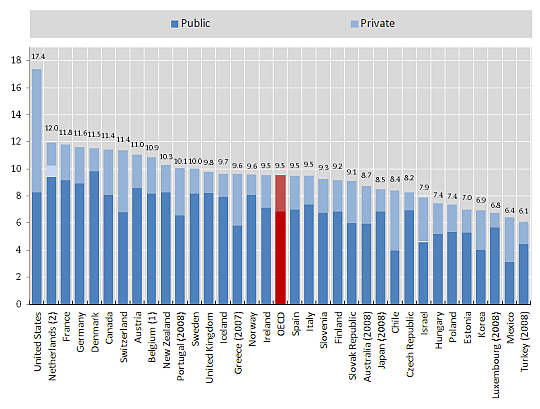
We spend 17.4% of GDP on healthcare. The OECD average is 9.5%, and we don't have better outcomes to show for it. That's ~$1.2-1.7 trillion of waste annually that could be used to improve our society instead of lining crony pockets. Employer-provided healthcare is one layer of the Kafka baklava that obscures the cost of healthcare and prevents better cost controls and price discovery in America. It also makes employees more reliant on their company, literally for their wellbeing. Our economy is less dynamic as a result, so my $1.2-1.7 trillon estimate might understate the problem.
The obesity explanation doesn't pass the sniff test. Canada is 12% less obese than the U.S., but it spends 6% less of its GDP on healthcare. Put differently, if obesity was the reason for excess spending, the U.S. would save $1.1 trillion for every 12% of its population that is cured of obesity. If true, that would peg the marginal cost of obesity at $27,777 per person per year (1.1 trillion/.12*330 million), or 9x the annual salary of a doctor in Cuba. That is beyond the realm of believability, even if I introduce the other population-induced causal factors which you implied but didn't specify.
Additionally, the government would be more invested in the population's health under a single-payer model. It would actively work to reduce the prevalence of obesity and lower its costs. That would include taxing consumable goods with a negative health externality, commensurate with the magnitude of that externality. That would also include incentivizing the consumption and production of goods with positive health externalities and investing in pro-health infrastructure.
Imagine if a city faced the following math: "A network of bike lanes would cost us $40 million and $10 million to maintain over the next 10 years. It would also save around $50 million in health expenditures every 10 years. After one decade, it will cost $10 million and continue to save us $50 million." All the bike lanes you could dream of would be built overnight, assuming there would be subsidies by a M4A healthcare program. I'm more excited at the prospect of converting roads into pedestrian walkways and scooter highways. That wouldn't seem like such an expensive proposition if the government would recoup the cost in healthcare savings.
> The obesity explanation doesn't pass the sniff test. Canada is 12% less obese than the U.S., but it spends 6% less of its GDP on healthcare.
It's my blog (RCA). My argument is that obesity substantially explains US health outcomes in relation to other countries. I never claimed obesity is the cause of high national health spending (as in, "inputs"). To the contrary, I have consistently argued US health spending is well explained by its wealth (technically income levels).
To a first approximation, national health spending is entirely explained by the average house income level in the long run. While time, healthcare technology, and other factors are assocatied with rising spending, these changes are ultimately very well explained by changing income levels.
Amongst high-income countries, a 1% increase in income is robustly associated with a long run increase of about 1.8% (it's highly elastic).
The US spends more than Canada because it's still a much richer country (which isn't to say Canada isn't a nice place!).
> That is beyond the realm of believability, even if I introduce the other population-induced causal factors which you implied but didn't specify.
Again, I never said this, but other population health risk factors such as age structure, disease rates, and the like are of negligible significance when it comes to long run aggregate spending. Such factors may be highly predictive within countries and may have some say in the short run (within budgetary constraints), but in the long run national picture the evidence suggests these factors amount to little more than noise. National household income levels trumps everything.
> Additionally, the government would be more invested in the population's health under a single-payer model.
US government programs, namely Medicare and Medicaid, spend more on healthcare than most other high-income countries do in total (even more so comparing public-to-public). Just how much more incentive do we need before these magical effects kick in? Higher health spending predicts higher obesity rates in time series and cross-sectionally (though this is likely ultimately mediated by long-run income levels and by time).
Where is the evidence that these programs have large, sustained effects and are cost effective? Most data indicate these programs have negligible effects in the long run and they almost always cost more than they save (which isn't to say we shouldn't necessarily do it, but the economic rationale is v. weak).
Obesity is not an independent variable - socialized healthcare does a better job of controlling obesity with preventative health measures. As it is now in the U.S., patients only go to medical professionals when there is a problem, making obesity epidemics one of the effects of how U.S. handles healthcare.
Nothing is perfect, but most experts believe this has little to do with healthcare today because healthcare interventions tend not to be effective causes of long-run weight loss and most countries aren't doing enough of the stuff likely to have large effects (e.g., surgical interventions) to explain much of the variance. Even if you could argue it might explain something, say 0.5 mean BMI points, other factors are clearly highly important. Cultural * and genetic factors are likely to play a significant role amongst high-income countries. Further, obesity rates rise with time and income levels despite higher health spending.
> socialized healthcare does a better job of controlling obesity with preventative health measures
evidence?
> As it is now in the U.S., patients only go to medical professionals when there is a problem
The US spends more on preventive medicine than almost any other country, though preventative medicine generally has very-small-to-modest effects on outcomes and rarely, if ever, saves money (usually quite the other way around)
~ RCA
note: * some of these "cultural" factors may be residual economic influences... the US escaped the malthusian trap long before almost all other high-income countries and this may have latent effects on attitudes towards food, diet, etc)
>"And we will have white/black lists for food. I don’t trust the same people who brought us the food pyramid and low fat as a reliable arbiter of what’s good and what’s bad."
It's telling that, whenever the government (rarely) enacts laws that tax or ban consumables with negative externalities, they actually target the right thing. After troves of empirical evidence, they heavily taxed smoking and banned trans fat (I'm aware of the government's misguided early endorsement of trans fat vs. saturated fat, but science has progressed a lot since then). Recently, local governments have tried to tax excess added sugar. That has been less successful, but it's guided by the right thinking. Excess sugar in our food supply is unequivocally, empirically bad. The government has less of a basis to tax it since it's not paying for all our healthcare, but that would change under M4A. Moreover, there would be more money behind nutritional/health research, because that research would have a more tangible payoff: an approximate dollar amount saved in public healthcare expenditures.
And we will have white/black lists for food. I don’t trust the same people who brought us the food pyramid and low fat as a reliable arbiter of what’s good and what’s bad.
The NHS/universal healthcare was introduced in Britain in 1948, after WWII. The NHS isn't perfect, but it's much better than the American system. If we want a more flexible healthcare model, we can have universal healthcare to cover necessary + preventative care, with the option to purchase supplemental insurance for expedited and/or non-medically necessary care. Several other countries have that model.
>"Do you think high-paying healthcare sector and patent R&D in the US creates more incentive for research and development of new medicine & healthcare technology?"
Yes, but there's a limit. Incentives have diminishing marginal returns. At the end of the day, a $2B pharma company is still going to doggedly pursue a 20 year monopoly on a potential $1B drug, even if it otherwise would have been a $1.5B drug if there was no Medicare for All. Moreover, the vast majority of waste in healthcare is with hospitals, administrators, surgeons, insurance companies, and doctors, not the pharmaceutical industry.
Pharma is closer to software in that one company can produce one product with zero marginal cost that can trivially serve everyone on Earth with a given condition. We can even leave Big Pharma as is and still realize hundreds of billions in savings, though I still believe that there should be some single-buyer negotiation for drugs. We can use empirical evidence to negotiate on drug prices without drastically changing the incentive scheme. Ultimately, I believe pharma companies would increase prices abroad if we implement price controls in the U.S. The U.S. is subsidizing the world's healthcare.
>"Every hospital I've been to seemed horribly understaffed.. and I'd be afraid of an underpaid surgeon. Not sure what waste you're referring to"
Doctor/surgeon labor scarcity exists for the following reasons:
- Medical associations lobbied the government to restrict residency positions a long time ago, and continually lobbied to keep them down until just recently when the shortages have become too obvious. They were even warning of an impending doctor surplus in the 90's. Ya, right.
- Medical associations and med schools have been smart about restricting the supply of doctors through our med school network and excessively tedious licensing system.
Additionally, the other OECD countries I've referred to have similar health outcomes for a much lower % of GDP. Clearly, universal healthcare did not worsen their population's health. If someone wants quicker healthcare, I'm almost certain the U.S. would allow supplemental insurance to get that hip transplant in 2 weeks instead of 6 months.
Thank you for all the replies, I have learned a lot. It seems like there are dozens of issues that need to be fixed in tandem. Meanwhile, I will stay as healthy as I can because that seems like the best plan for the moment
> At the end of the day, a $2B pharma company is still going to doggedly pursue a 20 year monopoly on a potential $1B drug, even if it otherwise would have been a $1.5B drug
The problem is they don't know it's a $1B drug instead of a dud until they've actually done the research, and most of the candidates fail. And since the successes have to cover the failures, if the successes make less money, they can't cover as many failures and you don't get as many attempts.
> Moreover, the vast majority of waste in healthcare is with hospitals, administrators, surgeons, insurance companies, and doctors, not the pharmaceutical industry.
It is certainly a multifaceted problem and there is plenty of inefficiency that could be improved. Not just healthcare, but also the plague of zoning rules that inflate real estate costs in cities. Which is where hospitals are for legitimate reasons, but hospitals not only need a lot of real estate, they also then have to pay salaries there that allow their (already expensive) staff to live within reasonable distances.
And the subsidy issue isn't just drugs, it's also technology. A lot of the "hospital" cost goes to equipment, which is the same subsidization of international R&D as drugs -- other countries with price controls not paying their share of the cost.
Which is why cost comparisons to socialized systems in other countries are so uninformative. Not only are they not paying their share of R&D, they typically have lower real estate costs, lower salaries across all industries, lower (and this one surprises a lot of people) taxes if you count "health insurance" as a tax, and it goes on.
There is a lot of pure inefficiency in the US healthcare system -- the level of bureaucracy is madness -- but a lot of its costs are also external to the system itself and symptomatic of healthcare being at the intersection of several independent sources of price inflation that each have to be addressed on their own terms.
Do you think high-paying healthcare sector and patent R&D in the US creates more incentive for research and development of new medicine & healthcare technology?
> We spend 17.4% of GDP on healthcare. The OECD average is 9.5%, and we don't have better outcomes to show for it.
The problem is we do have "allowing drug companies to keep researching new drugs" to show for it. We're subsidizing the rest of the world because they impose price controls on patented medications. We could do the same thing, but then where does the money to do the R&D come from?
People like to point out that they spend more on advertising than research, but the advertising generates more revenue than it costs or they wouldn't do it, which means without the advertising they would have less money for research.
It should come from other countries who have been free riding with price controls, but how do you get them to do that? The status quo is giving them a trillion dollar a year subsidy.
Pharma companies explain a relatively small amount of excess spending in the U.S. We can even change nothing about how we pay for drugs and still reduce a majority of the $1.2-1.7 trillion in healthcare waste (though we should still try, and let drug companies increase prices elsewhere). I discuss this a bit more below, ctrl+f monopoly
I saw your comment. Clearly, there is a lot of waste, and we both agree on that front. As for exogenous costs, the U.S. isn't the only country with expensive real estate. Almost all of the other OECD countries have a modest degree of real estate cost inflation. Similarly, most should exhibit a similar degree of adherence to the Baumol Cost Disease phenomenon. There is no reason that the U.S. healthcare industry should have a 50-70% higher magnitude of exogenous cost disease. Lastly, I already addressed direct R&D funding (my analogy was simplified, but it could be extended to a portfolio of drugs). However, you mentioned that U.S. purchasing of equipment and drugs disproportionately funds R&D activity. I'm sure that's true, but I see it as a problem to be solved rather than a fact of life. We should adopt universal healthcare just like almost every other developed nation, implement measures to mitigate incentive loss, wait for U.S. medical companies to renegotiate pricing with other countries, and, if incentives are still lacking, we can deal with that then. Surely there's enough money among all developed nations to more than pay for an adequate level of medical R&D.
Somewhat related, but Jennifer Doudna, a government employee, co-discovered CRISPR. CRISPR will prove to be one of the biggest step changes in health outcomes in the history of mankind, or, at some point, supermankind. Now hundreds of pharma companies will try to monetize on the government’s discovery: CRISPR for sickle-cell anemia, CRISPR for congenital retinal defects, CRISPR for lactose intolerance, etc... Should we have to reimburse drug companies for the value of the drug, or should we, recognizing the government’s contribution and the immense value of life, put a reasonable cap on reimbursement? I say the latter. A company developing CRISPR drugs is on record saying they plan to charge over $100,000 for their treatment. I’m not convinced that the drug would not have been developed if they stood to make much less than that per person. We trust the government to grant 20 year monopolies on drugs, and I believe we can also trust the government to reasonably modulate drug reimbursement without ruining incentives for development.
> We spend 17.4% of GDP on healthcare. The OECD average is 9.5%
Health spending is almost entirley explained by income levels, especially in the long-run. The US spends much more because the US is much richer than most and because health spending is highly elastic at a national level.
> and we don't have better outcomes to show for it
Norway and Luxembourg also spend 2x Spain and Italy and don't have more to show for it either despite the fact that they're also much richer, have larger welfare states, etc.
Countries increase health spending because they can, not necessarily because they need to. Evidence strongly suggests returns to health spending are falling everywhere and the US isn't particularly unique in this regard.
Your findings are not mutually exclusive with other theories about the underlying causes of high U.S. healthcare expenditure, such as a chronic lack of price transparency. The more money is in the pot, the greater the incentives to pilfer it, and, in lieu of adequate controls, the more it will be pilfered. The way I see it, your linear regression is between income and aggregate pilferage across all layers of the healthcare establishment (Kafka baklava :) ). I surmise that the accelerating nature of health expenditures (1.8% increase for every 1% increase in income) is due to the rapid inflation of disposable income relative to overall income at the higher levels. Disposable income and the saved wealth accrued from higher disposable income over time are more readily pilfered. I should say “otherwise disposable,” because the healthcare industry takes a progressively larger chunk of that and makes it de facto indisposable. I say this with no irony: a linear regression between income and amounts extorted during kidnapping, controlling for other variables, would show similar results.
> Your findings are not mutually exclusive with other theories about the underlying causes of high U.S. healthcare expenditure, such as a chronic lack of price transparency.
My findings strongly agitate against the notion that high US health spending is a product of idiosyncratic features of our system. Presumably most of these critics believe we'd spend much less if only our system looked more like other countries, but my evidence indicates we'd spend very similar amounts in the long run regardless. Further, we'd likely have similar outcomes and many other similar healthcare attributes (prices, intensity, health worker density, etc). Most of the things about US healthcare people believe to be important and unique (i.e., not explained by income) just aren't.
> The more money is in the pot, the greater the incentives to pilfer it, and, in lieu of adequate controls, the more it will be pilfered
I wouldn't argue there's no "pilfering" or that more money doesn't create more opportunity for this, but the high income elasticity likely has little to do with pilfering. Where are these ill-gotten gains going? I certainly don't think you'd have much success in showing this if you look at, say, the growth in physician incomes, pharma/biotech industry profits, and so on. The data are much more consistent with mundane explanations like rising technological sophistication, higher intensity, and so on (ultimately much of this being driven by some combination of patient/family demand and providers' "spare no expense" approach to caring). I mean, if you look at the economic data it's quite obvious most of the increase can be arithmetically attributed to a swelling of health workers (density or share of workforce) and that most of these workers have lower-to-middle income levels (especially on the margin).
> I surmise that the accelerating nature of health expenditures... is due to the rapid inflation of disposable income relative to overall income at the higher levels.
I'm not sure what you mean by this exactly, but a better, more parsimonous way to understand high income elasticity is that higher income countries are usually inherently more productive countries. We can spend substantially smaller shares of our income on food, clothing, shelter, and other "necessities" because we are able to produce these things so much more efficiently (or otherwise procure on the market) than we did decades earlier or than OECD countries of more significantly more modest income levels while still consuming more of these things in real terms. This frees up resources to be spent on higher order wants like health, education, recreation, culture, and so on. Many of these growth areas, meanwhile, are inherently subject to less productivity growth, meaning prices tend not to fall relative to incomes nearly as quickly as we observe in other sectors.
> I say this with no irony: a linear regression between income and amounts extorted during kidnapping, controlling for other variables, would show similar results.
I doubt that's true, though we're talking about the total spending (kidnapping ransom) per capita here. It's pretty clear the price per transaction (as in, health inflation) explains very little in US time series or cross-sectionally. Now maybe if kidnapping started to become a high amenity affair in developed countries (presuming this sort of thing happened with measurable frequency here) and 25% of the population worked delivering these services.....
There wasn't much to model. Complex health insurance systems were in their infancy during that period. People would sometimes pre-pay a local hospital to reduce costs, etc.
The employer-sponsored model of the US wasn't that bad during the 1940s, but I was clearly obsolete by the 1960s. What keeps it alive, ironically, may be Medicare: it removed the most expensive pool of patients (seniors) from the risk pool. This staved off the government needing to come in and heavily subsidize private insurance and set up nation-wide care provider networks.
Countries with private insurance industries that didn't bifurcate the risk pool in this manner ultimately did a better job of controlling costs for everyone
Medicare itself is a bit of compromise: it was suppose to be for everyone, but it ultimately just became for seniors. And while Medicare for All is back in the zeitgeist today, it was a consistent policy plank until the 80s, with the more conservative position being an approach where private companies would just sell medicare coverage (effectively creating a system like Switzerland or Germany, minus the public care providers).
Even the most left-leaning studies show that the hourly wage, taking into account all expenses (including depreciation) and basic healthcare, is around $9.50 per hour. If you have another job, that number goes up and Uber becomes much more lucrative, because you can target surge pricing in your free time. Other empirical studies show that Uber/Lyft drivers forego wages for the flexibility of Uber. It's a tradeoff that many are clearly willing to make, and Californian politicians are wagging their finger and telling them that they're being fooled.
Pretty sure we've already decided as a state that the minimum livable wage is $15/hr, so $9.50 doesn't cut it.
Are there stats on how many Uber drivers have a second job vs. for how many it's their primary source of income.
Regardless, I reject the notion that someone should be required to hold down more than one job in order to make ends meet. If they like to have more than one job, and the total hours work out to something reasonable, sure, but my impression of this is that we see people working multiple jobs out of necessity, at significantly north of 40 hours per week, and are still living paycheck-to-paycheck.
And the fact that people who want to stay freelance can't shows that government involvement in the free market and taking away people's right to choose how they want to work doesn't work either.
I fix computers in my neighborhood. When someone approaches me they say, "hey, I need this fixed. How much will that cost?" I give them a price, then I fix it, then they pay me. End of transaction. That's as complicated as a market needs to be for things like this.
The government has nothing to do with the market. They exist to complicate it and take their cut.
Well, yes. Do you think laws around making anti-compete clauses illegal shouldn't exist? Do you reject the notion of the minimum wage? Do you think we shouldn't have required unemployment insurance payments? Do you think we should allow companies to put onerous, life-threatening terms in contracts? Do you think we should allow companies to force workers to sign contracts banning union membership?
If you answered "yes" to these, then I expect people like you and people like me will fundamentally never have a productive discussion about this, as our values just don't match up.
Well, yes. Do you think laws around making anti-compete clauses illegal shouldn't exist?
No, at a certain level, if you are a highly compensated employee, you should be able to negotiate that you won't compete with your employer for x months after you leave the company in exchange for a certain amount of money.
Do you reject the notion of the minimum wage?
I reject the concept of a "livable wage". It's not the market's responsibility to provide a "livable wage" since that varies based on your situation -- a teenager staying at home vs a single mom with three kids. The "safety net" is the responsibility of government. That was the original thought behind the Earned Income Tax Credit, disability, etc.
Do you think we shouldn't have required unemployment insurance payments?
No, I should be able to negotiate that I want to be a 1099 employee (and I have) and know that I won't get UI in exchange for a higher hourly rate to allow me to "self insure".
Do you think we should allow companies to force workers to sign contracts banning union membership?
What I do outside of company's time is none of their business. However, if they pay me enough in exchange for me not being in a union (which I wouldn’t want anyway), sure I’ll take the money. If I don’t want the government coming in between negotiations between myself and my potential employer, why in the heck would I want a union?
Vox is still free to hire freelancers, but it has to treat them as freelancers the same way every traditional media outlet does. Vox shouldn't get a magic unicorn pass because it's digital.
Well, society also decided at various points that government should ban interracial marriage, same sex marriage and make consensual intercourse between two adults of the same sex illegal.
You’ll have to excuse me if I don’t think that we should celebrate giving the government more power over what consenting adults are allowed to do when it doesn’t invade another person’s rights.
The point is that there are also a few hundred people not working now, because their gig jobs were cut. At best its a zero sum game: fewer people make more money now. At worst its a net loss: the company saves money by eliminating a lot of positions and those few lucky union workers make more money individually but collectively they make less total money than the gig workers did before.
The widespread poverty and tenuousness in California, the vast majority of wealth flowing upward from gig platforms into the hands of execs and investors, that’s your definition of the market working?
AB5 seems aimed at addressing the vulturism that emerged in the wake of the Great Recession, where the economic collapse was used as an excuse to undo all kinds of more stable arrangements and protections, privatize costs onto workers, and grab an even greater share of wealth for the rich.
This doesn’t make sense. What would happen to these people if there were no startups and no gig economy? This feels like the same argument that wants Chinese factory workers to have to go back to starving in the fields rather than worker long hours in factories because it isn’t optimal.
He's a lawyer who moonlights as a writer for SactownRoyalty, a Sacramento Kings fan blog that is basically being shut down by SBNation.
One interesting point he makes is that it's unsurprising that the Vox Union hasn't said anything about these hundreds of people losing work in favor of a dozen or so full time workers. It's not in their best interest to let people do part-time as a hobby what they do for their careers full-time.
Unions always benefit the few lucky ones to get the work and the hiring process gets riddled with nepotism and friends/family of current union workers. It was an open secret in the small town I grew up in that you had to know people in the unions to get a job and multi-generational workers from families was the standard.
It does give workers plenty of power but the exclusionary nature of it is rarely talked about. I remember reading a history of unions about how they originally started by white working class groups who wanted to prevent new black migrant workers from taking their jobs and working at a lower rate than them. https://www.jstor.org/stable/30030646
It's too bad the focus couldn't have been giving freelance workers more rights and protections while still giving them flexibility work-wise. The fact freelance and part time workers are going to get burned by this shift isn't really surprising. People seem to want to force either/all in order to push more unions instead of a more mixed economic approach.
It's not surprising, but the narrative they prefer is that they're working for the benefit of union members against capital, not against hardworking independent contractors who are already making less money than them.
Not to mention that if a business has the audacity to hire non-union labor, the unions will picket them and make all kinds of accusations about the business. Unions, for all intents and purposes, do not believe in free markets.
"Free markets" in the Economics 101 sense don't exist anywhere but in the poorest parts of the world. A minimum wage is anti-market. So is paid time off, parental leave, anti-discrimination protections, and a host other rules and regulations that rich countries enshrined into law decades ago.
A minimum wage is essentially a subsidy for certain poor people which comes mostly at the expense of different poor people. It's a very silly and inefficient alternative to better policies to help the poor, like a UBI.
> So is paid time off
This is also basically useless (but not as actively harmful as a minimum wage), because not long after it's passed, the value of the benefit gets priced into wages. If people wanted lower wages in exchange for paid time off then there was nothing preventing them from negotiating it to begin with.
> parental leave
Almost the same as paid time off, except that it's a cross-subsidy in favor of new parents, so you couldn't negotiate it in exchange for the same wage reduction in a free market, since you get the benefit (and wouldn't negotiate for it unless you intend to use it), but the wage reduction is spread across everybody and not just you.
Notice that you could get the same cross-subsidy with less distortion by having the government pay your salary during parental leave rather than the employer, because then the cost wouldn't fall disproportionately on employers of parents. That would also require the government to do a more accurate accounting of the cost of the program rather than passing an unfunded mandate.
> anti-discrimination protections
This one's the weird one, because in theory it's a useless requirement since discrimination is irrational and money-losing so nobody should want to do it anyway. But that was a different story when you had white people refusing to patronize employers with black employees or then women, so the original reason this got passed was in the nature of antitrust, which is pro-market. It's debatable whether we still actually need it anymore but it probably doesn't do a lot of harm since (unlike e.g. minimum wage) it isn't prohibiting anything anybody has any good reason to do to begin with.
Of course we don't live in a free market, all western economies have a mixed social-capitalist market [1]. It is the constant tension between the two that must be balanced, because practically markets can't account for every externality.
But there are some extremists on both ends who pretend, both of which are quite rare but the "free market" ones are the most often mischaracterized as wanting zero government instead of a smaller one as they thousands of examples of an ever growing list of government interventions making people worst off or simply pilfering money that should be going to those who produce jobs/wealth into the hands of people whose only skill is having political connections, all wrapped in some social justice/equity nonsense that ultimately leaves the poor worse off and economies stagnating.
[1] In fact the US has the largest administrative state in the world in terms of things like licensing and economic intervention, despite is ridiculous perception as a champion of markets. The only one who may be worse is India. And for all of the talk of 'deregulation' in the US, it only happens rarely and almost exclusively for the top 1% businesses like the top 5 mega-banks, while squeezing out the smaller banks from competing. It is not a general trend in any way that is supported by data, western nation states have exploded in size and scale since WW2. Yet the deregulation myth persists.
The reason is that this is mostly true for how many unions got started. Fighting for rights like restrooms, safer working conditions, reasonable breaks, etc.
That's not to say many haven't grown into something more contentious, but the narrative I isn't unearned.
Worth stressing that this might be how unions work in the US (if that's really so generalisable). In western Europe unions are definitely not so exclusionary
When someone says they don't do something for the money, what they mean is that some of the value of doing the work is that you enjoy the work. You might be able to get $15/hour doing something you hate, but doing something you love for $5/hour a few hours a week is worth the $10/hour difference. That doesn't inherently mean it's worth a $15/hour difference.
And even if it is, that doesn't mean you're happy about losing the $5/hour.
"None of us wrote for StR for the money" is a colloquialism. It doesn't mean that they'd work for free, or for under some threshold where the money they get isn't financially responsible for them given the time they put into it.
I have to imagine that Vox Media is not going to allow people to write for them for free for a number of reasons, and the community the website developed is probably a main reason why they wrote there.
“In 2020, we will move California’s team blogs from our established system with hundreds of contractors to a new one run by a team of new SB Nation employees.”
So in other words, the headline could be "California's AB5 creates better jobs at Vox Media"
"Hundreds" of contractors fired, and "about 20" part and full time positions created.
To clarify: most of these "jobs" were so sparse they could hardly be classified as jobs. They were people working intermittently one or two hours a week as a hobby.
Replacing a bunch of people cosplaying journalists when the mood strikes them with a couple of dozen actual journalists is a good thing.
These team blogs were formerly run by actual fans of the teams they were covering. The content of these blogs is going to slide now that those responsible for them don't have a personal stake in them.
Why is that a good thing? Do you feel the same way about engineers and startup founders who help with shows like Silicon Valley and Mr. Robot? Would it be a good thing to get stop them from "cosplaying", and only allow full-time employees?
Given the precipitous decline in the quality of published journalism, I welcome anything that helps reestablish the profession giving it a longer-term outlook than the current clickbaity garbage we have.
Remember it's a choice by Vox Media to do handle it in this way. It's not some event of nature that just happens.
No matter how "necessary" it actually was, organized labor has never accepted the idea that many precarious jobs are better than a few decent jobs. It just leads to a race to the bottom.
That's expected, right? Their freelancer database likely has a long tail of occasional or inactive contributors. It's not like it makes sense to assume they have the equivalent of "hundreds" of current freelancer FTEs.
Wasn't a goal of this to convert "jobs" with low/unreliable hours to employee status?
What makes you think all of those freelancers wanted to be full time employees?
Jason Snell, the former editor of Macworld, quit his full time job to work on his blog and do his podcasts full time. He also does freelance writing on the side. He said that the new law has actually made it harder for him to do freelance work even though that's what he wanted.
Is there ever a situation where its preferable to have shitty jobs (shitty meaning no healthcare and no minimum wage protections in this example) regardless of the number?
Uh, yeah. When I was younger I got to choose between working as a contractor with no health care or not working, and I happily chose working as a contractor. Once I found something better, I voted with my feet and went there, but I don't appreciate legislatures "looking out for me" by reducing my options.
All regulations (worker protection and otherwise) exist because the required changes are things that wouldn't have happened on their own due to good will or market forces. They're always an above and beyond thing which costs someone money, potentially reducing the number of jobs available, increasing the end-user cost, or triggering automation efforts.
So it's a balance. There are probably also people out there who would happily drive a fork truck with no training or handle chemicals with no PPE, and resent that the government places limits on those jobs. But the reason we do it is because sane and safe work is in the end a commons— without some floor in terms of what's acceptable, it would be (and has been historically) a straight up race to the bottom. Banning certain types of contract work is on the same scale as limiting the number of hours a person is supposed to work in a given day or week.
Is that floor of acceptability in exactly the right spot at present? Maybe, maybe not. But there are good reasons to have your elected body and regulatory agencies "looking out for you."
In this case, there is no option. You either work contractor or don't work. This law is in place to establish this option of "better job". You wouldn't have an option without it.
No, that's the thing. It's not turning 300 contractor positions into 300 better jobs. It's turning 300 contractor positions into a very small number of better jobs (not all of which will actually go to those contractors), leaving a lot more people unemployed.
US unemployment is the lowest it’s been in 50 years and wages are starting to rise due to employers desperate for labor. This is the best time for labor policies that cause churn to be established.
...and those unemployed people will find better jobs with other companies, since all California companies are required to comply with the new law, and the collective amount of work performed by California companies (and thus the collective number of workers required to do this work) is not affected by the new law.
Why wouldn't the collective amount of work performed by California companies be affected? It seems very likely that consolidating a lot of contractors into a few employees would reduce the total number of working hours needed.
The collective amount of work performed by California companies is absolutely affected by the new law, because it's not a constant. The amount of work a company has to do is affected by the cost of performance. If costs go up, a lot of work is no longer affordable to complete, so that work doesn't happen.
Yes, John Siracusa now known mostly as a co-host for Accidental Tech Podcast said that if he actually calculated all of the time he spent writing his 100+ page reviews of MacOS for Engadget from 10 to 10.10, he earned less than minimum wage. He did it more as a hobby.
I had a part time working hobby as a fitness instructor for over a decade that definitely wasn't worth the money once you took into account the prep work, travel, etc.
Sure, like when it’s a side gig. If you’re picking up a bit of extra dough writing a few articles a month on something you care about, and then the State of California suddenly says you can’t.
The bill [0] Says you can't write more than 35 articles per company excluding content that is provided on a recurring basis on a general topic, to be specific. So you could write 2-3 articles (of a non-recurring format) a month and still get paid. But of course if the company policy now becomes "We just don't want to keep track of the article count done by contractors, so we just won't ever hire any contractors", then you can't contract with that company. Is that on California's legislature?
> Together, over 200 people on California sites wrote thousands of blog posts in 2019 [1]
Even if "thousands" is 9,999 and "over 200" is 201, that's about 50 a year on average. Likely there are some contractors that are way above 35, and some are below. If that's the case, they could have continued hiring contractors for some things and hired full time / part time for others.
Will it cost more to hire 20% of these folks full time and pay benefits, etc., or would it cost less to create a policy that people can apply to be full time employees after their 35th article, or 30th article? Could they hire some people full time, some people part time, and simply contract with the rest?
Was this really their only option? Their best option? Only hiring full timers can also limit the kinds of things they can report on sine they always have to send a full time employee.
AFAICT here's the relevant section of the bill. [0]
> (x) Services provided by a freelance writer, editor, or newspaper cartoonist who does not provide content submissions to the putative employer more than 35 times per year. Items of content produced on a recurring basis related to a general topic shall be considered separate submissions for purposes of calculating the 35 times per year. For purposes of this clause, a “submission” is one or more items or forms of content by a freelance journalist that: (I) pertains to a specific event or topic; (II) is provided for in a contract that defines the scope of the work; (III) is accepted by the publication or company and published or posted for sale.
Sure there is; it's typically better than no job. I've also done side jobs with no benefits to pay for college, and would have had much more debt without doing so.
Creating more restrictive employment regulations will result in job losses 100% of the time. Something that is very arrogantly dismissed by people who promote them. Also the idea that these jobs are better comes with its own set of problems. If you had one of the jobs that was outlawed by these regulations, you now possibly have no job at all. It’s self evident that anybody who had one of these jobs would prefer it to having no job at all. It also carries the not-at-all-self-evident assumption that anybody working one of these jobs would prefer to have a full time employment contract. I’m a contractor, I like being a contractor, if I lived in California I would have just had my livelihood taken away from me by the government, who would say they’re doing it for my own good.
Let’s wait for evidence on “better.” I wonder what kinds of demands will be placed on employees who know that their 20 positions have 200 former freelancers able and willing to do their job.
But improving employment for those that remain. There's something to be said for lower levels of stable employment relative to higher levels of unstable.
For example unstable employees would struggle to buy a house, car, and lack things like health insurance.
I'm a contractor, I pay health insurance out of pocket.
Wouldn't trade it for any employment situation. Unstable employment leads to more fluid job markets, which in my experience has led to a more accurate reflection of the value of someone's work...for better or for worse.
... for a few, and unemployment for more. I'm calling out the quiet part. It's easy to say "This will lead to better jobs available." It's not as easy (but should be required) to say "... but not for everyone, and a bunch of people will be completely out of work."
If an industry can only exist if it exploits its workers and leaves them destitute then that isn't an industry we should be celebrating. A lot of people are calling this unintended consequences, but this seems like one of the goals of the law. It sucks for the workers that they'll have to find new jobs, but at least their new jobs (if they can find them) are guaranteed to be less abusive.
The issue is many industries don't have any exemptions. You can write 35 articles for a company before you need to be hired.
There is no exemption for musicians. Say your drummer is sick and your band is performing. You'll need to hire that drummer as an employee for the 2hour gig. Or said drummer will need to pay Cali $800/yr to form an LLC and perform contract work.
Music venue? Same thing. Either hire the performers as employees or the band needs to form an LLC and pay cali $800/yr.
Wouldn't a drummer just be paid cash for a one-off 2-hour gig? The music industry isn't exactly renowned for ethical accounting and there is no union for session drummers that would enforce the rule you're describing.
Great, you now just cut the bottom rungs off the ladder of how people turn their hobby into a business. The higher the start up cost the less likely they exist in the first place. This is about harming the poor in favor of the rich and nothing else.
I certainly know freelance writers who have been doing it for a long time and they don't consider their jobs abusive. Some of them even have pretty well-known names within their areas of coverage. There is also certainly a lot of really poorly paid piecework in a lot of places but freelancers in media actually have a lot of history behind them that long pre-dates the "gig economy."
Of course freelancers aren't the only ones being cut. There is no shortage of stories about newsroom staffs being massively cut too.
So, yes, with a small number of (mostly national/global/specialty) exceptions, there's far less news coverage requiring significant legwork and story development, especially at the local level. I live in a fairly small town and there's basically no coverage of town events since a sort of labor love small newspaper shut down a number of years ago when the publisher got ill.
The business models are tough and you see it here when every story from a paywalled source is posted and someone posts a way to bypass the paywall. (But paywalls are tough too. I subscribe to The NYT and The Economist but that's probably about my limit. And most people don't even do that much.)
These jobs do exist, their simply done by ‘contractors’. When every stripper is classified as a contractor, if they state says they must use employees then the strip joint is going to close or swap paper work. That’s the only option, they can simply drop all contractors without any other change.
The jobs only exist if they're creating more value than it costs to hire someone. If you raise the cost of hiring someone, some of the jobs go away, either because the company folds or because it lets go some of the workers and dumps their workload on the remaining ones (who now can't quit because it's harder to find another job), or cancels shifts that had been only marginally profitable.
This typically has the greatest impact on the least productive workers who have the most trouble finding another job, especially when the same requirements are imposed on all local employers.
If the jobs go away who is doing the work the person was previously doing? Were they being hired unnecessarily because they were cheap, or are they going to make the remaining employees work twice as hard to cover all of the jobs? Or is stuff going to fall through the cracks.
Aren't the number of jobs needed more dependent on the demand for your product than the price of hiring employees? It's like the fallacy of supply side economics: people are hired to fill demand, not because it's cheap to hire them. Now more expensive labor can make your end product more expensive which can reduce demand for it and cost jobs, but that's a second order effect and should be muted if everybody is affected by the same laws at once.
The people who really get hurt are the ones competing with sweat shop slave labor in foreign countries, but most of those jobs are already gone and lazy Americans weren't willing to work 100 hour weeks for pennies anyway so competing fairly against them was Quixotic in the first place.
> If the jobs go away who is doing the work the person was previously doing?
Nobody. You used to have two shifts, one that made a lot of money because it was peak hours and one that you could justify with a lower labor cost but not anymore. So now there's one shift and the business has shorter operating hours.
> Were they being hired unnecessarily because they were cheap, or are they going to make the remaining employees work twice as hard to cover all of the jobs? Or is stuff going to fall through the cracks.
Well yes, that's exactly what can happen. Stuff falling through the cracks has a cost. If the cost is more than the cost of hiring someone to prevent it, you do. If the cost of hiring someone goes up, the cost of the problems may now be less than what you have to pay someone to prevent it.
> Aren't the number of jobs needed more dependent on the demand for your product than the price of hiring employees?
A job exists when it creates more value than it costs to hire someone. If the value it creates stays the same and the cost to hire someone goes up, some of the jobs move to the other side of the line and disappear.
You're basically assuming that all jobs at all companies have the same margins. The high margin jobs will stay but the low margin jobs don't. "Low margin jobs suck anyway" is little consolation to the people whose alternative is even worse. And if you gave them a better alternative then they would choose it even if you hadn't prohibited the worse one.
> Now more expensive labor can make your end product more expensive which can reduce demand for it and cost jobs, but that's a second order effect and should be muted if everybody is affected by the same laws at once.
If everybody is affected by the same laws at once it makes it easier to raise prices because your competitors have to do the same thing. But raising prices still reduces overall demand.
And in many cases the competitors aren't affected because they're in other jurisdictions, and then raising prices really reduces demand in your jurisdiction because people just buy from the competitors whose prices haven't gone up.
> The people who really get hurt are the ones competing with sweat shop slave labor in foreign countries, but most of those jobs are already gone and lazy Americans weren't willing to work 100 hour weeks for pennies anyway so competing fairly against them was Quixotic in the first place.
That's just a lazy rationalization. It's the people at the margin who get hurt, but that doesn't mean they don't exist or that they don't get hurt.
Right! This is twisting Capitals arm to pay the “true” cost of the labor it needs. ‘Cause if they didn’t need it, there wouldn’t have been contractors doing the job in the first place.
I am extremely satisfied to see labor rights advocacy making a comeback.
In my field, contractors make more than employees, even after accounting for benefits, because the employers prefer the flexibility and are willing to pay a premium for it.
This was done as a do-gooder bill and not something that actually took into account the wellbeing of freelance journalists.
Suppose I'm a journalist that specializes in recreational fishing for a particular region. Not only am I a journalist of what happens locally by keeping my ear to the ground, but I'm also an SME of both the types of fishing being done and also of the areas to fish and the conditions in which they bite.
How easy do you think it would be for a person like that to get a full-time paying gig somewhere with benefits? Probably very hard. But a person like that can make a decent living for himself by writing for fishing magazines, sports magazines, outdoor journals, newspapers, etc.
Not only does it limit opportunities for a writer like this, but it also diminishes the overall quality of all publications in an area. Because now he can't be that expert on one topic, he probably has to straddle a half-dozen fences in order to justify his continued employment.
I think that this is a unique situation among vocations and it's a shame that the politicians didn't listen to the people actually being affected.
There is nothing in the law that would require said journalist to become a full-time employee. The said journalist could continue to produce content for as many publications as they like on a freelance basis. If they were to produce more than 35 in a year for one particular publication they would have to become a part time employee for that publication which would not have to limit their ability to still work freelance for other publications or if need be become a part time employee for another publication.
If the journalist produced regular content regarding current fishing conditions they could offer the content as syndicated content to multiple publications and those would not fall under the 35 work limit.
Not to mention that this works out to almost 3 fishing articles per month. I would wager that that kind of throughput for fishing articles is already very rare.
My bro-in-law has been quite happily doing piecemeal editing work for at least 15 years after his old job got killed by the internets. If he has to get a "real" job then he'll have to do something he probably won't like as much because the internets -- which is highly likely as he's in California and lives somewhere there aren't a whole lot of jobs.
LA and SF are both dominated by workers who can’t afford the products/services offered by the businesses they work at. Not high-end businesses, just regular places.
Flexible labor markets are clearly a good thing for society. People changing jobs and doing things part time is a better way to find good jobs and do things they enjoy. There is nothing magical about a 35 hour a week job, or sticking with the same corporation all day every day.
One of the reasons I think we should push for decent social safety nets is specifically to free people up from being locked into arbitrary jobs. It is insane how often people put off changing careers or jobs because they are locked into a benefits plan.
Laws like this have their heart in the right place, but are doing the easier, worse thing.
This approach of changing jobs every 1-2-3 years seems really strange from a European perspective. Yes when you're young, but do you want to continue that for life?
No one is stopping you from quitting or changing jobs - but it's in everyone's interest to have a long-term relationship. The employer will treat their employees better and ensure they are happy and healthy, get regularly trained, etc and at the same time doesn't have to be constantly worried of employees gettint poached, training new staff, losing institutional knowledge, etc. And the worker knows that they have safety, can plan housing and family, etc.
It still doesn't need to be rigid (say forcing some to employ/remain employed), but there's no reason why you'd really need to be able to fire someone from one day to the next as seems to be the expectation in the US.
"I just lost my ability to earn a living because of California Assembly Bill No. 5. My freelance brokerage company says they have to let California authors go. Almost a decade of hard work gone in an instant. I can't stop crying.
Vox aren't alone in this, of course; a whole bunch of journalists across a swathe of publications acted as cheerleaders for this law right up until the point they realised it'd affect them and not just other freelance workers.
I'd like to think the journalists at Vox are able to express their views without interference from ownership or business administrators. In which case, it's not surprising that there are contradictions.
There is a huge problem with legislating in this country. Studies have shown that on the state level a large portion of laws passed are identical to model legislation proposed by think tanks and advocacy groups.
The 2017 tax bill was massive in regards to page length but had no debate and was passed without enough time for legislators to seriously read it and provide amendments. The same issue is happening with USMCA.
Journalists are pissed on Twitter and for good reason, but I hope the lesson here is that shotgun legislation is not the way to write bills. It's trendy to complain about how long it takes to get bills passed but this is the result of going too far in the other direction.
> Uber, Lyft and DoorDash pledged $90 million on a ballot initiative for the 2020 election that would exempt them from AB5.
How much would it have cost them to provide minimum wage coverage and health benefits to their CA workers, as opposed to putting that money towards advertising and lobbyist fees?
I guess maybe if I consulted with a CA company? Or rather, maybe they would choose not to offer consulting under the new rules? Seems like an overreach, and ironic that it was targeting the very companies that started in CA and disrupted the world (uber/lyft/airbnb etc)
Is that not a contradiction in terminus? You dont "cut jobs" when you terminate contracts with other businesses, that's what reducing the amount of freelancers comes down to.
Well, actually, they'll limit the CA freelancers to under 35 articles a year and move the work to non-CA freelancers. Other companies are letting their CA workers go completely.
The point is that this isn't particularly hurting Vox, just those CA residents who are doing contracting work that can easily be moved to other workers elsewhere.
Poorly crafted legislation primarily driven by unions that want new members = more union dues and designed to punish gig economy companies like Uber and Lyft, is now coming back to destroy the same people it was meant to protect. CA continues to show that it is the most business hostile state as it attempts to legislate every business into extinction. Sow the wind, reap the whirlwind!!
Of course! This shouldn’t be a surprise to anyone. As long as people overlook the vast wealth that’s right in front of us (or rather, underneath us — more on that below), there will always be a struggle between labour and capital.
1. Labour struggles to keep wage increases in lockstep with the cost of living.
2. Cost of living increases are primarily driven by rent increases (this includes property values, which contain capitalized rents).
3. The struggle between labour and capital remains as long as those rent increases are privatized and only flow into the hands of a few, namely property owners and banks that finance property ownership.
Once you truly start sharing rents, this binary struggle will disappear. Marx had it wrong, Henry George got it right.
Your snarky comment will probably not do to well on a site that services thousands of people who actually just learned to code and vastly improved their circumstances.