It's quite surprising to read this type of comments. Where I live (western Europe), I've never met anyone who went to jail, it's really uncommon. I just checked, the incarceration rate is almost ten times higher in the US.
Punishment is much harsher in the US and a lot of mentally ill people don't get treated but go to jail. also in general there is much less support for people at risk. I assume that people in the US on average aren't worse than people in other countries tries so to me it seems that there is a problem with policies in the US causing higher crime rates.
> I assume that people in the US on average aren't worse than people in other countries tries so to me it seems that there is a problem with policies in the US causing higher crime rates.
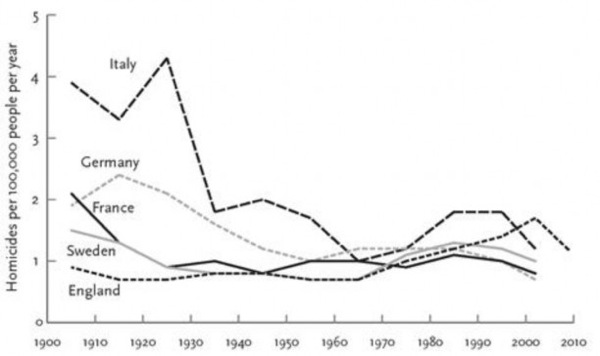
Why do you assume that? Murder rates in the US were 10 times higher than in continental Europe even at the beginning of the 20th century, long before support programs existed on either side of the pond. (Indeed, in Europe, all the modern support systems, government welfare, and gun control hasn’t reduced crime—at least homicide rates—at all. Homicide rates in England, France, and Sweden hit modern levels in the 1920s: https://ourworldindata.org/uploads/2013/03/homicide-rates-in.... Germany and Italy saw major drops in the early 20th century, but I’d probably chalk that up to increased political stability.)
This is not a rebuttal to your graph, whose source ("Better angels.." by Pinker) I know about and understand, but I thought it was useful context for my own understanding:
In the same units as that graph, WWII would likely register as over 1000 in Germany (compare with the less than 2 indicated in the graph).
You shouldn't forget about how different races, ethnic groups, and cultures - and how those differences throughout history may affect criminality or poverty. Hispanic and black people are incarcerated at approximately 2 and 6 times the rate of white people respectively[1] in the United States.
White Americans are substantially more likely to be incarcerated than Western Europeans, but not as substantially as the non-race differentiated number might suggest. White Americans are incarcerated at a rate similar to Russia.
I can't speak to the drug war in Europe, or if it exists, but it is a likely culprit for a large number of American incarcerations. 1.3 million arrests a year are for "possession only"[2] and the number of Americans in prison takes off late 80's early 90's as the drug war is ramping up [3].
My understanding of the American incarceration system, and this is mostly just my synthesized view from reading and thinking about it, I can't easily source this anywhere - is that there was a lot of crime in the late 80's and early 90's, especially in major cities. People realized that basically all violent crime is committed by relatively young men. So - they devised a system where a significant number of problematic young men (1 in 9 men [3]) are locked away for a period of time.
I checked the actual numbers. The incarceration rate in the US is not 10x higher than the EU, it's only 7 to 8 times higher on average. (Maybe the poster meant that the incarceration rate is 10x higher than the incarceration rate in his particular nation?)
In any case, the actual crime rates are about 3 times higher across the board. So we are incarcerating a lot more people for the same crimes somehow? About 2x as many. Alternatively, it's possible that drug crimes, which are an outlier, are pumping up our incarceration numbers vs some nations in the EU. Since they are not even arresting people for what we in the US would probably call possession at a minimum, obviously there would be no follow up prosecution and incarceration for those individuals? That might be the difference? But that's just speculation on my part. (It just kind of makes sense though, because we incarcerate a lot of people on drug charges. That's probably most of our prison population in some places.)
We actually don't. Obama tried to reduce the prison population by reducing the sentence or releaseing non-violent drug offenders. He found out that type make up less than 10% of the prison population.
The punitively long sentencing from the War on Drugs has meant that the people will go to great lengths to avoid arrest. Someone looking at 30-50 years for distribution won't think twice about murdering a witness if they think it will help them beat the charge.
>He found out that type make up less than 10% of the prison population.
Wait? What?
I'm from Wisconsin, and my second home is in Texas. In both places, non-violent drug offenders constitute the bulk of inmates by far. About 77000 of roughly 131000 inmates in Texas are in for drugs without theft or violent charges. If you factor out the ones in for big time distribution, it's about 62000 of the 131000.
Are you absolutely certain they said only 10% of people in prisons are drug offenders? In any case, at least where I'm from, drug offenders are, by far, the majority of the incarcerated.
EDIT: Hmm, it just occurred to me, are you only talking about Federal system prisons? Because most of our inmates are actually in the 50 state prison systems.
A much larger proportion of people are in federal prison for drugs than state prisons. (Gut check: there are few federal crimes that people regularly go to prison for, trafficking is one of them).
John Pfaff has done a lot of research into this [1], and drug offenders are a small minority (~20%) of prisoners. The bulk of prisoners are in for violent crimes, which makes the politics of decarceration... tricky.
> So we are incarcerating a lot more people for the same crimes somehow?
John Pfaff, a professor who studies incarceration, found that despite a falling crime rate, the number of charged felonies has been holding steady. He suggests that aggressive prosecutors are charging felonies where previously they would have accepted a misdemeanor. He suggests that part of this is because they need to burnish their "tough on crime credentials", and part is the state generally pays for prisons and felonies where the county pays for jails and misdemeanors.
>I checked the actual numbers. The incarceration rate in the US is not 10x higher than the EU, it's only 7 to 8 times higher on average. (Maybe the poster meant that the incarceration rate is 10x higher than the incarceration rate in his particular nation?)
7 to 8 is as good as 10x.
Going from 1x to 8 is a huge 800% increase.
Whereas the correct 8 from the mentioned 10 is a mere 25% error...
It seems to be cause and effect. The US incarceration rate increased was stable for most of the 20th century. It was about the same in 1972 as it was in 1930: https://upload.wikimedia.org/wikipedia/commons/thumb/4/48/U..... By 2005 it had increased by a factor of 5.
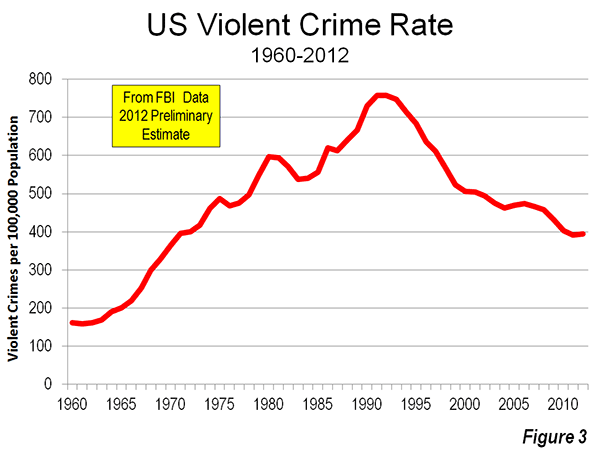
The causation seems to run in the direction of more crime leading to more incarceration. Incarceration rates stayed stable in the 1960s and early 1970s. By the time incarceration started ticking up in the early 1970s, violent crime had already increased by 2.5x. By 1980, the incarceration rate was about 40% higher than in 1960. But violent crime had increased by a factor of 4. The increase in incarceration rate didn’t catch up to the increase in violent crime rate until the mid to late 1990s, when violent crime started edging down.
I’m extremely sympathetic to the idea that criminal justice reform is required now that crime rates have gone down dramatically. But we need to grapple with our own history and the nature of our society. We went through a very violent phase from 1960 to 2000. We don’t know why that happened. But it seems pretty clear that our incarceration rate was a lagging response to that phenomenon.
> By the time incarceration started ticking up in the early 1970s
Don't just bury the lede. What changed in the early 70s that would have caused such a thing.
> We don’t know why that happened. But it seems pretty clear that our incarceration rate was a lagging response to that phenomenon.
Yes, we do know what happened. The 70s saw Vietnam Vets coming back from a pointless war with PTSD and heroin addictions. Nixon signed the Comprehensive Drug Abuse Act in 1970. Reagan threw gas on the smouldering fire with the Comprehensive Crime Act and bang, everything is illegal and now with the mandatory minimum sentencing. At every opportunity the federal government, rather than evaluating to see if these laws were effective, chose to make more things criminal. This didn't dissuage gangs from engaging in illegal activity. It actually made them more paranoid and more violent. Anynone that might have been remotely considered a snitch or narc was killed. If you're staring down a life sentence if you got caught might as well remove any doubt.
I didn’t mention the drug war because it doesn’t explain the increase in crime rate—it’s about a decade too late. The increase in violent crime actually began in the 1960s. By the time the DEA was created in 1973, violent crime had more than doubled since 1963. It then actually slowed down a bit—it increased only another 50% from 1973-1983. By the start of Reagan’s term in office, violent crime was already near peak levels. (It would increase about another 1/3 before peaking in the early 1990s.)
Vietnam is one possible explanation, having started in 1955. I have never seen any analysis of that. But unlike the drug war, at least the timing works out.
Is the Baby Boom sufficient explanation? Just having a lot more young adults rattling around, not fully attached and at loose ends tends to spike violence.
I half suspect that long-term declining fertility rates is one reason we currently have such historically low rates of violence.
What happened to the number of police in that same time period? Was there actually an increase in crime or did the amount of it being recorded just increase?
The number of police officers per capita increased by 30% from 1960-1970, but increased only moderately after that, peaking at about 40% above 1960 levels: https://eml.berkeley.edu/~jmccrary/chalfin_mccrary2014b.pdf. Violent crime rate more than doubled from 1970 to 1990 while police per capita went up only 10-20%.
Moreover, the overall increase in violent crime tracked the homicide rate. Homicides are very well reported, throughout the modern era. The homicide rate doubled from 1963 to 1973. That almost certainly reflects an actual increase in homicides, or just previously unreported homicides being reported due to increased policing.
A very large part of the prison population across the country comes from people convicted of a felony, given probation, and being kicked off of probation. The number 1 way to get kicked off probation is failing a drug test. The war on drugs led to the massive prison expansion since 1972 in the usa
And conveniently, mostly to the kind of communities like blacks and latinos more likely to use some cheapo drugs, and not to the kind of communities (basically rich white people) using the expensive shit (basically coke, which in the 70s and 80s was everywhere)...
Well, that's less an excuse for having more inmates, and more something for the US to do some thinking on what they do wrong as a society to get both of those things higher...
If they have both harsher penalties and more crime and recidivism, then the former are clearly not working much.
And one would need to wonder why have more crime in the first place.
Either we go with the "lower quality people" explanation (bad genes?), which I don't think has many takers, or there's some bad cultural and systemic shit going on.
It’s culture, but not the modern stuff (harshness of penalties, reducing recidivism, etc.). By 1800, almost all of Western Europe had a homicide rate under 2 per 100k. At that time they had no welfare states, and punishments were harsh. France, the Netherlands, and England all punished many property crimes with death at that time.
The poster you are replying to has a very well established HN reputation for a hard-line worldview that assumes government is almost never wrong about anything it does to citizens.



It's quite surprising to read this type of comments. Where I live (western Europe), I've never met anyone who went to jail, it's really uncommon. I just checked, the incarceration rate is almost ten times higher in the US.