This is a great article. Do I have to go vegan? No. But it would have the biggest impact if you did. Is organic farming the answer? No. It tends to use more land for less output (although maybe the health-foodies could get off the No-GMO bandwagon). I also appreciate that the authors recognize that for some people living in certain cultures and climates _have_ to eat meat and there's no shame in that.
The bulk of the reduction can definitely come from rich, affluent nations and have the biggest impact.
Articles like this seem important. Hiding the fact that meat/dairy production is such a huge factor in climate change hurts people more than it helps. When we all start to wonder why it isn't getting any better we need to know that there are ways we can do our part. Even if they're small things!
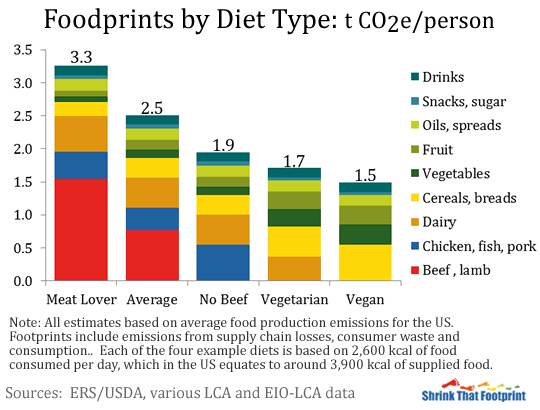
This is an awful article because it doesn't put numbers on the various alternatives. Without hard numbers, the discussion of alternatives is meaningless. Even going from an average diet to fully vegan will only reduce your food-related emissions by 40%, which only accounts for about 12.5% of your carbon emissions to begin with (in the US): http://www.greeneatz.com/wp-content/uploads/2013/01/foods-ca.... Cutting your CO2 footprint 5% is not going to do anything. Cutting it even less than that is utterly pointless.
"Doing your part" and "doing small things" will not have any impact on climate change. It ignores the enormous gap between where our emissions need to be and where they are now. If you could convince everyone in America to become a vegan tomorrow, that would cut global CO2 emissions by about a gigaton. That is how much CO2 emissions went up last year alone, mostly due to China and India. Think about that: the effect of every American undertaking an unprecedented lifestyle change all at the same time would be totally wiped out by a single year's growth globally.
I agree with both you and agentultra. I'm struggling to understand why. You're correct on the comparative impact. But I've long believed psychology is important too.
We lefties are frequently criticized, for better or worse, for hypocrisy. Maybe personal pro forma efforts will remove that rhetorical angle of attack.
Also, there's got to be some priming benefits, an opportunity to educate about the larger issues. However, my faith in this strategy has been rocked by failures (betrayal) of the whole recycling charade, which has served to alienate people and likely reduced future engagement.
I wish I knew what is best. Right now, I don't even have an opinion, just more questions.
The psychological factor of feeling empowered to take control of your part of the world, however insignificant, is important I think.
"No silver bullet," is something I've said elsewhere. I don't think this article nor I have implied that if everyone went vegan then the climate crisis could be averted. I think it's a good article because it doesn't try to frame our dietary choices as a solution. It informs us of the impact of our choices and makes sure people realize that eating some meat is okay. But if you want to do more, you can, and it will have an impact -- however small -- and that's a good thing in my books.
> the effect of every American undertaking an unprecedented lifestyle change all at the same time would be totally wiped out
It really wouldn't. You totally underestimate the "role model" influence the US has on the rest of the world. If the dynamics of the US market would change, all other markets would race to follow in the same direction. This would also be both supported and driven by the individuals across the globe, doing what is "fashionable." Humans are slaves of fashions, even when when is appears improbable.
>Is organic farming the answer? No. It tends to use more land for less output
Use of land per unit of output (or vice versa) is not the only important metric though, not by a long chalk. A more holistic approach is needed [1], otherwise it is back to the same as the issues that the OP attempts to address.
[1] An approach that considers equally important things like effects of pesticides, other negative effects of non-organic farming (there are other important ones, and more).
I agree and the article was more nuanced than that. I think organic farming is great and maybe needs GMO in order to thrive, sustainably, into the climate/soil future.
It's a deep topic and there are no simple answers, thanks for pointing that out!
Care to provide a source to back up that claim? If you read the article and associated sources you'd find a stack of scientific evidence to confirm that it has quite a large impact.
I know this isnt going to be a popular opinion here, but I'm going to say it anyways -- we are simply not going eat our away out of this climate change problem, and we shouldnt even try, we should focus the efforts in other places
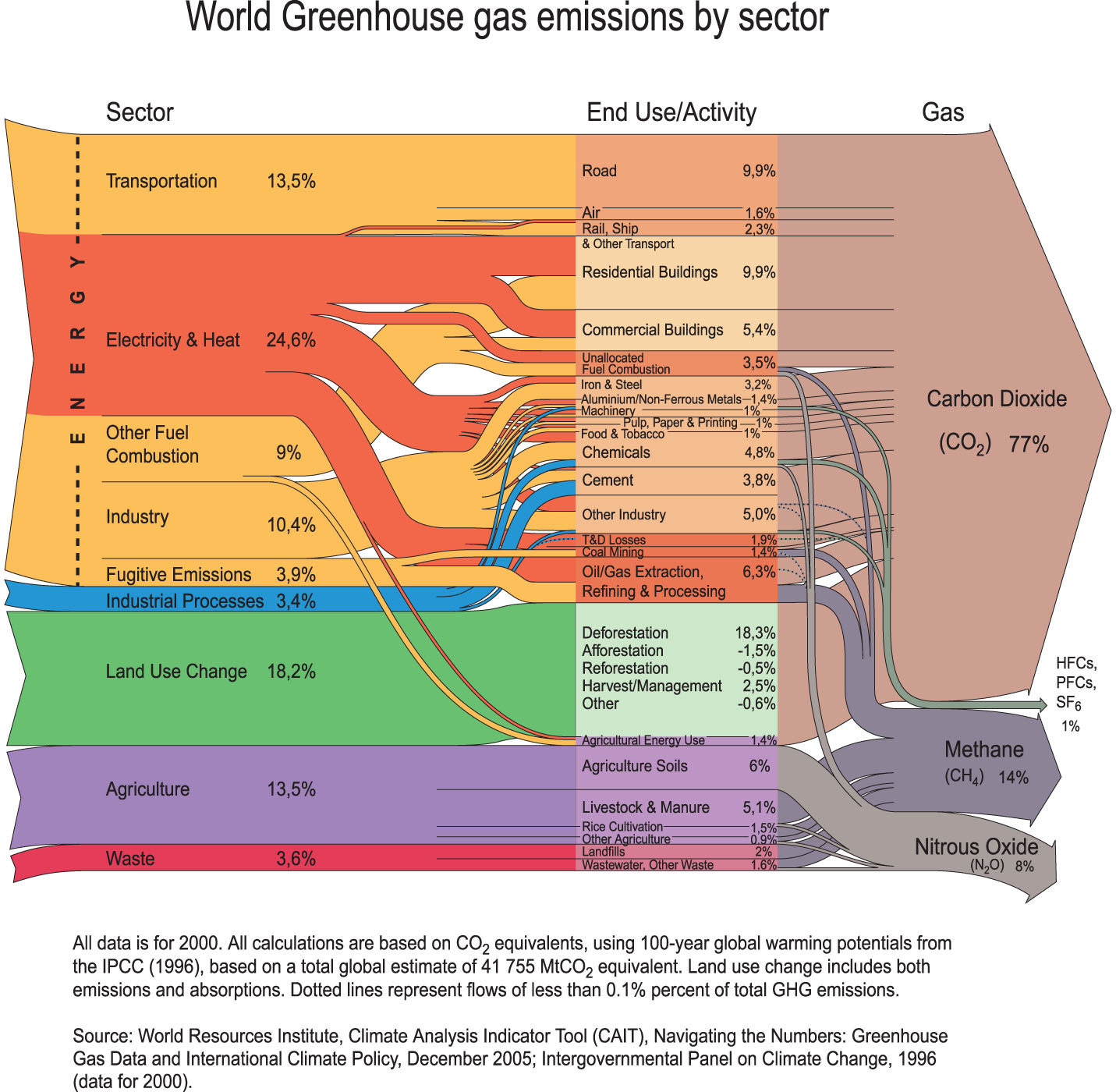
Here is the current breakdown of the world's emissions as of 2018:
1. heavy industry (29 percent)
2. buildings (18 percent)
3. transport (15 percent)
4. land-use change (15 percent)
5. the energy needed to supply energy (13 percent).
Livestock is responsible for 5.5 percent, mostly methane rather than CO2, and aviation for 1.5 percent.
Here is the estimated sacrifice needed to bring carbon emissions down by half and then to zero:
It would require forgoing electricity, heating, cement, steel, paper, travel, and affordable food and clothing.
Both of these are taken from Enlightenment Now by Pinker, and I have not seen the numbers or his conclusions refuted. I'm open to someone trying to change my mind, but with these numbers, I do not see how that is possible.
Most estimates put it at around 15%, not 5. Stopping climate change is going to require action on all these vectors, and diet is one of the easiest to change. It also has knock on effects like clear cutting rainforest to plant crops to feed to cows.
On top of that it’s just cruel and unnecessary to go on eating so much meat.
The main argument in favor changing diet, to me, is the potential psychological and social effects. When something you do multiple times a day is different from what you used to do, and what many others around you do, it stays active in your thoughts and might trigger other, more meaningful activity.
I don't know if this is actually true, but anecdotally at least it seems to be. The people around me who seem to be most active when it comes to the topic of climate change also tend to be vegetarians or vegans. And many of them started down this path by changing their diets, sometimes even for reasons that weren't ideological.
> The people around me who seem to be most active when it comes to the topic of climate change also tend to be vegetarians or vegans.
What do these people do? Unless they're working on renewables technology or carbon-capture technology, they're not doing anything useful. That's just how the math shakes out. The climate problem is so huge that only engineers and scientists can help us now. Everything else is just putting on one of those "raising awareness of breast cancer" ribbons.
I imagine some of them could be working on the things you mention, but most of them don't. But that's particular to my current network.
But some of them do have strong relationships with people who play some meaningful role in the whole climate issue. At least two of these 'people around me' have siblings that occupy high-level engineering/management roles in some of the most impactful (and worst) companies.
It's not much, maybe, but perhaps it's not meaningless.
The math seems to be shaking the proximal solution (green tech), and ignoring the path to get there. Technology doesn't exist in a vacuum, and green techs are disadvantaged because not only are they competing against options whose true costs are externalized, but there are trillions of dollars invested in the unsustainable status quo. We need not just for the right technologies to exist, but for policies that will allow them to win. And that requires people (even non-engineers) to care.
It's 15% globally, but just 5% in the U.S. That's because eating meat is one of the few things your average Bangladeshi or African does to create CO2 emissions. Those people aren't going to become vegans, and as those economies develop, they'll want more of the things that are responsible for the other 95% of your average American's carbon emissions.
Going from the average diet to becoming a vegan would save about 1 ton per person annually: http://www.greeneatz.com/wp-content/uploads/2013/01/foods-ca.... The carbon footprint in the U.S. is about 20 tons per capita annually, so going from an average diet to full vegan would save just 5%. (Just cutting out beef would capture most of those gains, reducing CO2 footprint by 0.6 tons, or 3%.) Just eating less meat, or eating organic or whatever will have zero impact. And that's assuming that switching to veganism doesn't alter your other habits. If switching to veganism means you e.g. sign up for a meal delivery service to keep things interesting, or drive to the grocery store more often to get fresh fruits and vegetables (which, unlike meat, you can't freeze in bulk), your gains will be much less.
All of this stuff about "reducing your carbon footprint" is just such a mind-boggling waste of time. To keep the temperature increase to 2C we have to cut CO2 emissions worldwide by 19 gigatons in the next decade. Instead, China added 10 gigatons in the last decade. The U.S. and EU28 together emit just 9 gigatons. In the face of those numbers, all this "turn the lights off when you leave the room" and "try to eat less meat" stuff is pissing in the ocean.
> Just cutting out beef would capture most of those gains
I was shocked when I read how much cows contribute to warming, and I have mostly stopped eating beef. "Don't eat beef, eat less dairy" and you're good when it comes to diet. That said, there are far more important factors contributing to your carbon footprint. This Ars Technica article from 2017 sums things up well: https://arstechnica.com/science/2017/10/emissions-eschmissio...
Even if individual waste were the problem, it would be woefully inadequate to engage in moralistic posturing. People tend to just form counter-cultures.
If I were a more careless person, I would have half a mind to increase my waste in response -- something I may as well advocate for anyway, because so long as society is not going to stop (or even measure) my wastefulness, then who can say it is wrong? Only 'feeble hypocrites' who don't care enough to actually do anything about it. You can blame me for destroying the world, but if you won't lift a finger to stop me, then you're intentionally conceding your moral responsibilities to permit outright evil. Our ship isn't strong simply because it refuses to go into rough waters.
>It would require forgoing electricity, heating, cement, steel, paper, travel, and affordable food and clothing.
I think this is where you would get the most disagreement. That is, people are focused on transforming all those listed rather than forgoing them, which is a non-starter. Transformation to emission-reduced or emission-free processes.
I agree with you but I wonder why you discourage changing diet to include less meat. While it has less of an impact it's one of the easier things on that list to directly influence as a single human being. It also has knock on effects and health benefits. We can focus our efforts in multiple places, going vegan won't distract us from the other areas. I won't try to debate you or change your mind however and I agree that the numbers are overwelming, especially when you take into condisderation that carbon emissions are only one part of the planetary boundary system.
I dont think eating a lot of meat is a bad thing. I feel 100% better when I eat mostly meat and no carbs. I could argue that a vegan diet, for me, is much worse than carnivore diet.
Good point. Also keep in mind the 5.5% of livestock emissions simply replaced the emissions by hundreds of millions of bison/buffalo, elk, deer, etc that we wiped out. So the livestock contribution is pretty much zero if you offset it with the loss of bison/buffalo, etc emissions.
And we have been in a global warming trend for thousands of years. Most of north america ( including NYC ) was under a sheet of ice, in some places sheet of ice 2 miles high.
It's disappointing to me that the nytimes would use climate change as a tool to push a highly environmentally and biologically destructive lifestyle like veganism. I wonder how many of the authors of the article has even farmed a day in their lives.
And the article reeks of ideology rather than news. Where is the news in the article? It's just pushing vegan propaganda which harms more young people everyday than nonsense like anti-vax movement. Vegans have starved their babies to death thinking that veganism is a healthy human diet. But I doubt they'd get as much backlash as the netflix '13 steps' producers did. The most environmentally and biologically friendly human diet is the omnivore diet. It has been since humans began and it will be while humans exist.
Gell-Mann Amnesia effect is a well established idea. I wish journalists would simply report news rather than pushing destructive ideologies, especially since they haven't a clue what they are talking about most of the time. They aren't an expert in almost anything they write about. So why not stick to reporting? Why give "advice"?
Why are you citing a popular science writer who is a psychologist? Who would bother to refute his numbers in the first place, when he's clearly not a primary source on them?
And that is only a secondary critique. Why should changing diets be mutually exclusive to other approaches? That seems like a false choice.
Why are you dismissing Pinker simply because he is "a popular science writer", and "not a primary source"? If you're going to refute Pinker, show your work. Otherwise, it's just borderline ad hominem.
It's definitely not ad hominem, nor am I dismissing him. He is absolutely and indisputably a cognitive psychologist. And I would say that Enlightenment Now is clearly a popular science piece.
Nothing is wrong with that. But he is just not a primary source on this data. So there is no refutation to be made in this context. Go to the bibliography, find the citation for the statistics that he used, and those can be discussed. I don't have the book and can't quickly obtain it, so I cannot provide that information.
This is social media, not a peer-reviewed journal. I don't think primary sources are necessary to justify basic numbers.
Pointing out that Pinker isn't a primary source isn't ad hominem. Bringing up that he's a psychologist and popular writer, repeatedly, is very much ad hominem. It's trying to discredit the messenger in order to dismiss the message. Don't do that, it's bad rhetoric.
Popular science writers serve an important role in disseminating ideas. As long as they're not misquoting sources, making up facts, or applying radical interpretations, there's nothing wrong with them. I don't see Pinker doing any of those things (if you disagree, be sure to source that!). And although Pinker may not be a climate scientist, he is a scientist of considerable credentials. He has taught at MIT, Stanford, and is a full professor at Harvard. In my mind, that brings a great deal of credibility to what he has to say on other scientific subjects, at least when quoting numbers.
So your arguments, as presented, provide approximately zero reason to doubt the numbers presented by the OP.
You say that, but witness Roger Penrose and James Watson speaking and writing outside of their areas of specialty. I think it's completely reasonable to ask for primary sources in any informed discussion, regardless of forum. It's just as easy as citing the secondary source in any book worth citing. I think your concerns over my rhetoric have some merit, but ultimate editing my comments at this point would just create confusion.
I think looking for primary sources is only necessary at this level when there is good reason to question the credibility of the secondary source. "Not their specific field of expertise" isn't sufficient, especially when they're just citing facts and not interpreting them.
I think there's a substantial difference in value between citing primary sources to refute a secondary source, versus dismissing a secondary source out of hand because it's not a primary source.
(This is actually familiar ground to me; my spouse has been teaching popularized dance history lately, and I've been encouraging her to write a book on the subject, because her interpretation challenges some conventional wisdom. She doesn't want to write a book because she's too reliant on secondary sources and too lazy to go read through more of the primary source material.)
I hope she writes the book. It doesn't have to be scholarly, it can just scratch an itch - but I am sure it will be a great contribution to the body of knowledge in that area. Createspace, Lulu, Gumroad are all pretty good resources for taking a single piece from a single print of "vanity" project to something with an isbn and distribution channels, possibly over multiple editions. Some have editing, cover design, and "typesetting" services available for reasonable prices. I hope nothing I've said would give the impression that I would hold this in anything but the highest regard. Best of luck to her.
I switched to a plant based diet last year after reading similar articles on climate change and was surprised to see an additional set of benefits. I feel a lot healthier, my skin is clearer (struggled with frequent untamable breakouts), I save money, etc. Diet is a very individualized thing, so don't dramatically overhaul your entire lifestyle based off what a random stranger says on the Internet but if you haven't tried a plant-based diet you may be pleasantly surprised like I was. I'll still eat meat if it's served to me but when I am eating out and cooking I go veggie.
I first tried eating vegetarian to deal with some digestion issues. It made it worse. Especially spinach, broccoli and other high fiber foods. I switched to a 90% carnivore diet and everything cleared up digestion wise, and I also felt much better, healthier, and my skin cleared up. As you say, diet is very individualized.
What was your diet before? Anecdotally, most people I know who felt better after going keto-ish had horrible diets to begin with. Dramatic reduction in processed foods, beer, HFCS, etc.
Simply preparing food at home with fresher ingredients and being conscious of what you're taking in can account for much of the gains they experienced.
The vast majority of people on the planet don't eat 90% meat diets, but if we did it would be a disaster! I'm not saying it isn't the case with you, but anyone who experienced amazing gains shifting their diet to mostly meat should consider survivorship bias, and that the benefits are from cutting other things out, not adding tons of animal protein in.
This was the clincher for me. I listened to the audiobook "How Not to Die" by Dr. Greger and was convinced of the common sense that eating plant based whole foods is the way to be healthier. The lowered cost and lowered impact on the environment are just icing on the cake. If eating meat was better for me, I'd still do it. The science done so far seems to suggest that a whole food plant based diet is the healthiest diet.
I have turned pescatarian a while ago for no other reason because I don't find it very natural to eat large amounts of meat. In the last five years or so I've been strongly of the belief that meat, especially meat like beef, should get taxed so highly that it essentially becomes a luxurious good which families can only enjoy once every so often and not 3-5 times a day. First people will be extremely upset and call it classist, but later (especially new generations) will just get used to the fact and quickly adapt to the new normal where farming beef and eating cows every day is just not a normal way of life.
Ultimately there is no birthright to eating meat every day, there are no health benefits or other benefits of doing so, contrary it;s actually bad for health and our planet and therefore there is nothing classist about taxing beef so high that the average person shouldn't be able to afford it more than a handful of times per month.
We need bold politicians in this world to look at the cost of these things and implement a tax system which incentivise a more balanced lifestyle and also account for the cost/damage that a high consumption of meat causes to society.
I know there will be comments saying that individual action is not enough to combat climate change, or that it's too late for that, but when governments are so slow to act and corporations will only change when their bottom line is at stake, it is left to individuals to take action. Going vegan is simply the right thing to do at this point.
Personally I think that individual action is largely futile. I've also stopped eating meat. I want to be able to look gen Z in the eye when I'm old and say I did everything I could.
I feel like the other attitude is popular because it gives people an excuse not to exercise real activism - propositions, getting out the vote, public education etc. Just eat a veggie-burger now and then and say "well I tried".
In addition, it's just not the appropriate or proportional response, considering the contributors [0]. Individual action alone is certainly not enough. Systemic change is crucial.
> Going vegan is simply the right thing to do at this point.
We're pretty much screwed (but not extinct) at this point no matter what, but going vegan doesn't matter nearly as much as living in a smaller house (i.e. less concrete), or driving and flying less.
I mostly avoid beef and dairy, which are the main diet-based causes of global warming, but beyond that it's a rounding error.
> Going vegan is simply the right thing to do at this point.
I'm sorry but no. Your diet is a personal choice and no amount of shaming is going to change that.
Do you travel internationally? Own a car? Do any other of a million things that have an impact on the climate but also constitute living your life?
It's great to put this information out there but telling people that your choices are "simply the right thing to do at this point" is incredibly condescending and will likely have the opposite impact you want it to have since no one likes to be preached at.
> Your diet is a personal choice and no amount of shaming is going to change that.
I guess that depends on how you define personal choice. Climate change has certain changed the calculus, but diet was never merely a personal choice when it required the death of other individuals.
As for the shaming, I'm not in favor of that because it does not seem to be an effective way of bringing about change. But simply having these kinds of discussions cannot fairly be called shaming. That's a cop-out to avoid meaningful discourse.
Isn't there a level of condescension and or proselytizing that always goes on around environmental conversations?
Reduce, reuse, recycle - if you do it, good! If you don't, bad! Travel less, don't own anything.
How can we frame these sorts of ideals so that people don't feel attacked?
There _is_ a climate crisis. At least some level of that crisis is driven by consumer demands. We should be able to advocate a change without people feeling like they're being shamed.
I think it’s their problem and not ours. No one ever wants to change and no matter how nicely you put things they’ll always feel attacked. It’s just how it work, ultimately no one really wants to change so they need to be pushed.
> No one ever wants to change and no matter how nicely you put things they’ll always feel attacked.
Precisely. As another example, when people claim that progress pics are "fatshaming", it's pretty obvious that the problem isn't with the information or how it's presented, it's with the person feeling ashamed, which they rightfully are. These people should self-reflect upon why they feel ashamed instead of throwing a tantrum and playing the victim.
I have been actively trying to reduce my ecological footprint because I believe climate change is real. I don't feel it's a matter of "personal choice" at this point. The way we live has a profound impact on the planet, and we all need to try and reduce that impact in any way we can. I realize this is a message people don't want to hear, but I believe they need to hear it. Going vegan and flying less are two of the biggest changes an individual can make.
Was it your personal choice to cut down rain forest to raise beef cattle, or palm oil? What about air freighting in fruit and veg that common sense says comes on a ship? No?
Your diet is small part personal choice, within the far larger part played by cultural mores and market-led financial choices imposed by producers and supermarkets. You can't escape the part played by billions on advertising, and the choices of restaurants and supermarkets that led to your "personal choice".
"The market" is not going to phase out ecologically reckless methods unless people stop buying. Yet how can they when that detail, very intentionally, never appears on the label, and 365 day availability ensures almost no one remembers when things are in season any more?
I can see why being "preached at" is being annoying, but the fact have been here long enough, yet a large percentage of the population haven't tried to change their diet.
If public shaming and social clout isn't involved, no one will.
Or we can accept people will keep their diet and go on with our lives. Just because something impacts the environment (literally everything does this btw) doesn't mean that we need to stop doing it. The climate will always be changing and humans will always have some impact on it. We need to accept that as fact.
That's pretty much saying "I put my personal food taste before the safety of the future generations.". Don't get me wrong, you're free to have this opinion but it's probably a good thing to frame it like that to fully understand the choice.
There's "climate is changing" and massive population migration, uninhabitable areas, unreliable food and water supply, sea level threatening entire cities and probably more.
The fact that "literally everything we do" impact the environment isn't a valid argument. It does seem daunting, but by looking at each cause individually and acting on it, it looks less discouraging.
I'm far from perfect, I'm not even vegan and I still fly quite a bit, I just came to understand I had to make progressive changes to my behaviour or the human existence we currently have is severely threatened,
Which doesn't abdicate us from preventing harm. My grandkids, if I am even lucky enough to have them, are going to live in a world where at least 31 days of the summer month will be too hot to go outside, winter will mostly be bouts of torrential super-storms, food will be incredibly expensive, and the politics of the day may very well be battles over how to handle the billions of migrants fleeing the uninhabitable places of the world.
Climate change is already displacing tens of thousands of people every year to floods, forest fires, and arid land. It's going to get worse before anything we do today to survive has an effect.
I think the thousands of scientists studying this phenomenon already understand the impact of human civilization on Earth rather well.
Yes, it sucks to be told you are a sinner. What language would you suggest people use in order to encourage people to be vegan? Suggesting it is the moral choice seems like a good method to me. Then again i am inclined to seek the moral and respond to guilt.
You seem more concerned about not being condescended to; for such an individual, what language would you find cogent?
I'm vegetarian and aspire to have a plant-based diet, but I recognize the difficulty in such a diet in a lot of places.
With that said, I'm curious why you don't want anyone trying to convince you to change your mind?
I don't want to eat meat, and I don't plan to, but if someone had some reasoned arguments as to why I should, I'd listen and decide for myself. I'm not you though, but I am curious what reason(s) you have for not being open to discussing it. I'm also curious why you phrased it as someone telling you to do it, rather than discussing it.
I love meat and many meat dishes. I would never stop eating them because they're a major part of my life. The question of if I want to change my diet is not one I'm asking myself. It seems weird to have to "debate" that with people. No amount of shaming is going to make me stop loving a good reuben sandwich or a carnitas burrito. I have no problem with other people eating what they choose but don't need to hear other people's thoughts on what I eat.
Think of it like pushy religious advocates. If they come to your door once and knock and you tell them to go way, that's mildly annoying but understandable. If they keep coming back every day saying that you "must" debate them, then that starts to get really annoying, really fast.
This is discussed in the article:
"Some scientists have suggested that grass-finished beef, if managed properly, can be a more sustainable option: As the cattle graze, they stimulate grass to grow deep roots and pull more carbon into the soil, helping to offset the cows’ climate impact. But, on the flip side, grass-finished cattle also take longer to reach slaughter weight, which means they spend more time burping up methane into the atmosphere. Because of this, some studies have suggested that grass-fed beef can actually be worse for the climate over all, though the debate about this continues to rage.
For now, it’s hard to say with confidence that grass-fed beef is consistently more climate-friendly than conventional beef."
Honestly the links between diet and health are always thin at best, but I don't know of any that strongly link a well-balanced vegan diet with reduced health. Usually, the opposite.
All the evidence seems to indicate that the less meat and dairy one eats, the healthier they are. I also used to believe vegans were unhealty until I did some research. As a personal anecdote, I've been vegan for about 4 years now and my health is better than ever.
As a personal anecdote, vegetarian didn't work for me! Persistent anemia, hair loss, fatigue; adding back some meat just fixed it.
Various diets are worth trying -- you never know until you try, and you learn a lot by trying. So for readers out there, try being vegan for a month: you'll learn a lot about what you eat and how to cook and you can observe how you feel.
Also worth noting: many traditional cultures embedded food restrictions into calendars and/or religious rules. Being vegan for a while before Easter is more or less a thing in some Christian groups; Ramadan involves fasting as a practice. These cultural practices, combined with the seasons in nature, make me wonder if we were built to be cyclically vegan/omnivore/berry-eater. This may be more sustainable for many.
Some evidence seems to suggest that it could negatively affect brain health. (See deficiencies in B12, Iron and Zinc.) I've even read anecdotes of people that have gotten diabetes going all wholefoods vegetarian.
My belief is that our biology is complex and specific to each individual to the point where we can't all share the same diet and expect the same effects on our bodies.
> I've even read anecdotes of people that have gotten diabetes going all wholefoods vegetarian.
There can be a problem with reducing fat and protein significantly while using carbs for the majority of caloric intake. This can lead to diabetes. But you can do this on an omnivore diet as well.
Giving up our growing space to grow lots of monocultured vegetables will be worse for the climate.
The co2 emissions from cows aren't the problem. Factory farming yes is a problem, but if cows are put on grass that grass is a co2 sink and gives off far less.
If you grow an acre of soy it's just as bad as it isn't sustainable.
Also the fact that being vegan has serious health consequences and animals provide far more nutrition.
The answer isn't going vegan at all but to have sustainable farming practices where animals and plants are grown together in a regenerative process.
Grass is one of the best crops to grow. It's a great carbon sink, and takes away methane. Builds its own fertility so no need for artificial fertilizers. No management, machines, pesticides etc. Grows everywhere. We just can't eat it. But ruminants (like cows/sheep/etc) can. They have a digestive system for it. They turn grass into meat and milk. Meat and milk that don't need storage until you need to harvest it. It also tastes better.
We used to have far loads more bison roaming the earth. But they didn't cause climate change because they ate grass. When you factor in the grass it's a net positive and not a negative like the article claims.
These studies like to look at things in a bubble, but the problem is far more complex than that.
Converting pasture to arable land to grow more plant based food will make the climate situation worse. You will reduce these carbon/methane sinks. You will need to fertilize and harvest the soil. Fetalization itself reduces the carbon/methane sink capabilities.
Eating beef can actually be a very sustainable option. In many cases, pasture-reared beef actually shows a carbon-equivalent net gain when carbon sequestration is taken into account.
Edit: Perhaps a comment or 2 would be nice on why people don't agree or why I might be wrong. Happy to read up and learn
I looked up the study, first up it wasn't "Oxford scientists" but a University of Oxford think tank called the Food Climate Research Network.
Follow the links, Monsanto has deep connection to the University of Oxford, at least £50 million pounds. UO professors routinely get consulting fees from Monsanto. They even have a Monsanto Senior Research Fellowship position.
There is a massive conflict of interest with Monsanto and the University of Oxford. You find this with most food and nutrition science. Since the funding for such sciences comes from the industry, any science that is critical of it's paymasters soon gets silenced.
A very thought-provoking article, but one that still leaves me with questions.
* The vast agricultural monocultures of the US have changed our climate on their own. Our fields of soy, wheat, and corn have decimated local ecosystems, led to high nitrate levels in the water, changed air temperature and humidity on their own, and encouraged a US diet that is high in processed food, leading to its own set of health problems.
* Yes, these vast monocultures are in a feedback loop with raising animals for meat. Corn-fed cattle and pigs and chickens are part of the reason Iowa is what it is today.
* If we all switch to tofu and tortillas with a side of Coke made with corn syrup, we overall preserve the agricultural status quo in the US. Is that really that big a win? Curious.
* Vegetables seem to be lacking in the standard American diet, and they're not subsidized by the federal government the way grains/corn/soybeans are, and they're also something a lot of us buy from far away. How can we change all that?
* Many people will still want meat products, some for health reasons -- it can be hard for some folks to be vegetarian or vegan healthfully (I had trouble with fatigue and anemia for instance, and yes I understand that maybe I could have tried harder/eaten more supplements/etc). How can we encourage the shift to animal production on 'waste' land, and decrease the incentives to ship beef from Brazil and Bolivia? Can we make goat meat cool again, for instance? or rabbit?
The alternatives I'm personally more interested in: shifting transportation patterns for US adults (biking and transit). Increasing green space. Re-encouraging locally grown food, where by local I mean the back yard. Rediscovering the foods you never knew you could eat but your great-grandparents did: nettles, dandelions, Virginia waterleaf, garlic mustard, purslane, daylilies, hostas. Many of you could get a whole week's worth of greens, even in May in colder climes, by walking outside -- and how many of us know it? Right now I'm motivated to rediscover these local foods for myself for health reasons, but it helps that they're $0 to grow and $0 to transport, and thus add 0 to my carbon emissions.
> If we all switch to tofu and tortillas with a side of Coke made with corn syrup, we overall preserve the agricultural status quo in the US.
It takes a lot less corn and soy to feed people directly than it does to feed a bunch of cattle. You get a lot of efficiency by skipping the intermediary trophic level.
this is a great article, both in content and in form.
keep in mind though managing your carbon budget is like managing any other budget, which in turn is like optimizing any other queue. meaning: don't over-optimize the 5th most important thing when you're ignoring the top 2 - 3 most important things.
by which I mean: #1 flying, #2 driving, #3 heating and #4 cooling.
just to put a sortof min-max on it: if you eat vegan but fly to a conference once a quarter and drive to work every day your emissions will be greater than if you eat cheeseburgers for lunch every day but take the subway to work and rarely fly.
which is why imho you should go for the 50 - 80% win (80+% reduction in red meat) in this category (food) instead of going all the way to vegetarian/vegan.
or put another way, being pro video-conference has a better GHG reduction return than being vegan :)
> #1 flying, #2 driving, #3 heating and #4 cooling.
At least in the UK Department of Energy and Climate Change's Global Calculator[1] the food lever appears to have the greatest impact on greenhouse gas emissions, even more than heating or transport.
For those that would like to hear a mind blowing discussion about climate (and the earth in general), watch all of the podcasts with Joe Rogan, Randall Carlson and Graham Hancock.
They are three hours each and I promise you will learn many things that give perspective on the repeat arguments and confusion about the climate. There are many other podcasts with these gentlemen, but here are three to start with.
Joe Rogan and Randall Carlson #606 (3 hours) [1]
Joe Rogan, Graham Hancock and Randall Carlson #725 [2]
I'm curious how the stated article jives with the following research by the USDA [0] into it's current resource and greenhouse emissions and the work done by Bjorn Lomberg and team that showed a modest 2% reduction in total CI globally [1] if the entire population switched to a vegetarian diet.
Bjorn Lomborg's analyses are well known for being highly motivated to push contrarian agendas, and shouldn't be taken as evidence of any sort of honest analysis. His thoughts are only useful to drive out of the box thinking, and should not be taken earnestly in any way.
This would be like asking "but how does all this new molecular biology work showing how smoking causes mutations that drive lung cancer square with Ronald Fisher's analysis showing that smoking is just correlated with lung cancer?" It just doesn't matter, because we need to realize when people are using statistics and analysis to push particular agendas, rather than using it to answer questions about the world.
Would you kindly provide evidence to the contrary and not just to what Bjorn has done but also the USDA?
And no, it is nothing like Fisher's contrarianism to the smoking issue. Both links acknowledged that the current global diet has an impact on CI, but tries to find the most likely size of the effect.
I ask because the science and evidence behind this stuff is complicated, and much of what is being said has a huge element of alarmism. I don't doubt that our current diets have impacts on CI, but I would like to see thoughtful analysis determining the effects. I'm sincerely asking this in good faith
> much of what is being said has a huge element of alarmism.
Could you kindly provide any evidence for this sort of claim?
And could you provide any sort of evidence that we should even use effort to examine Lomborg's claims, much less try to use it as what we compare the USDA to? He has a history of being wrong, and ignoring that history in order to "stop alarmism" seems like an equal sin to any potential alarmism.
Outlier analyses that have a history of producing incorrect analyses should not be taken as a gold standard of anything.
I provided links to the USDA report and it's findings. I provided the link to Lomborgs tweet and in it the referenced links to the findings. In it, he addresses the 10% reduction in emissions argument and show that it is cherry picking the available data. That to me has an element of alarmism in it.
"He has a history of being wrong" - if he does, I have not seen it. and I am open to changing my mind if there is evidence to the contrary - which I have asked you in good faith to provide.
while the world's economy is fueled by adding more people to the mix forever, we're not going to solve any problems. people have to imagine and accept a world where the market might not grow without limit and where outputs decrease from one year to the next without it being a disaster. grey pyramids have to be accepted without righteous outcry to open borders more fully. the population and its demands are the ultimate multiplier for all climate impacting activities.
When talking about the potency of methane as a greenhouse gas, lifespan of about 20 years. CO2, on the other hand, has a lifespan of around 100 years.
Interestingly, rice agriculture generates about as much methane as livestock, and burning biomass (wood) and landfills each generate about half as much methane as livestock.
Although this is not made clear in the article, the highest amount of greenhouse gasses are released by energy production and industry, which, combined, account for about half of all emissions [1].
So what this article is saying is that I should consider going vegan or reducing the (already meager) amount of meat in my diet so that fossil fuel companies can keep burning fossil fuels and don't have to get off their butt to develop greener alternatives, and so that industry can continue producing useless capitalist crap that nobody needs.
To take it even further, this article is suggesting I restrict my options so that others can continue profiting from the destruction of the environment.
Personally I don't drive and I don't fly. I don't even own a car. I go everywhere by train or bus and on foot. I contribute to greenhouse gasses much less than many vegans. And I'm very tired of hearing people saying I should reduce the amount of meat I eat because it's destroying the environment. Food is necessary- driving cars is not.
This reminds me of propaganda from the environmentalism movement of the 70s, which sought to shift the blame for litter (increased use of disposable packaging) from corporations onto consumers. Yes individuals can take responsibility for their own actions by "voting with their wallet" etc. - not denying that. But in a democracy, if you'd rather fight for greater regulations on Big Ag than give up meat in your diet, that should be your choice and don't feel ashamed about it.
> propaganda from the environmentalism movement of the 70s, which sought to shift the blame for litter
Oh really? Keep America Beautiful was conceived, paid for and started by: Philip Morris, Anheuser-Busch, Pepsi, and Coca-Cola and others. Then they started shifting blame onto the individual.
That was in reaction to Vermont proposing to require deposit and return bottles for drinks, after a surge in single-use packaging litter.
Phillip Morris and the beverage makers you mention were fighting against the threat of regulations that would prevent them from continuing to pump out non-biodegradable filter cigarettes and single-serve drink containers.
We could have had filterless cigarettes and returnable glass-bottle Coke. Instead, Keep America Beautiful was their brilliant idea to redirect the focus onto consumers, away from manufacturers.
Clearly, yet "propaganda from the environmentalism movement" implies, to me, propaganda from actual environmentalists.
I'd call what happened corporate propaganda, "propaganda from the multinationals", or perhaps the first example of greenwashing. I suspect that may explain why you picked up a few downvotes. It certainly distracted me from the real message you were trying to convey.
From your second comment, it's clear we are of similar mindset, and your point very valid. The current popular "theme of the moment" around veganism in the media does seem to have the same smell of someone trying to move the gaze away from the places that would move the dial fastest. Which in this case, of course, is constraining the global food players.
Life is experiencing an abrupt, widespread global species extinction event. Humans are destroying intricate webs of animals, plants, and microorganisms. These networks supply our food chain and sustain life on Earth; their annihilation from rapid deforestation and climate change is causing grave consequences: droughts, increased heat waves and wildfires, more frequent severe weather events, coastal flooding, food shortages, and water wars.
Earth’s atmosphere was once mostly carbon dioxide. Once life took hold, simple organisms (such as bacteria, algae, and plants) converted atmospheric carbon dioxide into oxygen by way of photosynthesis. When those organisms died, natural processes spanning eons changed their remains into carbon-bearing fossil fuels: coal, petroleum, and natural gas.
Burning fossil fuels recombines carbon with oxygen to make carbon dioxide (CO2). Since the mid-1800s humans have released a stupendous amount of CO2 into the atmosphere. In the following graph, average annual atmospheric CO2 measurements in parts per million (PPM) are plotted alongside averaged global ocean and surface temperature readings in degrees Celsius (°C), relative to 1881-1910:
Both atmospheric CO2 and temperature are increasing at an exponential rate, in lock-step.
Bubbles in ice cores drilled from polar glaciers trap historic atmospheric gas ratios. Long-term observations reveal an increasing average warming trend that is distinct from natural short-term fluctuations. Temperatures are climbing in proportion to the total amount of atmospheric CO2 added since the Industrial Revolution.
Choices
Our past choices have put life on Earth in peril; our children face an immense CO2 cleanup, devastating climate changes, or both. We can curtail the most severe catastrophic outcomes, though time to do so grows alarmingly thin.
If we choose air conditioner and refrigerator coolants based on hydrocarbon refrigerants; if we urge politicians to invest in on-shore wind turbines; if we reduce food waste; if we eat less meat; and if we support restoration of tropical forests. If we choose these, there is hope.
The hard sci-fi novel (from my profile) is on hold until the Impacts layflat coffee table book (quoted above) that links astronomy, the environment, and Earth's history is finished.
The hard sci-fi novel currently includes some diagrams and illustrations, too.
There’s a bunch of good reasons you should reduce or eliminate meat from your diet, including environmental effects but also including your health and mistreating and killing intelligent creatures. If your diet requires people to do things to thinking, feeling animals that would be criminal to do to a dog, maybe having some bacon on your breakfast plate really isn’t that important after all.
I also don't share your view on the ethics of eating other intelligent beings (from different species). Many other animals eat other animals, and for this they have to kill them and cause them pain. The pain comes from the fact that animals do not easily die, and our death is almost always painful and horrifying.
But- why shoud humans be any different than other animals, when it comes to the ethics of killing other animals and causing them pain in order to feed on their meat? Other animals don't have any compunctions about doing the same to humans. Why are humans so special that it is immoral for us to eat meat?
I don't see what dominance has to do with privileges and responsibilities. Besides, humans "dominate" only in a very narrow sense. Most of the biomass on the planet is not human. There are many species of insects and microorganisms that are much more "dominant" than we are.
Other animals don't necessarily kill out of necessity. For example, many animals perform surplus killing [1] - I personally know of two dogs who, together, entered a coop and killed about 40 chiken without eating any. In the same farm, dogs have often killed chickens and goats, which they just eviscerate without eating them.
Then of course there's the killing of young animals by older males- like male cats sometimes kill kittens, etc.
Besides, why is "need" to kill the only justification to kill? For example, if it's very difficult to survive without killing an animal, say because you're putting your health and that of your children at risk with a diet poor in animal protein- then why are you not justified to do it?
First of all it’s not at all difficult to get plenty of protein from plant sources. You are most likely putting your children at much greater risk by feeding them factory farmed meat than not feeding them meat at all.
I guess for me it just comes from a desire to respect and value all life. It’s in our power to create a world full of unnecessary death and cruelty or without it. Why would we choose the former? I found I became a much kinder and more empathic person when I stopped eating animals. I don’t think it’s a coincidence.
No all life. When we treat animal life as worthless we also come to value human life less. It’s a connection that’s hard to see while you’re still eating meat IMO.
At least in more “primitive” societies they would often acknowledge that the animal had given its life and thank it and treat the act of eating an animal with some solemnity. We instead do our best to forget that what we are eating was ever alive.
It takes as much as 10 kilos of plants to produce a kilo of meat, so if you respect plant life the best thing you can do is stop wasting it feeding it to animals you intend to eat.
And yeah I do notice and appreciate plants a lot more since I became vegan.
This talk does a good job of addressing the common objections to veganism, including all those you have raised:
>> It takes as much as 10 kilos of plants to produce a kilo of meat, so if you respect plant life the best thing you can do is stop wasting it feeding it to animals you intend to eat.
I do value and respect all life, but I don't think that means I shouldn't eat it. Your comment was the one that made that point.
Rather than watching a video I can't converse with I would prefer it if you explained to me yourself why it's OK to eat one kind of life one respects and values, i.e. plants, but not another, i.e. animals.
It is not as simply to reduce climate impact based on what you eat. The data this article use is based on averages, and as in every industry the lowest standard it drastically different from the top and carry more quantity.
On the very top you got meat produced that actively helps the environment. Highland cattle that keeps national reservations open comes to mind. There is also overpopulated and invasive species. At the bottom you got cattle who live their whole life inside a barn and get feed from deforested jungle farms, using unimaginable amount of pesticide and antibiotics.
It is also important to remember that diet is far from the most effective personal choice to make when it come to climate change (https://phys.org/news/2017-07-effective-individual-tackle-cl...). It is ranked 6th. Driving to buy produce at a farmer several miles out of town is likely to produce more C02 than biking down to eat a burger. An electric car might help, through it depend if the electricity is made from coal or wind.
The article gives some averages and for people who don't want to think about the climate and want a simple guide the article provides. However if you care about the topic and can spend the energy to go deeper and consider all facets then it is much better to make informed decision by digging deeper.
Meat is almost perfectly substitutable. So going out of your way to ensure that the beef you eat has low carbon impact isn't really doing much good. All you're doing is ensuring that somebody else won't eat the beef you bought and will eat something with higher carbon impact instead.
Where it does matter is when you choose not to eat meat. Less demand for beef means less beef raised, but which cattle are they going to stop raising -- the low carbon or the high carbon ones? My guess is that the high carbon beef is the marginal beef. When you stop eating beef you cause the price to drop, so the ranchers with the highest costs are going to be the first to go out of business. And carbon is one of the main costs of ranching, so I would predict that stopping eating beef would have a greater than average impact on carbon emissions.
Low carbon production has higher marginal costs and tend to be small farmers which is the group that suffer first when prices drops.
The high carbon beef is basically all import here in Sweden, and there is no deforestation issue from farming. From a environmental perspective we actually need more open fields to maintain bio diversity.
When climate aware people stop buying beef the ratio of imported beef increase. In last few years we have actually seen an decrease in imported beef, which has been attributed to more awareness of low carbon beef vs high carbon beef. People buy more local and significant less imported. Locally produced beef cost between 2-4 times as much as imported, which naturally impact how much people buy.
Since we are talking about climate change, it happens that the last couple of winters has been the mildest in ages and reduced the number of months that farmers need to keep cattle inside to between one and two months.
But it is more complex than that. We don't have deforestation issue from farming. Fields, even those that is just for hay are important for bio diversity and it is generally soils where other crops won't grow. We don't burn down old jungle forest to grow corn in order to feed cows that then get transported through half the globe. It is fields that if they get overgrown would remove the biotope that many species here depend on.
Highland cattle is the extreme end where they can basically live outside the whole year, and they do the job that people and motorized machines otherwise would need to do in order to maintain national reservations. I would be much interested in reading a study that compared the environmental effect of using forest machines vs letting cows keeping overgrowth down.




The bulk of the reduction can definitely come from rich, affluent nations and have the biggest impact.
Articles like this seem important. Hiding the fact that meat/dairy production is such a huge factor in climate change hurts people more than it helps. When we all start to wonder why it isn't getting any better we need to know that there are ways we can do our part. Even if they're small things!