Its not for everyone in every big city but certainly the Dutch model of transitioning cities from cars to transit and pedestrian/cycle focus is probably the clearest model for sustainable and healthy tansport out there.
I live in the Netherlands and I can confirm that. In just a couple of decades they transformed all their car friendly cities and made cars second rate citizens
Cycling infrastructure is amazing. It is almost always faster to travel by bike than by car.
They did it so long ago and the world still hasn’t caught up. I’m very sad about that.
Also somehow the amount of cars per capita is still very high in NL.
A good alternative to this is carsharing. Lots of people in Vancouver don't own a car, they just take one from one of the 5 car-shares when they need one
Pretty common in big cities. That's why everyone in Amsterdam rides cheap old omafietsen ("granny bikes") with huge locks that often cost more than the bike itself.
Not so bigi would say. Lived ~3 years in Amsterdam with an average bike always loosely locked in the street and it has never been stolen.
But to be honest, poverty in NL is also a problem that's been managed quite well ; which does not mean there is no crime (I've had 3 burglary attempts) but maybe crimes that paya bit more than stealing average bikes in the street.
Oh yes. As a Parisian and a big supporter of the electrification of all terrestrial transportation, I want as few EVs as city as possible. Cars simply don't make sense in dense cities (bikes do).
I lived in Paris for a spell, and one of the great things about the city is that it is so bike-able. It's not a large place! And it's dense. Lots of traffic, but the French seem to understand that bikes belong.
We almost never used the Métro, what was the point? Saved money and no one ever stole my wallet!
I take my vélo at least twice a day (to commute) and I still find it far more distressing than taking the bus/métro. No wonder why so few people rides bikes, expect on the week-ends: with all the big petrol cars and aggresive motorbikes, it is still pretty dangerous to ride and not (yet) agreeable. But things are improving so I'm optimist and resigned.
Related to the OP, I anecdotally have an acquaintance that is a bike messenger in the UK, who second-hand anecdotally reports that everyone who does it is an ostensible model of fitness until they 1) get hit by a car or 2) die at 50 of lung disease. There's a chicken/egg thing with regard to non-vehicle transport in that you're more directly exposed to exhaust, and aspirating it more quickly because of exercise. Which exacerbates the negative impact of pollution, which puts you back in a vehicle, which increases pollution :-/
Is there actually proof that it "works great"? Asking for myself every time I try to cross the street in downtown Manhattan and have to look for a cyclist on the sidewalk, going against traffic, blowing through a red light, or fighting with another cyclist.
A city that was never designed for bikes is hell for bikes, so you end up with only the most reckless bikers on the road.
I commute with a bike every day in Paris, France. The infrastructure isn't great but it's OK, and it's improving. The thing is: I'm a big, strong guy who can legally outrun most cars and motorbikes in such a big, dense city. I can fight my way in traffic, mostly because the law authorizes bikes to go both ways in most streets, to run red lights https://en.wikipedia.org/wiki/Idaho_stop, to ride between traffic lanes, etc. Most people are terrified to ride here so you only have the most reckless persons on bikes, including me. Although I'm respect the law (which does not make riding safe because no one wants to be anywhere near a big bus/truck, or between vehicles, or stuck in a diesel tailpipe…), I end up riding dangerously making people think that biking is only for reckless guys.
The worst is that, the more I respect the law, the more drivers get angry at me for taking to much space or slowing traffic down. So you move as quick and close as possible to vehicles and pedestrians. That's absurd but that how it is.
It's an infrastructure problem. The more you give space to bikes, the more reckless bikers can finally ride prudently, or prudent people dare to ride (making reckless bikers a tiny minority). It's the same with cars: what would happen if the infrastructure made car driving dangerous? You would only have road hogs and people would just hate cars.
I definitely agree about the last part. I live in London, don’t drive, and cycling would definitely be preferable to relying entirely on the Tube and taxis. But when I see the hell cyclists here have to contend with, and how aggressive they need to be, I know there’s no way I am a skilled or confident enough rider to do the same. But if the infrastructure and vehicle congestion ever improved to the point where cyclists were adequately protected, I would definitely start cycling.
Compared to many cities, London is actually pretty good for cycling now days, at least in central areas. We’re no Amsterdam, but there are some high-quality dedicated cycling routes and plenty of quiet side streets to use. Traffic speeds are relatively low and the vast majority of drivers are considerate and cycle-aware (occasional white-van idiots aside...)
I think I rode a taxi in Paris once or twice, but never a private car - and none of our friends had private cars, either. I assumed parking was a nightmare, and expensive. The narrow medieval roads didn't help, either. Many of the streets around our apartment were closed to cars (at least on Sunday).
Being a cyclist, I thought I found a slice of heaven. I thought about being an urban planner when I got back to the States.
>I assumed parking was a nightmare, and expensive.
I've been a car driver and a cyclist there for ~10 years now. Believe me, being the former is much easier than the latter. If you're on a bike, many assume you're just having a good time (either on vacation or unemployed, as many people says) so the politicians/police/media won't care about your well being and focus instead of the transportation means of "serious people", i.e cars and motorbikes.
It's insulting, because I do have a car (and a parking spot) but everything pushes me to drive it instead of riding my vélo (which makes no noise, does not emit anything, takes very little space, doesn't damage the road, is far less dangerous to others, makes me fit and save health insurance costs...). Go figure.
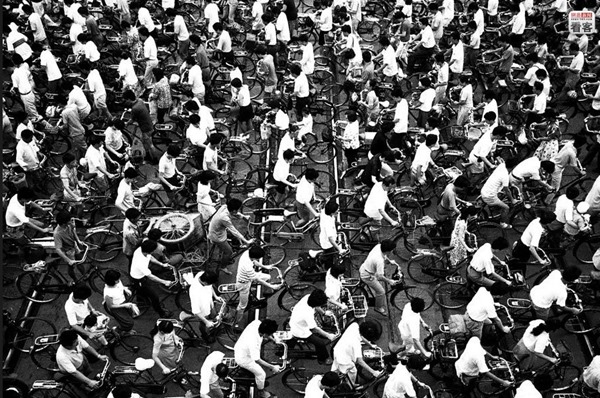
cycling isn't space efficient and doesn't really scales that good. It is a luxury ttransportation mode for low/mid density US cities not capable/not willing to build true mass transit modes. Look at the packed subway in say Moscow (https://www.youtube.com/watch?v=GCZKXHsZo68) and compare to the best possible bicycle situation - mid-80s China http://www.theurbancountry.com/wp-content/uploads/2013/02/83... - around 10 times density difference :) Take that photo, cut 1/5th in height (2-3 abreast) and put large distance between very enthusiastic riders (incl. speeding electrics) - such modern bike lane shows very low efficiency of space utilization/bandwidth and very insufficient capacity to move any significant number of commuting bodies.
Cycling is at least four times the space efficiency of cars, unless all the cars are Smart Fourtwo or equivalent. And that’s when parked, the multiplier goes up with speed.
Additionally, low density US cities are one of the worst places I’ve seen for cycling, because not only is everything spread out, but also the multi-lane roads everywhere make it much more dangerous than equivalently populated towns and cities in Europe. Despite having cycled through central London (UK) and just over 1,000 km along the Rhine, there’s no way you’d see me cycling around Salt Lake City or Sacramento. I’ve cycled around Davis (CA), but Davis has better than US average cycling infrastructure — almost as good as the average level in the UK.
London is getting there, slowly! There are some excellent examples of well-designed, well-used cycle infrastructure such as the new(ish) Cycle Superhighway along the Thames Embankment. This will hopefully serve as a model for future infrastructure.
In general, traffic speeds are low in London and there are lots of quiet side routes that are well suited to cycling. We’re no Amsterdam, but cycling is certainly much more popular and visible than it was 5-10 years ago.
London is unpleasant and stressful, but as Reason077 says, traffic is slow. Compared to the American cities I’ve seen, though, it’s second only to Davis.
A subway is a high latency, high bandwidth carrier. A bike track is a low latency, high bandwidth carrier. That is in a subway all "packets" (people) need to wait for the next opportunity to depart, whereas in a bike system all packets move more slowly, but at a more continuous pace (set by the maximum speed of the transport).
A lot more people can pass any point in a biketrack per hour than they can per subwaytrack, and they can often take a more direct path to their destination using bikes than they can by subway. That also means that a bike system is better suited to a city where both the departure and the destination are diverse among all "packets".
That's not even starting to talk about how biketracks scale much better economically since they are much cheaper to build.
>A subway is a high latency, high bandwidth carrier.
Trains coming in each couple minutes - show me lower latency than that :)
>A lot more people can pass any point in a biketrack per hour than they can per subwaytrack
several hundreds (up to a thousand in rush hour packing) people per train each couple of minutes - beat that.
Anyway, the rest of what you're saying about biking is just a theory that doesn't come even close to the reality of any big dense city in Europe/Asia. This is why those cities has highly developed subway system - the low latency high bandwidth and high speed mode of transportation. You put all these people on bikes and they would choke the city.
I stated from the start that lower density smaller cities (which Copenhagen or Amsterdam are - having density 1/3rd and 1/4th of San Francisco for example) may allow for luxury of letting people to enjoy their commute on bikes.
High density usually isn't the problem for American cities (though it might be for SF, I don't know that one specifically), but rather low density suburban sprawl is. Higher density usually makes it easier to walk or use personal transport like bikes.
For it to be too dense for biking to be a viable transport they would have to be much denser than European cities which would by definition not allow for parking in the places where business takes place (in which case nobody would drive).
Most American cities were clearly designed with cars in mind, while most European where not (having grown organically rather than being designed), and while the American decision might have seemed better for the better part of the last 100 years, that might not be the case for the next couple of decades.