it's interesting. too bad I couldn't find any video in a wind gallery. (edit: did my own, not the best software but it's something https://i.imgur.com/TudMHlX.png - there's some lift in there to be had)
Ultimately I'm still unconvinced it works the way they tell it works.
There's been actual research (incl. by NASA) on the KFm foil (although scaled up for real airplanes or military drones) which has come up inconclusive.
Just FYI, your simulation looks really underresolved and the leading edge of the foil should be rounded off. Not intended as criticism, just in case you want to improve.
If you do proceed to work on this, which I think would be interesting as KFm in the RC wing size regime seems not so well studied: avoid vortex panel method and anything else based on inviscid/potential theory, you're interested in laminar flow for RC applications. I'd give it a try e.g. with SU2 starting from the laminar flow around cylinder tutorial, and making you own mesh file for the KFm with gmsh (pretty easy to use mesher with GUI):
thanks for the pointers! I'm way out of my element here and just thrown together something with the first software I found on internet.
about this:
> the leading edge of the foil should be rounded off
I agree, however, in the first round of simulations the leading and trailing edge where they themselves giving a lot of lift to the foil (especially the trailing tapering), so in my naivety I slabbed both edges to reduce those effects and see if the flow was deflected by the slab alone.
interestingly, even if the model itself is flawed and the simulation technicalities off for the intended purposes, having the slab slightly forward gave also interesting results, almost the same lift and a lot less drag
so I came up with an idea for a foil that's still easy to craft out of foam or balsa and does use the different effects do redirect the flow more effectively
Interesting stuff! What you need to be careful about when comparing different foils is to ensure you compare at the same angle-of-attack (AoA). Especially the latter foil has a high "intrinsic" AoA.
The best way to do it is running simulations that span a range of AoA, calculating lift and drag for each one, and setting the reference for each foil at the zero lift AoA. Then you can do a fair comparison.
I build and fly RC .. and I love the Kline-Fogleman device.
Its so simple, you can teach anyone to build one, and it will fly. Its so simple, one wonders if it could be the basis of a self-assembly/auto-assembly art project, whereby raw material is fed into the box, a crank is turned, and out flies a new airplane. This is a mind-experiment I've been toying with for a while .. automated assembly of KF-based airplanes.
Do you have any links? I have a quad and figured I'd build a plane out of the spare parts, and ordered a Pixhawk, but none of the connectors seem to actually fit anything else. Am I doing something wrong or are they actually not consistent? Is there some website that helps you connect the components and configure the Pixhawk?
It doesn't look like he is using a Pixhawk? It's hard to be sure but it appears to be a commodity quad FC, presumably with wing/plane firmware flashed. Not sure which flight control firmware varieties still support planes and wings since the ones I've used haven't had support for that in years.
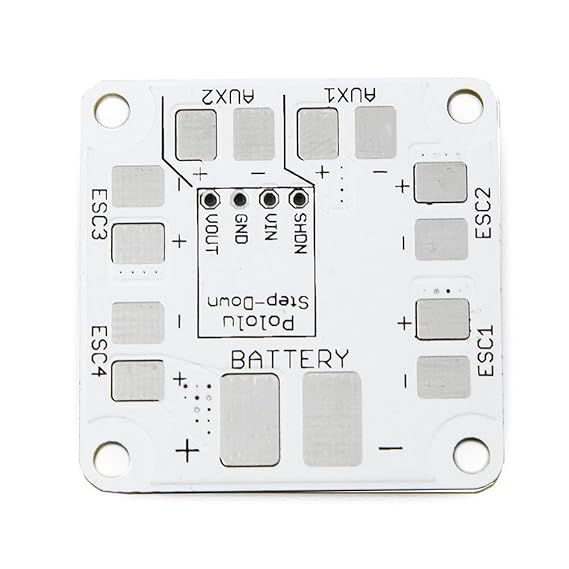
That's not a flight controller, it's a simple power distribution board, most likely [1]. Flying wings generally don't need flight controllers, they just need two servos and an electronic speed controller for the motor. A flight controller is nice because it can stabilize the plane, and it can also provide autonomous flying it it has a gps. If you just want to fly around like that, no need.
True, he just uses a power board. I went full hog and got the ArduPilot board plus the telemetry transceiver so I can have the plane fly from the computer with waypoints. Now if only I knew how to connect everything!
You'd be far better off scaling things back a bit and just learning traditional RC electronics - how an ESC gets wired up to the motors, where the servo's get their signals, and all that. ArduPilot definitely has sex appeal - but learn the basics of RC electronics first, is my advice ..
For basic FPV (first person view) the camera and transmitter to do this is super cheap now. At the low end they've become commodity items used in small quadcopter drone racing.
Flite Test [1] has a ton of good articles and videos, from beginner to advanced level. This is a good place for getting started with the hobby.
At least a couple of years ago, Hobbyking [2] was the most popular webshop for buying all the parts. It's a Chinese company, and shipping is a decent proportion of the total price, so keep that in mind when looking at prices.
A quick Google image search reveals that the airfoils on the Disco do not have rear-facing steps. These steps are the defining feature of the KF foil family.


it's interesting. too bad I couldn't find any video in a wind gallery. (edit: did my own, not the best software but it's something https://i.imgur.com/TudMHlX.png - there's some lift in there to be had)
Ultimately I'm still unconvinced it works the way they tell it works.