Personally, I think one of the main problems with current use of CGI (specifically in non-animated movies) is color treatment. Comparisons between the original non-altered version of Jurassic Park (JP) against Jurassic World (JW) shows my point. There is an increased tendency to change hue and saturation of color in post-production, in order to transmit ideas or set moods on the film itself, but this makes CGI look faker than what it is and the brain is able to identify it.
EDIT: I prefer the look of JP over JW, not because I think it has better CGI, but because colors look more closer to reality.
Modern color treatment in film totally drives me crazy, independent of what it does to CGI.
It seems like every film coming out of Hollywood these days is processed exactly the same way:
* Crank down the low end so half the frame is solid inky black.
* Pick one or two key colors, and jack up their saturation.
* Desaturate everything else.
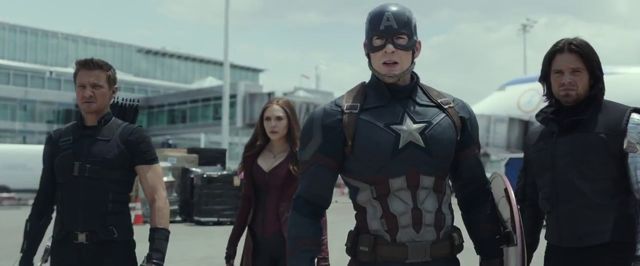
In other words, make the entire movie look like an over-dramatic poster for it. Throw any sense of naturalism or unique look out the door. Once you notice it, you see it everywhere. Here's the top live action movies of 2016:
This is a daylight shot. Look at how the characters are all squinting. Look at the big white fluffly clouds that should be diffusing the light and softening shadows. And yet, magically, all of the shadows are jet black and almost all of the color is gone.
The light is clearly diffuse, if you look at the shadows on the ground, and yet there is this deep black everywhere. Deadpool took the look further by only picking one color (red, Deadpool's outfit color) for the entire film.
Lest you think this is just an issue with superhero movies, let's ignore those and look at the other top non-superhero movies of 2016:
It also suffers strongly from the "It's a period movie so we're going to sepia tone everything so hard it looks like you're watching the movie through an aquarium full of pee" effect.
Blacks, grays and neon cyan, just like Rogue One. Look how unnatural his skin tone is! They wanted to jack up yellow to complement their primary blue so much that the poor dude has jaundice:
I'll give this one some credit for varying it up a bit. Also, dramatic spotlit stage lighting is a logical part of the movie's look. But it's still prey to the same cliched look in places:
Ectoplasm green and spooky violet were the key colors for the whole film. Secondary colors tend to come across as magical or eerie to viewers since they're different from the safe and familiary primary colors. Of course, jacking up magenta doesn't do flattering things to skin:
Also, what color is Melissa McCarthy's coat? Is it actually black? Who fucking knows.
Central Intelligence
The traditional comedy look is brightly-lit and saturated, so Central Intelligence didn't fare quite as poorly as the above. Whenever they had a chance to dim the lights, though, they revert to the same cliched look as well:
Jesus, we get it, colorist. They're in the wet jungle. We don't need to be physically assaulted with the colors blue and green to figure that out.
...You get the idea.
Go back and watch a movie from before 2000 and you'll quickly realize how much more pleasant to look at most of them where, and how much more variety there was in look. Compare Alien to The Graduate. But it seems like ever since the rise of digital coloring and superhero movies, Hollywood has decided every single fucking movie needs to look like a comic book page, whether it needs it or not.
One recent movie I really liked that bucked this trend was Her. It was heavily colorized, but in a way that stood out. In shots like these, even though there's a strong color cast and a lot of dark, there's still always some color and detail in the shadows:
I think that part of the reason this is happening is the move to digital cinematography, which makes this kind of adjustment from raw video files much easier.
Also, moving to digital allows you to basically configure your own "film look" rather than relying on the filmstock that you're feeding into your cameras.
Digital also tends to look a bit more flat and desaturated than film in general. So to make up for that, they make use of strongly direct lighting to cast shadows all over the actors (it's really noticeable on the face) to give depth to the image.
You are correct in every aspect. Non-color treatement is something I definitely miss from movies of the 90s. Digital processing technologies have made it easier for people working on cinema to color-treat the movie as product. Even directors not involved with digital filming, fall on this: Christopher Nolan and Quentin Tarantino, all fail to deliver a natural and coherent visual representation of color.
The Netflix show Lady Dynamite does a sort of gag with colorization to define moods of scenes. Different timelines of her story have their colors overdone on purpose, to comedic effect. It's pretty clever.
You can compare Snyder's work in Batman v Superman to Joss Whedon's last-minute changes in Justice League and how the CGI is actually worse off in a film that has a higher budget and lower runtime than the former.
I mean, complaining about the color realism of a film with gigantic monster dinosaurs (whose coloration we may never know to begin with) seems a bit silly. Movies are not documentaries. I'd buy in a bit more for things like the BBC's 'Planet Earth' needing color realism, but even then it's ok to dramatize things.
...but the whole point of the effects in those movies is to bring the idea to life, to make the unbelievable seem real and believable. If it fails to do that, it’s not silly to discuss how and why.
I thought movies were to make money, at least ones like the recent spat of Jurassic ones. JP, yeah, realism to a degree, BoB Horner became a household name because of it. And it was somewhat realistic for the research at the time. But nearly all the dinos should be covered in furry Emu-like feathers now if we want realism. And shaggy dirt-brown feathers aren't good looking and 'dazzle'. Maybe for some it's worth $10.50 to watch, but not for most.
When JP was filmed, the discovery of dinosaurs having feathers hadn't happened yet, and big efforts were made on providing accurate representations of what was known about the creatures. Back then scientists still thought dinosaurs were reptiles' ancestors, so the skin had to look reptile-like; personally, I think they succeeded, and a bigger success was shown in The Lost World, years after.
The relationship between dinosaurs and birds has been observed for at least 150 years, although until the 1990s the idea was that birds were descendants of dinosaurs, not the other way around.
Still, the idea that at least some dinosaurs might have had feathers predates Jurassic Park by decades. I distinctly remember learning about this possibility in my first grade classroom, which would have been 1988 at they latest.
You are correct. The idea of dinosaurs with feathers is older than the 90s, even Dr. Alan Grant suggests this when speaking about raptors, on the other hand evidence appeared until mid 90s.
But with Dinos, we can't. We've no idea what their color was, if they even have color receptors in their eyes, nor their movements. Fantasy is just as good as reality when it comes to T-Rex coloration and if they had feathers or not.
BTW, I tried to do a quick google on the current research and mostly came up with mixed answers. If anyone form HN knows about dino feather coverings, please chime in!
No, the studios want returns on their investment, at least enough to recoup costs and the perception of realism, to an audience, is not realism. What an audience thinks is real is often not real. Audiences love to hear sounds in space movies, yet that is impossible. Audiences think that spies have techno baubles and cool stuff, but they mostly have budget rate bureaucracy. Audiences think that we all live happily ever after, but we all know that's not reality. Movies aren't documentaries, they are entertainment you pay for.
Also, a realistic T-Rex may never survive in our modern atmosphere. Those lungs are so large because O2 content was about half of today's (http://www.firstpost.com/tech/news-analysis/atmospheric-oxyg...) and the mix of dinos they have in JP is just a mess of evolutionary reality.
I mean, yeah? The Jurassic series has a special place in my heart, the films, by and large, are great monster movies. But they are just that, monster movies.
Trying to say that the dinos are realistic is just crazy. Maybe, kinda, in the first one, they were, a little bit. Even then Jack Horner got a lot of flak from the community over his consultation on the films. But the evidence we have now just points to a much different creature than what we though of even a few years ago. They aren't monsters, just standard terrestrial vertebrates trying to make their way in a different world. We have so much to learn from them, about climate change, about physiology, about adaptation, etc. So trying to keep the monster and the known 'reality' separate is a big deal to me.
I think you are really missing the point here. The audience doesn't care whether the dinosaurs depicted are scientifically accurate, they only care whether they look like they could be accurate, and that is a big distinction. It is about matching the viewer's expectations, not reality. In JP the dinosaurs look like they could exist, whereas in JW they looked like CGI (the so-called 'uncanny valley' effect in CGI). That being said, of course JW succeeded from the perspective of the investors since it made so much money. Still, that aspect of the film is completely orthogonal to the aesthetical aspects that people here are discussing.
"Fantasy is just as good as reality when it comes to T-Rex coloration".
Then let's go for plaid and gingham dinosaurs, like the pink elephants on parade!
It doesn't need to match reality, it needs to aid suspension of disbelief. If color choices make the audience say, "That looks so fake", it hurts the storytelling.




EDIT: I prefer the look of JP over JW, not because I think it has better CGI, but because colors look more closer to reality.