The truly financially successful people I know have figured out a way to outsource all of this type of mundane day to day thing, except for maybe something they enjoy as a hobby, like cooking. (I also know a weird guy who just likes ironing shirts.) It goes beyond this. REALLY rich people have executive assistants to do their mundane work related stuff too. But anyway, everyone I know who is rich has someone to clean their house, do their laundry, book them plane tickets, do their taxes, manage their money, field their phone calls, schedule meetings and other appointments, etc.
It's not lack of maturity to want to avoid all this crap... it's actually a big time sink and not anything that will get you anywhere in life. It's important to get done but as soon as you can you should pay someone else to do it. However, putting it all off to surf the internet is also the wrong approach. I look forward to the day when I'm rich enough to pay someone else to read hacker news and post comments for me.
The 'maturity' part comes with doing things that need to get done, but aren't necessarily fun. Delegating those things to other people when you can afford it (or at least when your time is better spent elsewhere) is also part of maturity.
The 'lack of maturity' part comes from just ignoring those things because they aren't fun.
Maybe I should have specified, but maturity is a sliding scale. It's not pass-fail. Someone can be immature enough not to take care of the 'unfun' things if they have to do them manually, but be 'mature' enough to delegate them when they can afford it. Someone can be so immature that they don't even bother to delegate it even if they can afford to...
It's also maturity to be able to recognize that your time might be better spent elsewhere rather than demanding that you be the one to do it yourself.
You don't need to be rich to pay someone to do most of that stuff. You probably already pay someone to do your taxes. House cleaning/laundry isn't that expensive. I would hesitate to call someone who can't afford these things middle class.
I'm sure I'm going to get flamed and/or down-modded for taking the contrarian postion on this. Shame on me for choosing to accept the challenge of being an adult in our modern society.
If you think that going to the bank, doing your laundry, and answering emails in a timely manner is some sort of accomplishment or difficult, then you need to take a look in the mirror and realize that you are looking at the problem. It's called "being responsible for yourself". Tough concept for many people apparently.
I'm 39, been married for 12 years, and have two kids. I choose to be responsible because my kids can't do their own laundry or buy their own groceries. These are 5 and 10 year-old kids, not adults. Am I perfectly organized? Not even close. But I don't sit here and justify my failures like the girl who writes that blog. Yoda was right: do or do not, kids. There is no try.
Before you get all mad, I understand there are people who have mental or physical illnesses that makes doing these everyday, routine chores difficult. These people have my sympathies and understanding. The rest of us have no excuse. Yes, I include myself in "the rest of us."
Yes, much of every day life is not fun. I don't particular enjoy being a responsible adult, but if the alternative is the kind of ranting, over-the-top situations in that blog post (and on that blog in general), I'll take being a responsible adult. Grocery shopping is hard? Responding to emails is hard?!? Going to the bank is hard?!?!? This person who lives on the internet cannot order groceries online, answer emails or pay their bills online? Oh, that's right, they can never be an adult. Because it's too hard or something. Okay, back to Facebook and rating pictures of cute kittens. I'm sure there is a "responsible adult" out there who "cleans up" after this person. Resenting it while doing it too, I'm sure.
Don't blame it on TV or the internet or the poor diet North Americans eat or the "bureaucracy involved in modern city life". Millions of other people are in the same circumstances or worse and somehow manage to rise above it all, and have fridges with food, clean clothes, and money in their bank account. And they do it all by themselves too.
It's interesting, because you actually answered to a fun, insightful, and self-criticizing post that actually made me smile, with a patronizing, boring and full of stereotypes post that made me want to shoot myself while watching at a boring american movie.
EDIT : I thought i would develop a bit on my post because it's really a borderline flame as is. What i mean is that, okay we're all gonna try hard and be adults, even the author of this post eventually, and maybe he is, because for all i can tell about the tone of the post, it may all be fictionnal.
The OP did a brilliant job (IMHO) in capturing this moment of loneliness you get when you have to process this seemingly endless stream of borderline useless daily tasks, that constitutes the basic things you've got to do in modern society, and hence the infrastructure of being an adult responsible person, and you somehow can't seem to manage it. It was very well done and quite humoristic if you can't tell.
On the other hand, you're just serving a bunch of empty moralizations that everybody already interned, OP included. In short, you're totally missing the point and tone of the post from what i can tell.
Maybe I know the wrong people, but the people I know who actually manage it best seem to be in stable relationships with a more old-school division of responsibility (though sometimes the traditional gender roles are 100% flipped). Basically, one person is in charge of finding a way to bring in money, and the other person is in charge of groceries/bills/bank/etc.--- and, importantly, each can for the most part assume that the other side of the equation isn't their responsibility, so the money-earner can assume that daily life magically stays on track, while the daily-life-maintainer can assume that money magically appears.
Me and the missus don't split things up that way, but I can see how it would work. However, you did hit the nail on the head: defining who is supposed to do what means you don't have to spend all sorts of time worrying about whether things are getting done by the other person. Because if they don't, it's pretty obvious. ;)
I'm sure there is a "responsible adult" out there who "cleans up" after this person. Resenting it while doing it too, I'm sure.
This isn't the impression I got. She gets her stuff done, goes to the bank and responds to emails, but not in a timely and organised way and she's unhappy with that. You're right, this is a very lucky and privileged situation in the grand scheme of things, but her situation is not the same as yours.
What do you think would happen if she had a couple of kids? Would she a) Spend all day on Facebook and let them starve or b) Become a more organised person through her new responsibility?
Also bear in mind (from the FAQ):
Yes. Aside from the odd exaggeration for comic effect, the vast majority of my stories are completely true to life.
" Grocery shopping is hard? Responding to emails is hard?!? Going to the bank is hard?!?!?"
For someone with ADHD, it can be. The author mentions in her contact information that she does have ADHD so your situation probably doesn't compare with her's.
As someone who has had 4 younger siblings diagnosed with ADHD, and who has self-diagnosed with ADHD, I can assure you it is highly overrated as a mental illness. A cousin of mine has hyper-encephalitis with major retardation; that's a mental illness.
*I don't mean to say what you said is irrelevant... having ADHD definitely makes it harder to handle the day-to-day chores... but it doesn't put you in a category where you can't relate to other people about these issues. ADHD is more like a shift in cognition strategy than a genuine disability.
While I agree that there are far worse conditions out there, I'd like to point out that ADHD falls in a spectrum; while for many people it's a quirk that can go undiagnosed for their entire lives, for some it's an almost crippling disorder, especially when combined with common comorbidities like depression and social anxiety.
Just accepting the chores doesn't cut it. As engineers, we can also think about possible solutions. For example, I think washing machines have been one of the truly great advancements of civilization. In former times it was probably impossible to manage one household alone (hence also a higher importance put on marriage).
Banking doesn't seem that much of an issue anymore, with online banking. Maybe shopping could be replaced by ordering online, too. Cleaning is tricky - I still don't have a cleaning lady/gent, also because I worry about giving up some privacy.
Another way to ease the cleaning problem is to get a smaller flat and less stuff. (I don't think Roombas help that much yet, or do they?).
Oh no, I understand what the author says. I just disagree with her views on it. There is a huge difference between "I am not being responsible but want to be, tell me how" and "I take on too much stuff and then give up to surf the internet like a squirrel on PCP".
You seem to have a model of the human brain as a machine with a moral selector. If it is set to "good", then the morally-correct neural programs are automatically activated, producing a moral outcome, or at least a valiant attempt interrupted by bad luck.
"If you think that going to the bank, doing your laundry, and answering emails in a timely manner is some sort of accomplishment or difficult, ..."
In reality, the actions of the human brain appear to be directed by a complicated network of multiple pattern matchers that search for salient input. When one of them recognizes a pattern with sufficient intensity, it produces an output that directs attention and activity toward it. These pattern matchers vary across the population. Some people are entranced by music, some by tidiness, some by praise, some by chasing tail, some by financial work that they have been told needs to be done, etc. etc. etc.
There appear to be pattern matchers that work on thought itself, sustaining attention to an idea so that it spontaneously stays somewhere near the focus of attention with little perceived effort. This facility appears to vary a lot between people. Some people get stuck (obsessive-compulsive disorder), most folks remember the more important things most of the time, and for some people holding onto a thought is like trying to catch smoke. Studies of twins separated at birth show that this facility is about as heritable as adult height.
"Going to the bank is hard?!?!?"
Going is easy, but for some people it simply does not spontaneously float into the focus of attention. If the police aren't about the come asking awkward questions, if the person has enough folding money for food, and so forth, then it readily slips out their conscious mind. They'd rather it did not, but a weak meta-mind cannot readily fix itself with meta-thinking.
I fall on the easily-distracted-by-shiny-objects end of the spectrum. Somewhere around here I have a $50 refund check that I've had for ages. The cops don't care, nothing gets turned off if I ignore it, so it keeps falling off the radar. It will probably continue to be forgotten until it has more value as a collectible. One of my descendants will euphorically sell it for Federation credits and then promptly misplace their credit chip. They will feel really guilty, but this will not help them find their credit chip.
"I choose to be responsible because my kids can't do their own laundry or buy their own groceries."
Try choosing to be irresponsible for three straight weeks. Your kids will not be harmed by a few weeks of nachos and slightly-dirty clothes. I bet you couldn't do it. The salience detector in your brain would scream and you would be compelled to obsessively fix it, regardless of your previous "choice" to prove you could, and your brain's storyteller would then cook up a story about how you really meant to do laundry all along.
That line of thinking is well-suited to justify one's own failings while minimizing the successes of others. While I cannot argue against determinism--philosophy isn't my line of expertise--I don't think it is a useful model to go through life with. Call me old fashioned, but even as an atheist I've found having a "moral" view of the universe is far more productive. Personally it is more motivating and liberating to believe in free-will than to believe one is merely an automaton... true or not. Of course you might say I'm compelled to believe in such a way... so I guess we'll have to agree to disagree. :)
One could choose to use it to excuse one's failings but that doesn't make the argument invalid.
You have to understand your enemy. I know I am incredibly absent-minded. I've learnt through such reading that this is not a failing of willpower or discipline so all the people crying 'just try harder, stop being lazy' are wrong. These are not solutions to the problem.
Of course that doesn't mean I give up on being an adult. I just find solutions that don't revolve around some Victorian working ethic; 'hard work is the solution to all ills'
Some people will always fail to reach some goal the same way some may naturally gravitate to it whereas another may need a little work and yet another a lot of work to get there be the issue beating addiction or paying your bills on time.
"Free will" is not some state of consciousness that exists completely isolated from your biological processes, experiences etc. And, quite importantly, if something like it is assumed to exist, it will not be the same level of "free" for everyone.
That said, it is most certainly worth trying to reform one's bad habits. It is just not necessarily fair to make a moral judgment dependent on their success. Naturally this then extends to the bad habit of making moral judgments so I guess that gets us nowhere, which is pretty much how the universe works.
"Call me old fashioned, but even as an atheist I've found having a 'moral' view of the universe is far more productive."
Morality certainly is a useful approximation for rapidly predicting the effects of actions. My point is that it is not a useful basis for hacking the underlying machinery to take different actions.
All this routine Bullshit is "easy" if you turn you brain off. If you've alive, noticing things, going to the bank is torture, idiocy, ridiculous. Yes, young people hate this stuff long after they gain the skills to deal with it because they're brains aren't turned-off yet. And, yes, I'm proud to say I hate laundry, going to the bank, routine, all of it... I'm by no mean young but I'm to still be alive.
"You seem to have a model of the human brain as a machine with a moral selector. If it is set to "good", then the morally-correct neural programs are automatically activated, producing a moral outcome, or at least a valiant attempt interrupted by bad luck."
I don't believe in any of that, but thanks for jumping to conclusions.
This was never about morals to me, it's about someone trying to find a rationalization for a certain set of behaviours that they were comfortable repeating over and over again. I don't think the person who wrote that blog post is a "good" or "bad" person. Saying "oh well, this is the way I am" is not a solution to a problem. It's an excuse. Please also re-read what I said about people with medical conditions (including and not limited to mental illness) too.
I also don't believe that people are lucky or unlucky by nature, shit happens all the time that you cannot control. This isn't about morals at all, it's about getting shit done that needs to get done.
"Try choosing to be irresponsible for three straight weeks. Your kids will not be harmed by a few weeks of nachos and slightly-dirty clothes. I bet you couldn't do it. The salience detector in your brain would scream and you would be compelled to obsessively fix it, regardless of your previous "choice" to prove you could, and your brain's storyteller would then cook up a story about how you really meant to do laundry all along."
That actually made me laugh out loud. I don't do the laundry much (wife dislikes my choices on separating clothes into categories for washing) and I'm down for nachos a few times a week but the kids themselves don't want that. I do get my kids breakfast (always ask them what they want, and give it to them without being preachy or "that is not a breakfast food!" type of attitude), and make lunches for them while my wife gets ready for work.
I also let them dress themselves, and again don't give them the "those clothes are totally inappropriate!" speech either. Bet that surprises you.
The picture of me as some sort of obsessed parent who can't bring themselves to serve their kids nachos or send them to school without crisply-pressed clothes is enough to make anyone who knows me and reads this post laugh.
It's ironic that you have made the same snap judgements about me that I have made about the blog poster. For that I thank you for pointing it out.
  Going is easy, but for some people it simply does not spontaneously float
  into the focus of attention. If the police aren't about the come asking
  awkward questions, [..]
Ah, but there you have it. Given the right incentive, it suddenly isn't so hard to do or remember things that 'should' be done. These people complain that they are 'just incapable' of remembering certain things, but if they were really 'just incapable' of that, then they wouldn't be able to do it in the face of imminent eviction, arrest or death either.
This shows that in fact, the "I'm just not capable" line is just a smokescreen: an easy-to-give, hard-to-criticize excuse that saves them from having to do soul searching and give the true reason: they have chosen not to care and they have chosen not to go through the trouble of trying to remember/do this stuff. Having to defend a choice that goes contrary to societies expectations is much harder than defending a claimed 'incapability'.
So far, so good. There isn't really anything bad about that choice, though I wish people would just own up to it. What's a problem, is that people that don't admit, even to themselves, that they made this choice, tend to become lazy. Letting bills accumulate, feeding yourself badly, dressing in such a way that friends don't want to hang out with you because you smell: these are things that make your life worse. Actually going through the trouble to prevent it from happening would make them happier. People tend to conflate the choice for an alternative lifestyle with laziness, precisely because they tend to go hand-in-hand.
I bet these people have a hard time keeping relationships going. I've never met a girl that didn't feel strongly about something that I couldn't care less about. An example: I never drained the sink after washing up. It was just something that always slipped my mind. However, my girlfriend hates having to stick her hand into that filthy, cold water the next morning to pull the plug and she complained about that a few times. I also hate that when I have to do it, but it kept slipping my mind. At some point, I simply chose to remember it and ever since then: no problem. And you know what, it saves me the annoyance of cold, filthy water as well. I changed behavior that I had for years and that I always said 'I was just incapable of remembering'.
"I never drained the sink after washing up. It was just something that always slipped my mind."
This example is exactly what I'm talking about. The mind that was slipping is called working memory by the brain scientists. It seems to be the seat of focused attention, and is attached to the brain's logic and reasoning circuits.
"At some point, I simply chose to remember it and ever since then: no problem."
Habits and actions like this are stored by procedural memory. It seems to use different brain circuits and signals than working memory, so one can be strong while the other is weak. Once it learns how to do a process, it tends to be tenacious about holding onto the memory. The process tends to be triggered by location (kitchen facing the sink) and circumstance (washing up), without much involvement of conscious thought or working memory. It is the seat of habit and addiction.
Procedural memory is why there are so many funny true stories about absent-minded professors who have moved to a new house (generally involving amusing the new owners, then getting hopelessly lost -- repeatedly).
"I changed behavior that I had for years and that I always said 'I was just incapable of remembering'."
Indeed. But years of failure followed by sudden success is not consistent with a rational decision and a well-ordered plan.
"Having to defend a choice that goes contrary to societies expectations is much harder than defending a claimed 'incapability'."
I think it goes a lot deeper than simple face saving or effort avoidance. (Although there's plenty of that!) The brain seems to have a machine that constantly makes up cause-and-effect stories to explain events, but the logic is usually pretty superficial. For human events, it tends to latch on to choice as the cause. "She nearly hit me because she chose to recklessly answer her cell phone while driving." In reality, the ringtone activated her answering procedure, hijacking her brain. Her fault was not making a decision to be reckless (an act of commission), but rather failing to build a stop-and-think-this-through decision point into the answering procedure (an act of omission). The thing is, her brain probably makes up the same silly story, and she will not improve if she believes it.
There are spectacular examples of this in the brain damage literature. If you ask certain paralysis patients to hand you a glass of water, and then ask them why they didn't, they will tell you the most wonderful malarkey about how they just didn't want to. Or how they don't want to strain their shoulder. Or how they are teaching you to take care of your own glass of water. The OMG-arm-refusing-to-work signal just isn't making it through, but their storyteller is running just fine, thanks.
"I bet these people have a hard time keeping relationships going."
The ADHD divorce and family chaos rate is said to be appalling.
The theory of the brain presented in your third and fourth paragraph interests me. Can you recommend a book, wikipedia article, or white paper on the subject?
Oliver Sacks and V. S. Ramachandran have written several good books about the functional organization of the human brain. YouTube has several Ramachandran presentations, and those will have links to many other interesting videos. They are neurologists, so they excel at showing what happens when certain tiny regions of the brain are damaged.
The attention deficit disorder literation has a lot about attention and focus. Edward Hallowell and John Ratey's books are particulary readable; their Delivered From Distraction is a standard work.
Almost forgot: Mihaly Csikszentmihalyi has written extensively about the "flow" state of mind that people seem to find particular satisfying and attractive.
I know it's a shot in the dark, I'm also guessing that you don't have kids of your own. If you did, you would understand wanting the best for your kids, not the minimum.
I get no satisfaction from doing something I've done before. Work sucks: if it's something I know how to do, I hate doing it, and I drag my feet, and it sucks. So I volunteer for things and get in over my head, and people get impatient with me while I get over the learning curve, and that sucks too. Nobody wants to pay me just to learn to do stuff I don't know how to do yet, but doing something I already know how to do feels like death. In other words, I'm either incompetent or I'm bored out of my skull, and often the results are the same. I've performed significantly worse at my job the last couple of years than I did five years ago, because I just don't care. I feel the same whether I do a good job or a bad job. I don't get any satisfaction out of doing a good job, because, well, what have I proved? That I have a high threshold for boredom? That's not something to be proud of.
The same principle applies to all the practical stuff in life. "This morning you have to go to the bank, wash the dishes, do your laundry, go to Home Depot, and file an insurance claim. If you don't, you're an irresponsible slob." "And if I do?" "Then you're not an irresponsible slob. Not because of those things, anyway. You've got a whole list of things this afternoon that you could possibly screw up but could not possibly accomplish in a way worth taking pride in."
My biggest problem is mail. I HATE getting mail. I wish there was some way to make it illegal to send it to me. Processing the endless quantities of crap every day probably detracts more from my happiness than anything else in my life. I most loath having to figure out if pieces of mail from my bank are important in any way or just another preapproved credit card that I will never need in my life.
The biggest effect is second order. If I don't process it immediately, it piles up on the desk where I normally study. Once it has piled up, it becomes a barrier to studying, and I stop doing serious learning too.
I hated mail until I started treating it as a business problem: if it is a bill, I pay it immediately and then spend time figuring out how to make sure I never get another one. (Getting my bank to set up automatic payment of 8 recurring bills was one of the best things I ever did for my peace of mind.) If it is from my mother, I put it on my PC to be read later. If it is from the government, I grudgingly put it on my PC to be read later.
Everything else gets discarded immediately into the recycle bin kept next to the door for this purpose.
Oh, that's easy. If the mail doesn't have the word "revenue" (as in "internal revenue service" or "department of revenue") on the envelope, you don't need to open it.
That's your biggest problem? Either you're getting an ass-ton of mail or you are the luckiest SOB on the planet. I get what I assume to be an average amount of mail. Takes five brainless minutes a day to deal with. If you only have to deal with 5 minutes of bullshit a day you're pretty well off.
My advice is to get a second desk and put all the mail there.
Other than the space it takes up, keeping your mail in a pile is a pretty efficient system. The important stuff like this month's bills are usually near the top, while stuff that's not that important has probably been buried by a few layers.
I process my mail like this: anything that's clearly junk goes in the trash immediately. The rest goes into a box. I process everything in the box at the first of the next month. Takes maybe 30 minutes to an hour.
Set up your regular bills (mortgage, utilities, anything else with a draconian late fee) to be paid automatically.
Baby steps. To dig yourself out of a rut, you need to set yourself small achievable goals. Once you achieve those, your confidence grows and you can move on to the next goal. If you keep trying to change everything in your life at once, you will probably fail and fall into the cycle shown in the article/comic. Baby steps.
Also, go to the gym. My mind is so much clearer and I am so much calmer when I exercise.
I too suffer from this, and am looking for a sustainable way out. This must be how obese people feel about their weight. If anyone else has solutions please post away. Strangely, the solution that's made the biggest difference in outside-work lifestyle for me is writing tests before code at work. More tests means less debugging, which means less stress. Most of my relapses happen after a stressful day of debugging under deadline.
Taking a day to set up online bill pay, and paying other people to clean your house and do your laundry is one of the best decisions you can make. It seems expensive, but when you really look at the benefits to your life I really think you end up better off.
Is this author serious? I don't consider answering emails, doing laundry, keeping the house clean, paying the bills on time or doing other tasks like going to the bank to be much harder than breathing or tying my shoes in the morning. These are simple necessary tasks. They are done routinely and can be done without much thought or effort. I'm seriously concerned for someone who has this much trouble with these basic parts of life.
Is this a mental disorder? or just laziness to a level I haven't seen?
I agree with the author's choice of title though. If I had to imagine someone who has trouble with such simple tasks, a child is what I imagine.
The reality is that all the things the author lists are mundane tasks that have to be done over and over again, but provide no value to the world. These take time, and that time is spent not doing something you want to do.
Everyone has different ways of dealing with this. The author is introspective enough to realize that they are a drain on her productivity; they take time, and she feels like she accomplished something valuable after completing them, even though there is no real value in their completion. This makes it difficult for her, mentally, to even start the tasks, because there are so many negatives involved. Laziness is orthogonal.
Anyway, I'm pretty sure she does them anyway, but she just doesn't like to, and chose to write about that dislike. That's not a "mental disorder", it's storytelling.
In my case, I...
a) never really think about these things until it comes to my attention that they need to be done. This tends to be well after other people (my girlfriend, for example) notice that they need to be done. It just doesn't really bother me.
b) don't really care about most of that stuff anyway - productivity with regards to things that have an effect outside my little habitat matter to me a lot more than these trivialities. As long as I know where things are, cleaning (except where unsanitary) mostly just wastes time for very little real benefit.
I did note the title in my post. And I agree the title is a key part of the author's story. I still appreciate your reply and the others that tried to help me better understand where the author is coming from.
I'm still left wondering if she would be happier if she spent less time thinking about chores and errands and just did them. I feel like these things aren't a big deal to me because I don't sit around evaluating how "fun" they are or if I can procrastinate. I just do them, usually while thinking about unrelated things that I do actually care about while I'm doing them.
And thanks to whoever was nice enough to downvote my post. I'm sorry I didn't jump on the "I'm lazy too" bandwagon for easy karma. =(
The title of her blog, not the title of her post. The title of her blog is: Hyperbole and a Half. A hyperbole is an exaggeration or overstatement in order to achieve a desired effect, like comedy. I downvoted your comment because it was very apparent that you did not see this. It sounds like you still don't understand where the author is coming from. The author is only partially serious. You pay too much attention to the details of the story without recognizing that she purposefully exaggerates her laziness in order to drive the point home while at the same time making it funny. If you think she's childish and irresponsible, consider this: she makes a living off of that one blog, from ads and merchandise. How much commitment do you suppose that takes?
Fair enough. I was only evaluating the content of her post within the context of that post, I did not pay attention to the title of the blog itself.
I am impressed if she's making a living off of her just her blog. I'm disappointed if she's unable take care of her other responsibilities as well. I respect her for at least recognizing that as childish. I don't find any of it humorous.
Let the robots do it. Or at least, I planned for robots to do it. Right now, I don't have a proper screwdriver for dismantling the RC car so I can start building my first robot. I have everything else like an iron solder, leads, three cooper wires spool, a light sensors, and an arduino, LED. I am missing a vaccum cleaner(to dismantle), sonar and other useful sensors, etc.
I am also working on my web application development skill like mad so I can develop an RPG for real life.
One thing I already accomplished: Feeling like a ninja using emacs because I make an effort to learn one new thing everyday about emacs.
Problems common to most of us, I think, though I can't say I've ever framed them as a matter of adulthood so much as a matter of motivation. Having something to look forward to, something that feels like a net gain to one's subconscious cost/benefit analysis, is probably the most important factor when it comes to deciding whether or not to get out of bed in the morning.
Sometimes I get the feeling that the combination of school, drugs, the Internet, the standard american diet, and lack of exercise has left the vast majority of the population with some form of mild brain damage. Although the fact that most Americans are basically retarded, we live in a police state, and society is collapsing doesn't help much with the motivation either.
Most prominently, almost everyone now has social anxiety disorder. It really does exist (i.e. it's symptomatically a lot worse than just "shyness" or "introversion") and it seems like more people are developing it with each generation. Perhaps evolution is finally adapting us to city life by making us more and more neurotic?
I wonder to what extent this is new and to what extent this is just being exposed now by changing social norms. I get the sense that rampant alcohol abuse was much more prevalent a few decades ago than it is now. If everyone was constantly self-medicating with alcohol, that might mask all manner of anxieties, social and otherwise.
Sometimes it really can be hard to cope with all the norms, rules, responsibilities and bureaucracy involved in modern city life and we are definitely not cut out for this. But on the other hand humans are very adaptive beings and just a quick look in the history books will tell you that we're pretty much living in the best, richest, democratic & peaceful times ever happened on this planet (at least if you live anywhere in the US or EU). You know stuff could be so much worse, so just always be optimistic and appreciate you weren't born during the dark ages. Sometimes I even think in 200 years or so people will look back at the early 21st century and call it the 'golden age' of prosperity.
I remember when I used to wonder what my life would be like if the internet hadn't been invented yet. But I'm so past that now - these days I wonder how everyone's lives would be like without such heavy internet usage.
School only dates back until 1914 or so. Modern psychoactive drugs weren't around until the 50s. The Internet and lack of exercise are both new. Can't comment much on our diets, but I know crops from modern farms have a lot less nutrients than food grown the traditional way.
As for most Americans being basically retarded, just look at the decline in reading ability over time. As for America being a police state, the numbers (and laws) speak for themselves. As for society collapsing, the decline in critical thinking ability, reading ability, the national debt, environmental degradation, lack of long term planning, infrastructure collapse, etc. all point in the same direction.
In any event, the generation coming of age today is the first generation in American history whose parents believe their children will have worse lives than they did.
In the US, tax-supported public schools have existed since before the Revolution, and Europe and China had high-quality school systems hundreds of years before that. Education wasn't available to farm workers or other laborers, of course, but there were enough middle-class people to support reasonably competent education.
Modern psychoactive drugs weren't around until the 50s.
People have been getting high for thousands of years, on anything they can find. It's probably the second oldest recreational activity, next to sex. If anything, modern strides towards quality control and safety have made getting high safer than it ever has been.
The Internet and lack of exercise are both new.
The Internet is new, but scholarship isn't. Monks spent years copying manuscripts by hand, which is difficult but involves very little physical effort.
Can't comment much on our diets, but I know crops from modern farms have a lot less nutrients than food grown the traditional way.
[citation needed]. Seriously, this is the sort of absurd claim you find on health-nut sites. Do you also believe cell phones cause cancer, or that vaccines cause autism?
"In the US, tax-supported public schools have existed since before the Revolution, and Europe and China had high-quality school systems hundreds of years before that."
I was obviously talking about the Gary plan. (And the widespread adoption of compulsory schooling.)
"People have been getting high for thousands of years, on anything they can find."
Not on benzos, amphetamines, and SSRIs.
"[citation needed]. Seriously, this is the sort of absurd claim you find on health-nut sites"
Personally, I think people who think so ing pessimistic like you are THE degraders of the society. BTW, can you please stop the whole uninformed stream of junks about how glorious "the past" is? In the real past, people starved to death in "rich" countries (aka Western Europe, China, et al). In the real past, the number of literate people (at least in Western world) is abysmal. In the real past, there were no air conditioners, no heaters, no computers.
Oh, yes, in the past, people were in much better shape. They worked to death, you know.
I'm in India, and it is running on close to a year since I had to physically visit a bank. And even then it was something something so mundane that it could've been done over the 'phone, but I just happened to be right in front of a branch.
Try not to zero in on the specific 'bank' example she used. She probably only used it because 'bank' is one of the first things that came to her mind when thinking of 'responsible adult stuff'. The examples she gave were exaggeratedly simplistic for comedic effect: email, go to the bank, and clean stuff. It's funny. It's like a metaphor for 'stuff that adults do', alright?
This just reminded me to look into online grocery/misc shopping -- my plan is to analyse my shopping/use patterns and then try to automate that. I can't agree with this post enough -- I really hate grocery shopping.
I don't mind running necessary errands, except for when I have other things (coding, projects, etc) on my mind. The 'real world' of unswept floors and dirty dishes becomes a distraction that weighs on my mind when I need to focus. I wish there was some way I could delegate these tasks, but even if I had the money for that, a lot of this stuff just seems too personal to let someone else handle.
I also let a few emails unanswered for days sometimes. I don't know what the perfect solution to avoid that happening again. But i'm sure it starts with answering them.
the best time saver if you don't have a dishwasher: use throw away cutlery & plates. saved me a lot of time.
people that don't hate doing chores, simply look at them like a game. It does make them feel good, to have everything under control, a clean house, all bills paid...and i think you can train yourself that you will also feel that way and you will want to have everything neatly done. It's like going to the gym, if you go for a while, you will miss it when you stop going.
But i don't want to train myself to give annoying, boring things a meaning.
i guess it all changes when you have kids, then you have to do that stuff.
Ugh. Your time must be pretty darn important if we should get petroleum out of the earth, turn it into dishware, haul it to your home, haul it from your home and into the landfill just to save you the two minutes it would take to actually wash the stuff.
Part of being a grownup is learning to enjoy living responsibly.
Part of the cost of disposable dishware may be externalized. But except for that, the environmental impact of throwing away dishes after one use differs from the environmental impact of buying and disposing of detergent and using energy to heat water and rinse dishes only by the difference in cost between the two methods.


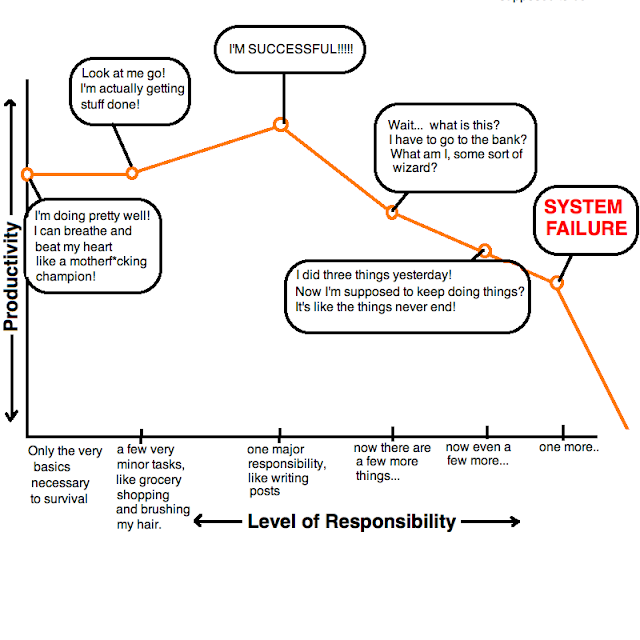
It's not lack of maturity to want to avoid all this crap... it's actually a big time sink and not anything that will get you anywhere in life. It's important to get done but as soon as you can you should pay someone else to do it. However, putting it all off to surf the internet is also the wrong approach. I look forward to the day when I'm rich enough to pay someone else to read hacker news and post comments for me.