"Thinner phone" is a stupid requirement. A thinner phone will be mechanically weaker.
Yes, Apple retired Floppy disks and DVD readers, because those were replaced by something better. This is not the case here.
A Bluetooth headphone will give you an inferior experience. A lightning converter will give you a worse experience because I can bet it doesn't stay plugged as firmly as a headphone in a high vibration situation (e.g. people exercising) and you can't have the charger plugged while you listen to music
Just as a reminder it was the EU who ended the BS of every company having a stupid proprietary charger.
I agree with the bluetooth being inferior, I hate that the standard headphone jack is going away. If it isn't broken, don't fix it.
That said I've been told that the 3.5mm jack takes up a surprising amount of internal space, and that between freeing up that space and a few other tweaks, getting rid of the jack substantially boosts battery life. Still, I think it's not a great trade-off, now you have to babysit a new battery in your headphones, which probably won't last a full day of use.
On a personal note, anticipated lack of a standard headphone jack is one of the reasons I upgraded to a 6S recently, this way I'll have the best 3.5-mm phone Apple made for a while. If I do have to upgrade later on, I'll be strongly tempted to get an SE instead of a higher end phone, as long as it has a 3.5mm jack.
> getting rid of the jack substantially boosts battery life
Yes, as you say, by moving the power draw for the DAC to another device, which must be charged separately. This isn't a real gain in battery life in any way.
Most of the people I know use the internal speakers on their phones extensively, and hardly ever use audio over either Bluetooth or the 3.5mm jack. In this case, how would battery life be improved. The DAC and amplifier cannot be removed unless the on board speaker is also. I hope this is not the case.
The only people I know who don't use headphones are both teenagers and reviled by the people around them. If what you claim is the case, public transport would be a wasteland of pop music and clash of clans sound effects. I highly suspect your friends aren't representative in the least of the general population.
I use the phone's internal speakers to play music in the car. I would use the audio jack for that, except that cars no longer seem to come with any way of accepting an audio cable. My car from 2002 had a tape player, and I was happy using an audio cable with a casette tape adapter on the other end. A car from 2015 just can't do it. :(
I also use the phone's internal speakers for playing the notification sound. (And, technically, ringing.) I sure hope that's not going away.
Micro FM transmitters. Plug into the 3.5mm jack, power from the cigarette / accessory adapter. Usually a choice of frequencies to broadcast on which can be picked up over your car's FM receiver.
Quite frequently found at highway truck stops, though almost certainly other electronics stores as well.
Plus, they're crap. Seriously. I bought one of the more expensive ones, with auto channel scanning, still crap. Made me go back to burning CDs until I put an aftermarket stereo with 3.5 mm jack in. Fortunately that's a near-universal feature these days.
Doesn't your car have Bluetooth? Or rather: how old does a car have to be before it doesn't come with Bluetooth as standard? Every rental I've had in the last five years has had Bluetooth to my recollection, and I don't hire expensive cars.
As pointed out elsewhere in the thread, bluetooth is not a good solution when you want to use one speaker (the car) with several devices. The beauty of a cable is that it's unambiguously connected to whatever it's plugged in to, and not to anything else.
I recently had the joy of having to delete a paired device in a car before I could add a new one. For some reason you could only have three devices paired.
Does your car have a USB port? If it does, it might speak iAP to play audio through it. If it doesn't, you can always replace the radio and get some more inputs.
Bluetooth's more reliable than USB in a car anyway.
It's always possible to add a battery. That's not the problem. The problem is that we have a passive device, headphones, that works well and are a stable and mature tech, that will become crap.
I dont want to charger yet another device in my daily routine. I won't, actually, and will steer away from any phone that requires active headphones to work.
I have a phone with a headphone jack, and I'm using Bluetooth headphones for hours every day. The headphone battery lasts a lot longer than the phone. In the past few years even audiophile brands have been releasing blueooth models and they are getting good.
I'm not saying I agree with getting rid of the headphone jack. The amount of utility it provides is pretty high relative to the volume it takes up.
I just got the One Plus 3 which has the USB3 type C and the 3.5mm jack right next to each other and I have to say the jack is only slightly larger so I don't see the point of replacing it.
Oh and it felt too damn thin as it is I was constantly wary I would accidentally bend it or scratch the metal casing so i got a rubberised cover. Now it feels a lot better to hold.
Yeah, that's my personal pet peeve too; if, instead, we had that kind of armor built into the device itself, it could still be pretty thin, durable, have a 2-day battery (which would be a one-day battery at the end of 18 months of daily usage), and fit a 3.5mm jack no problem. Instead we get a super fragile bendable piece of thin aluminum (which is not known for being very rigid in such gauges, especially with so many holes around the edges) and glass, which we are expected to never drop onto a hard surface or get wet. This would be fine if we all lived in the desert away from rocks and bodies of water, but instead, in most first-world countries, we spend the majority of our lives surrounded by hard things and wet things which don't play nicely with these now-ubiquitous devices.
They ship the phones with a small adapter that goes from micro USB to lightning. You're allowed a proprietary port into the phone as long as you provide the adapter for free.
Except for the fact that people have torn down their electronics accessories and found them to be significantly higher quality than the crappy ones you can buy for $5.
Better components, better design, better safety,
and better assembly. Plus then you have to package and ship the things.
People complain about Apple selling $20 accessories, then turn around and complain about working conditions in Apple's suppliers like Foxconn (despite Apple doing far better on that front than their competitors).
That link's about power supplies, where there actually is a significant difference in component quality. A lightning to microusb adapter doesn't involve voltage shifting or anything else that's super problematic. About all the lightning connector does is introduce lock-in.
The EU did, here's some background[0]. As for Apple, they didn't 'get away' with anything as far as I can tell. While iPhones are very popular, they make up well under 20% of the global smartphone market. It's a bit early to say standard headphone jacks are obsolete, but the notion sure does generate clicks and catchy headlines.
You may think that the current iPhones are thin enough, but almost nobody actually uses the phone on its own. You need to take into account the thickness of the case, and now that people are playing Pokemon Go, it really needs to be a battery case, which is even thicker. So the base phone needs to be thinner.
(They can't just make the phone a little thicker and put the extra battery inside it because reasons.)
Doesn't need to be a battery case if they design a phone with a replaceable battery, like every phone I've ever owned (after iPhone 3G, which was more or less the only option at the time).
I'd say bluetooth is good enough for using the device(s) as a phone - but a jack might be better for connecting a high-end stereo system. On the other hand, even for that, you would probably be even better off with a digital output, and a good DAC (either in the amplifier, or as a separate unit).
and I'm very happy (not for use with an Apple device though, I use it with a Sony Xpedia Z3+, my laptop and my desktop via a recent generation usb bluetooth dongle (for AptX support).
iPhones and Macbooks support aptX now. Surely this isn't just a hardware change — once Apple discloses the details, it won't be at all surprising if aptX Lossless (at minimum) is required for MFi licensing going forward.
FWIW, the transcoding you mention isn't a requirement of Bluetooth audio. MP3 and AAC bitstreams could be delivered straight to headphones for decoding there. We don't yet know if that's something Apple is discussing with MFi program members.
Yes, there are better codecs than the defaults. Now go to the specifications page for a random popular bluetooth audio device, and see if they even list which codecs are supported. If by some astonishing miracle they do say so, then work out which codec they would use with a random popular mobile device. It is all theoretically possible, but in practise regular folk are going to have a hard time!
I looked up recommendations for Bluetooth devices at Wirecutter and then went to the relevant tech specs page:
Mentions "bluetooth" (sometimes a2dp) and no more:
> Now go to the specifications page for a random popular bluetooth audio device, and see if they even list which codecs are supported.
That's an excellent point.
Sadly, I don't think the average consumer knows or cares about the badness that is lossy-to-lossy transcoding.
For those who do, aptX support is pretty easy to find in the sense that vendors tend to make "aptX" searchable in the name and/or description. (If you Google "amazon aptx headphones", you'll see what I mean.)
Finally, this is a great example of how Apple gets to "own" the mindshare for tech they don't invent. If Apple decides to hang their hat on the aptX brand for the iPhone 7 launch, that'll be how most people hear about it for the first time. Since aptX isn't their brand, it's more likely that Apple will simply tout "perfect wireless audio" and make sure customers know to look for "Made for iPhone" headphones.
I have to recharge my phone too, if I forget my phone at home I can't get a replacement for cheap, and after the initial setup, Bluetooth is easier than plugging in headphones.
It's easier if you have one device. It's easier to avoid getting tangled up.
It's harder if you want to listen to something on your laptop for a minute instead or on the phone. It's also harder when the phone is in your <front/back/just the wrong> pocket and because it's just in the wrong orientation for the BT to work your audio cuts out.
Recharging the phone and the cost of the phone are the things that are not going to change, regardless of what happens with the headphones, so I'm not sure why you're bringing it up.
> Bluetooth is easier than plugging in headphones.
Until it isn't, like needing to re-pair the devices, keep them charged, switch between multiple devices, etc. It's a hassle that I don't want to have to think about. I've got bluetooth headphones, but I never use them because they're a pain in the butt (and don't work with everything I want to use headphones with, anyhow). I don't understand people that are for removing functionality from their devices.
For me it's actually the opposite. I have small high quality headphones that I can forget in a pocket. I always have them on me, and they work on all my devices: iphone, ipad, laptop, work desktop.
My iphone losing the audio jack would be a major inconvenience. I would have to carry multiple headphones, and also potentially bigger headphones since they will need to do more (blutooth, DAC, etc). Frankly, after having owned pretty much every iphone and ipod model since the begining, I will most likely be looking for an alternative.
Same here. I've never lost a phone (knock wood), but have lost any number of sets of earbuds (also charging cables, wall warts... basically anything that isn't permanently attached to the device gets lost).
Point me to a nice BT sweatproof headset that also has decent enough mic to use for Siri and conf calls.
I've been through 10 BT headsets and the Apple EarPods are still the best and most flexible all-rounder. It's the equivalent of the inexpensive DSLR walkaround lens to me.
Can everything on the phone be rolled up into a taquito shape? Oh, 99% of all silicon chips are rigid, not flexible? Oh, bummer. I guess that'll take some serious semiconductor fab breakthroughs before it happens.
To use a 3.5mm jack headset you need to add power amplifiers inside the phone, do proper impedance matching and hope that noise in the path does not corrupt the data. But sending power and digital data solves all these problems, the wires don't need to be as well made either!
But the noise susceptible analog signal does not have to travel a long path, digital signal does. As such the power amplifiers do not have to be as power consuming/over designed. Moreover, you can do other stuff with the headset like taking multiple button inputs without additional wires.
"If you look at the previous generation of phones, things like Nokia phones, you had to have an adapter," he reasons. "If you want to connect headphones to professional equipment, you also need a professional adapter."
No, this was (for the most part) an anomaly. (Sony loved this crap.)
And the "adapter" you need for professional gear costs all of .25, unless you want to plug your headphones into BNC, then it's maybe 1$ in parts and 15 minutes at your bench.
Funny thing. My old sony-ericcson phone was the first that came with a hands-free that had a separate minijack above the mic, so you could use any headset with the (wired) handsfree (and it also had a standard "long" minijack for control+mic+output).
Sony made a couple of brilliant mp3 players with proper line out for a while - until Sony Music got upset about "piracy", and apparently the ensuing battle within Sony killed a lot of great products. Which turned out to be a net loss, as was obvious to anyone - it happened that Apple took the marked with the iPod, but it was obvious someone would).
If they are moving to a paradigm where I can't listen and charge at the same time, the 6 will be my last iPhone.
I wish they would stop trying to shave millimeters off my phone thickness and address actual user needs like battery life. When was the last time any of you said, "Damn, I wish this phone was thinner!"? Probably never. But many of us regularly bemoan the battery life of our devices.
I think users would be happier day-to-day with a larger battery, but in the ATT showroom they are more likely to go for the thinner phone with a small battery and no headphone jack.
For me the only thing that would make eliminating the headphone jack worth it is if they put a lightning jack on both ends and made the phone perfectly symmetrical. With literally no top or bottom, no right or wrong way to hold it, and finally a way for my phone to sit in the cup holder with a charge cable coming out the top and maps showing in the right orientation!
The trick in making all this work of course is what you do with the rest of the buttons. If Apple could come up with something truly better than what we have had all along for lock, volume, silent, and home, that would be really neat.
In other words, I can see justifying removal of the jack as part of a holistic redesign which really evolves how we interface with the device. Removing it to make the phone just a bit thinner would be disappointing.
I agree that two ports would make me a lot less annoyed by the change, especially when you can keep an adapter around for one of the ports.
But from experience, designs where the charging and audio ports are on opposing ends are pretty annoying in practice, because the two cords restrict how you can move the phone when it is charging and headphones are in use. Apple stopped doing it that way several years ago.
Your only other choice is a single port on one side. There's no way you get two ports side-by-side on one side. So your point is well taken, but the existing setup of charge and audio together on the same side would be gone no matter what.
I think the choice is eliminate the port and don't allow simple charging while listening without a weird adapter, or else you need two lightning ports.
What will be funny is the power cords which have a 3.5mm jack embedded in them. Take the jack off the phone, move it a couple inches away. It can be made very streamlined, doesn't have to be bulky. The possibility of a good power/jack cable makes me think they won't actually pull off a radical redesign, but I'd be so glad to be proven wrong, just to see something different from Apple.
While working on mobile phones, I've found a number of problems with the TRS style jack.
One is they trap lint internally, which can often result in the internal switch that detects insertion permanently thinking there is a headphone in it (Google "phone thinks headphones are in"). The external speaker is usually muted when a jack is inserted, so when this happens, the phone doesn't make any sounds. Lint is very difficult to remove from the outside the connector.
The other problem--which the original inventors couldn't have anticipated--involves the hook switch (hangup button) on wired phone earbuds. The switch usually works by shorting the microphone to ground. The problem is that, because of the geometry of the plug, the microphone is also shorted to ground while the plug is inserted or removed. To avoid erroneously interpreting insertion/removal as a hangup, the software must wait for the button to be held for around a second. This precludes doing other interesting things with the button, like having double clicks, or clicks with different durations perform other functions. It also feels a bit awkward to have to hold it for so long.
I've owned my current phone for ~4 years, and the first port to stop working — due to lint — was the USB port, not the audio port.
> Lint is very difficult to remove from the outside the connector.
Removing lint from a 3.5mm audio port is going to be vastly easier than removing it from a USB port (which is completely possible). The entrance is much wider, and you don't have to worry about damaging the connector thing that USB has in the middle, as it doesn't exist. I've even removed a silica gel ball (which are apparently about 3.5mm wide …) from an audio port (and needed a paper clip to crush it first). I'd not want to try the same thing on a digital USB or lightning port …
Lightning wouldn't be any more difficult than an audio jack — I'm not sure why you think it would be. Agreed that USB would be a nightmare, but thankfully that's not really a plausible scenario for an iPhone.
I think Apple did this too late. If they had done this with an earlier release where smartphones were still "advancing" I think they would have gotten better conversion.
Now what can they possibly offer in the next iPhone that offsets the loss of the headphone jack? Wireless headphones are just not all the way there and I don't really want to have to think about charging another device and then get mad if I forget to charge it then have nothing to listen to for the day.
Unless they offer something substantial with the next iPhone and assuming the headphone thing is true, I probably won't buy another iPhone.
The BBC failed to mention that there is also a 2.5mm jack available. Quite a bit smaller, but I haven't seen one for a while (~5 years).
After replacing so many headphones because of cables breaking, I'm really happy Bluetooth headphones. Although when I want to enjoy music, you can't beat decent headphones with a half decent soundcard/ DAC.
It's not quite 19th c. technology. It was .25 inches, but it had only two conductors, the tip, and the ring, separated by an insulator. Hence the "tip" and "ring" nomenclature for analog telephone wiring. Analog phone technology is remarkably back-compatible. You can use an 80 year old phone today. Not many, if any technology products could claim that level of compatibility.
But, so what? Analog phones are going away. They just lasted longer than most other technologies. So should codecs and amps inside of mobile devices. Those things belong with the transducer, so they can be tuned to the characteristics of the transducer.
The original 1/4" phone plug for switchboard use had a ball tip, rather than a pointed one. It's almost compatible with modern 1/4" jacks, but the proper jack is a "long frame telephone jack". I use those with antique Teletype machines. Unlike 1/4" audio jacks, the ring is not a ground, and the shell is always insulated.
One of the most backwards compatible technology I know of is railway signaling infrastructure - altough it's not a consumer product like a telephone:
There are still fully mechanical control centres where you have to switch the switches by hand and turn a crank (to generate a bit of AC) to signal another control centre the current state of your tracks. Doesn't matter if the next station uses relais-logic or computers, it works.
Speaking of railways, and connectors, the railway couplings in the US are another thing that's withstood the dest of time. The Janney railway coupler is compatible with couplers built 100+ years ago, and of a design dating back to the 1860s, with the refinements pretty much all been making individual components more and more standardized.
> So should codecs and amps inside of mobile devices. Those things belong with the transducer, so they can be tuned to the characteristics of the transducer.
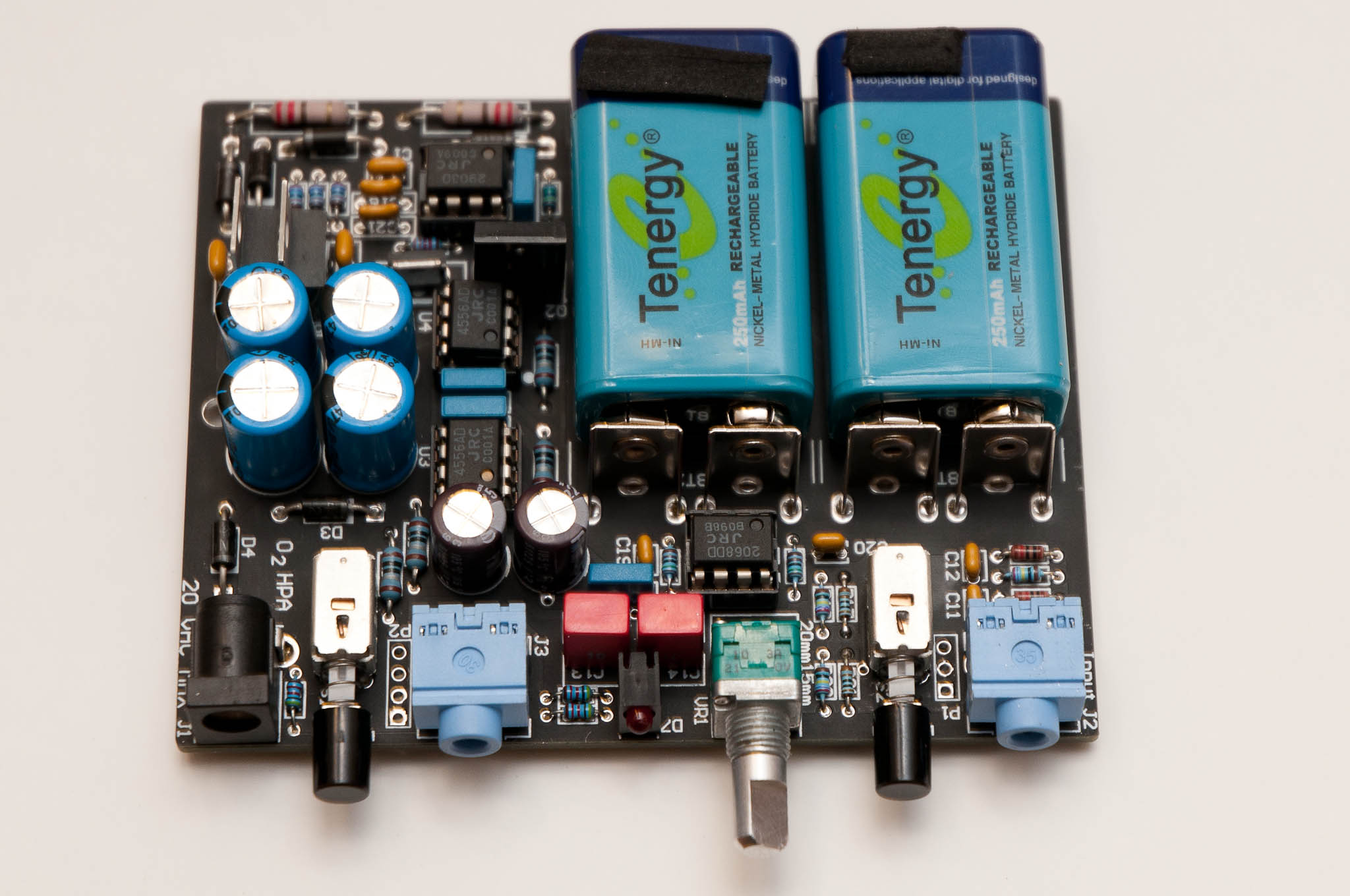
Amplifiers/DACs are not simple devices that can be crammed into a pair of headphones without significant compromises in audio quality. The DAC in an iPhone is acceptable for most uses but an amplifier requires a fairly large quantity of discretes and a large power source to drive many headphones. Here are some pictures of the inside of a minimalist audiophile headphone amplifier (Objective2), and with the DAC daughterboard added:
Furthermore, if the DAC/amp are internal to the headphones then the headphones themselves become significantly more expensive. For high-end usage most users will want to use their DAC/amp with multiple pairs of headphones, it's cost-ineffective to have a $200 DAC/amp unit built in to every single pair of headphones. Consumer gear is also cheaper, but you're still talking about the difference between a pair of headphones costing $30 and costing $50.
Also, there's not really any consensus on what "proper tuning" actually means with headphones. Some people like an absolutely flat "reference/analytical" sound, but this is only a small subset of high-end users, and consumer gear is not tuned anywhere near a flat response curve. And it's a highly perception-based area where different individuals hear totally different aspects of headphones, with a high degree of placebo effect.
The long-term fix for audiophile users is probably going to be to move to external DAC/amp units rather than integrating the DAC/amp into the headphones. This means yet another thing you have to carry around and keep charged (my Fiio X5ii lasts maybe 6-8h on a charge). I'm not currently aware of any that use Lightning, but if there's a market they will eventually exist. Consumer users probably won't care about the negative impacts on quality too much, but rather about how Lightning headsets are now going to be quite a bit more expensive.
Headphones have a lot more room for electronics and than do phones. Even a small volume-control module in line in an in-ear headphones would have a lot more room than is currently used by the audio circuitry in a phone.
> The long-term fix for audiophile users is probably going to be to move to external DAC/amp units
That's the current solution for audiophiles, and digital music connections, wired or wireless, will support this better.
I like that the 3.5 mm connector is fairly simple and is does not break easily.
I have seen many broken micro-usb connectors, and a couple of broken lightning connectors.
I cant remember ever seeing a broken 3.5mm connector, the cables break before the connector.
Do i want a thinner phone? No, i want a phone with better battery life. Like phones had back in the day(2005) a week or two was not uncommon.
When for some reason, my bluetooth headphone's connectivity is acting up (happens often), I can take my wired headphone and plug it in without even looking, knowing that it WILL work.
One of my car's electric windows has stopped working. For my next car, I want something where there's a fallback to a mechanical crank (the way car windows used to be).
I've had cranks fail in a variety of ways too. The fix is the same as for the electric ones: open the door panel and repair/replace the failed component.
I'm just old enough to remember cars with mechanical hand cranks to open the windows. You couldn't open the passenger side window if you were driving. It was dangerous to open the driver's side window if there was a lot going on. The rear passenger windows often didn't open at all in cheaper cars. The number of times you'd leave a window open by mistake was far higher because cars didn't alert you about it.
I'd much rather have electric windows that are cheap and easy to repair than reintroduce hand cranked windows, even just as a back up.
I drive a car with hand-cranked windows and I don't have any of those problems, maybe just cause I'm used to it? Did you know you could go out today and buy a 2016 model car with manual window cranks? It's still an option on a lot of vehicles.
Elon Musk: if you're reading this: if you put a manual window crank option in your cars (especially as a fallback in case the electric window fails), that's what I'll buy.
My last 2 cars have had manual cranks. One of them is only 20 years old, so I think most people are probably old enough to remember cars with manual cranks.
Can't say I like them any more or any less than electric windows to be honest. Six one, half a dozen the other.
They're definitely better for 4-wheel driving (not that my car can do that) though, because if you flood your electronics, you can still wind the windows down. I had a friend who ran into trouble when the truck he was in flooded, and he was in the back with the windows up. So there's a definite advantage to manual windows in certain circumstances.
It's absolutely unsafe to handcrank windows while driving, but when is that ever needed? I long for my old hand-cranked-window MB 200D days when my newer Toyota has 3 failed electrical windows out of four. And it's costing so much I only fixed my/driver side window.
I miss hand-cranked windows. Would love to have a dual system so you can easily open the windows with the electric power off, and as a backup.
I also miss the old quarter glass vent windows that cars used to have on the front doors.
How is USB-C working out as a connector, from the ruggedness standpoint? It has a huge number of pins (24) in a small space. How many insertion cycles can it survive in the real world? Is connector wearout going to limit phone life?
That's over 13 cycles/day for two years. Probably fine for most users.
Edit: The official spec is only available via a zipped folder of PDFs, here's the particulars to save readers the effort.
  5.7.1.3
  Durability or Insertion/Extraction Cycles (EIA 364-09)
  The durability ratings listed in Table 5-16 are specified for the USB 3.1 connectors.
  Table 5-16. Durability Ratings
  Connector   Standard Durability Class               High Durability Class
  USB 3.1     Standard-A connector 1500 cycles min    5000 cycles min
  USB 3.1     Standard-B connector 1500 cycles min    5000 cycles min
  USB 3.1     Micro connector family                  10000 cycles min
  The durability test shall be done at a maximum rate of 200 cycles per hour and no physical damage to any part of the connector or cable assembly shall occur.
13 cycles/day doesn't seem hard to hit. I have a charger at work and keep my phone on it when I'm at my desk. So right off that bat I'm at 2 cycles/day from going to work and coming home from work. Another for lunch.
Whenever I leave my desk, I take the phone with me so that the Health app can record steps and distance. Thus the phone comes with me on bathroom breaks, so that's a couple more.
I'll go talk to coworkers down the hall a couple times a day, adding a couple more cycles.
Every 30 minutes I get up and take a stroll around the office to mitigate the effects of sitting too long [1]. That's another maybe 10 cycles.
That's 17 cycles/day on work days, assuming no more cycles at home after work.
If I manage to have 6 more cycles at home on weekends or after work on work days, that will be bring my average over the week to 13 cycles/day.
So the same as micro-USB... which is not very good in my experience. No-way near 10,000 cycles anyway. Something like half of my cables fail within 1000 cycles.
The original 30 pin Apple connector wasn't bad, but when I looked at the new lightning connector I thought it would be a clear improvement. But now I'm not sure.
Lightning pins are quite small. I find my devices don't always make good contact. I find black stuff (oxidation?) building up on both pins and sockets.
Compared to lightning, USB-C just "feels" like it will be much worse. I predict it will be a disappointment in the real world (as most connectors turn out to be).
It is much worse. I've had a 2015 MacBook, a Razer Blade Stealth and a OnePlus 3. The cables are fragile and prone to breakage, the Razer's USB-C connector literally comes apart and all three of them have had pairing issues forcing you to pull the cable out and swap it around hoping it will actually connect.
I've not been surprised to see how slow the adoption of USB-C has been because I think it's obvious to insiders that the reliability issues are real. The shame is that when it works, it's great.
The reason why this obvious option isn't part of the discussion is because thinness is just the smokescreen. The real reason Apple et. al. want to move towards digital connections for headphones is DRM. They want to control the entire signal chain of their valuable (Beats = $3b) music content.
This is the sort of thing the market will sort out anyways. If there is enough of a market for people who don't care about the 3.5mm port, apple will be fine. People like me will buy something else. Just because apple doesn't have expandable storage hasn't made samsung discontinue it either. Same deal with the headphone jack.
While I'm with you and won't be buying one for reasons beyond the 3.5mm jack (but that would be a deal breaker if I was on the fence), I'll be more surprised if the removal of that feature stops scores of people lining up to get the latest phone (along with a new set of over-priced headphones).
At the end of the day, it's "give up the 3.5mm jack" or "don't get the latest iPhone" and I'll wager that they'll have no problem generating lines filled with people that just have to have the iPhone 7 because...Apple! Apple has a near-religious following. I got a kick out of a friend of mine who upgraded on release when they ditched the 30-pin connector. He'd recently purchased an alarm clock, an add-on for his home stereo and had already owned several other 30-pin reliant bits. They were on eBay the following week. Out of the non-techies I know that purchased the iPhone 6, none of them could tell what, specifically, they were getting over their existing iPhone 5S (that's a grand-anecdotal-total of 3 folks, though).
If there is resistance on this release due to there not being enough compelling features, that resistance will eventually give way. Many people are so wired in to Apple's products that lock-in will win. Maybe they'll wait until the 8. But eventually Apple will be making money on sales of ear buds with Apple-only connections and will benefit from yet another component that locks them into their platform. And the folks who spend $200 on supposedly high-end ear phones[0] will now feel even more compelled to stick with Apple's product line.
I'm biased and this is a little overly cynical. I've never owned an iPhone and the two Apple devices I've ever owned: an iPad that belongs to my wife and an iMac that I use as a display (target display mode) because, at the time, it was a little less than a comparable "screen only" device with similar specifications (and it was physically prettier, to boot). I've not logged into it, directly, in two years and don't really get the appeal of OSX.
[0] I've never understood this. I have a pair of 25 year old studio headphones (AKG, 1/4" jack, big, over-the-ear with a very long cord). I needed them due to equipment and was sicked that they ran 10 times the price of a pair of solid headphones, but I was amazed by the quality they produced. I didn't want to buy these, but after 25 years of heavy use (and the manufacturer still makes the model I purchased), I can't say I feel bad about the price. The Beats/Bose headphones? I can't tell the difference between them and a pair of $30 active noise cancelling headphones I purchased from Big Lots. Granted, I can't plug my AKGs into a phone even with an adapter -- they're too quiet.
The worst is that the apple-issued headphones are and have always been absolutely crap. If fact in public transports when you hear the loud music of a fellow passenger, it is almost always the crappy, leaky headphones that come with the iphone.
If I ever buy an audio jack free iphone (god save), the last company I will purchase headphones from is Apple.
I'm sure they are fine for $15 headphones and the reviews judge them accordingly. And then go back to using IEMs that go for 10x the money. Most of the reviews specifically mention the fact that they lack isolation, making them a pretty bad choice in public, for your own and everybody else's benefit.
My neighbor at work listens nearly exclusively to country music, using Apple buds. I was actually concerned for his ears, until he demonstrated that it was just sound leakage. Now I'm just concerned for my own ears.
> it received complaints that the headphone jack was sunk into the casing.
I had forgotten that. I paid $12.99 for an adapter that shouldn't have been necessary. I expect with modern times, the Lightning-to-3.5mm adapter will be twice the price, and just as unnecessary.
"Studying Moore's Law and the history of technology, it's clear we're not going to stick around with something analogue for long"
Dediu didn't study the basics of sound reproduction, which are all analogue. All the fancy ones and zeros end up in a stupidly innacurate shaking paper cone. Ignoring a few esoteric exceptions, that's the best that we've got.
When I use my iPhones for music (currently have a 6), I use one of two headphones:
- Plantronic BackBeat Pros
- Westone UM4r
The BackBeat's are great wireless, noise reducing over the ear headphones. I need to remember to charge them.
The Westone's are in ear monitors that, depending on type of bud you put on them, have noise reducing capabilities. They are wired. They are also some of the most amazing monitors I've owned over the years. (It hurts the time I lost a pair).
Sitting in a quiet space, the Westones will blow the Plantronics out of the water. In a plane, if I am not trying to comfortably sleep, the Plantronics are great. If I want to lay my head to the side -- IEMs rule the day.
Apple has yet to produce a set of headphones that feel comfortable for me or deliver decent quality. I can't bike/run w/ Apple's headphones, they fall out (or hurt).
If they go the route of no 3.5mm jack, I'll likely insist on one of those stupid converters.
I've yet to see anything from Apple or Beats that compares to upper end IEMs for quality, or upper end over the ear phones for noise reduction.
> "Studying Moore's Law and the history of technology, it's clear we're not going to stick around with something analogue for long," he says.
The real world is still analogue, and as long as we have biological brains there will need to be a digital to analogue conversion somewhere to interface with it.
Phone manufacturers might want to move that conversion out of their devices, which is understandable because analogue electronics is expensive and good quality even more so, and that change would make it someone else's responsibility.
In the end if this does go through it might not be totally a bad thing if the new digital connector is also a standard (and provides power, I might add). That way it would be possible to get a good quality DAC and reuse it everywhere.
In 1997 they had a proprietary Apple plaintak 3.5mm connector that was longer. In 2009 they moved controls from the shuffle to the headphone to force their thing again. And this is just on one plug.
They are the company of proprietary hardware and this is how they play.
that gen of Shuffle was a disaster and then they redesigned the little square one to make it better. Imo the Shuffle as it is now is one of the best devices ever designed.
What it should have read: Phone manufacturer (among which Apple with its popular iPhone) are starting to bring mobile devices without the omnipresent 3.5mm audio jack.
I don't understand the angst. Have an existing iPhone - keep it! Apple isn't going to send the earbud police to your house to confiscate it. Buying a new phone - buy an Android phone! Am I missing something here?
This is a lot of fuss over nothing. Of course there will be an adapter. Maybe not the most elegant thing in the world, but it's not as though millions of headphones are suddenly going to become useless.
Criticizing Apple for deciding to remove another port, is really shallow and superficial way to spread FUD (Fear, Uncertainty and Doubt) against this large corporation.
Just so we are on this page, you will _still_ be able to connect 3.5mm headphones to your iPhone. You will just have to use an adapter.
There are benefits for removing this port:
1. It frees up internal space.
2. It makes outer design more robust, simpler and cheaper for production.
3. It makes the phone lighter.
4. It allows you to make iPhone thinner.
5. You have one less limitation to account for when designing new iPhone.
6. You waste less materials on cables and oversized jacks made out of metal. I really like how article says that there will be lots of cables wasted from this. Well, so what? Should we stop all innovation and keep all standards forever the same so there is no waste? Ideally we should move on to smallest possible ports and most efficient standards. We can get there with tiny steps, and that will include throwing away legacy things.
7. It's easier to make phone waterproof when you have less openings.
In addition to that, lightning jack is superior to microUSB and other jacks, because you can insert it either way. It also has magnetic functionality that the other jacks lack.
Finally, for me as a customer, this change does not bring any problems either. I may have to spend $20 more for adapter. But if the phone costs $500, this change is insignificant.
Companies in the audio industry might have bigger problems from this, but it's their problems, not mine.
I am seriously surprised that BBC would be posting useless crap like this. Could it be because there is a lot of money to be made from shorting Apple stock and then releasing anti-Apple propaganda?



Yes, Apple retired Floppy disks and DVD readers, because those were replaced by something better. This is not the case here.
A Bluetooth headphone will give you an inferior experience. A lightning converter will give you a worse experience because I can bet it doesn't stay plugged as firmly as a headphone in a high vibration situation (e.g. people exercising) and you can't have the charger plugged while you listen to music
Just as a reminder it was the EU who ended the BS of every company having a stupid proprietary charger.