He didn't write that wind power doesn't make sense for the United States. He wrote that it doesn't make sense, period. You just put words in his comment, then used the words you invented to dispute me instead. I loathe when people do that. You might argue that contextually, given the comment he was responding to, I should have inferred some kind of Americentric context but he goes on to write "nuclear power is better," so there you have it.
You might see that as pedantry, but since I'm an American I'm acutely aware of how Americans like to say "that would never work" when what they actually mean "that would never work for Americans." The United States is enormous and the #1 consumer of electric energy, yes, and we need to plan accordingly. That doesn't mean ideas are bad in the general, it just means things won't work for us due to our size, as you astutely observe. Google could never scale PostgreSQL to handle their index; does that make PostgreSQL silly? You're automatically writing off all future development that you could never possibly know when you dismiss a technology because it doesn't work in one case.
I like to use every opportunity I get to point that out, so my fellow Americans will stop doing it and making us look like self-absorbed, spoiled people internationally, an assumption reinforced by our general diplomatic and military behavior on the world stage.
Calm down. No one put words into his mouth. You, however, did put words into my mouth, which I find quite astonishing.
Those windmills currently cover 1 million people. The world has 7 billion people and growing quickly. You really think windmills are feasible for Brazil, China, England, France, Germany, Russia, India, Pakistan, Vietnam, Iran, Japan, Mexico, Indonesia, South Africa, Spain, Argentina, Turkey, Colombia, Ukraine, or South Korea? (I can list several more if you want.)
I am quite calm, and I never wrote that anybody did.
> You, however, did put words into my mouth, which I find quite astonishing.
I think you need to look up what "putting words in someone's mouth" means, because I did nothing of the sort.
> Those windmills currently cover 1 million people. The world has 7 billion people and growing quickly. You really think windmills are feasible for Brazil, China, England, France, Germany, Russia, India, Pakistan, Japan, Mexico, Indonesia, South Africa, Spain, Argentina, or South Korea?
If power consumption had any sort of meaningful relationship with population, I might consider your argument remotely plausible. You're basing your entire argument on the flawed assumption that power consumption scales linearly with population. It doesn't, and you have reading to do[1].
Just as one example, the United States is the world's #1 electric energy consumer, beating both the whole European Union and China, but China has more than quadruple our population. As another example, India's population is quadruple ours, as well, yet about one-quarter our electric energy demand[2].
This is completely economically illiterate. China is a developing country. As a result, it uses less electricity than its developed counterparts. As China grows, it will be using much more electricity. Just look at their energy consumption trend since the late 70s. That applies to India, Russia, Indonesia, and any other developing country in growth mode.
Oh, and guess what. China passed the USA in energy consumption in 2010.
> As a result, they use less electricity than its developed counterparts.
It's almost like that's valuable information when we're discussing an electricity generation technology. You wrote this without qualification in terms of what you meant:
"Those windmills currently cover 1 million people. The world has 7 billion people and growing quickly."
I replied to exactly that, and you're calling me economically illiterate for pointing out the economic illiteracy in your original comment? You cannot be that stupid. There is absolutely no way. You have to be a troll.
> China passed the USA in energy consumption in 2010.
Total energy consumption, notably oil due to the sudden increase in automobiles in China since the 1990s once private citizens became able to own automobiles. China currently builds more automobiles than all of Europe, because demand is absolutely through the roof. So it would make sense that China passed the United States in total energy consumption rather quickly. We're discussing electric energy, remember?
You cannot be that stupid. There is absolutely no way. You have to be a troll.
I think it is more likely that you simply misunderstood the point he was trying to make, which is that the growth curve[1] matters.
We're discussing electric energy, remember?
You're right to point out the demand for automobiles in China, but that has a great deal to do with rapid urbanization and economic growth, which has had a similar effect on electricity consumption.
There's no reply button for me underneath your threads initially until some time passes. I guess that's how HN works for some. I'll respond to your latest comment here.
> If you say things like "we have a lot of people, so wind power won't work for us,"
Don't you just hate it when people put words into your mouth? Yeah, point me specifically to where I said or implied that.
tiredofcareer, thanks for calling me stupid. This conversation has surely turned professional. It's quite funny when you espouse economically illiterate statements, then question the intelligence of others.
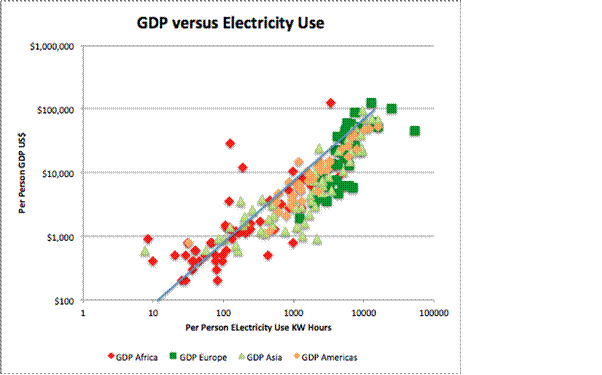
Electricity consumption depends on GDP. Just google those phrases, and you'll find a plethora of sources to confirm the relationship. I listed a graph for you [1]. Because China is growing at 7%, its electrical consumption will only continue to increase. Yes, if two countries of have similar GDPs, the one with the higher population will consume more electricity.
The US would require roughly the same amount of windmills per capita as Denmark. (There's a chance that the average Dane uses less energy than the average American, but I can't be bothered to look that up...)
The cost per capita in the US would be about the same as in Denmark. Probably less, due to economy of scale.
"As advances in turbine technology allow areas of moderate wind resource to be developed, more than a tenfold increase in the wind energy potential is possible. These areas, which cover large sections of the Great Plains and are widely distributed throughout many other sections of the country, have the potential of producing more than three times the nation's current electric consumption."
If 5 million Danes can afford to build X windmills, I don't see how 60-ish times 5 million US citizens can't afford to build 60-ish times X windmills.
Population density would be an argument (on average, higher population density means less wind power per capita), but there, New York probably has more land area nearby than Denmark.
Yes, but Danes are quite prepared to pay 25% VAT and up to 62% income tax so that among many other things, The (evil statist) State can afford to buy hugely expensive turbines from Siemens just to avoid giving money to Arabs. And those loaded Norwegians.
Americans, apparrently, while in huge numbers, in thrall to Rand/Objectivism and the Kochs, are not.
It doesn't make much sense to just compare the two countries by raw population numbers. Denmark has a population density of 130/km2 (or 336.7/sq mi), which is obviously vastly less than NYC, but almost 4 times that of the US. If Denmark was a country with enormous amounts of windmills and small pockets of actual humans, this wouldn't be much of a feat. But for a relatively densely populated country, it seems worth noting.
Though if you actually need land proportionate in size, and with the geography of Denmark - so flat that the highest point is no more than 171m - to service 300 million people, you might be out of luck (I don't know how much of a role this plays).
Lawyers are a bad example as they don't run on profit based accounting, typically. More of a fee for service arrangement. There do exist some lawyers with for-profit side businesses, or solely work for a for-profit business, but they're probably outnumbered by law firms + sole proprietor service provider + employed by non-profits + employed by .gov
There is no obvious reason other than tradition and cultural goals that a lawyer has to be paid $200/hr instead of $20/hr, ditto no reason a postdoc biomedical researcher has to be paid $30K/yr instead of $300K/yr. The supply of STEM grads is too high leading to low pay and the supply of lawyers is too low leading to high pay, but if you can convince the kids to select different majors, go ahead.
We live in a central govt controlled economy. If you have control of the government, which we probably don't, then you can also select the priorities.
It also has the assumption that profit is the only reason why people work. Simple salary arrangements work pretty well for most people, as does contract work. Some other ways people make money without profit include prizes (Nobel, etc) and being cultural heros (pro sports athletes, unfortunately definitely not biomedical research scientists)
Finally some people just love the subject area and will voluntarily starve their family, look at any STEM other than CS/IT/high level applied medical (aka hospital dr cardiologist etc). I would not bet on it, or demand that only people taking a vow of poverty are "real" scientists or whatever. But there always will be some nuts willing to eat Ramen every night for the rest of their lives.
>There is no obvious reason other than tradition and cultural goals that a lawyer has to be paid $200/hr instead of $20/hr, ditto no reason a postdoc biomedical researcher has to be paid $30K/yr instead of $300K/yr.
The average lawyer doesn't make $200/hr. You can't compare your average biomedical postdoc to the top law school graduates. A biomedical postdoc is sacrificing pay now because he probably hopes to get a job as a tenured professor some day. It's something like clerking for a judge after law school.
Another thing, law students pay for law school, many of them rack up $150k in debt before they even start working. Most STEM PhD candidates are being paid while going to grad school.
>The supply of STEM grads is too high leading to low pay and the supply of lawyers is too low leading to high pay, but if you can convince the kids to select different majors, go ahead.
There are far too many law school graduates each year for the amount of lawyers demanded. Unless you can get into a good school and graduate near the top, law school is probably a bad idea. While the prospects for most STEM degrees look much better than other majors.
Sorry, but law firms operate for-profit. Partners are the owners of those firms and don't give away their profits to charities at the end of every fiscal year. This is quite a ludicrous assertion. Several partners at top law firms pocket several million a year outside of their client fees. For many lawyers from top schools, making partner is the ultimate goal because of the potential windfall.
Krugman isn't being a political partisan hack here. Every mainstream economist from the Republican and Democratic administrations agree that a currency backed similarly to gold (as opposed to a central bank) is not a good idea.
Mainstream economists aren't central planners. I don't mean just economists from both administrations. I meant mainstream economists from every school on the US News and beyond.
But Krugman isn't complaining about Bitcoin's monetary policy here; he's complaining about the operation of the network itself. It's a pretty weak argument; he's claiming that the network costs too much without doing any kind of serious cost-benefit analysis, just an inapt comparison to gold coins.
How much does it cost to change bits of data on a computer? That's what happens with quantitative easing. Bernanke isn't calling up the printing presses to print $2 trillion in paper currency.
That's not how quantitative easing works. Quantitative easing doesn't fire up the printing presses. Bernanke can add $2 trillion into the system within 15 minutes, and no paper money is printed or manpower expensed aside from a few clicks on a computer mouse. Once you secure your financial system network, adding currency adds virtually no costs relative to the amount of currency you put into that system. You've already secured the network.
It's akin to Facebook's security system. It works the same regardless if it's 100 million users or 1 billion users.
$2 trillion in 15 minutes might be a wee bit of an exaggeration... considering the monetary base needs to, um, actually buy something, usually Treasury Bills. Which are managed by whole swath of administrators in the Dept of the Treasury (and could lead to printing presses -- for the T-Bills, anyway), as they're usually issued in bond series, etc.
The Fed prints money through an auction/market involving only privileged actors (a small number of investment bankers). The new money then changes hands a couple of times before being distributed wide enough to have the desired macroeconomic effects. By the time it reaches you our me inflation has already set in. In those intervening steps, profits are made that dampen the effects of quantitative easing, requiring that the fed spend/create more money than it theoretically would need to in order to have the desired effect. That extra money can be thought of an "economic rent".
It's certainly not being used as a currency, its original intention. It's being used by speculators to get rich. Sure you might find a few examples of buyers and sellers using bitcoin currency, but you'll find a lot more speculators buying and selling bitcoins to profit from the spreads.
It is being used as a currency, and any metric on this far exceeds where people thought it would be a few years ago. It's also having massive adoption from a wide number of people. The reason the price is moving is not "speculation" as people seem to assume, but adoption.
MtGox said they were getting 20,000 new accounts a day recently. By definition, new accounts are not "speculators" putting in trades to manipulate the price, they are people putting in trades to acquire their first bitcoins.
People rushing into a currency, right after the EU forced bank depositors to lose %40-%60 of their money in a state run bank (which was only insolvent because they were forced to buy greek debt by the very same EU) is not "speculation" -- it is seeking a safe haven.
A lot of people hope bitcoin will be a safe haven away from these increasingly manipulated and untrustworthy national currencies.
That's a huge level of success, given the limited expectations for bitcoin only a few years ago.
Suddenly it's actually considered a viable store of value for some segment of the population. Sure, it's a small percentage, but still, it's massive.
"By definition, new accounts are not "speculators" putting in trades to manipulate the price, they are people putting in trades to acquire their first bitcoins."
What definition are you talking about? That sounds exactly like speculation. You do not need to manipulate anything to be a speculator, you simply need to be making a gamble that what you are betting on will increase [or decrease if youre betting against] in value.
Do you have a source for this? As far as I know, and I know this is a theory but I suspect a good theory, people used bitcoin as a currency when it was relatively stable and before it skyrocketed in value, and became extremely volatile. I highly doubt they're using it as a currency now because the value of a bitcoin changes dramatically within a day. Say it stabilizes at this price (~$95), you won't be able to transact with everyday goods because the price of 1 bitcoin is close to $100. Who would buy a hamburger for 1 bitcoin right now?
That's how Wall Street works. You give money to Wall Street, and Wall Street in turn chooses to distribute the money to technology or research companies like Google or Merck (or even venture capital funds which in turn invest in start ups). Wall Street adds value by allocating resources.