You can't really call it real world speeds when latency is less than a millisecond, then you've hardly even exited the internal backbone of your ISP. Generally when accessing things abroad or somewhat far away the throughput will drop to 150-500Mb/s. So, not bad at all, but don't expect those speeds everywhere.
On a side note, my current ISP just started rolling out 10Gb/s here. The geek in me really wants to get it, but I'm having a real hard time even making up excuses for the added cost, around $700, compared to $40 for gigabit.
> You can't really call it real world speeds when latency is less than a millisecond
I have a Grande 1Gbps connection here in Austin (Google has not yet built out my neighborhood), and it's around 3.5ms RTT to work over the IPsec VPN (pfSense on both ends). 9 hops in-between, and yes, I leave one ISP and enter another.
a fiber Internet connection is different. 3mb is fine for browsing but fiber opens up the possibility of using the Internet for things like offsite backups.
Living in SLC, this is super exciting. I cannot wait to ditch Comcast (who has raised my rates for the same service every 6 months over the past 2 years) as soon as conceivably possible.
Cable pricing is odd... it constantly rises, but is reset to a promotional price whenever something changes (or threatens convincingly to change). It's common to call, and say you want to cancel because the price went up, that you're switching to satellite or something. That usually works.
I'm on Time Warner, and I just happened to move apartments, and I got the price reset without really asking for it. Some sort of "new service" treatment even though I only moved to a new address in roughly the same city.
Right now I am living in third world country, So believe it or not , Imagining internet speed more than 2 mbps is kinda hard for me , So I have question from those have Google fiber or any internet connection with speed more than 100 mbps , Can you download file from torrent ? how much your speed is ? How about ordinary web server's,Do they support download speed more than 30,40 mbps ?
You don't have to live in a 3rd world country to get 2 mbps. Plenty of places in the US get that kind of speed, where the only non-wireless ISP is liable to be the phone company providing DSL straight out of the 90s.
I have 300/100mbps down/up fiber in Paris. As important as the bandwidth is the latency. Basically it means I do most of my work SSHed (mosh'ed actually) to a cluster and don't notice I'm working from home or the company's network. Streaming plots or even videos for debugging is seamless.
Is there any scientific way for measuring latency ? ping'ing seems kind of stupid for measuring right latency of connection.(Maybe I am wrong and ping is reliable way) .
One caveat with using ping is that ISPs can very easily prioritize that traffic, so you could see results from ping that you might not see in your application.
Pinging works pretty well, but not perfectly. ICMP echo is treated specially by many "traffic shaping" appliances. Firewalls frequently blanket-drop pings from outside, and sometimes pings are given higher priority to aid in diagnostics.
Usually it's noticeable when this is going on (especially the blocking), so you only need to go to some other solution when you notice this.
Try tcptraceroute for comparison. Or you can eg, open up Wireshark, make a real connection and look at the relative times on packets for a real connection. Ping gives you a starting point, usually "best case".
The usual rule of thumb I've seen for incorporating protocol overhead is to divide by 10 instead of 8: a 100Mbps connection can usually download about 10MB/s in practice (over http, scp, rsync, etc).
Right now I am living in third world country, So believe it or not , Imagining internet speed more than 2 mbps is kinda hard for me
Being a third-world country is not a handicap to have high internet speed. Fiber is not heavy infrastructure. I live in a messy third-world and we have 100mbs fiber at around $80/month.
That's true. But it's also true that lot of third world people use about 2 Mbps internet or even less. Mainly they (we?) aren't used to paying a lot for internet and relative to income, it is costlier than in developed countries (due to PPP differences.)
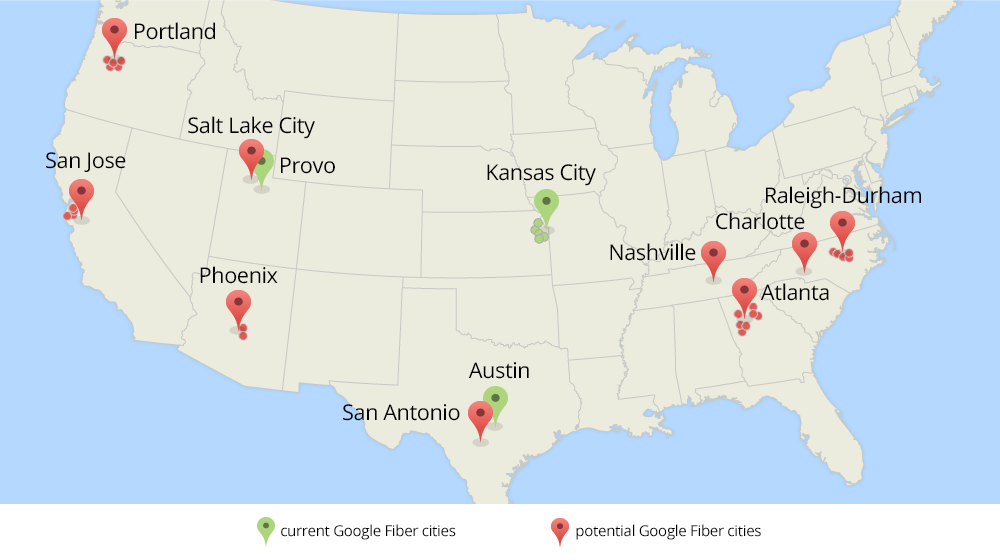
I know that Google bought a fiber build in Provo. Did they also/just now buy an existing one for SLC? When I was at Neumont, I was sad that the fiber in Sandy didn't come across I-15 to South Jordan.
> Every mile of this super-fast network has to be planned – we can’t just put it anywhere. We use the data shared with us to create a map of where we can build (based on existing utility poles and water, gas, and electricity lines).
> With our plan in place, we start the hard work of stringing and laying thousands of miles of brand new, state-of-the-art fiber optic cable. We will lay enough new fiber in the area to reach from here to Canada and back, and you will see our engineers and crews in the streets for a long time.
So this is definitely a new construction/infrastructure laying project, unlike Provo where it was mostly a purchase of the existing fiber network.
I'm also not sure what network they could even buy in SLC, since as far as I know there is no iProvo-like network there (most fiber is owned by telephone/cable companies who aren't leaving).
What they should do is buy Utopia from Layton city (north of SLC). It is essentially iProvo all over again, and they're even looking to sell it (an Australian company is interested).
So if Google stepped in and purchased Utopia, and built out their SLC network, they would already own a massive swath of northern Utah.
> I'm wondering if they are partnering with XMission.
Very unlikely, as Pete Ashdown (founder/owner) was recently discussing XMission investigating rolling their own fiber until wind of Google Fiber came up:
I wonder what this means for the metro Provo/Salt Lake Area. I live in between the two cities and would love to have access. Has Google expanded to the metro areas of other Google Fiber cities?
It means lots of competitors will be upping their Mbps sometimes double while they get their own Gb services in. Cox here in Phoenix doubled speeds and since Google Fiber announced Phoenix, Scottsdale and Tempe they all are the focus for Cox's new Gigablast service.
Google Fiber not only brings Gbps broadband they are encouraging it elsewhere in those cities and surrounding areas. I just wish Chandler was in the announcement as we were one of the first 4 cities to get cable broadband in the 90's largely due to Intel. The cities that Google Fiber picks are getting better internet just by being announced from Google and competitors alike.
Broadband cable during inception in the 90's was such a big leap it was almost magic from 56k to up to 6mb down when you were new on a node. It was unreal and the cable companies were heroes. They could have kept going, there are still only a small percentage of channels used for data/broadband. They can compete now but haven't, all that wasted on channels noone watches.
Now it feels like cities are winning the Google Fiber bandwidth lottery because broadband providers have been throttling in their extract phase for so long with no competition. Google Fiber is spreading competition and better internet almost as magically as the cable companies did with broadband in the 90s.
Comcast doubled their speeds throughout the Salt Lake metro area a few months back (around the same time Google announced Salt Lake City as a potential Google Fiber location). I'm on a 100 Mbps download now. It's a nice consolation prize for those of us between Salt Lake and Provo because while we aren't on the Google Fiber roadmap we still (seemingly) reap some of the competitive benefits of it being nearby.
I can't speak for every town, but Spanish Fork is upgrading its municipal network to have fiber to the homes... which I think is pretty good for a small town of 35K.
I think with SLC, Provo, and at least one of the small towns in the area all having fiber available, the rest of the front will follow suit... but it will not happen overnight.
The announcement stated that Google Fiber will be limited to the Salt Lake City-proper boundaries. There are only a couple hundred thousand people living in SLC itself though, and only a hundred thousand in Provo. The area between Salt Lake and Provo has close to 1.5 million people and is very close to being just one big contiguous sprawl. I can't imagine them not expanding into those areas unless the city councils make it too difficult.
I'd have to disagree. I don't have any insight into the church office building's internal network, but I do know that they already have massive lines going into the church office building and the surrounding Temple Square area. The church itself has no need for more fiber. Even if they did, they showed no desire to help UTOPIA along (they even have the capabilities of becoming a private leaser), so what makes you think they would want to pipe their traffic through a third party advertising agency?
Secondly, Salt Lake City proper, where I live and where this announcement is declaring the buildout initiative, is very much not-mormon. The number of people logging on to their site to stream videos is minuscule compared to the number of people in the surrounding suburban sprawl. Google Fiber isn't coming to Salt Lake Valley, it's coming to the City. This won't help them.
They LDS Church is pretty advanced technically, and like any large tech organization they have many hosting sites, mirrors, and data centers. That is like saying Tim Cook would help get Google Fiber in Cupertino because lots of people around the world download apps. Sure, but not really.
Does this have anything to do with the existing Utopia network or will it be a completely separate build-out?
I was in college when iProvo was building out, but it didn't live up to the hype. Over 10 years later and the dream of fiber in the front range is finally coming to fruition.
Completely separate. Pete Ashdown of Xmission (Utopia) has expressed annoyance[1] that SLC approved Google but not Xmission, which has been providing services to the city since its birth. I tend to agree with him, but any news like this is good news, and maybe it will introduce more competition.
I wouldn't think so since, as far as I know, the Utopia network was never built out in SLC. Provo had their own and it was a very simple handover for them, but Google's apparently[1] going to build one out, either using dark fiber that's already there or laying out new fiber.
This is good news in that, at the very least, it'll light a fire under Comcast's business. Qwest/Century link were never a serious competitor anyway.
Looking to the future, what is being done about in-home distribution? Ten years from now, are we going to find ourselves with 1Gb/s fiber lines to our houses, and still dependent on oversaturated 54Mbps WiFi to get to it?
What I'm getting at is, have we had any related push to wire up more homes with cat6a (or something of that nature)? It isn't quite as future proof as fiber, but it's cheap and 10Gb/s should keep up for a long time.
You know 802.11g released in 2003 offered maximum theoretical speeds of 54Mbit. It's been 12 years now and Wifi has evolved quite a bit since and will continue to evolve.
The unfortunate key here is "theoretical". 802.11g is old, and it's true I don't have any g-only devices left. But I do have a lot of wireless-N devices that max out at 72Mbit, and interference is a frequent problem.
WiFi has evolved, yes. But my 900Mbps router paired with a 450Mbps wireless adapter still underperformed my 10Mbps powerline network for network drives & filesharing, and interference frequently drops WiFi speeds to a tenth of their intended speed.
I wonder what are the considerations when Google decides the next city for Google Fiber? Some people mentioned NYC's bureaucracy, I guess the existing infrastructure is also another factor, Google would of course want to make larger impact. Now it seems that they are targeting middle-level cities (especially southern ones).
It's gotta be legal and infrastructural challenges. Don't know if you've been to SLC but aside from its downtown it's a very very spread out city. I don't know the numbers but I imagine the ppl/m^2 is less than 2,000 maybe even under 1,500.
Google announced this back in 2013.[1] And in 2014. We went through this with Verizon FIOS, which got a lot further than Google has before Verizon gave up expanding it. Google has only a few little projects. Verizon FIOS covers 12% of the US population.
Sonic.net is bringing gigabit fiber to San Francisco.[2] Construction is underway in the Sunset District. Next, Bernal Heights and the Castro. Also, Berkeley. Already operational in Sebastopol, Brentwood, and Santa Rosa. Sonic may have more actual users than Google does.
> Sonic.net is bringing gigabit fiber to San Francisco.[2] Construction is underway in the Sunset District. Next, Bernal Heights and the Castro. Also, Berkeley. Already operational in Sebastopol, Brentwood, and Santa Rosa. Sonic may have more actual users than Google does.
All of them in California. Those of us outside Silicon Valley would like fiber too, thanks.
Referring to the site of the 2002 Winter Olympics as a flat place in the Kansas category is a bit odd. If I assume you mean the valley floor then, yes, it's as flat as most cities, but Salt Lake City, like Provo, builds up the sides of the mountains. If a fiber installation can manage that, as local gas, electricity, and plumbing do, then almost all American cities should fall within this "flat like Utah and Kansas" category.
Laying internet in Manhattan is an unmitigated nightmare.
For context, they have been replacing about 1000 meters of water main outside of my apartment for 9 months.
I don't mean just a little bit of work, there has been a crew of 20 guys out there 6 days a week, firing up the jack hammers at 7:30am everyday and using heavy equipment until 4pm. (Not that I'm bitter about getting woken up that way). They're really working hard. It just takes a lot of cycles of digging up the street, moving an old pipe, repaving the street, digging up a different old pipe, repaving the street, etc.
I often think (in those moments when I wish I was sleeping instead of hearing construction) that there has to be a better way. I'm not sure what that is, but the layering of multiple systems really makes running anything under the roads hard. It's almost makes you think they should rip up an entire block and do it all over at once so it is organized.
I've seen that in use plenty in the US. My water mains were replaced a couple years ago like that. I presume it's not applicable to every situation, though. A place like Manhattan, with lots of connections in a short distance, it might not gain you much.
They did that on a small scale to my brother's 40 year old copper natural gas connection in the US. Very fast compared to trenching in a new line. They just pulled a new corrosion proof line in behind the splitter head.
Probably two problems: retrofitting large buildings that have been built and retrofitted to wildly varying specs over centuries, and negotiating an insane number of rights-of-way.
Salt Lake is not entirely flat. It's on the western slope of the Wasatch Mountains. The cost to lay fiber is more closely tied to availability of existing infrastructure (dark fiber), regulatory burdens (or lack thereof), subsidies, typical density (single family vs multi-tenant), etc.
I get the feeling that regulatory burdens is the biggest problem. I know that the laws in California are preventing them from offering the service there, and in Oregon they are waiting on a bill to pass before they will come to Portland.
Interestingly, Oregon is a blue state consisting of a blue city (Portland) surrounded by red (everywhere else), and all the non-Portland areas are ready and raring to go, with only Portland as the hold-up...
Pretty sure Google Fiber doesn't have much to do with politics. Correlation does not imply causation. However, I do agree that it will be a while until NYC gets Google Fiber.
Actually Google has made it pretty clear that it does have to do with politics; specifically, how easy the local/state governments make it for them to roll out fiber. It shouldn't come as too much of a surprise that red states may have a lighter regulatory/more pro-business hand.
It may be less about being "in bed" with the ISPs than the philosophical point of view that internet service is properly a private sector concern, not a governmental one.
All the "philosophical" views become rather hypocritical when those who have them receive a lot of money from monopolists who want to prevent competition. So stop the nonsense please. It's not about any philosophy. It's about money.
> This table lists the top donors to this candidate in the 2013-2014 election cycle. The organizations themselves did not donate, rather the money came from the organizations' PACs, their individual members or employees or owners, and those individuals' immediate families. Organization totals include subsidiaries and affiliates.
> The organizations themselves did not donate, rather the money came from the organizations' PACs, their individual members or employees or owners, and those individuals' immediate families.
And that makes a difference how exactly? ISPs are owned and controlled by various family clans and key people there.
In the end, the result is that politicians are paid to push the agenda of existing monopolists.
If that were even remotely true, they wouldn't be enacting laws to protect the entrenched ISP monopolies. They'd be passing laws reinstating things like local loop unbundling.
It has everything to do with politics: one party is more prone to regulation than the other, and it's easier to build where there is less regulation. There's a spectrum of regulation levels in the country, and Republican areas tend towards the lower-regulation side of the spectrum.
That logic doesn't seem to work as expected. Didn't community broadband face problems because of the local overregulation backed by existing monopolists? Many of those states are Republican dominated. So it means they are perfectly fine with regulation which protects monopolists, and they oppose one which boosts competition. Google is a threat to existing monopolists too, so why aren't they opposing the effort?
You're right. A more nuanced way of putting it would be that the Republicans prefer that government interfere less with economy. To that end, they support regulation which restrains government from interfering with the economy, and are against the more-typical regulation which directly interferes with the economy.
I think this restraint has merit, but not when applied to interference with monopolies and utilities.
> more nuanced way of putting it would be that the Republicans prefer that government interfere less with economy. To that end, they support regulation which restrains government from interfering with the economy, and are against the more-typical regulation which directly interferes with the economy.
But in this case this logic isn't even correct. Since they support laws which ban competition, and that is clearly interfering with the economy. I.e. it's interfering for the benefit of monopolists, and against the benefit of their competitors and the public. I get an impression that this abstract idea of "don't interfere with the economy" is simply inconsistent. More consistently that position looks like "against competition", which equals against free market.
Community broadband is not competition, it's seizure of a market by the government, an entity that does not have to make a profit and has generally broad authority to take other people's money by force.
More ISPs is competition and more choice for the public. Having a monopoly is surely not competition. There are no two ways about it and no amount of demagoguery will change that fact.
I'm not sure how it's related. If anything, many "red" officials today seem to pretend they hate stronger ISP competition and like monopolistic stagnation.
The amount of regulations involved in NYC to do anything makes it extremely unlikely that Google fiber will ever make it to New York unless the laws change.
NYC bureaucracy is on a whole different level from KS, TN, etc. NYS in general has ludicrous amounts of regulation compared to most states, and NYC is the creme de la creme.
1) Franchising, especially if you want to offer TV service (which is the money-maker). The city has to approve your overall deployment plan. As part of that deployment plan, you will usually need to agree to:
A) Build-out requirements. Cross-subsidies for poor neighborhoods are baked-into the process in almost every city. You have to build out to every neighborhood in the city above a minimum density.
B) Franchising fee. Usually a % of revenues.
C) Contributions for public services. The municipality will usually require you to spend (a few to tens of millions) per year on things like providing free fiber to government buildings, or contributing to local public TV programming, etc.
2) Permitting. You need a wide variety of permits for: A) laying cable; B) stringing cable on utility poles; C) tapping into the grid to power fiber cabinets; etc.
3) Negotiating rights of way.
4) Miscellaneous regulations: environmental permits, etc.
There are also the broader political dynamics. In NYC, de Blasio has turned FiOS deployment into a social justice issue: http://www.speedmatters.org/blog/archive/new-york-mayor-bill... ("If you can’t afford to feed your family by the end of the month, you can't afford $75 a month for the broadband service. And that's what we have to fix.")
Google's MO is to say "fuck you" to all that. They only agree to build Fiber on the condition that the municipality gets rid of build-out requirements, fast-tracks permitting, etc. Second and third-tier southern and western cities are willing to play along, because they see fiber as a competitive advantage. Cities like San Francisco and New York are not, because demand to live and work in those cities is so high to begin with.


https://instagram.com/p/oRf3z3hgzW/ https://instagram.com/p/wBzu2SBgxW/